If you’ve ever turned on the kitchen light at night and watched something dark scurry behind your stove, you already know the problem. Cockroaches are one of the most persistent pest challenges facing Karachi homeowners and restaurant owners — and they are not just an eyesore. They carry bacteria, trigger allergies, contaminate food, and can cause serious health problems for your family or your customers.
Karachi’s hot, humid climate — especially during the pre-monsoon and monsoon months — combined with its dense urban neighbourhoods, ageing drainage infrastructure, and bustling food industry creates the perfect breeding environment for multiple cockroach species. Knowing which species you are dealing with is the first step toward eliminating them for good.
In this guide, we break down the most common cockroach species found in Karachi homes and restaurants, what makes each one dangerous, and — most importantly — what you can do about them.
Why Karachi Is a Cockroach Hotspot
Cockroaches thrive where there is warmth, moisture, and access to food. Karachi delivers all three in abundance. Here is what makes our city especially vulnerable:
- Year-round warmth: Temperatures rarely drop low enough to naturally suppress cockroach populations.
- Monsoon humidity: From June to September, moisture levels surge, dramatically accelerating cockroach breeding cycles.
- Dense housing: Apartments and older residential buildings in areas like Lyari, Saddar, Orangi Town, and PECHS often share drainage and wall cavities — perfect cockroach highways.
- Thriving food industry: Karachi’s thousands of restaurants, dhabas, and street food stalls mean organic waste is never far away.
- Ageing sewage systems: Many areas of the city have underground drainage systems that are decades old, providing extensive shelter networks for cockroaches.
Now, let’s look at the specific species most commonly found inside Karachi properties.
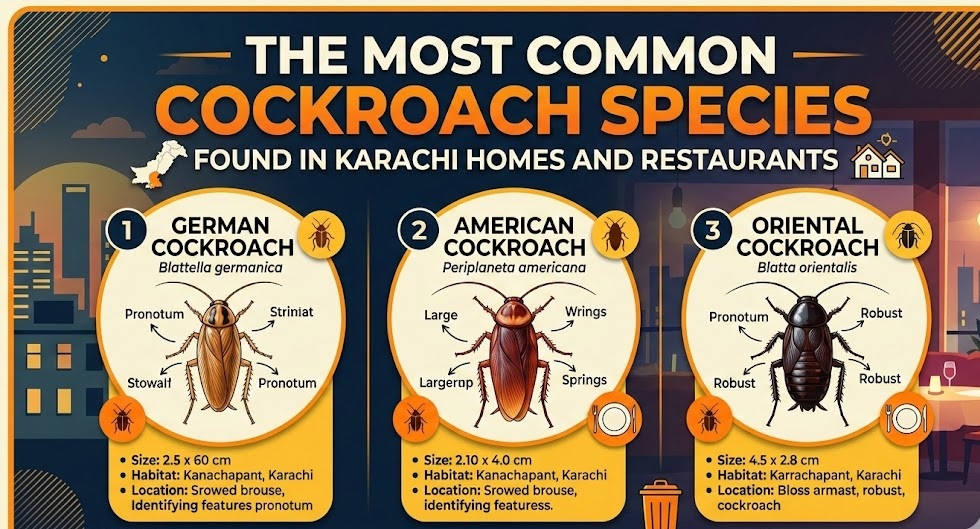
1. The American Cockroach (Periplaneta americana)
The Big One — and the Most Common in Karachi
Size: 35–50mm | Colour: Reddish-brown with a pale yellow band behind the head | Local name: Sewerage cockroach / Pani waala cockroach
Despite its name, the American cockroach is extremely common throughout South Asia, and it is arguably the most frequently spotted species in Karachi homes and commercial kitchens. You will most often find it in bathrooms and drains, under kitchen sinks and behind refrigerators, basement areas and utility rooms, restaurant kitchens and store rooms, and sewage systems — from where it enters homes through pipes and floor drains.
- Why it is dangerous: This cockroach travels through sewers and drains before entering your kitchen. It carries Salmonella, E. coli, and other pathogens on its body and legs, depositing them directly onto food preparation surfaces. Its droppings and shed skins are also known to trigger asthma and allergic reactions, particularly in children.
- Karachi note: In areas with older drainage infrastructure — such as parts of Clifton, Garden, and many katchi abadis — American cockroaches routinely migrate from the municipal sewer network directly into residential plumbing. If you are seeing large roaches near your bathroom at night, this is almost certainly the culprit.
2. The German Cockroach (Blattella germanica)
The Restaurant Nightmare
Size: 10–15mm | Colour: Light brown with two dark stripes on the thorax | Local name: Kitchen cockroach
If the American cockroach is the most common, the German cockroach is the most problematic — particularly for Karachi’s food service industry. This species breeds at an extraordinary rate: a single female can produce up to 400 offspring in her lifetime, and populations can double every few weeks under ideal conditions.
It is most often found inside restaurant kitchens, pantries, and food storage areas; inside electrical appliances such as microwaves and coffee machines; behind kitchen cabinets and under countertops; and in hotel rooms and canteens.
- Why it is dangerous: The German cockroach is notorious for contaminating food at scale. Because it lives and breeds inside electrical equipment and within wall cavities, it is much harder to eradicate with over-the-counter sprays.
- Karachi note: This species has been identified as a growing problem in Karachi’s commercial food zones — particularly in Bahadurabad, Burns Road, and Tariq Road — where high-density restaurant operations allow rapid cross-contamination between premises. For food businesses, a German cockroach infestation is a compliance risk you cannot afford to ignore.
3. The Oriental Cockroach (Blatta orientalis)
The Damp Dweller
Size: 20–25mm | Colour: Dark brown to black, glossy | Local name: Black cockroach / water bug
The Oriental cockroach prefers cool, dark, and very damp environments — making it a frequent resident in Karachi’s older properties, particularly during and after the monsoon season. Unlike the American cockroach, it rarely flies and tends to stay low to the ground.
You will most often find it around leaking pipes and water-damaged walls, in damp basement areas and storage rooms, near outdoor drains and rubbish areas, in ground-floor apartments with moisture problems, and in old buildings in areas like Saddar, Civil Lines, and Soldier Bazaar.
- Why it is dangerous: The Oriental cockroach is considered one of the filthiest cockroach species. It feeds predominantly on decaying organic matter and carries a particularly heavy load of bacteria and parasites.
- Karachi note: Water logging in certain parts of Karachi after heavy monsoon rainfall creates extended periods of standing water — ideal conditions for Oriental cockroach population explosions. Properties that experience flooding or rising damp are at significantly elevated risk.
4. The Brown-Banded Cockroach (Supella longipalpa)
The Hidden Invader
Size: 10–14mm | Colour: Brown with distinctive light-coloured bands across the abdomen | Local name: TV cockroach
The brown-banded cockroach is smaller and less commonly identified than the other species, yet it is present in many Karachi homes — often without homeowners even realising it. Unlike most cockroaches, it actively avoids moisture and prefers warm, dry, elevated areas.
It is most often found inside televisions, radios, computers, and other electronics; behind picture frames and ceiling corners; inside wardrobes and bookshelves; in bedrooms and living rooms — not just kitchens; and within wooden furniture and ceiling cavities.
- Why it is dangerous: Because it inhabits bedrooms and living spaces rather than kitchens, it poses a more intimate health risk. It sheds allergen-laden skin particles in sleeping areas, which can worsen asthma and cause night-time allergic reactions.
- Karachi note: The rise in electronic goods across Karachi households has inadvertently provided the brown-banded cockroach with more hiding places than ever. It is frequently transported between homes inside second-hand furniture, electronics, and cardboard packaging.
Warning Signs: Do You Have a Cockroach Infestation?
Cockroaches are nocturnal and secretive — by the time you see one in daylight, you almost certainly have a much larger hidden population. Watch out for:
- Droppings: Small, dark, pepper-like specks near food sources, in drawers, or along skirting boards.
- Egg cases (oothecae): Brown capsule-shaped cases attached to hidden surfaces — each can contain 15–50 eggs.
- Musty odour: A distinctive unpleasant smell that intensifies with large infestations.
- Shed skins: Cockroaches moult as they grow. Discarded skins near hiding spots are a clear sign.
- Smear marks: Dark, irregular marks along walls, especially near water sources.
- Daytime sightings: If you are seeing cockroaches in daylight, the infestation is likely severe and competition for space is forcing them out of hiding.
The Real Health Risks of Cockroach Infestations in Karachi
This is not merely a cleanliness issue. Medical research has consistently linked cockroach infestations to serious and sometimes chronic health conditions:
- Gastroenteritis and food poisoning: Cockroaches contaminate food and surfaces with Salmonella, E. coli, Listeria, and other bacterial pathogens.
- Typhoid and cholera: In urban environments with poor sanitation, cockroaches can act as mechanical vectors for these diseases.
- Asthma and allergies: Cockroach allergens — found in their droppings, shed skins, and saliva — are one of the leading triggers of childhood asthma in densely populated cities.
- Dysentery: Cockroach faecal contamination of water and food is a known contributor to dysentery outbreaks in high-density urban areas.
For Karachi families — especially those with young children, elderly relatives, or family members with respiratory conditions — cockroach control is a genuine health priority, not an optional one.
Why DIY Cockroach Control Fails in Most Karachi Homes
Walk into any pharmacy in Karachi and you will find rows of cockroach sprays, chalk, and traps. Yet infestations persist — often getting worse after initial treatment. Here is why:
- Resistance: German and American cockroaches have developed resistance to many commonly available insecticides.
- Incomplete treatment: Spraying visible areas does nothing to address cockroaches hiding deep inside walls, drainage systems, or electrical equipment.
- Egg cases survive: Most surface sprays do not penetrate egg cases, meaning the next generation hatches unaffected weeks later.
- No entry point control: Without sealing access routes — drains, cracks, pipe penetrations — cockroaches simply re-enter from outside.
- No root cause addressing: Eliminating the infestation without addressing the conditions that caused it results in reinfestation within weeks.
Effective cockroach control requires a professional integrated pest management (IPM) approach — one that combines species identification, targeted treatment, physical exclusion, and follow-up monitoring.
The Connection Between Cockroaches and Other Structural Pest Problems
Many Karachi homeowners are surprised to learn that cockroach infestations often coincide with other structural pest problems. Cockroaches exploit the same entry points — cracked foundations, damaged drainage, deteriorating woodwork — that other destructive pests use. In particular, properties dealing with cockroach entry through wall cavities and subfloor spaces should also be alert to the risk of termite activity in Karachi homes, which is especially prevalent in properties with wooden flooring, furniture, or structural timber. Termites and cockroaches often share the same hidden pathways — making a comprehensive pest inspection essential for any Karachi property owner concerned about infestation.
If your home has already experienced cockroach entry through the substructure, it is worth having a professional assess whether you also need professional termite control services in Karachi to protect the structural integrity of your property. Addressing multiple pest risks in a single inspection is both more cost-effective and more thorough.
Practical Cockroach Prevention Tips for Karachi Homeowners
While professional treatment is essential for an active infestation, these measures will help reduce your risk:
In the Kitchen
- Store all food — including dry goods like rice, flour, and lentils — in airtight containers.
- Do not leave dirty dishes overnight.
- Clean behind and beneath appliances regularly. Grease build-up behind stoves is a major attractant.
- Empty rubbish bins daily and use bins with tight-fitting lids.
- Fix leaking taps and pipes immediately — even a slow drip provides enough moisture to sustain a colony.
In Bathrooms and Drainage Areas
- Fit mesh screens or drain covers over floor drains and overflow pipes.
- Seal gaps around water pipes where they pass through walls.
- Ensure U-bends in plumbing are always filled with water, as dry traps allow direct entry from the sewer.
Around the Home
- Seal cracks and crevices in walls, skirting boards, and around door frames.
- Reduce clutter — cardboard boxes, paper bags, and stacked newspapers are prime cockroach harborage.
- Check second-hand furniture and cardboard packaging before bringing it inside.
- Ensure window and door screens are intact, particularly during monsoon season.
A Note for Karachi Restaurant and Food Business Owners
The stakes are even higher in a commercial setting. A cockroach infestation in a Karachi restaurant or food business is not just a health risk — it is a reputational and legal risk. Karachi’s food safety regulations increasingly require documented pest control programmes, and a visible infestation can result in closure orders.
German cockroaches in particular are virtually impossible to eliminate without professional treatment. Their ability to breed inside equipment, their resistance to standard pesticides, and their rapid reproduction rate mean that even a small initial population can become a full-scale infestation within weeks during Karachi’s warmer months.
A professional pest control programme — including regular scheduled treatments, documentation for regulatory compliance, and staff training on hygiene practices — is the only reliable solution for food businesses in Karachi.
Book Your FREE Cockroach Inspection in Karachi
Don’t wait until the problem gets worse.
Unique Fumigation offers free on-site pest inspections across Karachi. Our licensed technicians will identify the cockroach species present, assess the severity of the infestation, map all entry points and harborage areas, and recommend a targeted treatment plan — with no obligation.
We use government-approved, family-safe treatments designed to eliminate infestations at the source — and keep them from coming back.
Call or WhatsApp Unique Fumigation today to book your FREE inspection.
Serving DHA, Clifton, Gulshan-e-Iqbal, North Karachi, Korangi, PECHS, Saddar, and all surrounding areas.
Final Word
Cockroaches are not a sign of a dirty home — they are a sign of an environment that, without targeted intervention, will continue to attract and sustain them. Karachi’s unique climate and infrastructure make cockroach control a year-round challenge, not a one-time fix.
Understanding which species you are dealing with, why they are there, and how they are getting in is the foundation of effective control. But identifying the problem is only the first step — professional pest management is what turns awareness into lasting results.
Take action now — before the monsoon season amplifies the problem. Contact Unique Fumigation for a free, no-obligation inspection and protect your family, your guests, or your customers today.
© Unique Fumigation | Karachi’s Trusted Pest Control Specialists

Muhammad Ali Khan is the founder and director of Unique Fumigation Services, Karachi’s longest-running PPMA-registered pest control company, established in 1993. With over 30 years of hands-on experience in residential and commercial pest management, he has overseen more than 5,000 treatments across every major locality in Karachi — from DHA and Clifton to Orangi Town and Korangi.
Under his leadership, Unique Fumigation has maintained affiliations with the Pakistan Pest Management Association (PPMA), National Pest Management Association (NPMA), Federal Board of Revenue (FBR), and Sindh Revenue Board (SRB), while exclusively using WHO-approved, eco-safe chemicals — a standard he enforced from day one.
Muhammad Ali Khan writes on pest biology, infestation patterns specific to Karachi’s climate, treatment protocols, and chemical safety — drawing directly from three decades of field experience treating termite-damaged structures, dengue-prone areas, and food-industry facilities for clients including K-Electric, Hyperstar, IBA Karachi, and USAID.
His work is grounded in one principle: pest control done wrong is a health hazard, not just a failed service.