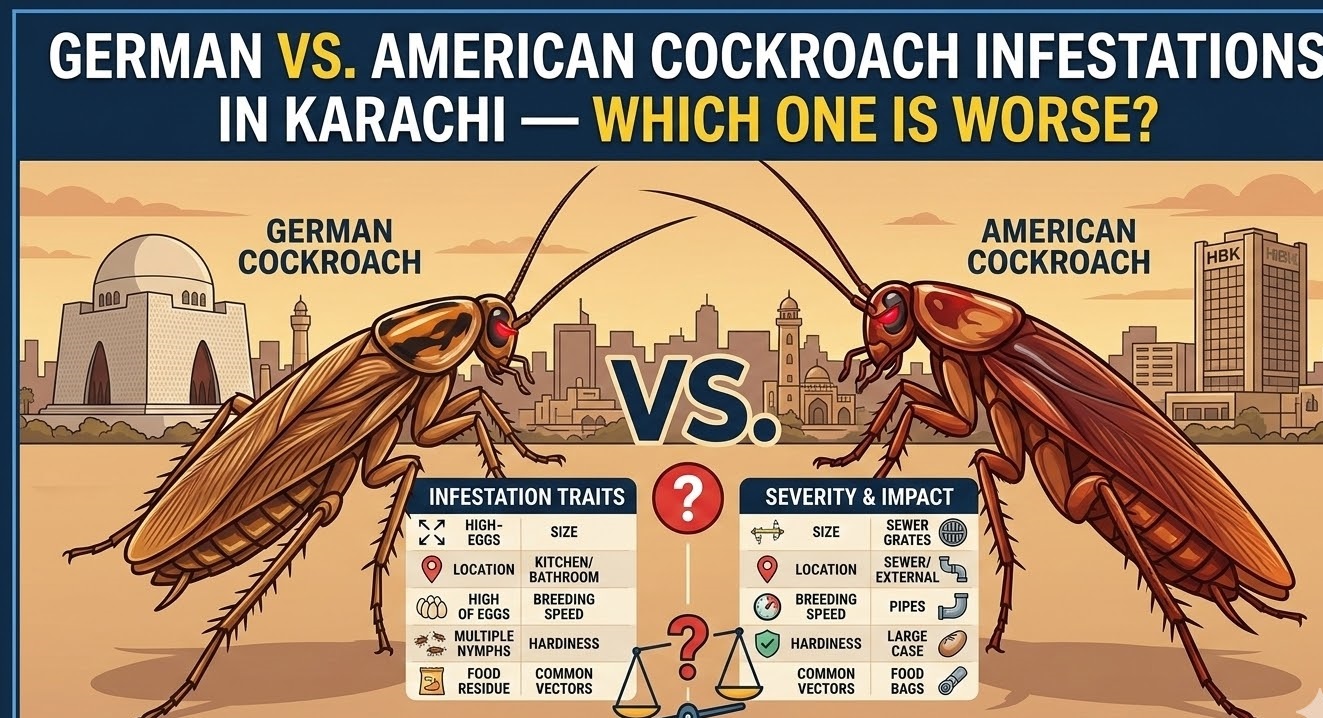
If you have ever spotted a cockroach in your Karachi home, you have probably asked yourself the same question most homeowners ask: where did it come from, and how serious is this? But there is a more important question hiding underneath that one — which species is it? Because when it comes to cockroaches, not all infestations are equal. The species you are dealing with determines how the infestation spreads, where it hides, how fast it grows, and — critically — how it needs to be treated.
Two species dominate cockroach complaints in Karachi homes and restaurants: the German cockroach and the American cockroach. They are both extremely common, both capable of causing serious health problems, and both thriving in Karachi’s warm, humid urban environment. But they are very different pests, with very different behaviours, and very different levels of threat.
In this guide, we break down both species in detail, compare them head-to-head across the factors that matter most to Karachi homeowners, and answer the question everyone wants answered: which one is worse — and what should you do about it?
Quick Comparison: German vs. American Cockroach at a Glance
Before we go deep, here is a side-by-side summary of both species across the most important factors:
| Feature | German Cockroach | American Cockroach |
| Size | 10–15 mm | 35–50 mm |
| Colour | Light brown, 2 dark stripes | Reddish-brown, pale band |
| Breeding rate | Up to 400 offspring/lifetime | ~150 offspring/lifetime |
| Primary habitat | Kitchens, appliances | Drains, sewers, basements |
| Can fly? | Rarely | Yes (occasionally) |
| Eradication difficulty | Very High | High |
| Entry route | Brought in on items/goods | Sewers & drainage pipes |
| Peak season (Karachi) | Year-round, worse in summer | Monsoon & pre-monsoon |
| Health risk level | Very High | High |
Read on for the detailed breakdown — because the numbers above only tell part of the story.
Meet the German Cockroach (Blattella germanica)
German Cockroach Profile
Size: 10–15 mm — small enough to hide in an electrical socket | Colour: Light tan to medium brown, with two distinctive dark parallel stripes running down the back of the head | Lifespan: Approximately 12 months | Reproduction: Up to 400 offspring per female in a lifetime
Where It Lives in Karachi Homes
Despite its small size, the German cockroach is considered the most problematic domestic cockroach species in the world — and Karachi is no exception. It is almost exclusively an indoor species, meaning it lives, breeds, and dies inside your home or business premises. It does not come in from the sewers.
Its preferred habitats in Karachi kitchens and homes include:
- Inside and behind kitchen appliances — microwaves, toasters, refrigerator motor housings, electric kettles
- Inside wall-mounted kitchen cabinets, especially hinges, corners, and the space behind shelving
- Behind and beneath the kitchen stove, particularly in the narrow gap between appliance and wall
- Inside electrical distribution boards and control panels
- In cracks and crevices behind tiles, particularly near heat and moisture sources
- Inside hotel rooms, guest houses, and restaurant kitchens — particularly in seating banquettes and under counter equipment
How It Gets Into Your Home
This is where the German cockroach differs most significantly from the American cockroach — and where it is most deceptive. It does not enter through drains or from the outside environment. It is almost always introduced through:
- Second-hand furniture, particularly sofas, wardrobes, and kitchen cabinets
- Cardboard boxes and grocery packaging — particularly bulk items purchased from wholesale markets like Jodia Bazaar or Empress Market
- Electrical appliances purchased second-hand or reconditioned
- Moving vans and storage facilities
- Cross-infestation from a neighbouring apartment in a shared building
The Karachi factor: Karachi’s apartment living culture — particularly in high-density buildings across Gulshan-e-Iqbal, North Nazimabad, Clifton, and Defence — means that a German cockroach infestation in one flat can spread to multiple neighbouring units within weeks through shared wall cavities, utility chases, and ventilation gaps. In buildings with older construction and minimal inter-unit sealing, this is a persistent and frustrating problem.
Why the German Cockroach Is So Hard to Eliminate
The German cockroach’s reproduction rate is extraordinary. A single fertilised female can produce an egg case (ootheca) every three to four weeks, and each case contains 30 to 40 eggs. Unlike most other cockroach species, the female carries the egg case with her until just before hatching — protecting it from environmental threats and desiccation.
At peak breeding rate in Karachi’s warm climate, a population can double every few weeks. A starting population of 10 cockroaches can theoretically become hundreds within a single season.
Additionally, the German cockroach has developed significant resistance to many of the insecticide compounds found in over-the-counter spray products available in Karachi pharmacies and supermarkets. Spraying visible cockroaches may reduce the population temporarily, but surviving individuals quickly repopulate — and resistance is passed to offspring.
Eradication Difficulty: Very High. Requires professional gel baiting, insect growth regulators, or targeted residual treatment. Over-the-counter sprays rarely achieve lasting results.
Meet the American Cockroach (Periplaneta americana)
American Cockroach Profile
Size: 35–50 mm — Karachi’s largest common household cockroach | Colour: Reddish-brown with a pale, yellowish figure-eight pattern on the back of the head | Lifespan: Up to 2 years | Local names: Sewerage cockroach, Pani waala cockroach
Where It Lives in Karachi Homes
The American cockroach is the large, reddish-brown cockroach that most Karachi homeowners are familiar with — the one that appears from the bathroom drain at night or scuttles along the kitchen floor when the light comes on. Unlike the German cockroach, it is primarily a pest of outdoor and semi-outdoor environments that regularly enters homes in search of food, water, and shelter.
Its preferred habitats and entry routes in Karachi include:
- Municipal sewage systems — from which it enters homes through floor drains, U-bends, and toilet plumbing
- Outdoor drainage channels and open nullahs — extremely common in many parts of Karachi
- Basements, ground-floor storage rooms, and utility areas
- Behind water heaters and in the warm, damp space beneath kitchen sinks
- In the wall cavities of older properties, accessed through deteriorating mortar and cracked plaster
- Under loose paving slabs, in garden areas, and in rubbish storage zones
How It Gets Into Your Home
The American cockroach enters homes almost exclusively through the building’s drainage and utility infrastructure — which is why it is so closely associated with bathrooms and kitchens. In Karachi, where much of the municipal sewage network is ageing and under capacity, the connection between sewer activity and household cockroach ingress is direct and consistent.
The Karachi factor: Areas of the city with older drainage infrastructure — including large sections of Saddar, Garden, Lyari, Keamari, and many parts of East and West Karachi — experience chronic American cockroach pressure because the municipal sewer network is essentially continuous with the domestic plumbing of nearby buildings. Cockroaches living in the sewer system can and do enter homes through floor drains when the water trap in the drain dries out, particularly during the hot and dry months from March to May.
The American cockroach can also fly, although it does so infrequently and typically only in high temperatures — another reason Karachi’s summer months see an increase in reported sightings.
Why the American Cockroach Is Still Dangerous
Because the American cockroach is large and visible, many Karachi homeowners underestimate the health risk it poses — treating the occasional sighting as a nuisance rather than a genuine threat. This is a mistake.
The American cockroach spends its time in sewage systems, waste areas, and organic debris before entering your home. It carries the pathogens, bacteria, and parasites from these environments directly onto kitchen surfaces, food preparation areas, and utensils. Documented health risks include Salmonella, E. coli, various parasitic organisms, and the transmission of gastroenteritis and dysentery — all of particular concern given Karachi’s existing public health challenges.
Its shed skin and droppings are also documented asthma and allergy triggers, particularly affecting children in homes with ongoing infestations.
Eradication Difficulty: High, but more achievable than German cockroach elimination with professional treatment that includes both chemical treatment and physical exclusion of entry points.
Head-to-Head: How They Compare on the Factors That Matter
1. Breeding Speed and Infestation Growth Rate
The German cockroach wins — in the worst possible way. Its reproduction rate is faster than any other common household cockroach species, and its habit of carrying the egg case on its body until hatching gives its offspring a significantly higher survival rate. In Karachi’s climate, where warm temperatures persist for most of the year, German cockroach populations can grow from a handful of individuals to hundreds within a single season.
The American cockroach breeds more slowly, produces fewer offspring per female over her lifetime, and deposits egg cases in the environment (where they are more vulnerable). Its population growth is still significant, but it does not escalate with the same alarming speed as a German cockroach infestation.
Winner (more dangerous): German Cockroach: Significantly faster breeding cycle and higher survival rate for offspring.
2. Difficulty of Elimination
Again, the German cockroach is considerably harder to eliminate. Its preference for living deep inside appliances, wall voids, and electrical equipment means it is physically difficult to reach with surface-applied treatments. Its acquired resistance to common pesticides means that many standard over-the-counter products have minimal long-term effect. And because it is an exclusively indoor species, there is no ‘outdoor population’ that can be addressed — the entire infestation is inside your home.
The American cockroach is hard to eliminate completely because new individuals continue entering from the drainage system. But the infestation itself is more accessible to professional treatment, and physical exclusion work — sealing drain covers, fitting pipe mesh, ensuring U-bends retain water — significantly reduces reinfestation pressure.
Winner (more dangerous): German Cockroach: Indoor-only habitat, pesticide resistance, and inaccessible harborage make it the harder infestation to resolve.
3. Health Risk to Your Family
Both species pose genuine and serious health risks through contamination of food and surfaces. However, the German cockroach’s habit of living inside kitchen appliances and food preparation areas means it has more direct and sustained contact with the surfaces your family eats from. It is also more likely to contaminate food at source — inside storage areas and appliances — rather than on surfaces that are regularly cleaned.
The American cockroach’s route through sewage infrastructure and waste environments means it carries a particularly heavy pathogen load. A single American cockroach walking across your kitchen counter after entering through the bathroom drain deposits organisms from the municipal sewer directly onto your food preparation surface.
Verdict: Both are high risk: German cockroach for sustained contamination of food prep areas; American cockroach for direct pathogen transfer from sewage environments. Neither should be tolerated.
4. Visibility and Early Detection
The American cockroach is large — up to 50mm — and significantly easier to spot. Most Karachi homeowners notice an American cockroach infestation at a fairly early stage, simply because a large reddish-brown cockroach scuttling across the floor at night is hard to miss.
The German cockroach is far more deceptive. At 10–15mm and living primarily inside appliances and cabinet interiors, German cockroach infestations often reach significant population sizes before homeowners notice anything. By the time you see a German cockroach in daylight, the infestation is almost certainly large and well-established.
Winner (more dangerous): German Cockroach: Its small size and hidden habitat mean infestations are typically discovered late — when they are already severe.
5. Karachi-Specific Threat Level by Area
Both species are present across Karachi, but their distribution reflects the city’s geography and infrastructure:
- German cockroach risk is highest in: Dense apartment buildings, restaurant districts (Burns Road, Bahadurabad, Tariq Road), hotels and guest houses, food processing facilities, and any property where second-hand goods or bulk packaging are frequently introduced.
- American cockroach risk is highest in: Properties near open nullahs or drainage channels, older properties with ageing plumbing (Saddar, Garden, Lyari, Civil Lines, parts of Korangi and Landhi), ground-floor and basement properties, and areas with irregular municipal waste collection.
Many Karachi homes — particularly in older mixed-use areas — are at elevated risk from both species simultaneously, which significantly complicates both prevention and treatment.
So Which One Is Worse? The Honest Answer
Based purely on the factors above, the German cockroach is the more dangerous infestation for most Karachi homeowners. Its faster breeding rate, greater resistance to treatment, deceptive hiding behaviour, and tendency to be discovered only once an infestation is already severe make it a significantly harder pest to manage once established.
However — and this is important — the American cockroach is absolutely not a problem you can ignore or dismiss. Its direct route from the sewage system into your kitchen, combined with the heavy pathogen load it carries from that environment, makes every American cockroach sighting a genuine health risk. And in areas of Karachi where sewage infrastructure is ageing or under capacity, American cockroach pressure can be relentless without professional intervention and physical exclusion work.
The most dangerous scenario of all — and one that is more common in Karachi than most homeowners realise — is a co-infestation of both species. When German and American cockroaches are both present in the same property, the complexity of treatment increases significantly. Different species require different treatment approaches, different harborage areas need to be targeted, and entry points need to be addressed alongside internal colony elimination. This is a situation that is virtually impossible to resolve with standard consumer products.
How to Tell Which Species You Have — Or Whether You Have Both
Use these identification clues to make an initial assessment:
Signs of a German Cockroach Infestation
- Small (under 15mm) light brown cockroaches visible in the kitchen, particularly near the stove or behind appliances
- Dark, pepper-like droppings inside kitchen cabinets, drawer corners, and near hinges
- A mild musty smell emanating from inside cabinets or appliances
- Egg cases (small dark brown capsules) glued to the interior surfaces of cabinets
- Cockroaches visible during the day — a sign the infestation is already large and space is at a premium
Signs of an American Cockroach Infestation
- Large (over 30mm) reddish-brown cockroaches, most often seen at night in bathrooms or kitchens
- Cockroach sightings near floor drains, toilet plumbing, or the area beneath the kitchen sink
- Larger, ridged egg cases left near damp, dark areas
- Smear marks along skirting boards and walls — dark, irregular streaks left where cockroaches repeatedly travel
- A strong, oily odour in utility areas or bathrooms
If you are seeing both small light-brown cockroaches AND large reddish-brown ones, or if you notice signs of both types, treat this as a co-infestation and seek professional assessment immediately.
Why Consumer Products Fail Against Both Species in Karachi
The shelves of Karachi’s pharmacies and supermarkets are stocked with cockroach sprays, chalk sticks, baits, and traps. Many homeowners spend significant money on these products and achieve, at best, a temporary reduction in visible cockroach activity. Here is why:
- Resistance: German cockroaches in particular have developed documented resistance to the pyrethroid compounds used in most over-the-counter sprays. Killing a visible cockroach with spray does not address the colony hidden inside your appliances.
- Egg case survival: Neither spray products nor chalk treatments penetrate the protective casing of cockroach egg cases. Even if every adult cockroach in your home is killed, the next generation hatches two to six weeks later completely unaffected.
- Inaccessible harborage: The interior of a microwave, behind a refrigerator compressor housing, or deep inside a wall cavity is not accessible to surface-applied sprays. The colony survives and rebuilds.
- No entry point treatment: Consumer products address cockroaches that are already present but do nothing to prevent new ones entering through drainage systems or from neighbouring properties.
- Wrong product for the species: Treatments effective against American cockroaches (focused on drainage and perimeter) are different from those required to eliminate German cockroach colonies (focused on internal baiting and harborage). Using a single product for both is rarely effective for either.
The Hidden Connection: Cockroaches, Structural Damage, and Other Pest Risks
There is one additional risk factor that many Karachi homeowners overlook when dealing with cockroach infestations: the conditions that allow cockroaches to thrive — particularly moisture, structural gaps, and deteriorating building materials — are the same conditions that make properties vulnerable to other serious pest problems. Properties in Karachi that are experiencing ongoing American cockroach entry through wall voids and subfloor areas should be assessed for termite activity, which is widespread in Karachi homes and often goes undetected until significant structural damage has already occurred.
Damp timber in subfloor spaces, wall cavities, and around ageing plumbing penetrations — exactly the environments that American cockroaches exploit — is also prime territory for termite colonies. If a professional inspection reveals extensive American cockroach ingress through structural gaps, it is well worth asking your pest control technician to also assess for termite infestation and structural damage in your Karachi property. Identifying and treating both problems together is considerably more cost-effective than dealing with them separately.
What Professional Treatment Looks Like for Each Species
Understanding the difference in treatment approach reinforces why species identification matters so much:
Professional Treatment for German Cockroach Infestations
- Targeted gel baiting — placed inside appliances, cabinet interiors, and wall voids — which cockroaches consume and carry back to the colony
- Insect growth regulators (IGRs) that disrupt the breeding cycle, preventing nymphs from reaching reproductive maturity
- Residual insecticide application to harborage points using formulations with documented efficacy against resistant populations
- Monitoring traps to assess population size and treatment progress
- Follow-up treatment sessions, as German cockroach infestations rarely resolve in a single visit
Professional Treatment for American Cockroach Infestations
- Residual insecticide treatment in drainage areas, utility rooms, and entry points
- Physical exclusion: sealing pipe penetrations, fitting mesh drain covers, ensuring U-bends retain water
- Exterior perimeter treatment to intercept cockroaches travelling from drainage channels and waste areas
- Drain flushing with specialist products where drainage systems are heavily infested
- Structural assessment to identify and seal the entry routes through which cockroaches are entering the building
For co-infestations of both species, a phased treatment programme is typically required — addressing internal German cockroach colonies first, then implementing American cockroach exclusion and perimeter management.
Not Sure Which Species You Have?
Book a FREE Professional Inspection with Unique Fumigation.
Correct identification is the foundation of effective cockroach control. Our licensed Karachi-based technicians will identify the species present in your home or business, assess the scale and severity of the infestation, identify entry points and harborage areas specific to each species, and design a targeted treatment programme — at no cost to you for the initial inspection.
Whether you are dealing with German cockroaches in your kitchen appliances, American cockroaches from the drainage system, or both — we have the experience, the products, and the local knowledge to resolve it.
Call or WhatsApp Unique Fumigation today to book your FREE inspection.
Serving DHA, Clifton, Gulshan-e-Iqbal, Nazimabad, North Karachi, PECHS, Korangi, Saddar, Lyari, Malir, and all surrounding areas of Karachi.
Final Word
German or American — both cockroach species found commonly in Karachi homes are capable of causing genuine harm to your family’s health, your food safety, and in the case of food businesses, your livelihood and compliance record. The question of which is worse is less important than the question of which one you have — and what you are going to do about it.
Do not wait for a large infestation to motivate action. Both species are far easier and less costly to eliminate when addressed early — before populations have established deeply, before resistance has compounded, and before egg cases have produced multiple new generations.
The pre-monsoon and monsoon seasons in Karachi are the highest-risk periods for both species. If you are reading this between March and September, the time to act is now.
© Unique Fumigation | Karachi’s Trusted Pest Control Specialists

Muhammad Ali Khan is the founder and director of Unique Fumigation Services, Karachi’s longest-running PPMA-registered pest control company, established in 1993. With over 30 years of hands-on experience in residential and commercial pest management, he has overseen more than 5,000 treatments across every major locality in Karachi — from DHA and Clifton to Orangi Town and Korangi.
Under his leadership, Unique Fumigation has maintained affiliations with the Pakistan Pest Management Association (PPMA), National Pest Management Association (NPMA), Federal Board of Revenue (FBR), and Sindh Revenue Board (SRB), while exclusively using WHO-approved, eco-safe chemicals — a standard he enforced from day one.
Muhammad Ali Khan writes on pest biology, infestation patterns specific to Karachi’s climate, treatment protocols, and chemical safety — drawing directly from three decades of field experience treating termite-damaged structures, dengue-prone areas, and food-industry facilities for clients including K-Electric, Hyperstar, IBA Karachi, and USAID.
His work is grounded in one principle: pest control done wrong is a health hazard, not just a failed service.