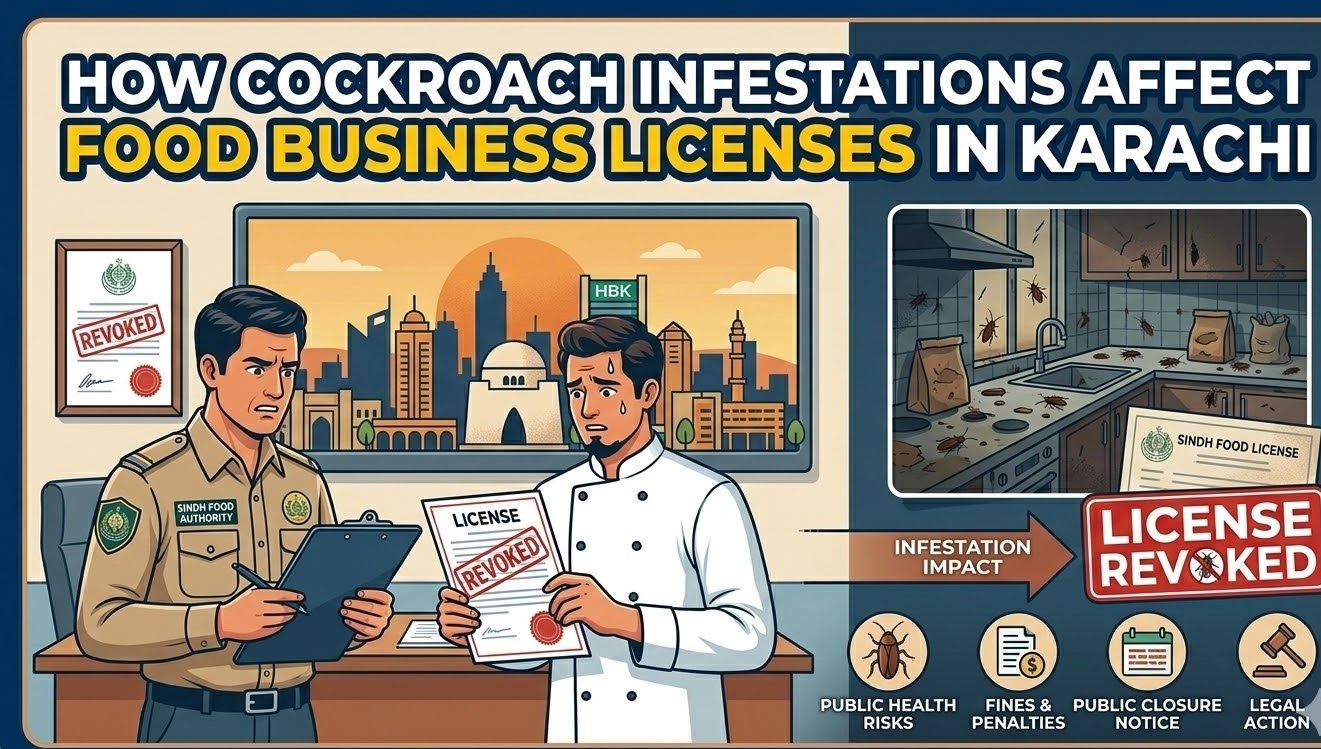
Running a food business in Karachi — whether it is a dhaba in Saddar, a bakery in Gulshan-e-Iqbal, a café in DHA, or a catering kitchen in North Karachi — is not just about great food and loyal customers. It is also about staying legally compliant. And one of the fastest ways to lose that compliance is a cockroach infestation.
Most business owners assume that a few roaches are a minor nuisance — something a can of spray can handle over the weekend. The reality is far more serious. In Karachi, food business licenses are directly tied to hygiene and pest control standards enforced by the Karachi Metropolitan Corporation (KMC), the Sindh Food Authority (SFA), and in some cases, the Pakistan Standards and Quality Control Authority (PSQCA). A single inspection finding cockroach activity can trigger warnings, heavy fines, forced closures, or permanent license revocations.
This article explains exactly how cockroach infestations threaten your food business license in Karachi, what inspectors look for, what the law says, and what you can do to protect yourself before it is too late.
The Regulatory Framework: Who Governs Food Businesses in Karachi?
To understand the risk, you first need to understand who is watching.
1. Sindh Food Authority (SFA)
Established under the Sindh Pure Food Act, the SFA is the primary authority licensing and inspecting food businesses across Sindh, including Karachi. It conducts both scheduled and surprise inspections of restaurants, bakeries, hotels, catering operations, and food manufacturing units. SFA inspectors follow a detailed hygiene checklist — and pest control is one of its most heavily weighted criteria.
2. Karachi Metropolitan Corporation (KMC)
KMC issues trade licenses and health-related no-objection certificates (NOCs) for food establishments in Karachi. A business operating without a valid KMC health NOC is effectively illegal, and that NOC can be suspended if pest-related hygiene violations are found.
3. Pakistan Standards and Quality Control Authority (PSQCA)
For packaged food manufacturers and larger food processing operations, PSQCA compliance is also required. Cockroach contamination in a production facility can lead to batch seizures and license suspension under national standards.
The bottom line: if you sell food to the public in Karachi, you are accountable to at least one — and possibly all three — of these regulatory bodies. None of them treat cockroach activity lightly.
Why Cockroaches Are a “Red Flag” Violation for Food Inspectors
Not all hygiene violations carry the same weight. Dirty walls or a missing soap dispenser might earn a warning. Cockroaches are different — they are classified as a critical food safety hazard for several reasons:
- Disease transmission: Cockroaches carry over 33 types of bacteria including Salmonella, E. coli, and Staphylococcus. They physically transfer pathogens from sewage, drains, and waste directly onto food preparation surfaces.
- Allergen risk: Cockroach droppings, shed skins, and saliva are potent allergens that contaminate food and trigger reactions in consumers.
- Structural infestation indicator: The presence of cockroaches — especially German cockroaches (the most common species in Karachi kitchens) — signals deep-rooted sanitation failures, not just surface dirt.
- Rapid reproduction: A single female German cockroach can produce hundreds of offspring in a few months. By the time you see them in daylight, the infestation is already severe.
For SFA inspectors, finding even a handful of live cockroaches is enough to classify your establishment as a high-risk premises — with immediate consequences.
What Happens When an Inspector Finds Cockroaches in Your Karachi Food Business?
Based on SFA and KMC enforcement patterns, here is a realistic timeline of what cockroach violations can trigger:
Stage 1: Verbal Warning and Improvement Notice
On a first offense with minor activity, an inspector may issue a formal improvement notice, giving you 7–15 days to resolve the issue. This is logged against your business license file.
Stage 2: Written Notice and Fine
If the infestation is moderate or the previous warning was not addressed, you face a written notice and a financial penalty. SFA fines for hygiene violations in Karachi have ranged from PKR 5,000 to over PKR 100,000 depending on severity and business category.
Stage 3: Temporary Closure Order
A serious or repeated infestation can result in an immediate closure order. Your business is sealed, and you cannot reopen until you provide documentary proof of professional pest treatment and a re-inspection is passed. This can mean days or weeks of lost revenue.
Stage 4: License Suspension or Cancellation
Repeated violations or failure to comply with closure orders can lead to permanent license suspension. Reinstating a cancelled food business license in Karachi is a lengthy, expensive, and uncertain process.
Stage 5: Public Blacklisting
Increasingly, the SFA publishes lists of non-compliant food businesses online and in the press. Being named publicly as a pest-infested establishment can destroy customer trust that took years to build.
Karachi-Specific Risk Factors That Make Cockroach Infestations Worse
Karachi is not like other cities. Several local factors dramatically increase the risk and speed of cockroach infestations — and inspectors know this, which is why they scrutinize Karachi food businesses with extra care.
- Heat and humidity: Karachi’s coastal climate — hot, humid summers and warm winters — is ideal for cockroach breeding year-round. Unlike colder cities where infestations slow in winter, Karachi provides no natural break.
- Irregular water supply: The city’s inconsistent municipal water supply leads businesses to store large water tanks and drums. These create moisture-rich environments that cockroaches use as harborage.
- Dense urban infrastructure: Areas like Saddar, Liaquatabad, Orangi Town, and New Karachi have aging buildings with crumbling plaster, exposed drains, and shared sewage infrastructure — all of which give cockroaches easy access to food businesses above.
- Irregular waste collection: KMC garbage collection is inconsistent in many neighbourhoods. Piled waste outside food businesses directly feeds cockroach populations that then migrate indoors.
- Shared commercial buildings: Many Karachi food businesses operate in multi-tenant commercial buildings where an infestation in one unit quickly spreads to others, even if your unit is clean.
These factors mean that even a well-maintained Karachi food business is at constant risk. Reactive pest control — spraying when you see a cockroach — is not good enough. Inspectors know the local conditions, and they expect to see evidence of proactive, documented pest management.
What Inspectors Actually Check: The Pest Control Audit
When an SFA or KMC inspector evaluates your premises for pest activity, they are not simply looking for live cockroaches. They conduct a structured audit that includes:
- Checking drains, under-sink areas, and grease traps for cockroach droppings and egg casings
- Inspecting food storage areas, dry goods shelves, and cold room door seals
- Looking behind and under equipment — ovens, fryers, refrigerators, and dishwashers — where heat and moisture accumulate
- Reviewing your pest control records: Do you have a contract with a licensed pest control company? Do you have treatment certificates? Are they dated and current?
- Assessing structural gaps: unsealed entry points around pipes, damaged door thresholds, cracks in walls near drains
This last point is critical. Inspectors do not just want to see that you treated the problem — they want to see that you have a system in place. A business that cannot produce a current pest control service agreement is immediately suspect, even if no live cockroaches are visible on inspection day.
This is the same structured approach that professional pest management teams apply when they assess premises for integrated pest control in Karachi — systematic, documented, and defensible to regulators.
The Documentation That Protects Your License
The single most protective action you can take — beyond actual pest control treatment — is maintaining a proper pest management paper trail. Here is what you should have on file at all times:
- Pest control service contract: A written agreement with a licensed, reputable pest control company in Karachi, specifying the frequency of treatments.
- Treatment certificates: Signed and dated certificates for every treatment visit, identifying the chemicals used, the areas treated, and the technician’s credentials.
- Monitoring logs: Records showing regular inspection of glue boards, bait stations, or other monitoring devices installed on your premises.
- Corrective action records: Documentation showing that when pest activity was detected, you responded promptly and took structural or procedural corrective steps.
- Staff training records: Evidence that your kitchen and cleaning staff are trained in basic pest prevention practices — proper food storage, drain cleaning, waste management.
When an inspector arrives unannounced — which is how most SFA inspections in Karachi happen — this documentation file is what stands between you and a closure notice.
Why DIY Pest Control Is Not Enough for Licensed Food Businesses
Many Karachi food business owners rely on off-the-shelf sprays, chalk lines, or ad hoc pest control measures. This approach fails for three reasons:
1. It is not documented. Inspectors cannot verify informal treatment. Without certificates and contracts, your efforts are invisible to regulators.
2. It does not address the root infestation. Consumer insecticides kill cockroaches on contact but do not eliminate egg casings, treat harborage areas behind walls, or address the structural conditions that allow re-infestation. A week after spraying, populations rebound.
3. It creates chemical safety risks. Applying pesticides incorrectly in food preparation areas can itself become a food contamination violation. Professional pest control operators know which products are food-safe and how to apply them in compliance with food business regulations.
Professional services — like licensed pest control services in Karachi — use Integrated Pest Management (IPM) approaches that combine chemical treatment, physical barriers, monitoring systems, and structural recommendations to deliver lasting, documented results.
A Real-World Scenario: How One Inspection Can Change Everything
Consider a mid-sized restaurant in Gulshan-e-Iqbal that had been operating for eight years without major issues. The owner managed pest control informally — using spray when needed, keeping the kitchen reasonably clean.
An SFA spot inspection at 10 PM — when cockroach activity peaks — found evidence behind the commercial refrigerator and inside a dry goods cabinet. The inspector noted live activity, droppings, and egg casings. No pest control service agreement was on file.
The result: an immediate 10-day closure order, a fine of PKR 75,000, mandatory professional pest treatment with documented certification before reopening, and a re-inspection condition. The 10-day closure alone cost the restaurant an estimated PKR 300,000–400,000 in lost revenue — far more than years of professional pest control contracts would have cost.
This scenario plays out repeatedly in Karachi. The cost of prevention is always a fraction of the cost of a violation.
How to Get and Stay Compliant: A Practical Checklist
Here is what proactive compliance looks like for Karachi food businesses:
- Hire a licensed, reputable pest control company and sign a formal service contract with regular treatment schedules
- Request treatment certificates after every visit and file them in a dedicated pest control folder
- Install cockroach monitoring stations (glue boards) in high-risk areas — under sinks, near drains, behind appliances — and check them weekly
- Seal all structural entry points: gaps around pipes, broken drain covers, damaged door seals
- Implement strict waste management: sealed bins, daily removal of food waste, regular cleaning of grease traps
- Train staff on food hygiene basics, including overnight food storage, cleaning rotations, and drain maintenance
- Schedule a pre-inspection self-audit every 3 months to identify and address issues before regulators do
If you are unsure about your current compliance status, a professional pest inspection in Karachi can identify vulnerabilities you may not have noticed — giving you the chance to act before an SFA inspector does.
Do Not Wait for an Inspector to Tell You There Is a Problem
In Karachi’s competitive food industry, your license is your most valuable asset. Losing it — even temporarily — can mean lost staff, lost customers, and a reputation that takes years to rebuild. Cockroach infestations are not a matter of personal embarrassment; they are a direct, documented threat to your ability to operate legally.
The good news is that this is entirely preventable. With the right professional partner, consistent documentation, and proactive maintenance, you can stay fully compliant and focus on what matters: running a great food business.
📋 Book Your Free Inspection with Unique Fumigation Today
Unique Fumigation offers certified cockroach control services trusted by food businesses across Karachi — from small dhabas to large catering operations. Our team provides fully documented treatments, service certificates, and ongoing monitoring programs designed to keep your business inspection-ready at all times.
Do not let a cockroach cost you your license. Contact Unique Fumigation now for a free pest inspection — we will assess your premises, identify risks, and give you a clear plan to stay compliant and protected.
Your customers trust you to keep their food safe. We help you keep that promise.

Muhammad Ali Khan is the founder and director of Unique Fumigation Services, Karachi’s longest-running PPMA-registered pest control company, established in 1993. With over 30 years of hands-on experience in residential and commercial pest management, he has overseen more than 5,000 treatments across every major locality in Karachi — from DHA and Clifton to Orangi Town and Korangi.
Under his leadership, Unique Fumigation has maintained affiliations with the Pakistan Pest Management Association (PPMA), National Pest Management Association (NPMA), Federal Board of Revenue (FBR), and Sindh Revenue Board (SRB), while exclusively using WHO-approved, eco-safe chemicals — a standard he enforced from day one.
Muhammad Ali Khan writes on pest biology, infestation patterns specific to Karachi’s climate, treatment protocols, and chemical safety — drawing directly from three decades of field experience treating termite-damaged structures, dengue-prone areas, and food-industry facilities for clients including K-Electric, Hyperstar, IBA Karachi, and USAID.
His work is grounded in one principle: pest control done wrong is a health hazard, not just a failed service.