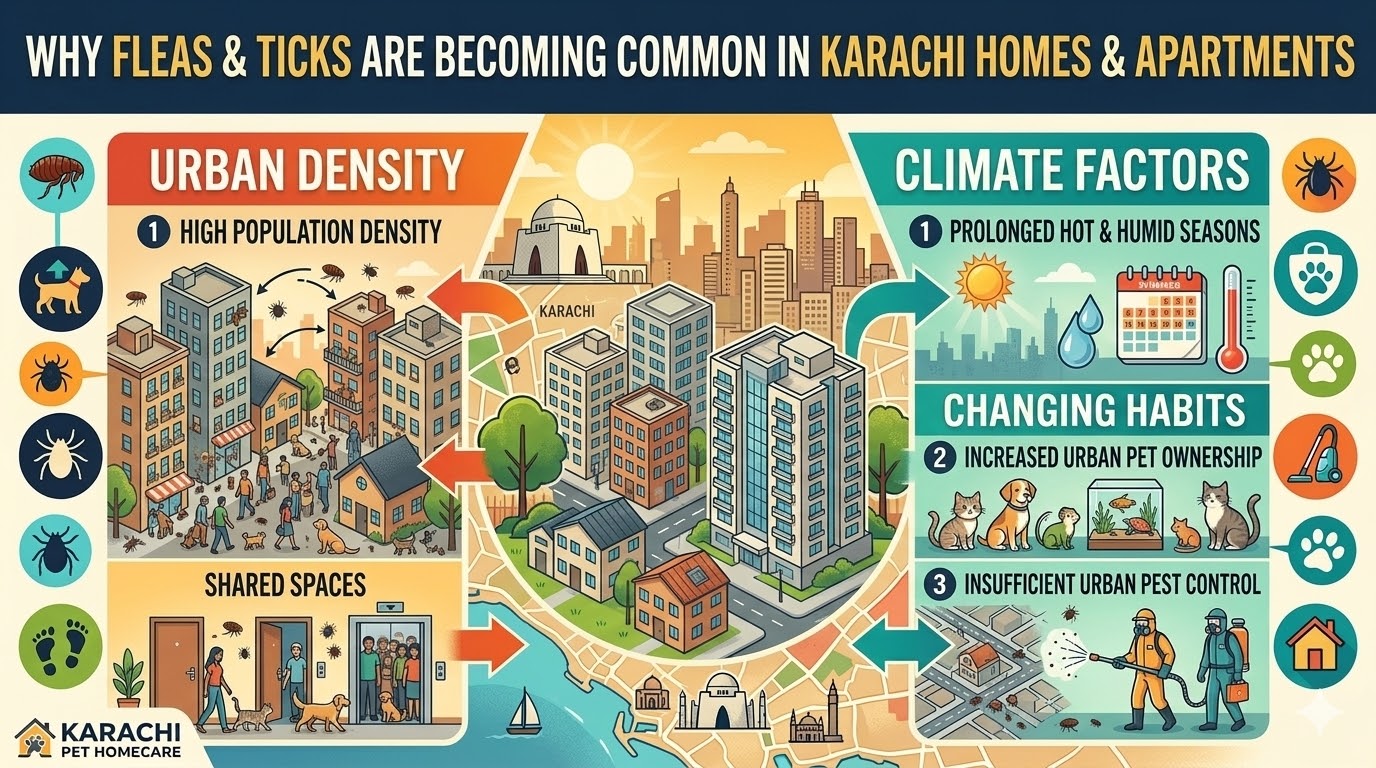
Something is changing in Karachi’s homes — and many residents are only noticing it after a trip to the vet or an unexplained rash on their child’s ankle. Reports of flea and tick infestations in Karachi houses and apartment buildings have risen sharply over the past several years, affecting pet owners and non-pet owners alike. This is not a coincidence. A convergence of environmental, urban, and behavioural factors unique to Karachi is quietly turning our homes into ideal breeding grounds for these blood-feeding parasites.
If you have noticed your pet scratching more than usual, found unfamiliar bites on your skin, or spotted tiny insects on your carpets or sofas, this article will explain exactly why this is happening — and what you can do before a manageable problem becomes a serious infestation.
1. Karachi’s Climate Is a Paradise for Fleas and Ticks
The single biggest driver behind rising flea and tick cases in Karachi is the city’s climate. Fleas reproduce most aggressively between 21°C and 30°C, with relative humidity above 50%. Karachi sits comfortably in that range for most of the year — and during the monsoon season (July to September), when humidity regularly climbs above 80%, flea eggs hatch faster and larvae develop into adults in as little as two to three weeks.
Unlike cities in northern Pakistan — Lahore, Islamabad, or Peshawar — where cold winters kill off a significant portion of the flea population, Karachi’s mild winters (rarely below 15°C) provide no such natural reset. This means flea populations that establish themselves in your home in March can still be thriving in December, growing with every generation.
Ticks are equally well-adapted to Karachi’s coastal conditions. The combination of warmth, moisture from sea air, and abundant greenery in areas like DHA’s older phases, Clifton, and the outskirts near Gadap Town create ideal tick habitat — tall grass, leaf litter, and shrub-covered plots where ticks wait for a passing host.
2. Rapid Urban Development Is Disrupting Wildlife Habitats
Karachi is one of the fastest-growing megacities in the world, with new housing schemes, apartment towers, and commercial developments rising across Scheme 33, Bahria Town Karachi, Saadi Town, and dozens of other areas. This rapid construction is having an unintended consequence: it is pushing wildlife — including small rodents, stray cats, pigeons, and other flea and tick hosts — directly into established residential neighbourhoods.
When the land around a new housing society is cleared, the animals that lived there do not simply disappear. Rats, bandicoots, and feral cats relocate to the nearest available habitat — which is often the gardens, boundary walls, drains, and utility spaces of adjacent homes. These animals carry fleas and ticks with them. Once inside a residential area, fleas drop off these hosts and begin infesting the environment, including gardens, ground-floor apartments, and any home with gaps in its perimeter.
Residents of newer societies in areas like Gulistan-e-Jauhar’s newer blocks, Surjani Town, or the Malir development corridor are disproportionately affected by this phenomenon — but the effect radiates into older, established neighbourhoods too.
3. The Rise of Pet Ownership in Karachi — Without Matching Awareness
Pet ownership in Karachi has grown enormously over the past decade. Dogs and cats are now common in apartments in Clifton, Gulshan-e-Iqbal, PECHS, and DHA — areas where keeping pets was far less common a generation ago. This is a positive cultural shift. But it has also introduced a significant, underappreciated public health challenge.
Many new pet owners in Karachi are not aware of the basics of flea and tick prevention. Year-round preventive treatments (monthly spot-on products, oral medications, or flea collars) are still not widely practised. Pets that visit parks like Hill Park, Bagh Ibn-e-Qasim, or Frere Hall’s lawns, socialise with other animals, or are walked along footpaths with grass verges are routinely exposed to fleas and ticks — and bring them home.
Groomers and veterinary clinics in Karachi increasingly report seeing dogs with severe tick burdens and cats with flea infestations that have clearly been ongoing for weeks or months without the owner’s knowledge. In many cases, the pet has been treated — but the home has not, guaranteeing re-infestation within days.
This is one reason why professional flea and tick control for Karachi homes must treat the environment — carpets, soft furnishings, pet bedding, and garden areas — not just the animal.
4. Apartment Living Creates Hidden Infestation Pathways
A growing share of Karachi’s population now lives in apartment buildings — and multi-storey living creates infestation dynamics that many residents do not expect. Fleas and ticks can spread between apartments through:
- Shared corridors and staircases — fleas dropped from an infested pet on the second floor can be picked up by a resident on the third
- Utility ducts and cable conduits — small enough for fleas in larval or pupal form to migrate between units
- Visitors and their pets — a single infested guest dog can seed an entire apartment building
- Second-hand furniture — sofas, rugs, and mattresses purchased from markets like Empress Market or through online classifieds can carry dormant flea pupae that hatch weeks after entering your home
Unlike a standalone house where the source of infestation can usually be identified and isolated, an apartment infestation may be constantly refreshed from an adjoining unit or shared common area. This is why building-level treatment — coordinated across multiple apartments simultaneously — is sometimes necessary for complete resolution.
5. Stray Animal Populations Are at Historic Highs
Karachi has one of the highest densities of stray dogs and cats of any major city in Asia. Despite ongoing municipal efforts, the stray population remains enormous — and strays are the primary reservoir for fleas and ticks in urban environments. Every stray animal that passes through your street, enters your compound, or shelters near your building’s exterior is a potential source of infestation.
Ground-floor apartments and homes with gardens or boundary walls that adjoin open plots are particularly vulnerable. Fleas can jump up to 33 centimetres vertically — easily clearing a door gap, a threshold, or a low window ledge. They do not need direct contact with your pet or family members to enter your home; they simply need proximity.
In older Karachi neighbourhoods like Lyari, Saddar, Liaquatabad, and parts of Korangi, where stray populations are densest and older housing stock has more structural gaps, flea ingress from the external environment is a near-constant challenge — regardless of whether residents own pets.
6. Do-It-Yourself Treatments Are Not Solving the Problem
Walk into any supermarket or pharmacy in Karachi and you will find shelves of flea sprays, pet shampoos, and cheap flea collars. These products give homeowners a sense of control — but they address only the surface of a flea infestation, not its root.
Here is what most people do not know: at any given time, only about 5% of an established flea infestation consists of adult fleas on the host animal. The remaining 95% — eggs, larvae, and pupae — are hidden in your carpets, sofa fabric, mattress seams, skirting board gaps, and garden soil. Standard consumer sprays kill adult fleas on contact, but do not penetrate into carpet fibres or neutralise pupae, which are encased in a cocoon resistant to most insecticides.
The result: homeowners spray, see improvement for a week or two as adult fleas die, and then experience a resurgence as the next generation hatches. This cycle can repeat for months, causing frustration and significant wasted expense — while the infestation continues to grow.
Professional tick and flea extermination services in Karachi use a combination of adulticides, insect growth regulators (IGRs), and environmental treatments that break the flea life cycle at every stage — something no consumer product achieves.
7. Climate Change Is Extending Tick Season
Karachi has experienced measurable changes in temperature and weather patterns over the past two decades. The city’s pre-monsoon heat now starts earlier and lasts longer, and post-monsoon cooling is delayed. For tick populations, this means a longer active season and faster generational turnover.
Tick species that were historically confined to Karachi’s outskirts and rural periphery — areas bordering Balochistan and Sindh’s agricultural zones — are increasingly being found in urban neighbourhoods. The brown dog tick (Rhipicephalus sanguineus), the most common tick species in Karachi homes, is now a year-round threat in most of the city rather than a seasonal one.
This matters because ticks transmit serious diseases. Canine ehrlichiosis and babesiosis are regularly diagnosed by Karachi veterinarians, and there is growing awareness of tick-borne fevers in humans — though these are often misdiagnosed as dengue or a viral fever given the symptom overlap.
What This Means for Karachi Homeowners Right Now
The combination of these factors — climate, urbanisation, growing pet ownership, stray animal density, ineffective DIY products, and climate change — means that fleas and ticks are not a problem that will resolve on its own. Without deliberate action, a minor infestation becomes a major one within weeks.
The key insight is this: you do not need to have a pet to have a flea problem. Karachi homeowners without any pets are increasingly discovering flea infestations through bites on family members, flea sightings on floors, and even flea dirt in apparently clean rooms. The external environment — your building’s exterior, adjacent plots, visiting guests, second-hand items — is all it takes.
And once established, a flea infestation in a Karachi home will not clear itself. The warm, humid environment keeps it going indefinitely. Professional intervention is not a luxury — it is the only reliable solution.
Practical Steps Every Karachi Homeowner Should Take
- Keep pets on year-round veterinarian-recommended flea and tick prevention (monthly spot-on or oral treatments)
- Inspect your pet after every outdoor walk or visit to a park, garden, or groomer
- Wash pet bedding weekly at 60°C or higher
- Vacuum carpets, sofas, and rugs weekly — and discard the vacuum bag sealed outside your home immediately after
- Avoid purchasing second-hand upholstered furniture or rugs without thorough inspection
- Seal gaps around doors, windows, and utility entries at ground floor level
- Keep garden grass trimmed short and remove leaf litter from compound corners
- Schedule a professional inspection at the first sign of a problem — do not wait
📞 Book Your Free Home Inspection — Before It Gets Worse
Unique Fumigation is Karachi’s most trusted name in professional pest control. Our specialists understand the specific conditions — neighbourhood by neighbourhood, building type by building type — that drive flea and tick infestations in this city. We have helped hundreds of families in DHA, Gulshan-e-Iqbal, Clifton, North Nazimabad, PECHS, Johar Town, and across Karachi reclaim their homes from these persistent parasites.
We offer a completely free home inspection to assess your infestation risk, identify active problem areas, and provide an honest, no-obligation treatment recommendation. Our treatments use WHO-approved formulations that are effective against all life stages of fleas and ticks — and safe for children and pets when applied by our trained technicians.
Don’t let Karachi’s climate work against you. Take control now with professional flea and tick treatment in Karachi from Unique Fumigation — and get lasting relief, not just temporary results.
✅ Free inspection | ✅ Same-week availability | ✅ WHO-approved treatments | ✅ Child & pet-safe | ✅ Follow-up guarantee
Visit uniquefumigation.com or call us today to schedule your free inspection. Because in Karachi’s climate, waiting only makes it worse.
Tags: flea control Karachi, tick control Karachi, pest control Karachi apartments, flea infestation causes, tick prevention Karachi, Unique Fumigation Karachi

Muhammad Ali Khan is the founder and director of Unique Fumigation Services, Karachi’s longest-running PPMA-registered pest control company, established in 1993. With over 30 years of hands-on experience in residential and commercial pest management, he has overseen more than 5,000 treatments across every major locality in Karachi — from DHA and Clifton to Orangi Town and Korangi.
Under his leadership, Unique Fumigation has maintained affiliations with the Pakistan Pest Management Association (PPMA), National Pest Management Association (NPMA), Federal Board of Revenue (FBR), and Sindh Revenue Board (SRB), while exclusively using WHO-approved, eco-safe chemicals — a standard he enforced from day one.
Muhammad Ali Khan writes on pest biology, infestation patterns specific to Karachi’s climate, treatment protocols, and chemical safety — drawing directly from three decades of field experience treating termite-damaged structures, dengue-prone areas, and food-industry facilities for clients including K-Electric, Hyperstar, IBA Karachi, and USAID.
His work is grounded in one principle: pest control done wrong is a health hazard, not just a failed service.