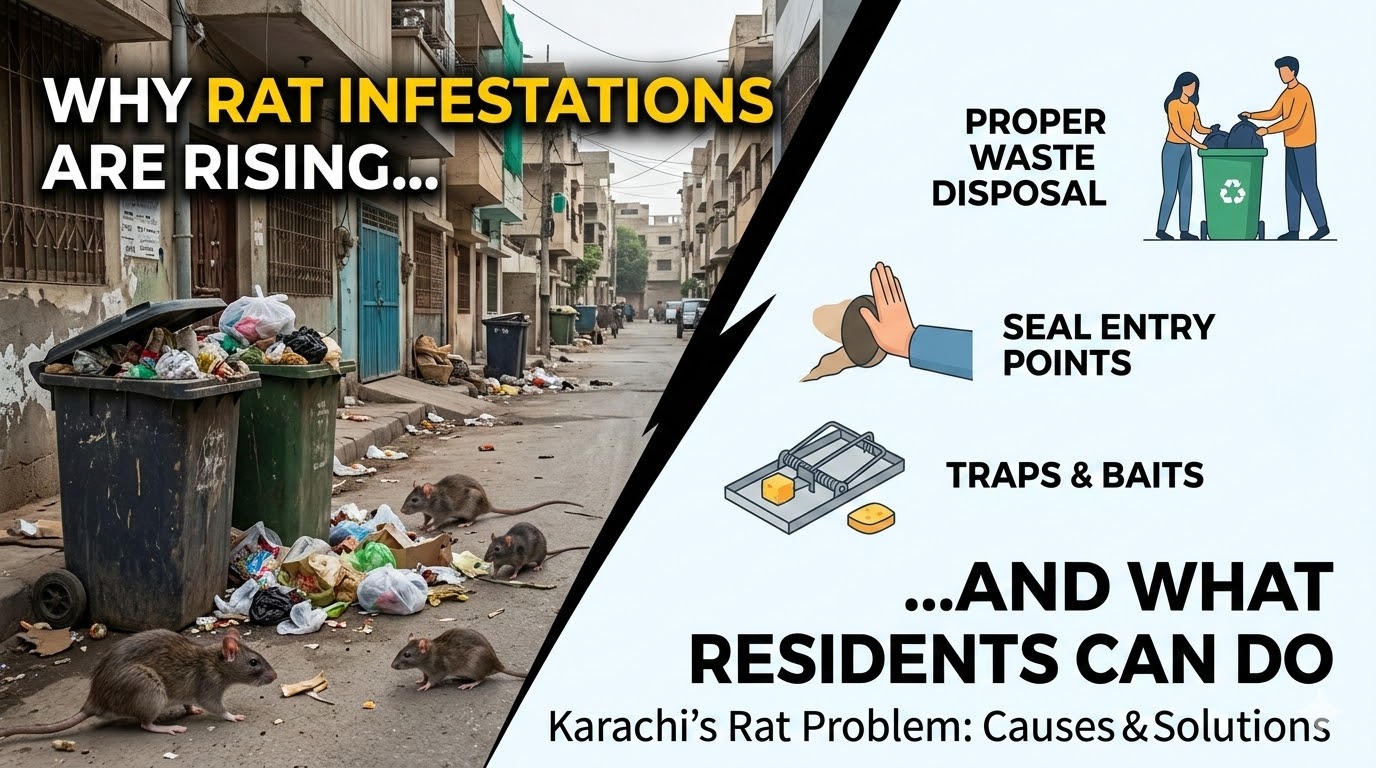
If you’ve noticed more rat droppings, gnawed wires, or scratching sounds in your walls lately, you’re not imagining it. Rat infestations in Karachi have been escalating at an alarming rate — and residential neighbourhoods across the city, from North Nazimabad and Gulshan-e-Iqbal to Clifton and Korangi, are feeling the pressure.
In this article, we break down exactly why this is happening and, more importantly, what Karachi homeowners can do right now to fight back before the problem spirals out of control.
The Growing Rat Problem in Karachi: What the Data Tells Us
Rats — primarily the Norway rat (Rattus norvegicus) and the roof rat (Rattus rattus) — are not new to Karachi. But urban pest experts and fumigation professionals working across the city confirm that call volumes for rodent control have surged significantly in recent years, particularly in densely populated residential zones.
So what’s behind this surge? The answer is a combination of urban, environmental, and infrastructural factors — many of which are unique to Karachi.
Top Reasons Rat Infestations Are Worsening in Karachi
1. Rapid Urbanisation and Informal Settlements
Karachi is one of the fastest-growing megacities in the world, with an estimated population of over 20 million people. This rapid urban expansion has led to sprawling informal settlements (katchi abadis) where sanitation infrastructure lags far behind population density. These areas offer rats exactly what they need: food, shelter, and warmth — in abundance.
As new construction pushes out into previously undeveloped land, it displaces rat colonies — which then migrate into established residential neighbourhoods.
2. Overflowing Waste and Irregular Garbage Collection
Karachi’s waste management system has struggled for years. In many areas, open rubbish dumps, blocked nullahs (drains), and garbage piles that go uncollected for days provide a reliable food source for urban rat populations.
Rats are opportunistic omnivores. An overflowing bin outside a DHA home is just as attractive to them as a rubbish heap in Orangi Town. Once they find a food source near a property, they will nest nearby.
3. Aging Sewer and Drainage Infrastructure
Much of Karachi’s underground sewage and drainage network dates back decades and is in critical disrepair. Cracked pipes, broken manholes, and flooded nullahs create ideal rat highways — allowing rodents to travel freely underground and surface inside homes and buildings. This is a major reason why even well-maintained homes in areas like PECHS or Gulberg require professional rat control services in Karachi that specifically target entry points and burrow networks.
4. Monsoon Season Drives Rats Indoors
Every year, Karachi’s monsoon season — typically from July to September — disrupts rat colonies living outdoors, in drains, and in open ground. Flooding displaces thousands of rats and forces them to seek higher ground. That higher ground is often your home.
After the monsoon, rat populations rebound quickly. Females can produce up to 5 litters per year, with each litter containing 6–12 pups. By winter, a small infestation can become a serious one.
5. Food Storage and Kitchen Habits
Traditional Pakistani kitchens often store grains, lentils, rice, and spices in large quantities. Without airtight storage containers, these become irresistible to rats. Even small gaps around kitchen pipes or cabinets can allow rats access to your pantry — and once they’ve found food, they will return repeatedly.
6. Climate and Mild Winters
Unlike cities in colder climates where winters thin out rat populations, Karachi’s mild winters allow rats to breed year-round. There is no natural seasonal die-off, which means populations compound continuously without human intervention.
How to Tell If Your Home Has a Rat Infestation
Rats are nocturnal and rarely seen during the day — but the signs of their presence are unmistakeable:
- Droppings — dark, pellet-shaped, usually near food sources or along walls
- Gnaw marks — on wires, wood, plastic containers, or even walls
- Scratching or scurrying sounds — especially at night, in walls or ceilings
- Burrow holes — in garden beds, under flooring, or near waste areas
- Grease trails — oily smear marks along walls where rats regularly travel
- Musky odour — a persistent unpleasant smell, particularly in enclosed spaces
If you’re noticing one or more of these signs, the infestation is likely already beyond the early stage. This is the point at which DIY solutions — snap traps, glue boards, or over-the-counter poison baits — often fail to address the root cause. A thorough rat extermination and control treatment in Karachi can identify the scale of the problem and eliminate it systematically.
⚠️ Important: Rats are not just a nuisance — they are a genuine health hazard. They carry diseases including leptospirosis, salmonella, and hantavirus, and can contaminate food and water supplies. Chewed electrical wires from rats are also a leading cause of house fires.
What Karachi Homeowners Can Do Right Now
Seal All Entry Points
Rats can squeeze through gaps as small as 1.5 cm. Inspect your home carefully: check where pipes enter walls, gaps under doors, cracks in foundations, and ventilation openings. Seal gaps with steel wool, wire mesh, or concrete — rats can chew through soft fillers and foam.
Improve Food and Waste Storage
Store all dry food items in sealed, hard-sided containers. Keep kitchen bins tightly lidded and empty them daily. Never leave pet food out overnight, and clean up fallen fruit in gardens promptly.
Eliminate Nesting Sites
Clear clutter from storage areas, garages, and around the exterior of your home. Rats love to nest in piles of cardboard, old clothing, or garden debris. Keep vegetation trimmed back from the walls of your home and stack firewood away from the house.
Reduce Water Sources
Fix leaking pipes and taps. Rats need water daily, and even a slow drip can support an entire colony. Ensure there is no stagnant water accumulating under appliances or in outdoor drains.
Use Traps Strategically
If the infestation is minor, snap traps placed along walls and in dark corners (where rats travel) can help. However, traps alone will not solve a moderate or large infestation — they are a supplementary tool, not a solution.
Bring in Professionals
For any infestation beyond the earliest stage, professional treatment is strongly recommended. A qualified pest control team will inspect your property, identify access points and nesting sites, deploy appropriate baiting and trapping systems, and apply targeted treatments in inaccessible areas. If you’re searching for effective, reliable rodent control and rat fumigation services in Karachi, working with an experienced local provider makes all the difference between a temporary fix and permanent resolution.
Why DIY Rat Control Often Fails in Karachi
Many Karachi homeowners try to manage rat problems themselves first — and understandably so. But there are several reasons why DIY approaches frequently fall short:
- Rats are neophobic — they avoid new objects (like traps) in their environment for several days.
- Over-the-counter poisons can be dangerous to children, pets, and even the household water supply if misused.
- Without identifying and sealing entry points, new rats will replace any that are eliminated.
- Rats that die in inaccessible cavities create odour problems and attract secondary infestations of flies and beetles.
- Colony size is almost always larger than homeowners estimate — what looks like one or two rats often means dozens nearby.
Professional pest controllers have the tools, training, and access to regulated rodenticides and exclusion materials that simply aren’t available off the shelf. They also know how to safely remove dead rodents and sanitise affected areas.
Neighbourhood-Specific Risk Factors in Karachi
While no part of the city is immune, some areas face heightened rat infestation risk due to local conditions:
- Lyari, Orangi Town, Baldia Town: High density, older drainage infrastructure, and proximity to industrial waste zones increase vulnerability significantly.
- Korangi and Landhi: Proximity to industrial zones means rats move between factory waste areas and residential homes frequently.
- Old City area and Saddar: Ageing buildings with legacy plumbing and a high density of food businesses create persistent pressure.
- DHA and Clifton: Newer construction with manicured gardens can still attract rats from adjacent areas, particularly near commercial zones and through drainage networks.
- Gulshan-e-Iqbal and PECHS: Mixed residential-commercial zoning and dense housing mean rat pressure from restaurants and markets can spill into homes.
No neighbourhood is fully safe. If you’re concerned about your specific locality, a professional assessment through Unique Fumigation’s rat control experts in Karachi can give you a clear picture of your risk level and the most appropriate treatment approach.
Don’t Wait — Rat Infestations Grow Exponentially
A single breeding pair of rats can produce over 1,000 descendants within a year under ideal conditions. Rats don’t wait for a convenient time to expand their colony, and infestations don’t resolve themselves.
The earlier you act, the less costly and disruptive the treatment will be. Whether you’re seeing the first signs of a problem or dealing with an established infestation, professional intervention gives you the fastest, safest, and most reliable path to a rat-free home.
🐀 Book Your Free Rat Inspection Today
Unique Fumigation offers free on-site inspections for Karachi homeowners.
Our licensed pest control specialists will assess your property, identify all rat entry points and nesting areas, and recommend a customised treatment plan — at no upfront cost to you.
👉 Click Here to Schedule Your Free Inspection with Unique Fumigation
Protect your family. Protect your home. Act before the problem grows.
About Unique Fumigation
Unique Fumigation is a Karachi-based pest control company specialising in residential and commercial fumigation, rodent control, termite treatment, cockroach extermination, and bed bug elimination. With teams operating across all major Karachi districts, Unique Fumigation provides licensed, safe, and effective pest management solutions to homeowners and businesses throughout the city.

Muhammad Ali Khan is the founder and director of Unique Fumigation Services, Karachi’s longest-running PPMA-registered pest control company, established in 1993. With over 30 years of hands-on experience in residential and commercial pest management, he has overseen more than 5,000 treatments across every major locality in Karachi — from DHA and Clifton to Orangi Town and Korangi.
Under his leadership, Unique Fumigation has maintained affiliations with the Pakistan Pest Management Association (PPMA), National Pest Management Association (NPMA), Federal Board of Revenue (FBR), and Sindh Revenue Board (SRB), while exclusively using WHO-approved, eco-safe chemicals — a standard he enforced from day one.
Muhammad Ali Khan writes on pest biology, infestation patterns specific to Karachi’s climate, treatment protocols, and chemical safety — drawing directly from three decades of field experience treating termite-damaged structures, dengue-prone areas, and food-industry facilities for clients including K-Electric, Hyperstar, IBA Karachi, and USAID.
His work is grounded in one principle: pest control done wrong is a health hazard, not just a failed service.