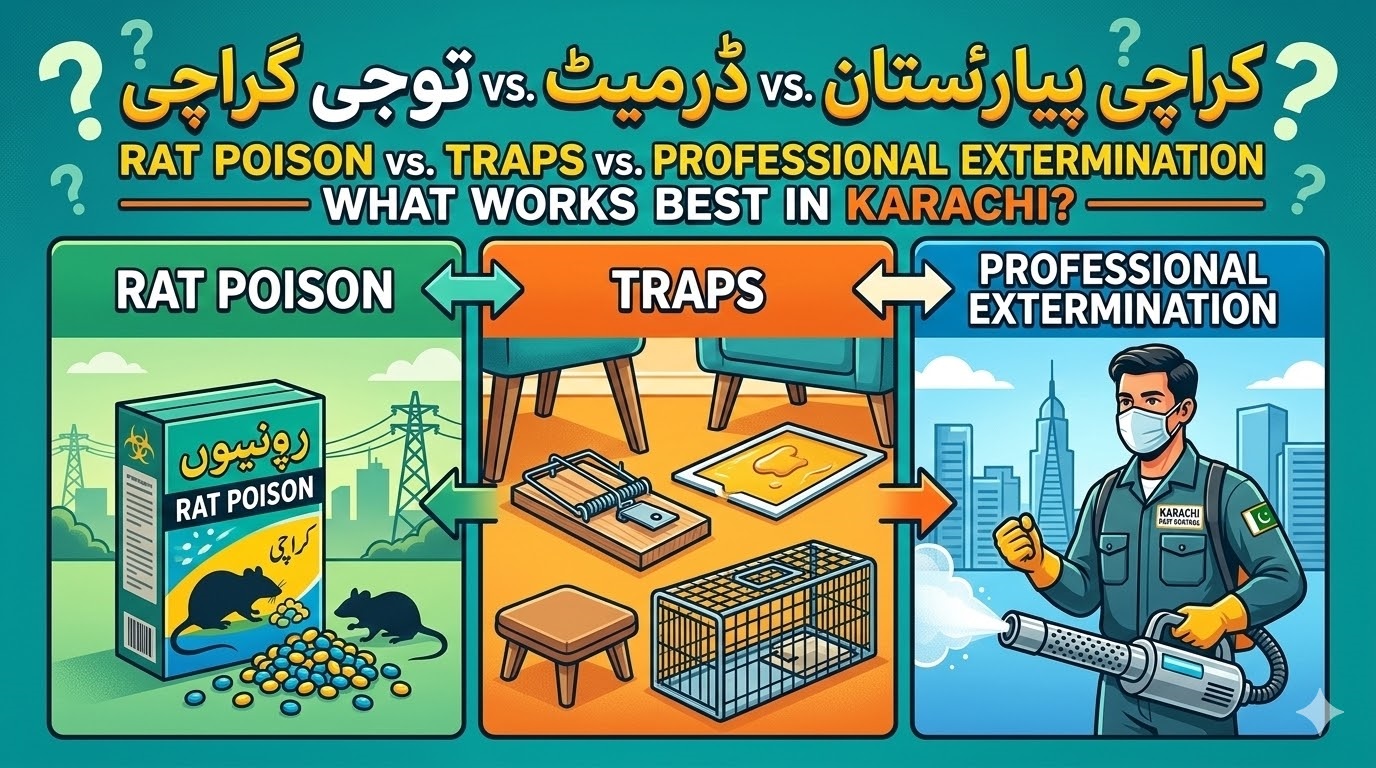
You’ve spotted the signs. Droppings behind the fridge. A gnawed bag of rice in the pantry. Scratching sounds in the ceiling at 2 AM. Now you’re standing in the pest control aisle at your local shop in Karachi, staring at boxes of rat poison and snap traps — wondering if any of it actually works.
The honest answer is: it depends — but probably not in the way the packaging suggests. Every method has real limitations, and Karachi’s specific urban conditions make some approaches significantly less effective than they are elsewhere in the world.
This guide cuts through the marketing and gives you a clear, practical breakdown of all three main approaches — rat poison, mechanical traps, and professional extermination — so you can make an informed decision for your home and family.
Why Rat Control in Karachi Is Harder Than You Think
Before comparing methods, it’s important to understand why rat infestations in Karachi are particularly stubborn and why solutions that work in other cities often fall short here:
- Aging sewer and drainage networks — Cracked underground pipes give rats a protected highway directly into homes. Most DIY methods cannot address what’s happening underground.
- Year-round breeding climate — Karachi’s mild winters mean there is no natural seasonal population die-off. Rat colonies grow continuously, compounding week by week.
- Dense housing and shared walls — Even if you eliminate rats from inside your home, colonies in neighbouring properties, shared drainage, or nearby nullahs will repopulate your space rapidly.
- Annual monsoon displacement — Flooding every July–September drives outdoor rat colonies into homes en masse, creating sudden surges that overwhelm any passive control measures already in place.
- High population pressure in urban areas — In areas like Orangi Town, Gulshan-e-Iqbal, PECHS, and Korangi, the sheer density of the surrounding rat population means any gap in your defences will be found and exploited quickly.
Understanding this context matters because the right approach to rat control for Karachi homes is not the same as what works in a low-density suburban environment. Let’s now examine each method honestly.
Method 1: Rat Poison (Rodenticides)
Rat poison — sold in grain, block, or paste form — works by causing internal bleeding (anticoagulants like brodifacoum and bromadiolone) or organ failure (acute toxicants). It is widely available from hardware stores and chemists across Karachi and is one of the most commonly used DIY rat control methods.
How It Works
A rat consumes the bait and dies within 3–10 days depending on the formulation. First-generation anticoagulants require multiple feeds; second-generation products can be lethal from a single dose. The idea is to place bait in areas of known rat activity and allow the population to self-reduce over time.
The Real-World Limitations in Karachi
- It does not stop new rats entering. Poison kills individual rats but does nothing to address the entry points, drainage access, or burrow networks that allow continuous re-infestation from outside.
- Dead rats in inaccessible spaces. Rats often retreat into walls, ceiling voids, or under flooring to die. The resulting odour — which can last weeks — and secondary insect infestations (blowflies, dermestid beetles) are often worse than the original rat problem.
- Bait shyness and neophobia. Rats are highly cautious around new objects and unfamiliar food sources. Without correct placement and pre-baiting techniques, many rats simply avoid commercially sold poison bait stations entirely.
- Serious risk to children, pets, and wildlife. Second-generation anticoagulants are extremely dangerous. In Karachi homes where children and pets have access to storage areas and gardens, poison baiting without professional protocols carries real risk of accidental poisoning.
- Partial colony impact. Even in ideal conditions, poison rarely eliminates an entire rat colony. Dominant individuals and pregnant females are often the last to access bait — meaning survivors breed rapidly and populations recover quickly.
- No impact on drain-dwelling rats. A significant portion of Karachi’s rat population lives in the sewer and drainage network. Surface poison bait cannot reach these animals, meaning the reservoir population remains entirely untouched.
⚠️ Safety Warning: Second-generation rodenticides available in Karachi markets have caused accidental poisoning of children and domestic animals. Never use loose grain bait in areas accessible to family members or pets, and never place bait near water sources. If you are unsure, do not use poison without professional guidance.
When Rat Poison Can Be Useful
As part of a professionally managed baiting programme — where correct placement, tamper-proof bait stations, and monitoring are all in place — rodenticides are a legitimate and effective tool. The issue is not the product itself; it is unsupervised DIY application in complex urban environments.
Verdict on Rat Poison Alone:
⚠️ Provides short-term, partial relief at best. Does not address root cause. Carries real safety risks in domestic settings. Not a standalone solution for Karachi homes.
Method 2: Mechanical Traps (Snap Traps, Glue Boards, Live Catch)
Traps are the other go-to for DIY rat control in Karachi. They come in several forms — traditional snap traps, adhesive glue boards, and live-catch cage traps — and are sold in hardware stores, supermarkets, and online across the city.
Types of Traps and How They Work
- Snap traps: Spring-loaded bars kill rats instantly on contact with the trigger. When set correctly with appropriate bait, they are one of the most humane and immediately effective mechanical options.
- Glue boards: Adhesive boards trap rats on contact. They do not kill immediately and are considered inhumane by many pest professionals — rats caught on glue boards suffer stress injuries attempting to escape.
- Live catch cage traps: Catch rats alive for relocation. Require daily monitoring and a plan for releasing the animal far from the property — which is impractical in dense Karachi neighbourhoods where release points are limited and re-infestation risk is high.
The Real-World Limitations in Karachi
- Neophobia makes placement critical — and difficult. Rats avoid new objects in their territory for several days. A snap trap placed incorrectly, or with the wrong bait, will simply be walked around. Most homeowners place traps in the wrong locations and abandon them after seeing no results.
- Traps address individual rats, not colonies. A typical Karachi home infestation involves dozens of rats — not two or three. Traps cannot scale to address a colony-level problem; they are a supplementary tool at best.
- Regular handling and resetting is required. Effective trap use requires daily inspection, resetting, and hygienic disposal of dead animals. In practice, most homeowners find this unsustainable within days.
- Completely ineffective for drainage-based infestations. If rats are entering through broken sewer pipes or under-slab drainage — which is extremely common in Karachi’s older residential areas — traps inside the home cannot intercept them at the source.
- No preventive value. Like poison, traps do nothing to stop new rats from entering. As long as entry points exist, any rats caught will be replaced from the external population within days.
💡 Placement Tip: If you do use snap traps, place them flush against walls and skirting boards — perpendicular to the wall, with the trigger end nearest the wall surface. Rats travel along walls and edges, not across open floor space. Bait with peanut butter, dried fruit, or a small piece of chocolate rather than cheese.
When Traps Are Genuinely Useful
Snap traps have a legitimate role in a professionally designed integrated pest management programme — deployed strategically in large numbers along mapped rat runways, monitored regularly, and used alongside proofing and baiting. As a standalone DIY solution for a Karachi home with an active infestation, they are insufficient.
Verdict on Traps Alone:
⚠️ Useful for single rat encounters or minor activity. Ineffective against established colonies or drainage-based infestations. Best used as a supplementary tool within a professional programme.
Method 3: Professional Rat Extermination
Professional pest control is not just a more powerful version of what you can buy at a shop. It is a fundamentally different approach — one that addresses the entire system rather than individual rats. Here is what a quality professional rat extermination service in Karachi actually delivers:
What a Professional Inspection Covers
- Full property survey: Every room, ceiling void, under-floor space, garage, garden, and external wall is assessed — not just the areas where you’ve seen rats
- Entry point identification: All gaps, cracks, pipe penetrations, drain access points, and ventilation openings that allow rats to enter are mapped
- Rat run and nesting site mapping: Grease trails, droppings, and burrow evidence are used to trace the routes and resting areas of the colony
- Drain and sewer assessment: The underground access points that are the primary entry route in most Karachi infestations are specifically examined
- Colony size estimation: A professional can assess whether you are dealing with a handful of rats or a large, established colony — which directly determines the treatment strategy
What a Professional Treatment Delivers
- Physical proofing and exclusion: Steel mesh, concrete, and door seals close the entry points that allow continuous re-infestation — the step that no poison or trap can replicate
- Tamper-proof bait station deployment: Regulated rodenticides in locked, child- and pet-proof stations, placed precisely along rat runways for maximum uptake and minimum risk
- Drain treatment: Targeted treatment of sewer and drainage entry points that are inaccessible to any DIY method
- Mechanical trapping at scale: Multiple snap traps deployed simultaneously across mapped rat runways — far more effective than a homeowner’s two traps by the kitchen door
- Follow-up monitoring: Return visits assess bait consumption, identify any new activity, and confirm that the colony has been eliminated — not just temporarily disrupted
- Sanitisation guidance: Advice on decontaminating affected areas, including droppings, urine trails, and nesting material, to remove disease risk and odour attractants
- Service documentation: Written records of treatment — valuable if you ever need to demonstrate pest management compliance to landlords, buyers, or authorities
✔ Why Proofing Is the Game-Changer: In Karachi, where external rat pressure from drains, nullahs, and neighbouring properties is constant, physical exclusion is the only method that delivers lasting results. Without sealing entry points, any treatment — professional or DIY — is simply buying time before the next infestation begins.
Verdict on Professional Extermination:
✅ The only method that addresses the complete rat problem — colony elimination, entry point closure, drain treatment, and prevention of re-infestation. Higher upfront cost, dramatically lower total cost when the full lifecycle of DIY attempts is accounted for.
Side-by-Side Comparison: All Three Methods
The table below summarises the key differences between all three approaches for Karachi homeowners:
| Criteria | Rat Poison | Traps | Professional Extermination |
| Kills rats? | Yes — slowly | Yes — immediately | Yes — completely |
| Stops new rats entering? | ❌ No | ❌ No | ✅ Yes (proofing) |
| Eliminates whole colony? | ⚠️ Partial | ⚠️ Partial | ✅ Yes |
| Safe around children & pets? | ❌ High risk | ⚠️ Moderate risk | ✅ Food-safe options |
| Addresses entry points? | ❌ No | ❌ No | ✅ Yes |
| Effective in Karachi drains? | ❌ No | ❌ No | ✅ Yes |
| Works in walls & ceilings? | ⚠️ Partially | ❌ No | ✅ Yes |
| Requires expertise? | Low | Low | High |
| Recurring cost | Medium | Low–Medium | Low (contract) |
| Overall Verdict | ⚠️ Short-term relief only | ⚠️ Limited use case | ✅ Only complete solution |
The 5 Most Common Rat Control Mistakes Karachi Homeowners Make
Even homeowners who take rat control seriously often make these avoidable errors:
- Acting only after a sighting. By the time you see a rat, the colony is usually well established. Waiting for a visual confirmation before acting means the problem is already weeks or months old.
- Treating only the interior. The source of your infestation is almost certainly outside — in drains, gardens, or neighbouring properties. Treating only inside the home is equivalent to mopping the floor while the tap is still running.
- Stopping treatment too soon. Homeowners often stop after a few days of no visible activity. Rat colonies are highly resilient — pregnant females and juveniles often survive the initial knockdown and repopulate rapidly.
- Underestimating the colony size. Rats are nocturnal and extremely cautious. For every rat you see, there are typically 10–20 you don’t. A handful of droppings can represent a colony of dozens.
- Not addressing monsoon season proactively. Karachi’s July–September flooding displaces massive outdoor rat populations every year. Homeowners who wait until after the monsoon to treat infestations are always responding to a larger, more entrenched problem.
When Should You Call a Professional? A Simple Decision Guide
Not every rat encounter requires immediate professional intervention. Here is a clear guide:
Consider DIY Methods If:
- You have seen a single rat once, with no other signs of activity
- The sighting was near an external door and you can identify and seal the entry point
- There are no droppings, gnaw marks, or sounds indicating ongoing activity
Call a Professional Immediately If:
- You have found droppings in multiple locations inside the home
- You are hearing scratching or movement sounds in walls, ceilings, or under floors
- You have found gnaw marks on wiring, pipes, or food packaging
- You have already tried DIY methods and activity has continued or returned
- Your property is in a high-pressure area — near a nullah, food market, or densely packed neighbourhood
- It is approaching or immediately after monsoon season (June–October)
- You have young children, elderly family members, or pets — making poison use unsafe
If you are in any doubt, a professional assessment costs nothing with Unique Fumigation’s free rat inspection for Karachi homes — and gives you an accurate, expert picture of what you are actually dealing with before you spend money on any approach.
Stop Guessing — Get a Professional Assessment for Free
The reality is that most Karachi homeowners who deal with rat infestations spend weeks and hundreds of rupees on poison and traps — only to find themselves back at square one. The rats return because the root cause was never addressed.
A professional assessment does not just tell you how many rats you have. It tells you where they are coming from, how they are getting in, what is sustaining the colony, and exactly what it will take to eliminate the problem permanently.
🐀 Book Your Free Rat Inspection in Karachi
Unique Fumigation offers completely free on-site rat inspections for Karachi homeowners.
Our licensed pest specialists will inspect your entire property — interior, exterior, drains, and entry points — map the infestation, and give you a clear, honest treatment plan. No commitment, no cost.
👉 Click Here to Schedule Your Free Inspection with Unique Fumigation
Stop wasting money on partial solutions. Get the full picture — free.
About Unique Fumigation
Unique Fumigation is a Karachi-based pest control company providing licensed residential and commercial pest management services across all major city districts. Specialising in rodent control, termite treatment, cockroach extermination, and bed bug elimination, Unique Fumigation delivers integrated pest solutions backed by professional documentation and guaranteed results.

Muhammad Ali Khan is the founder and director of Unique Fumigation Services, Karachi’s longest-running PPMA-registered pest control company, established in 1993. With over 30 years of hands-on experience in residential and commercial pest management, he has overseen more than 5,000 treatments across every major locality in Karachi — from DHA and Clifton to Orangi Town and Korangi.
Under his leadership, Unique Fumigation has maintained affiliations with the Pakistan Pest Management Association (PPMA), National Pest Management Association (NPMA), Federal Board of Revenue (FBR), and Sindh Revenue Board (SRB), while exclusively using WHO-approved, eco-safe chemicals — a standard he enforced from day one.
Muhammad Ali Khan writes on pest biology, infestation patterns specific to Karachi’s climate, treatment protocols, and chemical safety — drawing directly from three decades of field experience treating termite-damaged structures, dengue-prone areas, and food-industry facilities for clients including K-Electric, Hyperstar, IBA Karachi, and USAID.
His work is grounded in one principle: pest control done wrong is a health hazard, not just a failed service.