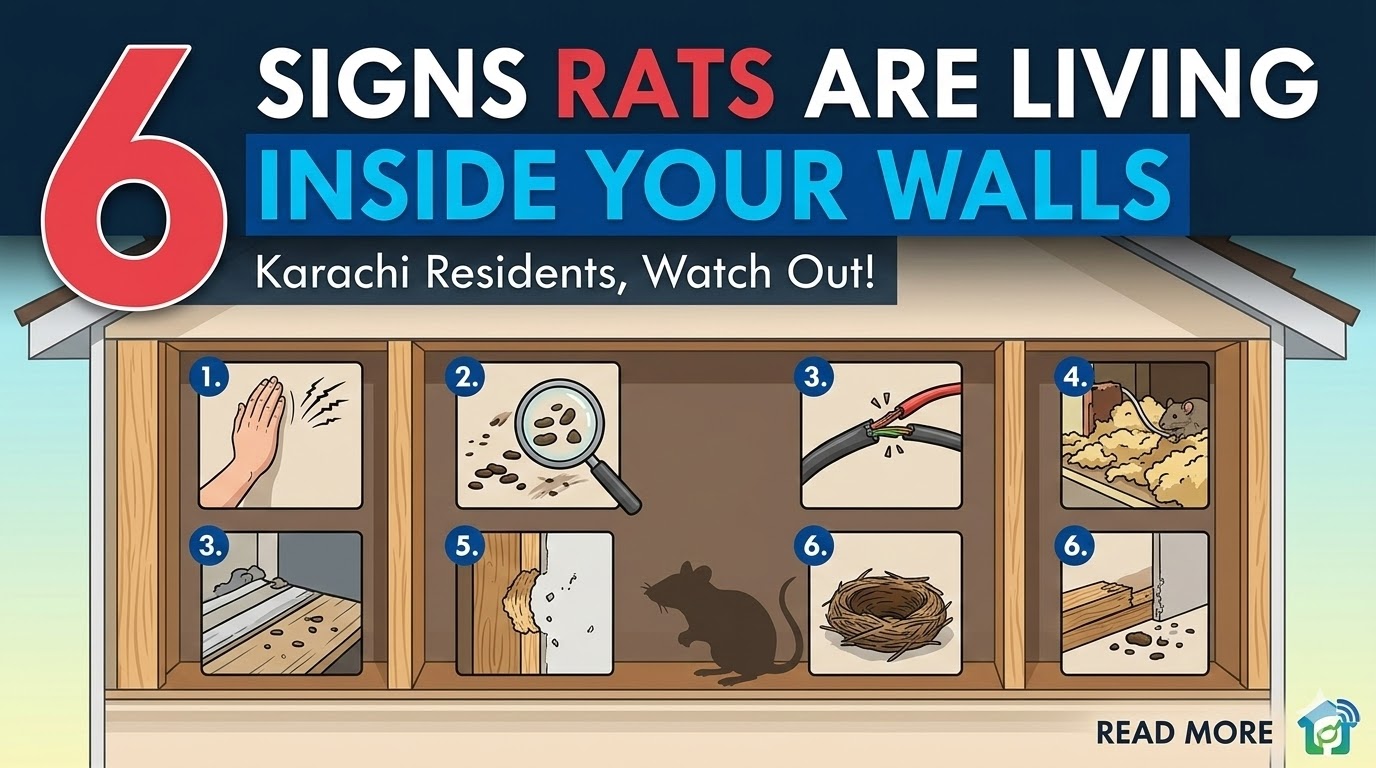
There is a deeply unsettling truth that most Karachi homeowners discover too late: by the time you see a rat, there are almost certainly many more you are not seeing. Rats are nocturnal, cautious, and extraordinarily skilled at remaining hidden. A mature colony of Norway rats (Rattus norvegicus) can live inside the walls, ceilings, and floors of a Karachi home for months — gnawing through wiring, contaminating insulation, and breeding rapidly — before a single animal is spotted in the open.
The challenge is knowing what to look for. Rats leave behind a specific and recognizable set of clues, but most homeowners either do not know the signs or mistakenly dismiss them as minor household issues. This guide is designed to change that.
Below, we walk you through the 6 most reliable signs that rats are living inside your walls right now — with specific context for Karachi’s urban environment, climate, and housing types. If you recognize even two or three of these signs in your home, do not delay: contact professional rat control services in Karachi before the situation escalates.
Why Karachi Homes Are Particularly Vulnerable
Karachi’s combination of dense urban construction, aging infrastructure, warm year-round climate, and overstressed drainage systems creates near-perfect conditions for rat infestations. From the old colonial-era buildings of Saddar and Kharadar to the high-rise apartment towers of Gulshan-e-Iqbal and Clifton, and the newer developments spreading across DHA, Bahria Town, and Malir — no neighbourhood in Karachi is fully immune.
Rats enter homes through gaps as small as half an inch (roughly the diameter of a 5-rupee coin). Once inside, they navigate through wall cavities, plumbing chases, utility conduits, and POP false ceilings. They nest in insulation, behind kitchen cabinets, inside electrical panel boxes, and under flooring. Karachi’s K-Electric load-shedding cycles and the resulting voltage surges make the electrical damage they cause especially dangerous.
Here is how to tell if they have already moved in.
Sign #1: Nocturnal Sounds Inside Your Walls and Ceiling
The most common first sign — and the one most Karachi homeowners experience before any other — is unexplained sounds from inside the structure of the building after dark. These typically begin between 10 PM and 3 AM, when the household has gone quiet and rat activity is at its peak.
What You Will Hear
- Rapid, light scratching or scrabbling — like fingernails on a hard surface — from inside walls or the ceiling
- Soft thudding or rolling sounds, often from above, as rats move across ceiling cavities
- Intermittent squeaking or chattering, particularly when multiple animals are present
- Gnawing sounds — a persistent, repetitive chewing noise — especially near electrical conduits, wooden beams, and pipe entry points
Karachi-Specific Context
In Karachi’s older apartment buildings — particularly those built in the 1960s through 1980s in areas such as North Nazimabad, Liaquatabad, Orangi Town, and Federal B Area — wall cavities are often wider and less sealed than in newer construction. This gives rat colonies more room to establish large nesting areas and travel routes. In buildings with POP false ceilings, sounds from above are especially common and can be heard clearly.
If the sounds occur consistently at the same time each night and stop abruptly when you make a loud noise (rats freeze when they detect vibrations or sudden sounds), this is a strong indicator of active rodent activity rather than building settlement or plumbing noise.
| Important: Do not assume sounds in the ceiling mean birds or geckos. The scratching pattern of rats — fast, irregular bursts followed by movement — is distinct from the slow, deliberate movement of a lizard and the fluttering of a bird. If the sounds repeat every night, rats are the most likely explanation. |
Sign #2: Droppings in Corners, Cabinets, and Along Walls
Rat droppings are one of the clearest and most unambiguous signs of infestation. A single Norway rat produces between 40 and 50 droppings per day. In an established colony of even ten animals, this means hundreds of droppings deposited nightly in fixed locations along their travel routes.
How to Identify Rat Droppings
- Shape: spindle-shaped (tapered at both ends), approximately 1.5–2 cm long
- Colour: dark brown to black when fresh; grey and crumbling when old (more than 3 days)
- Location: concentrated along walls, in the corners of kitchen cabinets, behind the refrigerator or washing machine, inside storage cupboards, and near plumbing under sinks
- Texture: soft and shiny when fresh; hard and dull when dried
Where to Check in a Karachi Home
Rats are creatures of habit. They use the same routes repeatedly, known as “rat runs”. In Karachi homes, the most common locations to find droppings include:
- Behind and under kitchen counters, particularly near the stove and sink — areas where food odours are strongest
- Inside pantry shelves where atta, rice, lentils, or spices are stored in fabric or thin plastic packaging
- Along the base of external walls, especially walls that back onto a stairwell, utility shaft, or neighbouring wall
- In the lower shelves of wardrobes, particularly in ground-floor apartments
- Behind the toilet cistern or under bathroom sinks — rats frequently enter via drainage pipes
| Safety Warning: Never handle rat droppings with bare hands. Rat urine and droppings can carry serious pathogens including Leptospira bacteria (causing leptospirosis), Hantavirus, and Salmonella — all of which pose real health risks. Wear disposable gloves and a mask, and disinfect the area thoroughly with a bleach solution before disposal. |
Sign #3: Grease Marks and Smear Trails Along Walls
This is one of the most conclusive signs of rat activity, yet it is consistently overlooked or misidentified by homeowners. Rats have extremely poor eyesight and rely heavily on smell and touch to navigate. They press their bodies against walls and surfaces as they move, and the oils and dirt in their fur leave behind dark, greasy smear marks along their regular pathways.
What Rub Marks Look Like
- Dark grey to brown streaks or patches at a consistent height (typically 5–15 cm above the floor, or along the top edge of skirting boards)
- Oily or waxy texture if touched (use a tissue to test — if it comes away dark, this is a rub mark)
- Concentrated at corners, around pipe entry points, along baseboards, and where walls meet floors or ceilings
- Consistent and repeating — rub marks appear where rats travel every night
Karachi-Specific Context
In Karachi homes with white or light-coloured wall paint — very common in apartment buildings across Clifton, Defence, and PECHS — rub marks become highly visible, particularly in low-light conditions or when you run your hand along the lower section of a wall near a pipe entry point. In older buildings with darker, textured walls, shine a torch at a low angle along the wall surface; the grease marks will reflect light distinctively.
Fresh rub marks indicate current, active use of a route. Old rub marks that are dry and powdery suggest past activity. Multiple fresh rub marks in multiple locations indicate a well-established, ongoing infestation — the kind that requires professional rodent extermination treatment in Karachi rather than DIY measures.
Sign #4: Gnaw Marks on Wiring, Wood, and Food Packaging
Rats must gnaw continuously because their incisor teeth grow throughout their lives at approximately 11–14 cm per year. They gnaw on almost any hard material — wood, plastic, aluminium, concrete, and especially electrical wiring insulation. In Karachi homes, gnaw damage is one of the most dangerous and costly consequences of an infestation.
What to Look For
- Chewed edges on food packaging — particularly atta bags, plastic storage containers, cardboard boxes of food, and biscuit packets
- Bite marks on wooden furniture edges, door frames, skirting boards, and cabinet corners — look for rough, uneven chewing patterns with two parallel groove marks from the incisors
- Frayed or stripped plastic insulation on extension cords, appliance cables (behind refrigerators, washing machines, microwave units), and exposed wiring
- Gnaw holes in walls — particularly at the base of walls near pipes, or around the edges of utility access panels
- Chewed plastic covers on electrical switches and sockets, particularly in kitchens and utility areas
The Electrical Fire Risk — A Karachi-Specific Warning
This sign warrants particular urgency in the Karachi context. K-Electric’s load-shedding cycles subject home wiring to repeated power interruptions and restoration surges. Wiring that has been partially stripped by rats — even slightly — is dramatically more vulnerable to arcing and short-circuiting during these surges. A fire starting inside a wall cavity from rat-damaged wiring can smoulder undetected for hours inside the structure before breaking through.
If you find gnaw marks anywhere near electrical cables, this is not a situation to monitor and wait. Have an electrician inspect the wiring and contact a certified pest control company for immediate rat infestation treatment in Karachi to eliminate the source of the damage.
Sign #5: A Persistent, Unpleasant Ammonia-Like Smell
Rat urine has a very strong, sharp ammonia odour that is distinct from other household smells. In an active infestation, this smell can become a constant background presence in certain rooms — particularly those near active nesting sites. Many Karachi homeowners initially mistake this smell for drainage issues, mould, or dampness, especially during the monsoon months of June to September when humidity intensifies all odours.
Characteristics of Rat Odour
- Sharp, stale, and musky — often described as “like a dirty animal cage”
- Strongest in enclosed spaces: inside cabinets, behind large appliances, in store rooms, and inside false ceilings
- In the case of a dead rat inside a wall cavity: a pungent, intensifying decomposition odour that can last 1–3 weeks and is virtually impossible to mask
- Concentrated in nesting areas: look for the smell near soft insulating materials such as stored fabric, cardboard, or foam packaging — rats use these for nesting material
Karachi-Specific Context
Karachi’s high humidity — particularly in coastal areas of Clifton, DHA Phase 1–4, Keamari, and Lyari — amplifies the odour of rat urine significantly. If you notice an ammonia-like smell in a room that has otherwise clean drains and no visible mould, begin checking enclosed spaces systematically.
The smell of rat urine is also a health hazard in its own right. Dried rat urine particles can become airborne and inhaled, carrying the risk of leptospirosis — a bacterial infection that causes flu-like symptoms and can progress to organ failure in severe cases. This disease is a documented public health concern in Karachi, particularly in flood-affected and low-lying areas during the monsoon season.
| Health Alert: Leptospirosis cases spike in Karachi every monsoon season, particularly in areas such as Surjani Town, Korangi, Orangi, and Malir where floodwater mixes with drainage. Rat urine is the primary vehicle for this disease. A rat infestation inside your home is not merely a property problem — it is a direct threat to the health of every person in the household. |
Sign #6: Your Pets Are Acting Strangely Near Walls or Floors
This sign is surprisingly reliable — and often the earliest indicator of a hidden infestation. Dogs and cats have sensory capabilities far beyond human perception. Their sense of smell is between 10,000 and 100,000 times more sensitive than ours, and they can detect the ultrasonic vocalisations rats make while communicating — sounds completely inaudible to human ears.
Behaviours to Watch For
- A dog or cat fixating on a specific section of wall, continuously sniffing, pawing, or scratching at the base of the wall or skirting board
- A cat sitting for extended periods staring at the ceiling — particularly common in apartments where rats are active in the false ceiling above
- A normally relaxed pet becoming restless or alert at night, particularly between 10 PM and 4 AM
- A pet that refuses to enter a specific room or area of the home that it previously used comfortably
- A dog whining, barking, or growling at walls, cupboards, or the area under a sink for no apparent reason
How to Use This Sign Effectively
If your cat or dog is displaying one or more of these behaviours, take note of exactly where in the home the behaviour is occurring. This location data is extremely valuable for a pest control inspector — it can help pinpoint the active rat run or nesting site immediately and reduce the time required for a full inspection. Note the location, the time of day it occurs, and whether it is consistent on multiple nights.
A pet that has correctly identified a rat presence inside a wall cavity is giving you an early warning that professional intervention is needed urgently. The earlier a trained pest control team can assess the situation, the more limited the structural damage and the lower the cost of treatment.
Three Additional Red Flags Karachi Homeowners Should Know
Beyond the six primary signs above, there are three additional indicators that commonly appear in Karachi homes and strongly suggest an active rat problem:
Footprints and Tail Drag Marks
In dusty areas — common in utility rooms, storage areas, and rarely-used rooms across Karachi — you may be able to see rat footprints (four toes on front feet, five on back) and the drag line of their tail between footprints. Sprinkle a thin layer of atta or talcum powder along a suspected travel route overnight and check in the morning.
Nesting Material Accumulation
Rats build nests using shredded soft material. If you find unexplained collections of shredded paper, chewed fabric, cotton wool, or torn cardboard in a corner, inside a cupboard, or behind a large appliance — particularly if this material seems to have been deliberately gathered — this is a nest, or a rat in the process of building one.
Unexplained Electrical Faults
Repeated circuit breaker trips, intermittent flickering lights, or appliances that malfunction without obvious cause — especially when these faults are localised to one room or one circuit — can indicate rat damage to wiring inside walls. Combined with any of the other signs in this guide, this represents a serious and urgent situation that warrants both an electrician and expert rats removal services in Karachi without delay.
Why Snap Traps and Supermarket Poison Will Not Solve the Problem
Walk through any market in Karachi — from Tariq Road to Empress Market to any kiryana store in Korangi — and you will find snap traps, glue boards, and rat poison pellets readily available. Many homeowners try these first. Most find that they catch one or two rats at best, and the problem continues.
There are specific biological reasons for this:
- Neophobia: Rats are instinctively afraid of new objects in their environment. A snap trap or bait station placed without knowledge of the exact rat run will be avoided for days or weeks.
- Bait shyness: If a rat consumes enough poison to feel ill but not enough to die — which is common with imprecisely dosed retail products — it will associate the bait with sickness and avoid it permanently.
- Colony size: A retail trap catches one rat. An established colony inside a Karachi wall cavity can contain 20–50 animals or more. Catching individuals does not eliminate the colony.
- Entry point remains open: Without identifying and sealing the specific gap or pipe entry through which rats are entering the building, new animals will continue entering from Karachi’s extensive urban rat population.
A comprehensive, professionally executed treatment addresses all of these factors simultaneously — population elimination, strategic bait placement based on surveyed rat runs, and structural recommendations to prevent re-entry. This is precisely what Unique Fumigation’s rat control and extermination service in Karachi is designed to deliver.
How Unique Fumigation Solves Rat Problems in Karachi Homes
Unique Fumigation’s rodent control programme is built specifically for the realities of Karachi’s urban pest environment. Our approach is structured, evidence-based, and thorough:
- Detailed Site Survey: A trained inspector examines all key risk areas — wall cavities, utility entry points, DB boxes, false ceilings, drainage connections, and kitchen areas — to identify the species present, estimate population size, and map all active rat runs
- Strategic Bait Station Deployment: Professional-grade rodenticides placed in tamper-resistant stations along confirmed rat pathways — not guesswork. The positioning is critical to effectiveness
- Entry Point Documentation: We identify every gap, crack, and pipe entry through which rats are accessing the property and provide detailed recommendations for sealing
- Child and Pet-Safe Protocols: All bait stations are secured and positioned to prevent access by children and household pets
- Follow-Up Monitoring: We return to verify that the treatment is working, replenish bait as needed, and confirm complete elimination before closing the case
- Written Report: Every inspection and treatment is documented so you have a full record of findings and actions taken
Whether you are in DHA, Gulshan-e-Iqbal, Nazimabad, PECHS, Bahria Town, Korangi, or any other area of Karachi — our team knows the local pest environment and is equipped to handle infestations of any scale in residential apartments, houses, and commercial buildings.
Frequently Asked Questions
How quickly can rats cause serious damage inside a wall?
An active colony can strip insulation from wiring, contaminate an area with droppings and urine, and chew through wooden structural elements within a matter of weeks. The damage accelerates exponentially as the colony grows — a pair of rats can produce a colony of 50 or more within three to four months under Karachi’s warm conditions.
Is it safe to stay in the home during rat treatment?
Yes. Professional bait stations are sealed and tamper-resistant. The rodenticides used by Unique Fumigation are placed in secured housings that are inaccessible to children and pets. Our team will advise you on any specific precautions needed for your property type.
Can rats come back after treatment?
Without structural gap-sealing, rats from Karachi’s extensive urban population can re-enter a property. This is why our treatment includes entry-point documentation and follow-up monitoring. Homes in high-risk areas (near open drains, commercial zones, or older buildings) benefit from a preventive maintenance programme.
How long does a rat treatment take to work?
Most infestations show significant reduction within 7–10 days of professional treatment. Complete elimination and follow-up verification typically takes 2–4 weeks depending on colony size and property type.
I only heard sounds once. Should I still call?
Yes. A single incident of nocturnal scratching inside a wall is enough reason for a professional inspection. Early detection dramatically reduces treatment time, cost, and structural damage. A free inspection carries no obligation — and if there is no problem, you will have peace of mind.
Recognized Any of These Signs in Your Home?
Act Now — Before the Problem Gets Worse
| Book Your FREE Rat Inspection with Unique Fumigation If you have seen even one of the signs in this guide, there is a real possibility that rats are already living inside your walls. Every day without action is another day of gnawing, breeding, contamination, and growing risk. Unique Fumigation is offering Karachi homeowners a completely free, no-obligation property inspection. Our certified pest control specialist will visit your home, assess the situation thoroughly, and give you an honest picture of what is happening — and what it will take to fix it. Visit us at: uniquefumigation.com/rats-control-services-in-karachi to book your free inspection today. |
Karachi’s homes deserve protection. Unique Fumigation delivers it.

Muhammad Ali Khan is the founder and director of Unique Fumigation Services, Karachi’s longest-running PPMA-registered pest control company, established in 1993. With over 30 years of hands-on experience in residential and commercial pest management, he has overseen more than 5,000 treatments across every major locality in Karachi — from DHA and Clifton to Orangi Town and Korangi.
Under his leadership, Unique Fumigation has maintained affiliations with the Pakistan Pest Management Association (PPMA), National Pest Management Association (NPMA), Federal Board of Revenue (FBR), and Sindh Revenue Board (SRB), while exclusively using WHO-approved, eco-safe chemicals — a standard he enforced from day one.
Muhammad Ali Khan writes on pest biology, infestation patterns specific to Karachi’s climate, treatment protocols, and chemical safety — drawing directly from three decades of field experience treating termite-damaged structures, dengue-prone areas, and food-industry facilities for clients including K-Electric, Hyperstar, IBA Karachi, and USAID.
His work is grounded in one principle: pest control done wrong is a health hazard, not just a failed service.