If you’ve spotted unusual bites on your child’s legs, noticed your dog scratching relentlessly, or found a tiny crawling insect on your sofa — you’re likely dealing with either fleas or ticks. Both are common in Karachi. Both can make your family and pets seriously unwell. But they’re very different parasites, they spread differently, they hide in different places, and they require different approaches to eliminate.
So which one is the bigger threat? The answer might surprise you — and understanding both is the first step to protecting your home effectively.
This guide gives you a clear, honest comparison of fleas and ticks in the context of Karachi’s unique environment: the climate, the stray animal problem, the monsoon season, and the risks specific to our city’s residential areas.
Understanding the Two Pests: What You’re Actually Dealing With
What Are Fleas?
Fleas are tiny, wingless, blood-sucking insects — typically 1 to 3 mm in length, dark brown, and almost impossible to spot until they jump. They move by leaping (up to 33 cm in a single jump — extraordinary for their size) and reproduce at a staggering rate. A single female flea can lay up to 50 eggs per day.
In Karachi, the most common species is Ctenocephalides felis (the cat flea) — despite its name, it infests dogs, cats, and humans equally. These fleas are year-round residents of Karachi homes, but populations spike dramatically after the monsoon season due to increased humidity.
What Are Ticks?
Ticks are not insects — they’re arachnids, closely related to spiders and mites. They’re generally larger than fleas (3–5 mm unfed; up to 1 cm when engorged with blood), slow-moving, and they attach firmly to their host to feed, sometimes for several days at a time.
The most relevant species in Karachi is Rhipicephalus sanguineus — the Brown Dog Tick. Unlike most tick species that prefer outdoor environments, the Brown Dog Tick has adapted to complete its entire lifecycle indoors. This makes it uniquely dangerous for urban Karachi homes.
How Karachi’s Environment Amplifies Both Threats
Most pest comparisons are written for temperate climates. Karachi is different — and both fleas and ticks exploit our city’s specific conditions to thrive:
- Year-round warmth: Karachi rarely drops below 15°C even in January. Both fleas and ticks remain active throughout the year, with no cold season to suppress populations.
- Monsoon humidity: The June–September monsoon season creates the near-perfect warm and humid conditions that accelerate flea egg hatching and tick activity. Post-monsoon months (October–November) typically see the sharpest spikes in infestation reports.
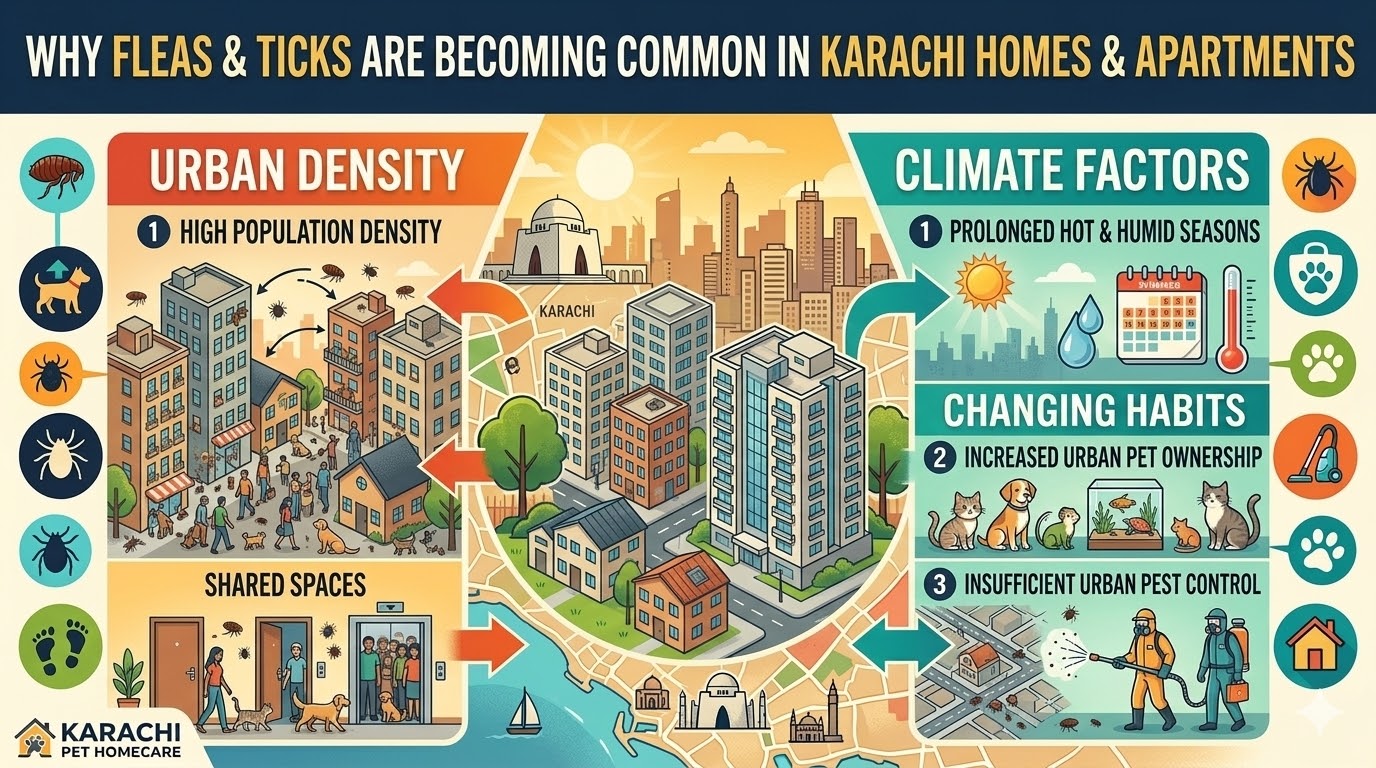
- Dense residential areas: Neighbourhoods like Gulshan-e-Iqbal, North Nazimabad, PECHS, Liaquatabad, and even upscale areas like DHA and Clifton have tightly packed homes with shared walls, gardens, and drainage — allowing pests to spread quickly between properties.
- Stray animal population: Karachi has one of the largest stray dog and cat populations in South Asia. These animals carry both fleas and ticks, acting as a constant re-infestation source for residential areas throughout the city.
- Outdoor lifestyle: Families in areas like Bahria Town, Scheme 33, and Gulistan-e-Johar with gardens or outdoor seating areas face heightened tick exposure during and after monsoon season when vegetation stays moist.
Fleas vs. Ticks: Side-by-Side Comparison
Use this quick reference to understand how the two pests differ across the factors that matter most for Karachi homeowners:
| Category | Fleas | Ticks |
| Size | Tiny — 1–3 mm, barely visible | Larger — 3–5 mm; engorged up to 1 cm |
| Speed of spread | Very fast — can infest a home in weeks | Slower but deeply embedded once inside |
| Karachi season risk | Year-round; peaks post-monsoon | Peak during and after monsoon (Jun–Sep) |
| Primary host | Dogs, cats, humans | Dogs, wildlife, humans |
| Disease risk (pets) | Tapeworms, FAD, anaemia | Babesiosis, Ehrlichiosis, tick paralysis |
| Disease risk (humans) | Bites, rare murine typhus | Spotted fever, Lyme (rare), toxin risk |
| Survives indoors? | Yes — eggs last 12+ months | Brown dog tick completes full cycle indoors |
| DIY treatment success | Low — misses 95% of lifecycle | Very low — hides deep in fabrics, crevices |
| Professional treatment | IGR + adulticide + follow-up | Targeted acaricide + environment treatment |
The Health Risks: Which One Can Actually Harm Your Family?
This is where the comparison gets serious. Both parasites pose genuine health risks — but in different ways, and with different levels of urgency.
The Health Risks of Fleas
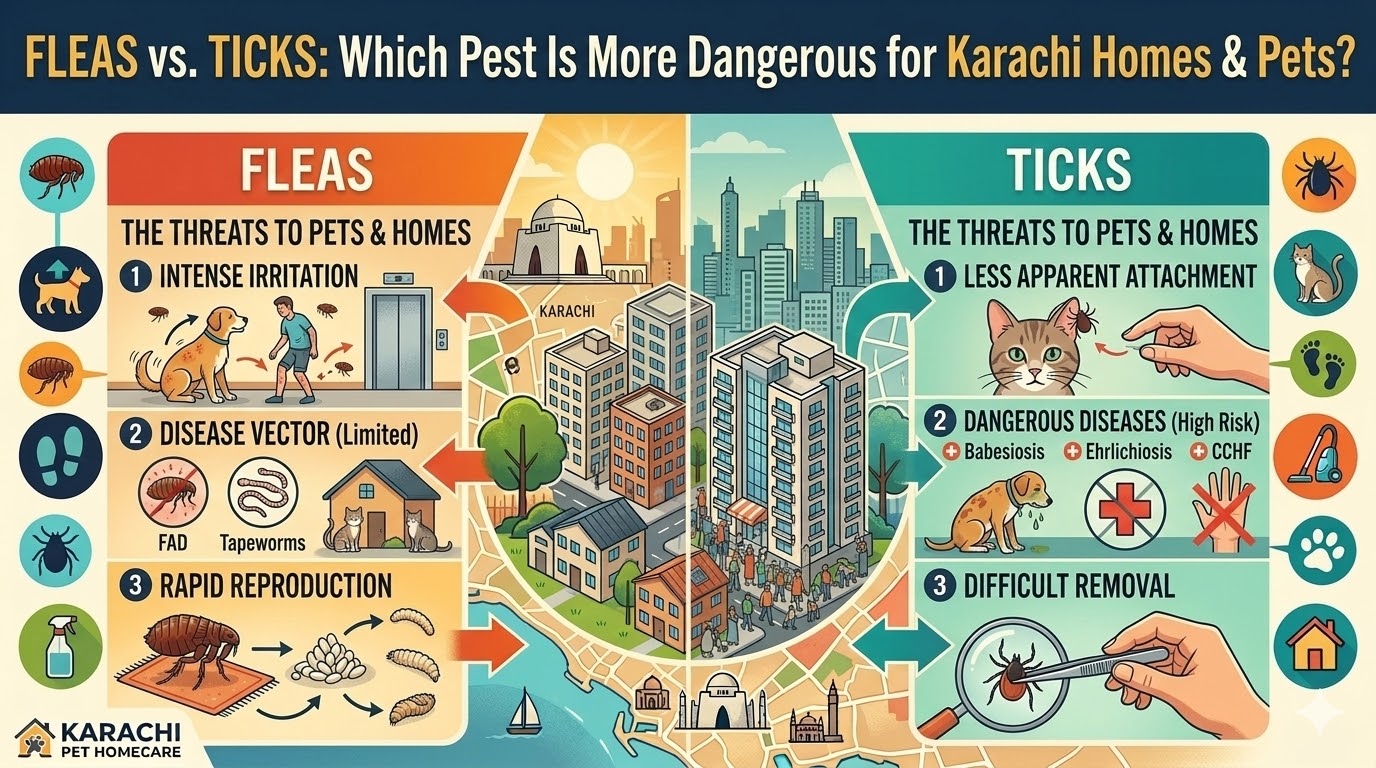
- Flea Allergy Dermatitis (FAD): The most common flea-related condition in Karachi pets. Even a single flea bite can trigger severe allergic reactions in sensitive dogs and cats — causing intense itching, hair loss, hot spots, and skin infections that require veterinary treatment.
- Tapeworm infection: Fleas serve as intermediate hosts for Dipylidium caninum — a tapeworm. Dogs, cats, and even young children can become infected by accidentally swallowing an infected flea. Children playing on infested carpets or floor cushions are at particular risk.
- Anaemia: In severe infestations — especially in puppies, kittens, or elderly pets — the sheer volume of blood loss from multiple daily flea bites can cause life-threatening anaemia.
- Murine Typhus: Caused by Rickettsia typhi bacteria transmitted by rat fleas. While not the most common scenario in residential homes, it has been documented in urban Pakistani environments and causes fever, headache, and rash in humans.
- Secondary skin infections: Relentless scratching of flea bites — in both pets and humans — breaks the skin and can lead to bacterial infections, particularly in children.
The Health Risks of Ticks
- Babesiosis: A serious tick-borne disease that destroys red blood cells in dogs. Common in Karachi’s pet population, it causes fever, pale gums, weakness, and can be fatal without rapid veterinary intervention. Reports of Babesiosis in Karachi dogs are well-documented among local vets.
- Ehrlichiosis: Caused by Ehrlichia bacteria transmitted by the Brown Dog Tick — the very species most prevalent in Karachi. Symptoms in dogs include fever, loss of appetite, bleeding disorders, and, in chronic cases, bone marrow suppression.
- Tick Paralysis: Certain female ticks secrete a neurotoxin while feeding that can cause progressive paralysis in dogs — and in rare cases, in children. Symptoms develop over days and resolve after the tick is removed, but it can be frightening and dangerous if not caught early.
- Rocky Mountain Spotted Fever (RMSF): Though primarily associated with the Americas, Rickettsia species transmitted by brown dog ticks have been documented in South Asian contexts. RMSF in humans causes high fever, severe headache, and a characteristic rash.
- Lyme Disease: Less common in Pakistan than in Europe or North America, but worth noting, particularly for Karachi families who travel internationally or whose pets have had contact with imported animals.
| ⚠️ Veterinary Alert: Karachi veterinarians consistently report tick-borne Babesiosis and Ehrlichiosis as among the most common serious illnesses they treat in dogs. If your dog develops a sudden fever, becomes lethargic, or stops eating — tick-borne disease should be your first suspicion. Act immediately. |
So Which Is Actually More Dangerous — Fleas or Ticks?
The answer depends on which risk dimension you prioritise:
For Sheer Speed and Scale of Infestation: Fleas Win
Fleas spread faster, reproduce faster, and are harder to fully eliminate than ticks. A flea infestation left untreated for 30 days can involve hundreds of thousands of eggs, larvae, and pupae embedded throughout your home. The scale of disruption — to your pets, your family’s comfort, and your home — is typically greater with fleas.
For Severity of Individual Disease Risk: Ticks Are More Dangerous
Tick-borne diseases like Babesiosis and Ehrlichiosis can kill a dog within days if untreated. Tick paralysis can cause sudden, frightening physical deterioration in pets and children. While flea-related illnesses are serious, the disease risk per bite from a tick — particularly the Brown Dog Tick prevalent in Karachi — is generally higher.
The Realistic Verdict for Karachi Homes
In practice, most Karachi households dealing with a pest problem are dealing with both simultaneously. A dog that picks up ticks on a walk through Bagh Ibn Qasim or encounters a stray in Gulshan almost certainly brings fleas back too. The two infestations reinforce each other, making combined treatment essential.
This is exactly why professional flea and tick control in Karachi is designed to address both parasites together — not as separate problems, but as a combined threat that must be eliminated systematically.
Where Fleas and Ticks Hide in Your Karachi Home
Effective treatment depends entirely on knowing where these pests actually are. Most homeowners treat only the surface — and that’s why DIY solutions consistently fail.
Where Fleas Hide
- Deep within carpet fibres and rugs — particularly thick-pile or wool carpets common in Karachi drawing rooms and bedrooms
- In the crevices and seams of sofas, mattresses, and upholstered furniture
- Under skirting boards, in floor cracks, and along baseboards
- In pet bedding, blankets, and cushions
- In soil and sand in garden areas — particularly post-monsoon
Where Ticks Hide
- In tall grass, shrubs, and vegetation — particularly relevant for Karachi homes with gardens or proximity to parks
- Behind their host’s ears, between toes, around the neck, and in the groin area — deeply attached
- In wall crevices, ceiling gaps, and around window and door frames — the Brown Dog Tick is particularly adept at hiding in structural gaps indoors
- In outdoor furniture, doormats, and any fabric items kept near entrances
| Did You Know? The Brown Dog Tick — Karachi’s most common indoor tick species — can survive up to 18 months without feeding. This means an empty, temporarily unoccupied property can still harbour an active tick infestation waiting for the next occupant. |
Warning Signs: How to Tell If You Have Fleas, Ticks, or Both
Signs You Have Fleas
- Your pet scratches constantly, especially around the base of the tail, neck, and belly
- You find tiny dark specks (“flea dirt” — digested blood) on your pet’s skin, in bedding, or on white sheets
- You notice itchy red bites in clusters on your ankles and lower legs
- Performing the white sock test: walk across your carpet in white socks — fleas will jump on and become visible
- You can see tiny fast-moving brown specks on light-coloured floor tiles or your pet’s coat
Signs You Have Ticks
- Finding ticks attached to your pet — often requiring a close inspection around the ears, neck, and between the toes
- Your pet develops a sudden fever, refuses food, or becomes unusually lethargic — possible signs of tick-borne disease
- Discovering engorged, seed-like insects on yourself or family members after spending time in grassy areas
- Finding brown, flat insects crawling slowly on walls, curtains, or around window frames
Signs You Have Both (Very Common in Karachi)
- Multiple pets showing different symptoms simultaneously
- Bites on human family members AND visible ticks on pets
- Visible flea dirt on bedding alongside ticks found on the dog after walks
Why Over-the-Counter Products Fail Against Both
Walk into any Karachi pet shop or pharmacy and you’ll find sprays, powders, collars, and shampoos promising to eliminate fleas and ticks. Here’s why they consistently fall short:
- They address adults only: Consumer sprays kill adult fleas on contact but cannot penetrate the flea pupa — which is sealed against chemical intrusion. The next generation emerges 7–14 days later and the cycle restarts
- They don’t treat the environment: Treating your pet without treating your home is like mopping a floor while the tap is still running. The 95% of the infestation in your carpets, sofas, and crevices continues to develop
- Tick collars give false security: While they reduce tick attachment, they do not eliminate ticks already present in your home or garden — particularly problematic with the indoor-adapted Brown Dog Tick
- No residual protection: In Karachi’s heat, consumer insecticides degrade quickly — providing protection for only a few days before becoming ineffective
- Resistance: Repeated use of the same over-the-counter products can contribute to resistance in local flea populations, making future infestations harder to control
The only solution that addresses both parasites completely — across all lifecycle stages, all hiding spots, and with residual protection — is professional flea and tick pest control in Karachi delivered by trained technicians using commercial-grade products and proven protocols.
How Unique Fumigation Treats Both Fleas and Ticks Simultaneously
Because fleas and ticks are so frequently found together, Unique Fumigation’s treatment protocol is designed as a combined, comprehensive intervention — not a separate product for each pest.
The Treatment Process
1. Free Home Inspection: We begin with a detailed assessment of your home, garden, and pets’ environments. We identify the species involved, the infestation level, and all active zones — indoors and out.
2. Indoor Treatment: We apply professional-grade Insect Growth Regulators (IGRs) combined with targeted adulticides and acaricides to every affected area — carpets, furniture seams, skirting boards, wall crevices, and beneath furniture. IGRs prevent flea eggs and larvae from reaching adulthood, breaking the lifecycle.
3. Outdoor & Garden Treatment: For Karachi homes with gardens or outdoor seating, we treat vegetation, soil, and outdoor resting areas where ticks shelter between hosts — a critical step that is almost always missed by DIY treatments.
4. Pet Coordination Advice: We work alongside your veterinarian’s pet treatment plan to ensure indoor treatment and on-animal treatment happen simultaneously — the only way to prevent immediate re-infestation.
5. Mandatory Follow-Up Visit: Due to the flea pupal stage, we schedule a second treatment 10–14 days later to eliminate any newly emerged adults before they can breed — ensuring the infestation is fully broken.
6. Post-Treatment Guidance: We provide specific, practical advice for your home’s layout, your pets’ routine, and the season — whether you’re heading into Karachi’s monsoon or the drier winter months.
| Safety Note: All products used by Unique Fumigation are WHO-approved and applied according to certified safety protocols. Post-treatment re-entry times are strictly communicated to ensure complete safety for children, pets, and elderly household members. |
Preventing Fleas and Ticks in Your Karachi Home: Practical Steps
For Pet Owners in Karachi
- Use vet-prescribed monthly flea and tick preventatives — topical spot-ons or oral chewables are far more effective than collars alone
- Inspect your dog thoroughly after every walk, especially in grassy areas like parks in PECHS, Defence, or Gulshan-e-Iqbal
- Never allow pets to interact with stray animals — a difficult but important boundary given Karachi’s large stray population
- Wash all pet bedding weekly in hot water above 60°C
For Your Home and Garden
- Vacuum carpets and upholstered furniture at least twice a week — immediately dispose of the vacuum bag or empty the canister outside
- Keep garden grass short and remove leaf litter and debris where ticks like to shelter
- Seal gaps under doors, around pipes, and along skirting boards to reduce entry points and indoor tick hiding spots
- Schedule professional preventative inspections before Karachi’s monsoon season (May–June) and after it (October–November) when infestation risks peak
Frequently Asked Questions
Can fleas and ticks infest a home without pets?
Yes — though pets dramatically increase the risk. Ticks can enter on clothing after outdoor exposure. Fleas can be introduced on second-hand furniture, carpets, or by moving into a previously pet-occupied property where dormant eggs are still present. Karachi’s stray animal problem also means fleas can enter via wildlife that accesses open gardens or rooftops.
Which is harder to get rid of — fleas or ticks?
Both are notoriously difficult to eliminate without professional treatment. Fleas are harder to fully eradicate because of the sheer scale of infestation and the insecticide-resistant pupal stage. Ticks are harder to locate and remove because they hide in structural gaps and on animals in hard-to-reach spots. Combined, they’re best addressed together by a professional pest control service.
My dog has been treated by the vet. Do I still need home treatment?
Absolutely yes. Treating your pet eliminates the adults on the animal — but has no effect on the hundreds or thousands of eggs, larvae, pupae, and unfed ticks already present in your home environment. Without environmental treatment, your pet will be re-infested within days of returning home from the vet.
Is Karachi’s monsoon season the worst time for fleas and ticks?
The monsoon itself is not the peak — it’s the period immediately after, typically October through November, when humidity remains high and the environment is still warm. This creates the optimal hatching and activity window. Many Karachi families first notice serious infestations in October, after the monsoon has ended.
How quickly can a combined flea and tick infestation be resolved professionally?
Most infestations are fully resolved within 3–4 weeks from the first professional treatment, including the mandatory follow-up visit. This timeline accounts for the flea pupal stage and ensures no new adults can establish a breeding population after treatment.
| Don’t Wait Until the Problem Gets Worse Whether you’re dealing with fleas, ticks, or both — the longer you wait, the larger and more expensive the infestation becomes. In Karachi’s climate, neither pest will disappear on its own. Unique Fumigation offers a FREE home inspection for Karachi residents. ✓ Certified pest control professionals ✓ WHO-approved treatments ✓ Guaranteed follow-up Book your free inspection at uniquefumigation.com/fleas-ticks-control-in-karachi — or call us today. |
Related reading: For a full guide on how flea and tick infestations start in Karachi homes and the step-by-step prevention strategies, explore our professional flea and tick control services in Karachi — covering everything from inspection to treatment to long-term protection.