If you share your home with a dog or cat in Karachi, there is one threat that lurks quietly in your sofas, carpets, and garden soil — fleas and ticks. Thanks to Karachi’s year-round heat and humidity (especially brutal from April through October), these parasites thrive and multiply at alarming speed. The bad news? Most pet owners only discover an infestation after it has already taken hold. The good news? If you know what to look for, you can act fast — before your family and pets pay a painful price.
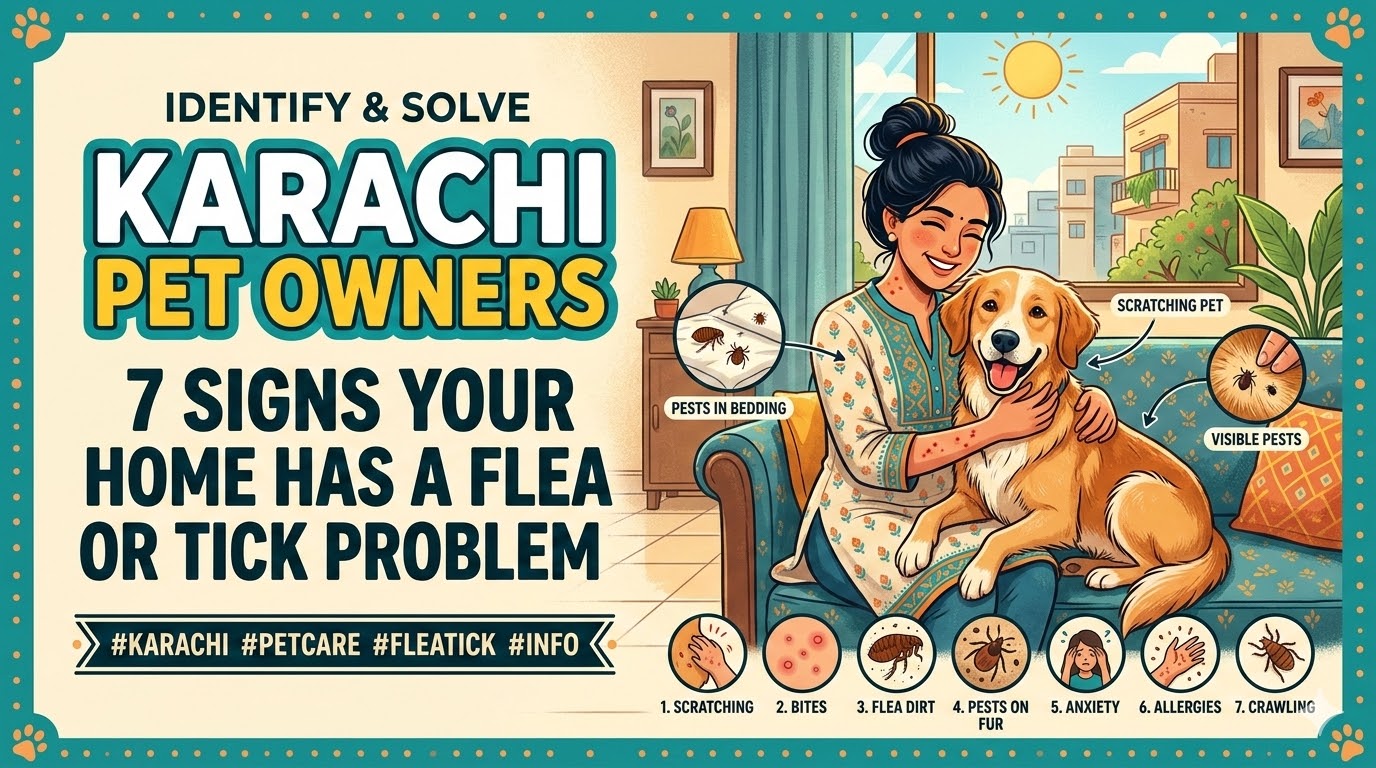
Below are the 7 clear warning signs that your Karachi home may already have a flea or tick problem — along with expert advice on what to do next.
Sign 1: Your Pet Is Scratching Constantly — Even After a Bath
The most obvious red flag is a pet that cannot stop scratching, biting, or licking itself — particularly around the neck, base of the tail, inner thighs, and belly. While occasional scratching is normal, relentless scratching that continues even after a recent bath strongly suggests fleas are feeding on your pet.
Fleas inject saliva when they bite, triggering an allergic reaction called Flea Allergy Dermatitis (FAD). In humid Karachi neighbourhoods like North Nazimabad, Gulshan-e-Iqbal, and DHA, pets are exposed to fleas year-round — there is no cold winter to break the cycle.
What to do: Part your pet’s fur and look for tiny brown dots (fleas) or black pepper-like specks on the skin (flea dirt — actually digested blood). Even finding one flea means hundreds more are likely in your home.
Sign 2: You Spot Small, Fast-Moving Insects on Your Furniture or Floors
Fleas are tiny — about 1–3 mm — but visible to the naked eye if you look carefully. They are reddish-brown, wingless, and move with incredibly fast lateral jumps. If you notice small insects darting across your light-coloured sofa, bedsheet, or tiled floor, do not dismiss them as dust particles.
A reliable test: place a white paper or plate on the floor and leave it overnight. Fleas are attracted to warmth and CO₂; in the morning, you may find them on the paper. In Karachi homes with marble or ceramic floors, fleas can be spotted more easily near rugs, pet bedding, and corners.
Tick identification is different: ticks are larger, slow-moving, and often attach firmly to skin or fabric. You may find them behind your dog’s ears, between the toes, or embedded in your garden furniture.
Sign 3: You or Your Family Members Are Getting Mysterious Bites
Fleas do not restrict themselves to pets. When an infestation grows, they begin biting humans — and their bites are distinctly unpleasant. Look for:
Small, red, intensely itchy bites, often in clusters of 2–3
Bites concentrated around the ankles, shins, and lower legs (where fleas jump to from the floor)
Bites that appear in the morning after sleeping in an infested bedroom
In Karachi’s densely-populated housing societies, where families often live in close quarters and pets roam multiple rooms, flea bites on family members — especially children — are a serious warning sign that demands immediate attention. Do not assume these are mosquito bites without investigating further.
Sign 4: ‘Flea Dirt’ Appears on Your Pet’s Bedding or Your Carpets
‘Flea dirt’ is a polite term for flea faeces — and finding it is a near-certain confirmation of infestation. It looks like tiny black or dark brown specks, resembling ground pepper or coffee granules, scattered on pet bedding, carpets, sofa cushions, or even your pet’s fur.
To confirm it is flea dirt and not regular dust: place the specks on a wet piece of white tissue. If they dissolve and turn reddish-brown (because they contain digested blood), you have flea dirt — and therefore fleas.
This is one of the most reliable early indicators. Many Karachi homeowners notice this on their durries (floor rugs) or in corners of rooms where pets rest. If you find flea dirt, it is time to seek professional flea and tick control in Karachi before the population explodes.
Sign 5: Your Pet Is Losing Hair, Has Red Skin, or Developing Scabs
Prolonged flea infestation causes serious dermatological damage to your pet. Repeated biting and your pet’s own scratching response can lead to:
Patchy hair loss (alopecia), especially around the lower back and tail base
Hot, red, inflamed skin — sometimes raw and moist (known as ‘hot spots’)
Scabs and crusting from broken skin
Secondary bacterial or fungal infections in open wounds
In Karachi’s heat, open wounds on a pet can quickly become infected. A dog or cat showing these symptoms needs both veterinary treatment AND a home pest inspection — treating only the pet without eliminating the infestation from the environment means re-infestation is almost certain.
Sign 6: You Find Ticks Attached to Your Pet — or Yourself
Ticks are particularly prevalent in Karachi’s outer areas — Defence Housing Authority’s older sectors, Scheme 33, Gadap Town, and homes with gardens or access to open land. They wait on tall grass and shrubs, and attach to warm-blooded hosts when they brush past.
Unlike fleas, ticks embed themselves and feed for hours or days. Check your pet’s body regularly — pay special attention to:
Inside and behind the ears
Between the toes and paw pads
Under the collar and armpits
Around the tail and groin area
Finding even one tick on your pet is a red alert. Ticks transmit serious diseases including Ehrlichiosis and Babesiosis in dogs, and Lyme disease (less common but present) in humans. If ticks are present on your pet, they are almost certainly in your garden and potentially inside your home.
A thorough professional tick control treatment in Karachi is the most effective way to eliminate them from both your pet’s environment and your outdoor spaces.
Sign 7: Your Pet Is Unusually Lethargic or Has Developed Anaemia
This is the sign most homeowners do not associate with fleas — but it is one of the most serious. A heavy flea infestation on a small dog, a puppy, or a kitten can cause significant blood loss, leading to anaemia. Signs include:
Pale gums (check by lifting your pet’s lip — healthy gums should be pink)
Unusual fatigue and weakness — your pet sleeps far more than usual
Reduced appetite
Rapid breathing or heart rate
Flea-induced anaemia is a medical emergency, particularly in young or small animals. If your pet is showing these signs alongside any of the other signs above, contact a veterinarian immediately — and simultaneously schedule a professional pest inspection of your home.
This level of infestation means fleas have been present and multiplying in your home for weeks or months. Over-the-counter sprays will not be enough. You need a comprehensive, professionally executed flea and tick extermination service in Karachi that treats your home, pet resting areas, and garden systematically.
Why Karachi Homes Are Especially Vulnerable
Karachi’s climate is almost ideal for flea and tick reproduction. Here is why:
Year-round warmth (rarely below 15°C): Fleas breed fastest between 21°C and 30°C — exactly Karachi’s average temperature for most of the year
Humidity during monsoon (July–September): Relative humidity of 70–90% accelerates flea egg hatching and larval development in carpets and sofa fabric
Outdoor lifestyle of pets: Many Karachi dogs accompany owners on morning walks at Clifton Beach, Hill Park, or in Askari neighbourhoods — all areas where tick exposure is common
Construction and open plots: Karachi’s rapidly developing areas mean many homes border vacant land, which is prime tick habitat
Multi-pet households and communal park visits: Pets socialising in parks like Burns Garden or Bagh Ibn-e-Qasim can easily bring fleas home from other infested animals
This unique combination of factors means flea and tick problems can escalate from minor to severe within just a few weeks in a typical Karachi household.
What You Should Do If You Spot These Signs
If you recognise two or more of the signs above, here is an immediate action plan:
Consult your vet and get your pet treated with a flea/tick prevention product (collar, spot-on, or oral medication)
Wash all pet bedding and fabric covers at 60°C or higher
Vacuum all carpets, sofas, and rugs thoroughly — then seal and discard the vacuum bag immediately
Do NOT use household flea sprays unsupervised near pets, children, or food preparation areas
Book a professional inspection — DIY measures alone rarely eliminate an established infestation
The reality is that for every flea you see on your pet, there are likely 100 more in various life stages (eggs, larvae, pupae) hidden in your home environment. Only a targeted, professional treatment breaks the entire life cycle.
📞 Book Your Free Inspection with Unique Fumigation
Do not wait until the problem becomes unmanageable. Unique Fumigation is Karachi’s trusted name in professional pest control, with specialist expertise in flea and tick control across all Karachi areas — from DHA and Clifton to Gulshan, PECHS, Johar Town, and beyond.
Our trained technicians conduct a thorough home inspection to assess the extent of infestation, identify hotspots, and recommend a customised treatment plan that is safe for your family and pets. We use WHO-approved chemicals with proven efficacy against all life stages of fleas and ticks.
Call us today or visit uniquefumigation.com to schedule your free home inspection. Protect your pets, your family, and your peace of mind — before the problem goes any further.
Tags: flea control Karachi, tick control Karachi, pet pest control, home fumigation Karachi, flea infestation signs, Unique Fumigation
If you’ve noticed your dog scratching more than usual, found mysterious bites on your ankles, or spotted tiny fast-moving specks on your furniture — your Karachi home may already have a flea or tick problem. And if you’re thinking “it’ll go away on its own” — it won’t. Without professional intervention, these infestations grow fast, spread through every room, and put your entire household at risk.
In this guide, we break down exactly how flea and tick infestations take hold in Karachi’s unique environment, what warning signs to watch for, and — most importantly — how to eliminate them for good.
Why Karachi Homes Are a Hotspot for Fleas and Ticks
Karachi’s climate is one of the biggest reasons why flea and tick infestations are so common here. With temperatures averaging 27–35°C throughout most of the year and humidity levels that spike significantly during the monsoon season (June–September), the city creates near-ideal breeding conditions for these parasites.
Fleas thrive at temperatures between 21°C and 32°C. Ticks can remain active year-round in Karachi’s mild winters. Unlike colder cities where harsh winters kill off pest populations, Karachi’s warmth keeps them breeding continuously.
Key Local Factors That Drive Infestations
Dense residential areas: DHA, Gulshan-e-Iqbal, North Nazimabad, and Clifton — with their tightly packed homes and shared boundary walls — allow pests to travel quickly between properties.
Stray animal populations: Karachi’s large stray cat and dog population acts as a constant reservoir for fleas and ticks. A single encounter between your pet and a stray is enough to bring an infestation indoors.
Grassy and green areas: Parks in areas like PECHS, Gulistan-e-Johar, and Bahria Town are common tick habitats, especially during and after the monsoon when vegetation stays moist.
Second-hand items and carpets: Fleas can survive in dormant egg and pupa stages for months. Purchasing second-hand rugs, sofas, or even moving into a previously occupied home can introduce an infestation instantly.
How a Flea or Tick Infestation Typically Starts in a Karachi Home
Most Karachi homeowners are surprised to learn that infestations rarely start with a large-scale invasion. They creep in quietly — and by the time you notice them, they’re already established.
The Most Common Entry Points
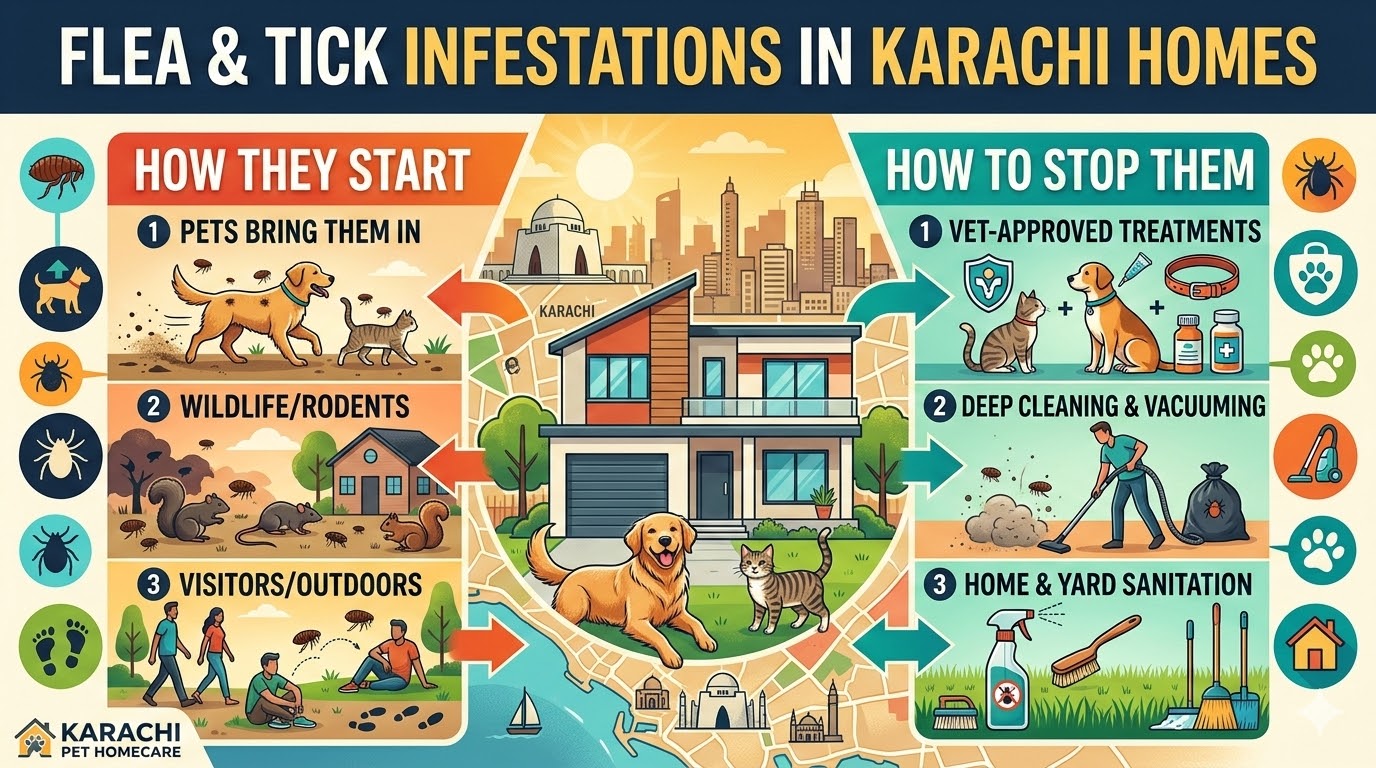
1. Your pets: The number one entry route. Dogs and cats that go outdoors — even briefly — can pick up dozens of fleas or ticks in a single outing. These parasites then fall off inside your home, where they find dark corners, carpeting, and bedding to breed in.
2. Visiting animals: A neighbour’s pet, a stray that wandered into your garden, or a relative’s dog visiting for Eid can leave eggs behind without anyone realising.
3. Clothing and shoes: Ticks are hitchhikers. Walking through tall grass or sitting in a public park in areas like Sea View or Bagh Ibn Qasim can result in ticks attaching to your clothing and entering your home on you.
4. Infested goods: Flea eggs in dormant stages can survive in second-hand furniture, fabric items, or even in the corners of a rented property where the previous tenants had pets.
The Lifecycle That Makes Infestations So Hard to Break
Understanding the flea lifecycle is critical. Adult fleas — the ones you see — represent only about 5% of the total infestation. The remaining 95% consists of eggs, larvae, and pupae hidden in carpets, upholstery, and floor cracks.
This is why DIY sprays and flea collars rarely work. You kill the adults, but the eggs hatch weeks later and the cycle restarts. The pupal stage is particularly stubborn — it’s resistant to most insecticides and can remain dormant for up to 12 months, waiting for vibrations or warmth that signal a host is nearby.
Quick Fact: A single female flea can lay up to 50 eggs per day. In just one month, a pair of fleas can produce a population of over 20,000 eggs, larvae, and pupae in your home.
Warning Signs: Is Your Karachi Home Already Infested?
Because infestations often build silently before becoming visible, knowing the early warning signs is essential. The sooner you act, the easier — and less expensive — the treatment.
Signs of a Flea Infestation
Your pet is scratching, biting at its skin, or losing patches of fur — especially around the base of the tail and neck
You notice small, dark specs (“flea dirt” — actually flea faeces) on your pet’s coat, bedding, or white sheets
You find itchy, clustered bites on your lower legs and ankles, often in a line or group of three
Tiny, fast-moving brown specks are visible on light-coloured surfaces like floor tiles or your pet’s white fur
The “white sock test”: walk across your carpet in white socks — fleas will jump onto them and become visible
Signs of a Tick Infestation
Finding ticks attached to your pet — particularly around the ears, between toes, and on the neck
Discovering engorged ticks on yourself after spending time in grassy or garden areas
Your pet appearing lethargic, off food, or developing unexplained fever — possible signs of tick-borne illness
Spotting brown or reddish-brown seed-like insects crawling on walls, upholstery, or curtains
The Health Risks You Cannot Afford to Ignore
Many Karachi families underestimate flea and tick infestations as a mere nuisance. The reality is far more serious.
Flea-Related Health Risks
Flea Allergy Dermatitis (FAD): Extremely common in dogs and cats, causing intense itching, hair loss, and skin infections
Tapeworms: Fleas are intermediate hosts for tapeworm larvae. Children who accidentally ingest an infected flea — which can happen during play — can develop tapeworm infections
Anaemia: In severe infestations, particularly in puppies and kittens, blood loss from flea bites can lead to life-threatening anaemia
Human skin reactions: Flea bites cause intense itching, and scratching can lead to secondary bacterial skin infections
Tick-Related Health Risks
Babesiosis and Ehrlichiosis: Tick-borne diseases that affect dogs and can cause fever, anaemia, and organ failure if untreated
Rocky Mountain Spotted Fever (RMSF): While rare in Pakistan, it has been documented and can be severe in humans
Lyme Disease: Though more common in Europe and North America, the risk should not be entirely dismissed
Tick Paralysis: Certain ticks secrete toxins that can cause temporary paralysis in pets and, in rare cases, humans
⚠️ Important: If you notice unusual symptoms in your pet — particularly fever, loss of appetite, or joint pain — consult a veterinarian immediately and mention the possibility of tick exposure.
Why DIY Solutions Fail (And What You’re Up Against)
The Karachi market is flooded with flea sprays, tick collars, anti-flea shampoos, and home remedies like neem oil and garlic. While some offer temporary relief, none of them solve the core problem — and here’s why:
Flea eggs and pupae are insecticide-resistant: Over-the-counter sprays kill adults on contact but cannot penetrate the protective pupal casing. The infestation restarts within 2–4 weeks
Incomplete treatment: DIY treatments typically address the pet but not the environment — leaving thousands of eggs in your carpets, sofa, and floorboards
No residual protection: Consumer products wear off quickly in Karachi’s heat and humidity, leaving your home vulnerable again almost immediately
Missing hidden zones: Professional pest controllers know where fleas and ticks hide — under baseboards, inside wall voids, in garden soil. These are places a home spray never reaches
This is why professional flea and tick control in Karachi is the only solution that actually breaks the entire lifecycle — treating both your home and the source of re-infestation systematically.
The Professional Approach: How Unique Fumigation Tackles Flea & Tick Infestations
At Unique Fumigation, we’ve been treating flea and tick infestations across Karachi for years. We understand the local conditions — the monsoon season spikes, the stray animal problem, the densely populated residential areas — and we design our treatment protocols accordingly.
Our Integrated Treatment Process
Step 1 — Free Inspection: Our trained technicians assess the level of infestation, identify the entry points, and map all problem zones in your home — including your garden, outdoor areas, and any pets on the premises.
Step 2 — Indoor Treatment: We apply professional-grade Insect Growth Regulators (IGRs) combined with adulticide treatments to kill adults and prevent eggs and larvae from maturing. This breaks the lifecycle at every stage.
Step 3 — Outdoor & Garden Treatment: Particularly relevant for Karachi homes with gardens or yards, we treat outdoor areas where ticks and fleas shelter between hosts.
Step 4 — Follow-Up Visit: Because of the pupal stage, a second treatment is scheduled 7–14 days after the first to eliminate any newly hatched adults before they can reproduce.
Step 5 — Prevention Guidance: We advise you on pet treatment coordination, post-service hygiene, and how to reduce the risk of re-infestation — specific to your home’s layout and lifestyle.
All products used by Unique Fumigation are safe for children and pets when applied by certified professionals. We use WHO-approved formulations appropriate for residential environments.
Preventing Future Infestations: What Karachi Homeowners Can Do
After professional treatment, maintaining a flea and tick-free home requires consistent habits. Here’s what works in Karachi’s environment:
For Pet Owners
Use veterinarian-prescribed monthly flea and tick preventatives (topical treatments or oral tablets) — not just collars
Check your pet thoroughly after walks, especially in grassy areas like parks in Gulshan or Defence
Wash pet bedding weekly in hot water (above 60°C)
Avoid letting pets interact with strays — a challenge in Karachi, but important
For Your Home
Vacuum carpets, rugs, and upholstery at least twice a week and empty the vacuum immediately outside
Wash bedding, curtains, and fabric covers regularly, especially during and after monsoon season
Keep grass and garden vegetation trimmed short — ticks love tall, damp grass
Seal gaps under doors and around plumbing entry points to reduce wildlife and stray animal access
Schedule a professional inspection every 6 months, particularly before and after Karachi’s monsoon season
Know When to Call the Professionals
If you see any of the warning signs listed above, or if you’ve tried over-the-counter products without success — don’t wait. The longer a flea or tick infestation is left untreated, the larger and more difficult it becomes to resolve. Early professional intervention saves time, money, and a great deal of discomfort for your family and pets.
Karachi families dealing with recurring infestations often find that professional flea and tick control services in Karachi are the only reliable solution, particularly for homes with pets, gardens, or proximity to common stray animal routes.
Frequently Asked Questions
How quickly can a flea infestation spread through a Karachi home?
Extremely quickly. In Karachi’s warm climate, flea eggs can hatch in as little as 2 days, and a new generation of adults can emerge in as few as 14 days. A small infestation involving a handful of fleas can become a serious problem within 3–4 weeks.
Are ticks common inside homes or only in gardens?
Ticks are primarily outdoor parasites, but in Karachi they frequently enter homes via pets or clothing. Brown dog ticks (Rhipicephalus sanguineus) — the most common species found in Karachi — are well adapted to indoor environments and can complete their entire lifecycle inside a home.
Can I treat the infestation myself after buying a pet flea treatment?
Treating only your pet addresses just 5% of the infestation. The remaining 95% — eggs, larvae, and pupae in your environment — will continue the cycle. Effective treatment must address both your pet and your home simultaneously. For established infestations, professional treatment is strongly recommended.
How long does professional flea and tick treatment take?
The initial treatment typically takes 1–2 hours depending on the size of your property. A follow-up visit is required after 7–14 days. Most infestations are fully resolved within 3–4 weeks from the first treatment.
Is the treatment safe for my children and pets?
Yes, when carried out by trained professionals using appropriate products. Unique Fumigation uses WHO-approved formulations and provides specific guidance on re-entry times and post-treatment precautions to ensure the complete safety of your household.
Don’t Let a Flea or Tick Infestation Take Over Your Home — Act Now
A flea or tick infestation doesn’t resolve itself. In Karachi’s climate, it only grows. Every day you wait, more eggs hatch, more hiding spots are colonised, and the problem becomes harder and more expensive to treat.
Unique Fumigation has helped hundreds of Karachi families — from DHA and Clifton to Gulshan and North Nazimabad — completely eliminate flea and tick infestations and protect their homes from future outbreaks.
📞 Book Your FREE Inspection Today Contact Unique Fumigation now to book a no-obligation, free home inspection. Our team will assess your infestation, provide an honest evaluation, and recommend the most effective treatment plan for your specific situation. ✅ Certified pest control professionals ✅ Safe, WHO-approved treatments ✅ Guaranteed follow-up service Visit uniquefumigation.com/fleas-ticks-control-in-karachi or call us today. Karachi’s pest-free homes start here.
Related Services: Alongside professional flea and tick control in Karachi, Unique Fumigation offers comprehensive pest management services for cockroaches, bed bugs, rodents, termites, and more across all areas of Karachi.
Something is changing in Karachi’s homes — and many residents are only noticing it after a trip to the vet or an unexplained rash on their child’s ankle. Reports of flea and tick infestations in Karachi houses and apartment buildings have risen sharply over the past several years, affecting pet owners and non-pet owners alike. This is not a coincidence. A convergence of environmental, urban, and behavioural factors unique to Karachi is quietly turning our homes into ideal breeding grounds for these blood-feeding parasites.
If you have noticed your pet scratching more than usual, found unfamiliar bites on your skin, or spotted tiny insects on your carpets or sofas, this article will explain exactly why this is happening — and what you can do before a manageable problem becomes a serious infestation.
1. Karachi’s Climate Is a Paradise for Fleas and Ticks
The single biggest driver behind rising flea and tick cases in Karachi is the city’s climate. Fleas reproduce most aggressively between 21°C and 30°C, with relative humidity above 50%. Karachi sits comfortably in that range for most of the year — and during the monsoon season (July to September), when humidity regularly climbs above 80%, flea eggs hatch faster and larvae develop into adults in as little as two to three weeks.
Unlike cities in northern Pakistan — Lahore, Islamabad, or Peshawar — where cold winters kill off a significant portion of the flea population, Karachi’s mild winters (rarely below 15°C) provide no such natural reset. This means flea populations that establish themselves in your home in March can still be thriving in December, growing with every generation.
Ticks are equally well-adapted to Karachi’s coastal conditions. The combination of warmth, moisture from sea air, and abundant greenery in areas like DHA’s older phases, Clifton, and the outskirts near Gadap Town create ideal tick habitat — tall grass, leaf litter, and shrub-covered plots where ticks wait for a passing host.
2. Rapid Urban Development Is Disrupting Wildlife Habitats
Karachi is one of the fastest-growing megacities in the world, with new housing schemes, apartment towers, and commercial developments rising across Scheme 33, Bahria Town Karachi, Saadi Town, and dozens of other areas. This rapid construction is having an unintended consequence: it is pushing wildlife — including small rodents, stray cats, pigeons, and other flea and tick hosts — directly into established residential neighbourhoods.
When the land around a new housing society is cleared, the animals that lived there do not simply disappear. Rats, bandicoots, and feral cats relocate to the nearest available habitat — which is often the gardens, boundary walls, drains, and utility spaces of adjacent homes. These animals carry fleas and ticks with them. Once inside a residential area, fleas drop off these hosts and begin infesting the environment, including gardens, ground-floor apartments, and any home with gaps in its perimeter.
Residents of newer societies in areas like Gulistan-e-Jauhar’s newer blocks, Surjani Town, or the Malir development corridor are disproportionately affected by this phenomenon — but the effect radiates into older, established neighbourhoods too.
3. The Rise of Pet Ownership in Karachi — Without Matching Awareness
Pet ownership in Karachi has grown enormously over the past decade. Dogs and cats are now common in apartments in Clifton, Gulshan-e-Iqbal, PECHS, and DHA — areas where keeping pets was far less common a generation ago. This is a positive cultural shift. But it has also introduced a significant, underappreciated public health challenge.
Many new pet owners in Karachi are not aware of the basics of flea and tick prevention. Year-round preventive treatments (monthly spot-on products, oral medications, or flea collars) are still not widely practised. Pets that visit parks like Hill Park, Bagh Ibn-e-Qasim, or Frere Hall’s lawns, socialise with other animals, or are walked along footpaths with grass verges are routinely exposed to fleas and ticks — and bring them home.
Groomers and veterinary clinics in Karachi increasingly report seeing dogs with severe tick burdens and cats with flea infestations that have clearly been ongoing for weeks or months without the owner’s knowledge. In many cases, the pet has been treated — but the home has not, guaranteeing re-infestation within days.
This is one reason why professional flea and tick control for Karachi homes must treat the environment — carpets, soft furnishings, pet bedding, and garden areas — not just the animal.
4. Apartment Living Creates Hidden Infestation Pathways
A growing share of Karachi’s population now lives in apartment buildings — and multi-storey living creates infestation dynamics that many residents do not expect. Fleas and ticks can spread between apartments through:
Shared corridors and staircases — fleas dropped from an infested pet on the second floor can be picked up by a resident on the third
Utility ducts and cable conduits — small enough for fleas in larval or pupal form to migrate between units
Visitors and their pets — a single infested guest dog can seed an entire apartment building
Second-hand furniture — sofas, rugs, and mattresses purchased from markets like Empress Market or through online classifieds can carry dormant flea pupae that hatch weeks after entering your home
Unlike a standalone house where the source of infestation can usually be identified and isolated, an apartment infestation may be constantly refreshed from an adjoining unit or shared common area. This is why building-level treatment — coordinated across multiple apartments simultaneously — is sometimes necessary for complete resolution.
5. Stray Animal Populations Are at Historic Highs
Karachi has one of the highest densities of stray dogs and cats of any major city in Asia. Despite ongoing municipal efforts, the stray population remains enormous — and strays are the primary reservoir for fleas and ticks in urban environments. Every stray animal that passes through your street, enters your compound, or shelters near your building’s exterior is a potential source of infestation.
Ground-floor apartments and homes with gardens or boundary walls that adjoin open plots are particularly vulnerable. Fleas can jump up to 33 centimetres vertically — easily clearing a door gap, a threshold, or a low window ledge. They do not need direct contact with your pet or family members to enter your home; they simply need proximity.
In older Karachi neighbourhoods like Lyari, Saddar, Liaquatabad, and parts of Korangi, where stray populations are densest and older housing stock has more structural gaps, flea ingress from the external environment is a near-constant challenge — regardless of whether residents own pets.
6. Do-It-Yourself Treatments Are Not Solving the Problem
Walk into any supermarket or pharmacy in Karachi and you will find shelves of flea sprays, pet shampoos, and cheap flea collars. These products give homeowners a sense of control — but they address only the surface of a flea infestation, not its root.
Here is what most people do not know: at any given time, only about 5% of an established flea infestation consists of adult fleas on the host animal. The remaining 95% — eggs, larvae, and pupae — are hidden in your carpets, sofa fabric, mattress seams, skirting board gaps, and garden soil. Standard consumer sprays kill adult fleas on contact, but do not penetrate into carpet fibres or neutralise pupae, which are encased in a cocoon resistant to most insecticides.
The result: homeowners spray, see improvement for a week or two as adult fleas die, and then experience a resurgence as the next generation hatches. This cycle can repeat for months, causing frustration and significant wasted expense — while the infestation continues to grow.
Professional tick and flea extermination services in Karachi use a combination of adulticides, insect growth regulators (IGRs), and environmental treatments that break the flea life cycle at every stage — something no consumer product achieves.
7. Climate Change Is Extending Tick Season
Karachi has experienced measurable changes in temperature and weather patterns over the past two decades. The city’s pre-monsoon heat now starts earlier and lasts longer, and post-monsoon cooling is delayed. For tick populations, this means a longer active season and faster generational turnover.
Tick species that were historically confined to Karachi’s outskirts and rural periphery — areas bordering Balochistan and Sindh’s agricultural zones — are increasingly being found in urban neighbourhoods. The brown dog tick (Rhipicephalus sanguineus), the most common tick species in Karachi homes, is now a year-round threat in most of the city rather than a seasonal one.
This matters because ticks transmit serious diseases. Canine ehrlichiosis and babesiosis are regularly diagnosed by Karachi veterinarians, and there is growing awareness of tick-borne fevers in humans — though these are often misdiagnosed as dengue or a viral fever given the symptom overlap.
What This Means for Karachi Homeowners Right Now
The combination of these factors — climate, urbanisation, growing pet ownership, stray animal density, ineffective DIY products, and climate change — means that fleas and ticks are not a problem that will resolve on its own. Without deliberate action, a minor infestation becomes a major one within weeks.
The key insight is this: you do not need to have a pet to have a flea problem. Karachi homeowners without any pets are increasingly discovering flea infestations through bites on family members, flea sightings on floors, and even flea dirt in apparently clean rooms. The external environment — your building’s exterior, adjacent plots, visiting guests, second-hand items — is all it takes.
And once established, a flea infestation in a Karachi home will not clear itself. The warm, humid environment keeps it going indefinitely. Professional intervention is not a luxury — it is the only reliable solution.
Practical Steps Every Karachi Homeowner Should Take
Keep pets on year-round veterinarian-recommended flea and tick prevention (monthly spot-on or oral treatments)
Inspect your pet after every outdoor walk or visit to a park, garden, or groomer
Wash pet bedding weekly at 60°C or higher
Vacuum carpets, sofas, and rugs weekly — and discard the vacuum bag sealed outside your home immediately after
Avoid purchasing second-hand upholstered furniture or rugs without thorough inspection
Seal gaps around doors, windows, and utility entries at ground floor level
Keep garden grass trimmed short and remove leaf litter from compound corners
Schedule a professional inspection at the first sign of a problem — do not wait
📞 Book Your Free Home Inspection — Before It Gets Worse
Unique Fumigation is Karachi’s most trusted name in professional pest control. Our specialists understand the specific conditions — neighbourhood by neighbourhood, building type by building type — that drive flea and tick infestations in this city. We have helped hundreds of families in DHA, Gulshan-e-Iqbal, Clifton, North Nazimabad, PECHS, Johar Town, and across Karachi reclaim their homes from these persistent parasites.
We offer a completely free home inspection to assess your infestation risk, identify active problem areas, and provide an honest, no-obligation treatment recommendation. Our treatments use WHO-approved formulations that are effective against all life stages of fleas and ticks — and safe for children and pets when applied by our trained technicians.
Don’t let Karachi’s climate work against you. Take control now with professional flea and tick treatment in Karachi from Unique Fumigation — and get lasting relief, not just temporary results.
Visit uniquefumigation.com or call us today to schedule your free inspection. Because in Karachi’s climate, waiting only makes it worse.
Tags: flea control Karachi, tick control Karachi, pest control Karachi apartments, flea infestation causes, tick prevention Karachi, Unique Fumigation Karachi
If you’ve spotted unusual bites on your child’s legs, noticed your dog scratching relentlessly, or found a tiny crawling insect on your sofa — you’re likely dealing with either fleas or ticks. Both are common in Karachi. Both can make your family and pets seriously unwell. But they’re very different parasites, they spread differently, they hide in different places, and they require different approaches to eliminate.
So which one is the bigger threat? The answer might surprise you — and understanding both is the first step to protecting your home effectively.
This guide gives you a clear, honest comparison of fleas and ticks in the context of Karachi’s unique environment: the climate, the stray animal problem, the monsoon season, and the risks specific to our city’s residential areas.
Understanding the Two Pests: What You’re Actually Dealing With
What Are Fleas?
Fleas are tiny, wingless, blood-sucking insects — typically 1 to 3 mm in length, dark brown, and almost impossible to spot until they jump. They move by leaping (up to 33 cm in a single jump — extraordinary for their size) and reproduce at a staggering rate. A single female flea can lay up to 50 eggs per day.
In Karachi, the most common species is Ctenocephalides felis (the cat flea) — despite its name, it infests dogs, cats, and humans equally. These fleas are year-round residents of Karachi homes, but populations spike dramatically after the monsoon season due to increased humidity.
What Are Ticks?
Ticks are not insects — they’re arachnids, closely related to spiders and mites. They’re generally larger than fleas (3–5 mm unfed; up to 1 cm when engorged with blood), slow-moving, and they attach firmly to their host to feed, sometimes for several days at a time.
The most relevant species in Karachi is Rhipicephalus sanguineus — the Brown Dog Tick. Unlike most tick species that prefer outdoor environments, the Brown Dog Tick has adapted to complete its entire lifecycle indoors. This makes it uniquely dangerous for urban Karachi homes.
How Karachi’s Environment Amplifies Both Threats
Most pest comparisons are written for temperate climates. Karachi is different — and both fleas and ticks exploit our city’s specific conditions to thrive:
Year-round warmth: Karachi rarely drops below 15°C even in January. Both fleas and ticks remain active throughout the year, with no cold season to suppress populations.
Monsoon humidity: The June–September monsoon season creates the near-perfect warm and humid conditions that accelerate flea egg hatching and tick activity. Post-monsoon months (October–November) typically see the sharpest spikes in infestation reports.
Dense residential areas: Neighbourhoods like Gulshan-e-Iqbal, North Nazimabad, PECHS, Liaquatabad, and even upscale areas like DHA and Clifton have tightly packed homes with shared walls, gardens, and drainage — allowing pests to spread quickly between properties.
Stray animal population: Karachi has one of the largest stray dog and cat populations in South Asia. These animals carry both fleas and ticks, acting as a constant re-infestation source for residential areas throughout the city.
Outdoor lifestyle: Families in areas like Bahria Town, Scheme 33, and Gulistan-e-Johar with gardens or outdoor seating areas face heightened tick exposure during and after monsoon season when vegetation stays moist.
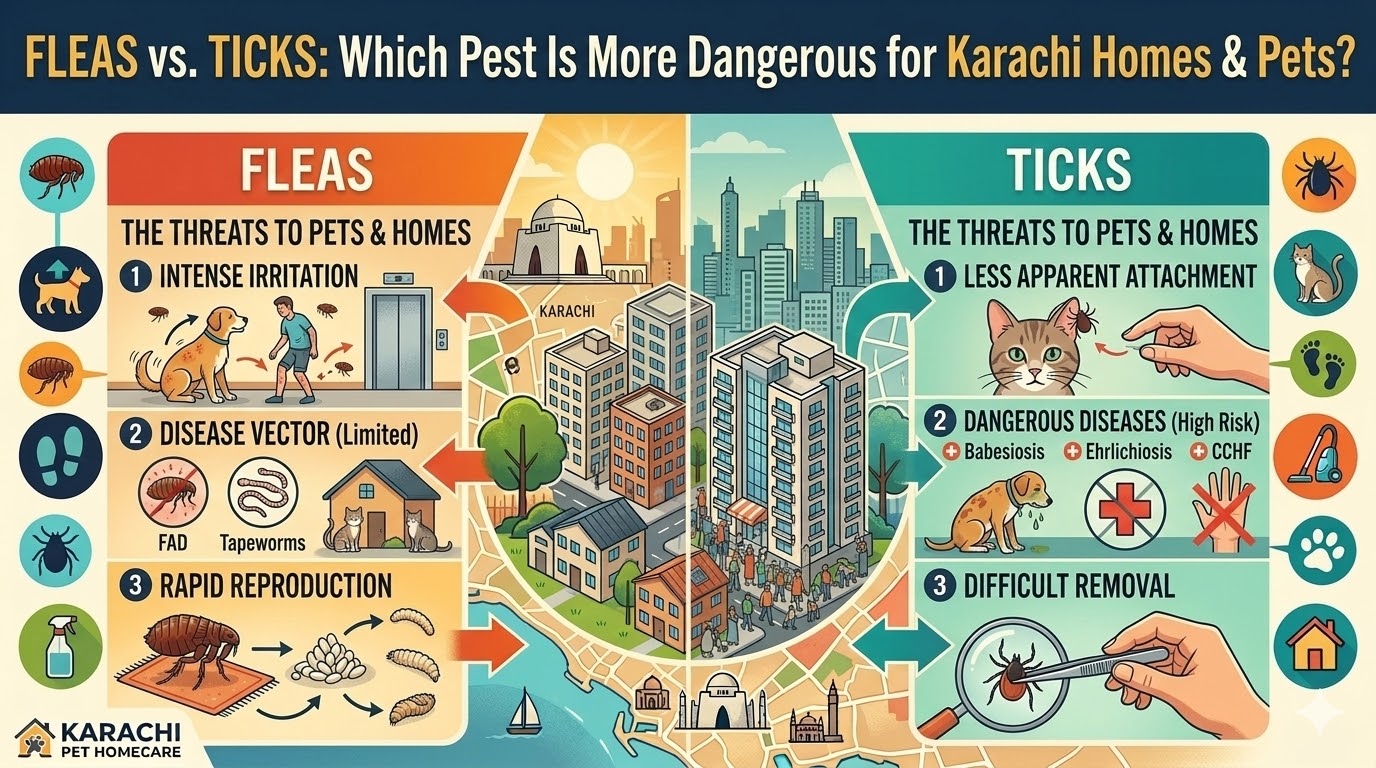
Fleas vs. Ticks: Side-by-Side Comparison
Use this quick reference to understand how the two pests differ across the factors that matter most for Karachi homeowners:
Category
Fleas
Ticks
Size
Tiny — 1–3 mm, barely visible
Larger — 3–5 mm; engorged up to 1 cm
Speed of spread
Very fast — can infest a home in weeks
Slower but deeply embedded once inside
Karachi season risk
Year-round; peaks post-monsoon
Peak during and after monsoon (Jun–Sep)
Primary host
Dogs, cats, humans
Dogs, wildlife, humans
Disease risk (pets)
Tapeworms, FAD, anaemia
Babesiosis, Ehrlichiosis, tick paralysis
Disease risk (humans)
Bites, rare murine typhus
Spotted fever, Lyme (rare), toxin risk
Survives indoors?
Yes — eggs last 12+ months
Brown dog tick completes full cycle indoors
DIY treatment success
Low — misses 95% of lifecycle
Very low — hides deep in fabrics, crevices
Professional treatment
IGR + adulticide + follow-up
Targeted acaricide + environment treatment
The Health Risks: Which One Can Actually Harm Your Family?
This is where the comparison gets serious. Both parasites pose genuine health risks — but in different ways, and with different levels of urgency.
The Health Risks of Fleas
Flea Allergy Dermatitis (FAD): The most common flea-related condition in Karachi pets. Even a single flea bite can trigger severe allergic reactions in sensitive dogs and cats — causing intense itching, hair loss, hot spots, and skin infections that require veterinary treatment.
Tapeworm infection: Fleas serve as intermediate hosts for Dipylidium caninum — a tapeworm. Dogs, cats, and even young children can become infected by accidentally swallowing an infected flea. Children playing on infested carpets or floor cushions are at particular risk.
Anaemia: In severe infestations — especially in puppies, kittens, or elderly pets — the sheer volume of blood loss from multiple daily flea bites can cause life-threatening anaemia.
Murine Typhus: Caused by Rickettsia typhi bacteria transmitted by rat fleas. While not the most common scenario in residential homes, it has been documented in urban Pakistani environments and causes fever, headache, and rash in humans.
Secondary skin infections: Relentless scratching of flea bites — in both pets and humans — breaks the skin and can lead to bacterial infections, particularly in children.
The Health Risks of Ticks
Babesiosis: A serious tick-borne disease that destroys red blood cells in dogs. Common in Karachi’s pet population, it causes fever, pale gums, weakness, and can be fatal without rapid veterinary intervention. Reports of Babesiosis in Karachi dogs are well-documented among local vets.
Ehrlichiosis: Caused by Ehrlichia bacteria transmitted by the Brown Dog Tick — the very species most prevalent in Karachi. Symptoms in dogs include fever, loss of appetite, bleeding disorders, and, in chronic cases, bone marrow suppression.
Tick Paralysis: Certain female ticks secrete a neurotoxin while feeding that can cause progressive paralysis in dogs — and in rare cases, in children. Symptoms develop over days and resolve after the tick is removed, but it can be frightening and dangerous if not caught early.
Rocky Mountain Spotted Fever (RMSF): Though primarily associated with the Americas, Rickettsia species transmitted by brown dog ticks have been documented in South Asian contexts. RMSF in humans causes high fever, severe headache, and a characteristic rash.
Lyme Disease: Less common in Pakistan than in Europe or North America, but worth noting, particularly for Karachi families who travel internationally or whose pets have had contact with imported animals.
⚠️ Veterinary Alert: Karachi veterinarians consistently report tick-borne Babesiosis and Ehrlichiosis as among the most common serious illnesses they treat in dogs. If your dog develops a sudden fever, becomes lethargic, or stops eating — tick-borne disease should be your first suspicion. Act immediately.
So Which Is Actually More Dangerous — Fleas or Ticks?
The answer depends on which risk dimension you prioritise:
For Sheer Speed and Scale of Infestation: Fleas Win
Fleas spread faster, reproduce faster, and are harder to fully eliminate than ticks. A flea infestation left untreated for 30 days can involve hundreds of thousands of eggs, larvae, and pupae embedded throughout your home. The scale of disruption — to your pets, your family’s comfort, and your home — is typically greater with fleas.
For Severity of Individual Disease Risk: Ticks Are More Dangerous
Tick-borne diseases like Babesiosis and Ehrlichiosis can kill a dog within days if untreated. Tick paralysis can cause sudden, frightening physical deterioration in pets and children. While flea-related illnesses are serious, the disease risk per bite from a tick — particularly the Brown Dog Tick prevalent in Karachi — is generally higher.
The Realistic Verdict for Karachi Homes
In practice, most Karachi households dealing with a pest problem are dealing with both simultaneously. A dog that picks up ticks on a walk through Bagh Ibn Qasim or encounters a stray in Gulshan almost certainly brings fleas back too. The two infestations reinforce each other, making combined treatment essential.
This is exactly why professional flea and tick control in Karachi is designed to address both parasites together — not as separate problems, but as a combined threat that must be eliminated systematically.
Where Fleas and Ticks Hide in Your Karachi Home
Effective treatment depends entirely on knowing where these pests actually are. Most homeowners treat only the surface — and that’s why DIY solutions consistently fail.
Where Fleas Hide
Deep within carpet fibres and rugs — particularly thick-pile or wool carpets common in Karachi drawing rooms and bedrooms
In the crevices and seams of sofas, mattresses, and upholstered furniture
Under skirting boards, in floor cracks, and along baseboards
In pet bedding, blankets, and cushions
In soil and sand in garden areas — particularly post-monsoon
Where Ticks Hide
In tall grass, shrubs, and vegetation — particularly relevant for Karachi homes with gardens or proximity to parks
Behind their host’s ears, between toes, around the neck, and in the groin area — deeply attached
In wall crevices, ceiling gaps, and around window and door frames — the Brown Dog Tick is particularly adept at hiding in structural gaps indoors
In outdoor furniture, doormats, and any fabric items kept near entrances
Did You Know? The Brown Dog Tick — Karachi’s most common indoor tick species — can survive up to 18 months without feeding. This means an empty, temporarily unoccupied property can still harbour an active tick infestation waiting for the next occupant.
Warning Signs: How to Tell If You Have Fleas, Ticks, or Both
Signs You Have Fleas
Your pet scratches constantly, especially around the base of the tail, neck, and belly
You find tiny dark specks (“flea dirt” — digested blood) on your pet’s skin, in bedding, or on white sheets
You notice itchy red bites in clusters on your ankles and lower legs
Performing the white sock test: walk across your carpet in white socks — fleas will jump on and become visible
You can see tiny fast-moving brown specks on light-coloured floor tiles or your pet’s coat
Signs You Have Ticks
Finding ticks attached to your pet — often requiring a close inspection around the ears, neck, and between the toes
Your pet develops a sudden fever, refuses food, or becomes unusually lethargic — possible signs of tick-borne disease
Discovering engorged, seed-like insects on yourself or family members after spending time in grassy areas
Finding brown, flat insects crawling slowly on walls, curtains, or around window frames
Signs You Have Both (Very Common in Karachi)
Multiple pets showing different symptoms simultaneously
Bites on human family members AND visible ticks on pets
Visible flea dirt on bedding alongside ticks found on the dog after walks
Why Over-the-Counter Products Fail Against Both
Walk into any Karachi pet shop or pharmacy and you’ll find sprays, powders, collars, and shampoos promising to eliminate fleas and ticks. Here’s why they consistently fall short:
They address adults only: Consumer sprays kill adult fleas on contact but cannot penetrate the flea pupa — which is sealed against chemical intrusion. The next generation emerges 7–14 days later and the cycle restarts
They don’t treat the environment: Treating your pet without treating your home is like mopping a floor while the tap is still running. The 95% of the infestation in your carpets, sofas, and crevices continues to develop
Tick collars give false security: While they reduce tick attachment, they do not eliminate ticks already present in your home or garden — particularly problematic with the indoor-adapted Brown Dog Tick
No residual protection: In Karachi’s heat, consumer insecticides degrade quickly — providing protection for only a few days before becoming ineffective
Resistance: Repeated use of the same over-the-counter products can contribute to resistance in local flea populations, making future infestations harder to control
The only solution that addresses both parasites completely — across all lifecycle stages, all hiding spots, and with residual protection — is professional flea and tick pest control in Karachi delivered by trained technicians using commercial-grade products and proven protocols.
How Unique Fumigation Treats Both Fleas and Ticks Simultaneously
Because fleas and ticks are so frequently found together, Unique Fumigation’s treatment protocol is designed as a combined, comprehensive intervention — not a separate product for each pest.
The Treatment Process
1. Free Home Inspection: We begin with a detailed assessment of your home, garden, and pets’ environments. We identify the species involved, the infestation level, and all active zones — indoors and out.
2. Indoor Treatment: We apply professional-grade Insect Growth Regulators (IGRs) combined with targeted adulticides and acaricides to every affected area — carpets, furniture seams, skirting boards, wall crevices, and beneath furniture. IGRs prevent flea eggs and larvae from reaching adulthood, breaking the lifecycle.
3. Outdoor & Garden Treatment: For Karachi homes with gardens or outdoor seating, we treat vegetation, soil, and outdoor resting areas where ticks shelter between hosts — a critical step that is almost always missed by DIY treatments.
4. Pet Coordination Advice: We work alongside your veterinarian’s pet treatment plan to ensure indoor treatment and on-animal treatment happen simultaneously — the only way to prevent immediate re-infestation.
5. Mandatory Follow-Up Visit: Due to the flea pupal stage, we schedule a second treatment 10–14 days later to eliminate any newly emerged adults before they can breed — ensuring the infestation is fully broken.
6. Post-Treatment Guidance: We provide specific, practical advice for your home’s layout, your pets’ routine, and the season — whether you’re heading into Karachi’s monsoon or the drier winter months.
Safety Note: All products used by Unique Fumigation are WHO-approved and applied according to certified safety protocols. Post-treatment re-entry times are strictly communicated to ensure complete safety for children, pets, and elderly household members.
Preventing Fleas and Ticks in Your Karachi Home: Practical Steps
For Pet Owners in Karachi
Use vet-prescribed monthly flea and tick preventatives — topical spot-ons or oral chewables are far more effective than collars alone
Inspect your dog thoroughly after every walk, especially in grassy areas like parks in PECHS, Defence, or Gulshan-e-Iqbal
Never allow pets to interact with stray animals — a difficult but important boundary given Karachi’s large stray population
Wash all pet bedding weekly in hot water above 60°C
For Your Home and Garden
Vacuum carpets and upholstered furniture at least twice a week — immediately dispose of the vacuum bag or empty the canister outside
Keep garden grass short and remove leaf litter and debris where ticks like to shelter
Seal gaps under doors, around pipes, and along skirting boards to reduce entry points and indoor tick hiding spots
Schedule professional preventative inspections before Karachi’s monsoon season (May–June) and after it (October–November) when infestation risks peak
Frequently Asked Questions
Can fleas and ticks infest a home without pets?
Yes — though pets dramatically increase the risk. Ticks can enter on clothing after outdoor exposure. Fleas can be introduced on second-hand furniture, carpets, or by moving into a previously pet-occupied property where dormant eggs are still present. Karachi’s stray animal problem also means fleas can enter via wildlife that accesses open gardens or rooftops.
Which is harder to get rid of — fleas or ticks?
Both are notoriously difficult to eliminate without professional treatment. Fleas are harder to fully eradicate because of the sheer scale of infestation and the insecticide-resistant pupal stage. Ticks are harder to locate and remove because they hide in structural gaps and on animals in hard-to-reach spots. Combined, they’re best addressed together by a professional pest control service.
My dog has been treated by the vet. Do I still need home treatment?
Absolutely yes. Treating your pet eliminates the adults on the animal — but has no effect on the hundreds or thousands of eggs, larvae, pupae, and unfed ticks already present in your home environment. Without environmental treatment, your pet will be re-infested within days of returning home from the vet.
Is Karachi’s monsoon season the worst time for fleas and ticks?
The monsoon itself is not the peak — it’s the period immediately after, typically October through November, when humidity remains high and the environment is still warm. This creates the optimal hatching and activity window. Many Karachi families first notice serious infestations in October, after the monsoon has ended.
How quickly can a combined flea and tick infestation be resolved professionally?
Most infestations are fully resolved within 3–4 weeks from the first professional treatment, including the mandatory follow-up visit. This timeline accounts for the flea pupal stage and ensures no new adults can establish a breeding population after treatment.
Don’t Wait Until the Problem Gets Worse Whether you’re dealing with fleas, ticks, or both — the longer you wait, the larger and more expensive the infestation becomes. In Karachi’s climate, neither pest will disappear on its own. Unique Fumigation offers a FREE home inspection for Karachi residents. ✓ Certified pest control professionals ✓ WHO-approved treatments ✓ Guaranteed follow-up Book your free inspection at uniquefumigation.com/fleas-ticks-control-in-karachi — or call us today.
Related reading: For a full guide on how flea and tick infestations start in Karachi homes and the step-by-step prevention strategies, explore our professional flea and tick control services in Karachi — covering everything from inspection to treatment to long-term protection.
Most Karachi homeowners assume the same thing: “We don’t have a dog or cat, so we don’t need to worry about fleas or ticks.” It’s an understandable assumption — and it’s completely wrong.
Fleas and ticks don’t need a resident pet to enter your home. They need a host to travel on — and in Karachi, those hosts are everywhere. From the stray cats prowling your street in Gulshan-e-Iqbal to a visiting relative’s shoes after a walk through a park in PECHS, from second-hand furniture bought at a Saddar market to the rats running through your boundary wall at night — the entry points are numerous, and most families never see them coming.
This guide exists specifically for the Karachi homeowner who doesn’t own pets but has found unexplained bites, noticed unfamiliar insects, or simply wants to protect their home proactively. We’ll walk through every realistic entry route, explain why Karachi’s environment makes your home especially vulnerable, and tell you exactly what to do about it.
Why the “No Pets, No Problem” Assumption Is Dangerous in Karachi
The idea that fleas and ticks only affect pet-owning households comes from a misunderstanding of how these parasites actually survive and travel. Here’s the reality:
Fleas don’t live permanently on their host. Adult fleas spend as little as 20% of their time on an animal. The rest of the time — as eggs, larvae, and pupae — they live in the environment: carpets, floor cracks, upholstery, and soil.
Ticks are ambush predators. They don’t chase hosts. They wait — on grass blades, fabric, doorframes — and latch on when a warm body passes. That warm body doesn’t have to be a pet.
Karachi’s stray animal population is enormous. Pakistan has one of the largest stray dog and cat populations in South Asia. Karachi alone has hundreds of thousands of strays. These animals carry fleas and ticks and travel through every residential area in the city — including yours.
Flea eggs survive without a host for up to 12 months. An infestation in a property can remain dormant — in eggs and pupae — for nearly a year, then explode into activity the moment warmth, vibration, and carbon dioxide signal that a host is nearby. Moving into a new flat? The previous tenant’s fleas may already be waiting for you.
Karachi Context: Unlike cities in colder climates where winter temperatures suppress flea and tick populations, Karachi’s year-round warmth (rarely below 15°C) and high post-monsoon humidity create conditions where these pests remain active and reproductive 12 months of the year. No season offers you a natural break.
The 9 Ways Fleas and Ticks Enter Pet-Free Karachi Homes
Each of the following entry routes is realistic, common, and documented in urban Karachi environments. Read them carefully — you may recognise your own situation.
1. Stray Animals Accessing Your Property
This is the single most common entry route for pet-free Karachi households. Stray cats are particularly agile and routinely access rooftops, balconies, courtyards, open stairwells, and ground-floor gardens across the city — from densely packed areas like Liaquatabad and New Karachi to the more spacious bungalow zones of DHA and Clifton. A stray cat resting in your courtyard for 20 minutes can deposit hundreds of flea eggs into your soil, floor tiles, or doormats. Those eggs hatch and develop entirely without the cat ever returning.
2. Rodents: The Hidden Carrier Most Families Don’t Consider
Rats and mice are heavily infested with fleas — specifically the Oriental Rat Flea (Xenopsylla cheopis), a species that readily transfers to humans. Karachi has a significant urban rodent problem, particularly in older residential areas like Saddar, Lyari, and parts of Orangi Town, but also in the roof spaces and utility shafts of modern apartment buildings. When rats travel through your walls, ceiling voids, and drainage pipes, the fleas they carry fall off and establish themselves in your home without you ever seeing a rat. If you have a rodent problem — even a minor one — you almost certainly have fleas too.
⚠️ Important: The Oriental Rat Flea is historically significant as the vector for Bubonic Plague and is a known carrier of Murine Typhus — a bacterial disease that causes fever, headache, and rash in humans. While Bubonic Plague is extremely rare today, Murine Typhus remains an active concern in urban environments with high rodent and flea populations. This is not a pest to ignore.
3. Visiting Guests and Their Pets
Eid gatherings, family visits, and social events are a normal part of Karachi life — and they’re a completely overlooked flea and tick entry route. When a relative visits with their dog, or when a friend’s cat accompanies them during a Ramadan visit, fleas jump off onto your carpets, sofas, and cushions within minutes. The visiting animal leaves. The fleas stay. You don’t discover the infestation until two to three weeks later when the eggs hatch and the adults emerge. This scenario is responsible for a significant number of infestations in households with no resident pets.
4. Second-Hand Furniture, Carpets, and Fabric Items
Karachi’s second-hand furniture markets — from the well-known stalls in Saddar to neighbourhood sales and online marketplaces — are a significant risk factor that almost no buyer considers. Flea eggs and pupae are microscopic, odourless, and invisible to the naked eye. They can exist deep in the fibres of a used carpet, inside the foam of a sofa, or in the seams of an upholstered chair. They survive for months without hatching. A beautiful second-hand rug or a discounted sofa from a previous pet-owning household can introduce a full-scale infestation into your home within weeks of purchase.
5. Previously Occupied Properties and Rental Flats
This is among the most common — and least anticipated — scenarios for Karachi renters and buyers. The flea pupal stage is specifically designed for long-term dormancy. Pupae can remain sealed and inactive for up to 12 months, waiting for the vibrations, warmth, and carbon dioxide that signal a new occupant has arrived. Moving into a flat in North Nazimabad, an apartment in Gulshan, or a bungalow in Defence that was previously occupied by a pet-owning family means you may be walking into a dormant infestation that activates the moment you move in. Many tenants report an explosion of flea bites within the first week of moving into a new property.
Key Fact: If you’re moving into a new property in Karachi, always ask whether the previous occupants had pets. If they did — or if you’re unsure — a professional inspection before moving in is a worthwhile investment that can save you weeks of discomfort and expense.
6. Clothing, Shoes, and Personal Items After Outdoor Exposure
Ticks, in particular, are expert hitchhikers. They position themselves on the tips of grass blades and low vegetation — a behaviour called “questing” — and latch onto anything that brushes past. In Karachi, this risk is highest in grassy public spaces like Bagh Ibn Qasim, the parks along Clifton Beach, the green belts in Bahria Town, and any garden or grassy verge in neighbourhoods like Scheme 33, Gulistan-e-Johar, or the Defence Housing Authority. A walk through a park, sitting on grass at a picnic, or even gardening in your own lawn can result in ticks attaching to your clothing and entering your home on your person.
7. Birds and Bird Nests on Your Property
This entry route surprises most homeowners. Certain flea species — including the Hen Flea (Echidnophaga gallinacea) and European Chicken Flea — are associated with birds. In Karachi, pigeons and sparrows commonly nest in roof overhangs, balcony ledges, air conditioning unit housing, and water tank areas. The fleas associated with these birds can migrate from the nest into living spaces, particularly when the nest is abandoned or disturbed. Homes in older parts of the city with open roof access are particularly vulnerable.
8. Domestic Workers, Tradespeople, and Visitors
Household staff who travel across the city daily — through areas with high stray animal density, on crowded public transport where other passengers may have pets, or through their own homes where pets are kept — can inadvertently carry flea eggs or even larvae on their clothing into your home. The same applies to plumbers, electricians, AC technicians, and delivery personnel. This is not a reason for alarm, but it is a reality of urban Karachi life that is almost never acknowledged as an infestation risk.
9. Shared Walls, Common Areas, and Stairwells in Apartment Buildings
Karachi’s high-rise apartment culture — particularly in areas like Gulshan-e-Iqbal, Nazimabad, and parts of Saddar — creates specific infestation dynamics. When a neighbouring flat has a flea infestation, fleas can migrate through gaps under doors, along pipes, through shared ventilation shafts, and into adjoining units. Ground-floor stairwells and common areas where stray cats may rest are particularly effective transit routes. You can have a severe infestation with no pets, no second-hand furniture, and no identifiable entry point — because the source is your neighbour’s flat two doors down.
Which Entry Routes Are Most Common in Karachi’s Different Neighbourhoods?
Karachi’s residential areas have distinct characteristics that make certain entry routes more prevalent than others:
DHA, Clifton, and Bahria Town
Larger bungalows with gardens, proximity to green spaces, and higher rates of pet ownership among neighbours. Primary risks: stray animals accessing gardens, tick exposure in grassy areas, visiting pets during family gatherings, and bird nests on rooftop parapets and balconies.
Gulshan-e-Iqbal, North Nazimabad, and PECHS
High-density residential areas with a mix of bungalows, apartments, and ground-floor units. Primary risks: stray animal activity in narrow galis and shared courtyards, rodent infestations in older buildings, neighbouring flat migration in multi-storey blocks, and second-hand furniture from local markets.
Saddar, Lyari, and Older Central Areas
Older building stock, high rodent activity, busy markets with second-hand goods. Primary risks: rodent-borne flea transfer, second-hand item purchases, and high ambient stray animal density. These areas carry a higher Murine Typhus risk due to the rat-flea dynamic.
Scheme 33, Gulistan-e-Johar, and Surjani Town
Rapidly developing areas with a mix of new and established housing, proximity to undeveloped land. Primary risks: ticks from surrounding vegetation and undeveloped plots, stray animal populations in transitional zones, and construction activity disturbing tick habitats.
New Karachi, Orangi Town, and North Town
Dense residential areas with significant foot traffic and shared infrastructure. Primary risks: communal stairwells and shared entrance areas, rodent activity, and the high concentration of domestic workers travelling across multiple households.
What Happens Once Fleas or Ticks Are Inside a Pet-Free Home?
Here is where many pet-free homeowners assume they are protected: “Even if fleas got in, they’ll die without a pet to feed on.” This is not accurate.
Fleas Will Feed on Humans
Fleas have preferred hosts — cats and dogs — but they are opportunistic feeders and will readily bite humans when no animal host is available. Human blood is sufficient for flea survival and, critically, for flea reproduction. In a pet-free home, fleas simply switch to human hosts. The result is relentless biting, typically on the lower legs, ankles, and feet. The infestation grows on a human blood supply alone.
Tick Species Adapted to Indoor Environments Survive Without Pets
The Brown Dog Tick (Rhipicephalus sanguineus) — the most common species found in Karachi homes — is uniquely adapted to complete its entire lifecycle indoors. It can feed on humans, rodents, and even birds when dogs are unavailable. It hides in wall crevices, ceiling gaps, and structural voids and can survive for up to 18 months without a blood meal. The absence of pets does not eliminate this species.
Dormant Eggs Activate When Conditions Are Right
Flea pupae are sealed in a protective cocoon that makes them resistant to desiccation and insecticides. They detect vibration (footsteps), warmth, and carbon dioxide from exhaled breath. Every time you walk across an infested carpet, you may be triggering the emergence of a new generation of adults. The infestation that lay dormant for months in an empty property activates the moment you move in.
⚠️ Health Alert for Pet-Free Households: Without a pet to absorb flea bites, every flea in a pet-free home feeds exclusively on human family members. Children, who spend more time on floors and carpets, are disproportionately affected. Persistent flea bites in children cause intense itching, sleep disruption, and carry a risk of secondary infection from scratching.
Warning Signs in a Pet-Free Home
Because pet-free homeowners don’t associate themselves with flea and tick risk, they often misidentify the problem for weeks — attributing bites to mosquitoes, dismissing crawling insects as harmless, or blaming skin conditions. Here’s what to watch for:
Signs of Fleas
Itchy, red bites appearing in clusters or lines, typically on the lower legs, ankles, and feet — particularly after sitting or walking on carpeted areas
Bites that are worse first thing in the morning or after returning home from a period of absence (triggering dormant pupae)
Tiny dark specks on light-coloured flooring, mattress surfaces, or white bedsheets — this is flea excrement (digested blood)
The white sock test: walk across carpeted areas in white socks. If fleas are present, they will jump onto the fabric and become visible as tiny dark specks
Seeing tiny, fast-moving brown specks jumping on floor tiles, walls, or furniture in a sunny room
Signs of Ticks
Discovering an engorged, seed-like insect attached to your skin after spending time in a garden, park, or grassy area
Finding flat, brown, slow-moving insects on walls, curtains, or around window frames and skirting boards
Developing a circular rash around a bite site (potential indicator of tick-borne infection — consult a doctor immediately)
Unexplained fever, fatigue, or headache following outdoor exposure in a grassy environment in Karachi
Signs You Have Both
Multiple family members experiencing simultaneous biting, particularly at different body heights (flea bites at ankle level; tick bites at various heights)
Infestation appearing suddenly after moving into a new property, receiving second-hand furniture, or hosting a family gathering
Why DIY Treatments Are Even Less Effective in Pet-Free Homes
There’s a counterintuitive truth here: DIY flea treatments are actually harder to apply correctly in pet-free homes, because the source of the infestation is less obvious and the standard advice — “treat your pet and your home simultaneously” — doesn’t apply.
You don’t know where to start. Without a pet as the obvious focus, it’s harder to locate the epicentre of the infestation. Eggs and larvae can be spread across multiple rooms with no clear source
Consumer sprays miss the pupal stage. The flea pupa is sealed against chemical intrusion. Over-the-counter sprays kill the adults you see but leave the next generation intact. Two weeks later, the infestation restarts
You may be treating the wrong pest. Without professional identification, you may be applying flea treatments to a tick infestation or vice versa — wasting time and money while the real problem grows
Rodent-source infestations require the rodent problem to be resolved first. Treating fleas without eliminating the rats that are reintroducing them is entirely ineffective — the infestation will return within days
Structural hiding spots go untreated. The Brown Dog Tick’s preference for wall crevices and ceiling voids makes it impossible to treat adequately with surface sprays. Professional application equipment is required to reach these areas
This is why professional flea and tick control in Karachi is especially important for pet-free households — where the source of the infestation needs to be correctly identified before any treatment begins.
What Professional Treatment Looks Like for Pet-Free Homes
Unique Fumigation’s approach to pet-free households differs from a standard pet-home treatment protocol, because the entry point, species identification, and treatment zones are different.
Step 1 — Source Identification
Before any treatment is applied, our technicians conduct a thorough inspection to identify the likely entry route. This includes checking for signs of rodent activity, examining potential stray animal access points, inspecting recently acquired furniture, and assessing the property’s history of occupancy. Correct source identification is the foundation of effective treatment.
Step 2 — Species Confirmation
We confirm whether the problem is fleas, ticks, or both — and which specific species are involved. This determines the correct product selection and treatment method. Treating a Brown Dog Tick infestation with flea-specific products, for example, will not deliver full results.
Step 3 — Whole-Home Environmental Treatment
We apply professional-grade Insect Growth Regulators (IGRs) combined with targeted adulticides across all affected zones — carpets, upholstery, skirting boards, under furniture, and inside structural crevices. IGRs are particularly important because they prevent eggs and larvae from developing into reproducing adults, effectively breaking the lifecycle at its source.
Step 4 — Targeted Entry Point Treatment
Access points identified during the inspection receive specific treatment. This may include garden and outdoor areas, rooftop or balcony spaces with bird nest activity, roof spaces and utility corridors with rodent evidence, and shared stairwells or common areas in apartment buildings.
Step 5 — Follow-Up Inspection and Second Treatment
A mandatory follow-up visit at 10–14 days ensures any newly emerged adults — from pupae that were present but resistant to the initial treatment — are eliminated before they can reproduce. This step is non-negotiable for achieving complete eradication.
Step 6 — Entry Point Sealing Recommendations
We provide specific guidance on how to reduce future entry risks for your property — from door gap sealing to garden maintenance, stray animal deterrence, and safe practices for purchasing second-hand items.
Note on Safety: All Unique Fumigation treatments use WHO-approved formulations applied by certified technicians. Clear re-entry time guidance is provided after every treatment to ensure the complete safety of children, elderly family members, and any household members with respiratory sensitivities.
Practical Steps to Reduce Your Risk — Starting Today
Even before you call a professional, there are immediate steps Karachi homeowners without pets can take to reduce the risk of infestation:
Seal Your Property
Fit draught excluders or door sweeps to exterior doors and shared corridor doors in apartment buildings
Seal visible gaps around pipes, utility entry points, and skirting boards — these are both tick hiding spots and rodent entry points
Use fine mesh screens on ground-floor windows and balcony doors to prevent stray animal access
Manage Your Garden and Outdoor Areas
Keep grass cut short and remove leaf litter and garden debris — particularly important in post-monsoon months
Avoid leaving outdoor furniture cushions on the ground, where they are easily colonised by ticks and become rest spots for strays
Remove or seal any bird nests from roof overhangs, balcony ledges, and AC unit housing
Apply appropriate deterrents to discourage stray cats from resting in your courtyard or garden
Be Careful with Second-Hand Items
Before bringing any second-hand fabric item — carpet, sofa, mattress, cushions — into your home, ask about the source. If the previous owner had pets, treat with extreme caution
Consider having second-hand fabric items professionally heat-treated or inspected before introducing them to your home
If purchasing from Karachi’s second-hand markets, avoid fabric items entirely or quarantine them outdoors before bringing inside
Protect Yourself Outdoors
Wear long trousers and closed shoes when walking through grassy areas, parks, or gardens in Karachi — particularly during and after monsoon season
Check your clothing carefully before re-entering your home after outdoor exposure in high-risk areas like Bagh Ibn Qasim, Clifton Beach parks, or any green belt area
Change and wash outdoor clothing promptly after high-risk exposure
Stay Alert After Guests Visit
If a guest visits with a pet — or if you visit a pet-owning household and spend time sitting on carpeted areas — vacuum your home’s carpets and upholstery promptly and wash any clothing worn during the visit
After large family gatherings like Eid events where multiple families with pets may have visited, a precautionary inspection is worthwhile
Frequently Asked Questions
Can I get fleas even if no animal has ever been inside my home?
Yes. Flea eggs can be introduced on your clothing after outdoor exposure, on second-hand items, or via rodents moving through wall voids and drainage pipes. If the property was previously occupied by a pet owner, dormant flea pupae may already be present inside the fabric of the building, waiting to hatch.
How do I know if it’s fleas or mosquitoes biting me?
Flea bites are typically clustered, extremely itchy, and concentrated on the lower legs, ankles, and feet. They often appear in groups of three (the “breakfast, lunch, and dinner” pattern). Mosquito bites are more randomly distributed across the body and tend to be isolated. If you’re experiencing bites primarily at ankle level when sitting or walking on carpet, fleas are the far more likely culprit.
Can ticks live inside an apartment building in Karachi?
Yes — the Brown Dog Tick, the most common tick species in Karachi, has specifically adapted to indoor environments. It can complete its entire lifecycle — from egg to larva to nymph to adult — inside a building, hiding in wall crevices, beneath skirting boards, and in ceiling voids. It does not require outdoor exposure to survive and reproduce.
We’ve just moved into a new flat. Could there already be fleas?
Potentially yes. Flea pupae in carpets and floor crevices can survive up to 12 months in a dormant state. The vibrations from your first days of moving in, combined with the warmth and carbon dioxide your household generates, can trigger a mass emergence of adults within the first week. If you notice bites shortly after moving in and the flat was previously occupied by pet owners, this is almost certainly the cause.
Is professional flea and tick treatment different for homes without pets?
Yes, meaningfully so. Without a pet as the focal point, the treatment protocol emphasises source identification first — correctly locating and addressing the entry route — before environmental treatment. The product selection and treatment zones also differ depending on whether the source is rodent-borne, bird-related, structural (ticks in wall voids), or imported via second-hand items. This is why a professional inspection, rather than a generic DIY approach, is especially important for pet-free households.
Not Sure If You Have a Problem? Find Out — Free. You don’t need to be certain to book an inspection. That’s what the inspection is for. Whether you’ve noticed suspicious bites, found unfamiliar insects, moved into a new property, or simply want peace of mind — Unique Fumigation’s trained technicians will assess your home honestly and give you a clear picture. No pets required. No obligation. Just answers. ✓ Inspection at no cost ✓ Karachi-experienced technicians ✓ Clear, honest assessment Book today at uniquefumigation.com/fleas-ticks-control-in-karachi — or give us a call.
If you’ve noticed more rat droppings, gnawed wires, or scratching sounds in your walls lately, you’re not imagining it. Rat infestations in Karachi have been escalating at an alarming rate — and residential neighbourhoods across the city, from North Nazimabad and Gulshan-e-Iqbal to Clifton and Korangi, are feeling the pressure.
In this article, we break down exactly why this is happening and, more importantly, what Karachi homeowners can do right now to fight back before the problem spirals out of control.
The Growing Rat Problem in Karachi: What the Data Tells Us
Rats — primarily the Norway rat (Rattus norvegicus) and the roof rat (Rattus rattus) — are not new to Karachi. But urban pest experts and fumigation professionals working across the city confirm that call volumes for rodent control have surged significantly in recent years, particularly in densely populated residential zones.
So what’s behind this surge? The answer is a combination of urban, environmental, and infrastructural factors — many of which are unique to Karachi.
Top Reasons Rat Infestations Are Worsening in Karachi
1. Rapid Urbanisation and Informal Settlements
Karachi is one of the fastest-growing megacities in the world, with an estimated population of over 20 million people. This rapid urban expansion has led to sprawling informal settlements (katchi abadis) where sanitation infrastructure lags far behind population density. These areas offer rats exactly what they need: food, shelter, and warmth — in abundance.
As new construction pushes out into previously undeveloped land, it displaces rat colonies — which then migrate into established residential neighbourhoods.
2. Overflowing Waste and Irregular Garbage Collection
Karachi’s waste management system has struggled for years. In many areas, open rubbish dumps, blocked nullahs (drains), and garbage piles that go uncollected for days provide a reliable food source for urban rat populations.
Rats are opportunistic omnivores. An overflowing bin outside a DHA home is just as attractive to them as a rubbish heap in Orangi Town. Once they find a food source near a property, they will nest nearby.
3. Aging Sewer and Drainage Infrastructure
Much of Karachi’s underground sewage and drainage network dates back decades and is in critical disrepair. Cracked pipes, broken manholes, and flooded nullahs create ideal rat highways — allowing rodents to travel freely underground and surface inside homes and buildings. This is a major reason why even well-maintained homes in areas like PECHS or Gulberg require professional rat control services in Karachi that specifically target entry points and burrow networks.
4. Monsoon Season Drives Rats Indoors
Every year, Karachi’s monsoon season — typically from July to September — disrupts rat colonies living outdoors, in drains, and in open ground. Flooding displaces thousands of rats and forces them to seek higher ground. That higher ground is often your home.
After the monsoon, rat populations rebound quickly. Females can produce up to 5 litters per year, with each litter containing 6–12 pups. By winter, a small infestation can become a serious one.
5. Food Storage and Kitchen Habits
Traditional Pakistani kitchens often store grains, lentils, rice, and spices in large quantities. Without airtight storage containers, these become irresistible to rats. Even small gaps around kitchen pipes or cabinets can allow rats access to your pantry — and once they’ve found food, they will return repeatedly.
6. Climate and Mild Winters
Unlike cities in colder climates where winters thin out rat populations, Karachi’s mild winters allow rats to breed year-round. There is no natural seasonal die-off, which means populations compound continuously without human intervention.
How to Tell If Your Home Has a Rat Infestation
Rats are nocturnal and rarely seen during the day — but the signs of their presence are unmistakeable:
Droppings — dark, pellet-shaped, usually near food sources or along walls
Gnaw marks — on wires, wood, plastic containers, or even walls
Scratching or scurrying sounds — especially at night, in walls or ceilings
Burrow holes — in garden beds, under flooring, or near waste areas
Grease trails — oily smear marks along walls where rats regularly travel
Musky odour — a persistent unpleasant smell, particularly in enclosed spaces
If you’re noticing one or more of these signs, the infestation is likely already beyond the early stage. This is the point at which DIY solutions — snap traps, glue boards, or over-the-counter poison baits — often fail to address the root cause. A thorough rat extermination and control treatment in Karachi can identify the scale of the problem and eliminate it systematically.
⚠️ Important: Rats are not just a nuisance — they are a genuine health hazard. They carry diseases including leptospirosis, salmonella, and hantavirus, and can contaminate food and water supplies. Chewed electrical wires from rats are also a leading cause of house fires.
What Karachi Homeowners Can Do Right Now
Seal All Entry Points
Rats can squeeze through gaps as small as 1.5 cm. Inspect your home carefully: check where pipes enter walls, gaps under doors, cracks in foundations, and ventilation openings. Seal gaps with steel wool, wire mesh, or concrete — rats can chew through soft fillers and foam.
Improve Food and Waste Storage
Store all dry food items in sealed, hard-sided containers. Keep kitchen bins tightly lidded and empty them daily. Never leave pet food out overnight, and clean up fallen fruit in gardens promptly.
Eliminate Nesting Sites
Clear clutter from storage areas, garages, and around the exterior of your home. Rats love to nest in piles of cardboard, old clothing, or garden debris. Keep vegetation trimmed back from the walls of your home and stack firewood away from the house.
Reduce Water Sources
Fix leaking pipes and taps. Rats need water daily, and even a slow drip can support an entire colony. Ensure there is no stagnant water accumulating under appliances or in outdoor drains.
Use Traps Strategically
If the infestation is minor, snap traps placed along walls and in dark corners (where rats travel) can help. However, traps alone will not solve a moderate or large infestation — they are a supplementary tool, not a solution.
Bring in Professionals
For any infestation beyond the earliest stage, professional treatment is strongly recommended. A qualified pest control team will inspect your property, identify access points and nesting sites, deploy appropriate baiting and trapping systems, and apply targeted treatments in inaccessible areas. If you’re searching for effective, reliable rodent control and rat fumigation services in Karachi, working with an experienced local provider makes all the difference between a temporary fix and permanent resolution.
Why DIY Rat Control Often Fails in Karachi
Many Karachi homeowners try to manage rat problems themselves first — and understandably so. But there are several reasons why DIY approaches frequently fall short:
Rats are neophobic — they avoid new objects (like traps) in their environment for several days.
Over-the-counter poisons can be dangerous to children, pets, and even the household water supply if misused.
Without identifying and sealing entry points, new rats will replace any that are eliminated.
Rats that die in inaccessible cavities create odour problems and attract secondary infestations of flies and beetles.
Colony size is almost always larger than homeowners estimate — what looks like one or two rats often means dozens nearby.
Professional pest controllers have the tools, training, and access to regulated rodenticides and exclusion materials that simply aren’t available off the shelf. They also know how to safely remove dead rodents and sanitise affected areas.
Neighbourhood-Specific Risk Factors in Karachi
While no part of the city is immune, some areas face heightened rat infestation risk due to local conditions:
Lyari, Orangi Town, Baldia Town: High density, older drainage infrastructure, and proximity to industrial waste zones increase vulnerability significantly.
Korangi and Landhi: Proximity to industrial zones means rats move between factory waste areas and residential homes frequently.
Old City area and Saddar: Ageing buildings with legacy plumbing and a high density of food businesses create persistent pressure.
DHA and Clifton: Newer construction with manicured gardens can still attract rats from adjacent areas, particularly near commercial zones and through drainage networks.
Gulshan-e-Iqbal and PECHS: Mixed residential-commercial zoning and dense housing mean rat pressure from restaurants and markets can spill into homes.
No neighbourhood is fully safe. If you’re concerned about your specific locality, a professional assessment through Unique Fumigation’s rat control experts in Karachi can give you a clear picture of your risk level and the most appropriate treatment approach.
Don’t Wait — Rat Infestations Grow Exponentially
A single breeding pair of rats can produce over 1,000 descendants within a year under ideal conditions. Rats don’t wait for a convenient time to expand their colony, and infestations don’t resolve themselves.
The earlier you act, the less costly and disruptive the treatment will be. Whether you’re seeing the first signs of a problem or dealing with an established infestation, professional intervention gives you the fastest, safest, and most reliable path to a rat-free home.
🐀 Book Your Free Rat Inspection Today
Unique Fumigation offers free on-site inspections for Karachi homeowners.
Our licensed pest control specialists will assess your property, identify all rat entry points and nesting areas, and recommend a customised treatment plan — at no upfront cost to you.
Protect your family. Protect your home. Act before the problem grows.
About Unique Fumigation
Unique Fumigation is a Karachi-based pest control company specialising in residential and commercial fumigation, rodent control, termite treatment, cockroach extermination, and bed bug elimination. With teams operating across all major Karachi districts, Unique Fumigation provides licensed, safe, and effective pest management solutions to homeowners and businesses throughout the city.
It only takes one moment. A customer spots a rat darting across the floor. Someone films it on their phone. Within hours, it’s circulating on WhatsApp groups and Instagram stories across the city. By the following morning, your restaurant’s reputation — built over years of hard work — is in ruins.
This is not a hypothetical. It has happened to real food businesses in Karachi. And with rat infestations on the rise across the city, no restaurant owner can afford to treat this as someone else’s problem.
In this article, we walk through exactly how a rat infestation can destroy a food business in Karachi, the very real legal and financial consequences you face, and — most importantly — what you can do right now to prevent it.
The Scale of Karachi’s Rat Problem in Food Areas
Karachi’s restaurant and food business scene is one of the most vibrant in South Asia. From the iconic Burns Road food street and the restaurants of Boat Basin and Zamzama, to the countless local eateries in Gulshan, Saddar, and Orangi Town — food is at the heart of the city’s culture and commerce.
But this same density of food businesses creates a perfect storm for rodent pressure. Rats are driven by three needs: food, water, and shelter. A busy commercial kitchen provides all three in abundance — and Karachi’s specific urban conditions make the problem significantly worse:
Aging drainage and sewer infrastructure provides underground rat highways directly into kitchen areas
Irregular municipal waste collection creates consistent food sources near food streets and commercial zones
Dense back-alley service areas in food streets like Burns Road and Tariq Road provide nesting sites just metres from kitchens
Monsoon flooding displaces outdoor rat colonies every year — pushing them into commercial buildings seeking higher ground
Shared walls and drainage in older buildings mean a neighbouring business’s rat problem quickly becomes yours
Pest control professionals who provide commercial rat control services in Karachi report that restaurant kitchens, storage rooms, and dry goods areas are consistently among the highest-risk sites they attend — often with infestations far larger than the owner realised.
How a Rat Infestation Can Destroy Your Restaurant
1. The Viral Moment You Cannot Take Back
In today’s digital environment, a single video of a rat in a Karachi restaurant can reach tens of thousands of people within hours. Pakistan’s food bloggers and reviewers are highly active on Instagram, TikTok, and Facebook — and negative content about a restaurant spreads far faster than positive reviews.
Several Karachi restaurants have faced exactly this scenario in recent years. The business impact is severe: immediate footfall drops, cancellation of bookings, negative review floods on Google and Zomato, and in some cases, permanent closure.
⚠️ Real Risk: Once a video of a rat in your restaurant goes viral in Karachi, no amount of crisis PR can fully repair the damage. The only strategy that works is prevention.
2. PSQCA and Local Authority Inspections
The Pakistan Standards and Quality Control Authority (PSQCA) and Karachi Metropolitan Corporation (KMC) have the authority to inspect food premises and issue notices, fines, or closure orders for hygiene violations — including evidence of rodent activity.
Signs that inspectors look for include rat droppings in storage or food prep areas, gnaw marks on packaging, evidence of contaminated food stocks, and the presence of live or dead rodents. A failed inspection can result in:
Immediate temporary closure pending remediation
Substantial fines and compliance orders
Mandatory destruction of contaminated food stock at your cost
Permanent licence suspension for repeat violations
Public notification of the closure, amplifying reputational damage
3. Food Contamination and Customer Illness
Rats contaminate food through direct contact, droppings, urine, and hair. They carry serious pathogens including Salmonella, Leptospirosis, and E. coli — all of which can cause severe illness in customers.
If a customer becomes ill and traces the source to your restaurant, you face not only reputational damage but potential civil liability. In a city where word-of-mouth and community reputation are critical to a food business’s survival, a food poisoning incident linked to rodents can be fatal to the business.
4. Physical Damage to Your Premises
Rats gnaw constantly — on electrical wiring, gas pipes, structural woodwork, refrigeration units, and packaging. In a commercial kitchen environment, this creates serious fire and safety hazards on top of the contamination risk. The cost of repairing rat-damaged infrastructure can run into hundreds of thousands of rupees, and may not be covered by standard commercial insurance if the infestation was not proactively managed.
5. Staff Morale and Retention
Kitchen staff who work in a rat-infested environment will leave — and they will talk. In Karachi’s competitive hospitality labour market, a reputation for poor hygiene conditions makes it harder to recruit and retain quality staff. The hidden cost of staff turnover in restaurants is consistently underestimated by business owners.
High-Risk Areas and Times for Karachi Restaurants
While every food business in Karachi faces some level of rat pressure, certain locations and circumstances carry significantly elevated risk:
High-Risk Locations
Burns Road and Saddar food streets: High food density, aging drainage, shared back-alley waste areas
Boat Basin and Zamzama (Clifton): Proximity to sea drains and dense commercial-residential mix
North Nazimabad and Gulshan-e-Iqbal: Heavy mixed-use zoning with frequent waste management lapses
Korangi industrial/commercial zone: Adjacent to industrial waste — high rat pressure migrating into food outlets
Tariq Road and Bahadurabad: High foot traffic, street food density, and older drainage infrastructure
High-Risk Times
Monsoon season (July–September): Flooding displaces rat colonies; infestations spike after heavy rains
Post-Eid periods: Increased food waste in surroundings attracts and sustains larger rat populations
Winter construction nearby: Ground disturbance displaces burrowing colonies into adjacent buildings
After any neighbouring business closure: Rats from vacated premises migrate to active food sources nearby
The Warning Signs Every Restaurant Owner Must Know
Rats are nocturnal and adept at avoiding humans — but they leave clear evidence of their presence. Train yourself and your staff to look for:
Droppings — dark, spindle-shaped pellets, often concentrated near food storage, under equipment, or along walls
Gnaw marks — fresh marks appear lighter in colour; check packaging, wooden shelving, electrical conduits, and gas lines
Grease trails — dark smear marks along walls and skirting boards where rats travel repeatedly
Burrow holes — in ground-level flooring, near drainage, or in external walls
Scratching or scurrying at night — often heard in ceilings, walls, or under kitchen units after closing time
Unusual odour — a persistent musky or ammonia-like smell in enclosed storage areas
Disturbed stock — gnawed packaging, spilled grains or lentils, or food items moved from their original positions
💡 Staff Training Tip: Brief your kitchen and storage staff weekly on these warning signs. Early detection is the single most effective way to prevent a minor rat sighting from becoming a full infestation — and a minor problem from becoming a public crisis.
What Effective Rat Control Actually Looks Like for a Karachi Restaurant
There is a significant difference between what most food businesses do about rats and what actually works. Here is a realistic breakdown:
What Doesn’t Work
Placing a few snap traps near the back door and hoping for the best
Using over-the-counter rat poison bait without a systematic baiting strategy
Reacting only after a sighting — by which point the colony is already established
Relying on municipal pest control, which is inconsistent and covers only public areas
Assuming a clean kitchen is rat-proof — entry points are in walls, drains, and flooring, not on surfaces
What Actually Works
Professional site survey: A trained pest controller assesses your entire premises — kitchen, storage, drains, exterior walls, ceiling voids — to map rat entry points, travel routes, and nesting sites
Proofing and exclusion: Physical sealing of entry points using steel mesh, concrete, and door sweeps — stopping new rats from entering regardless of pressure from outside
Targeted baiting strategy: Tamper-proof bait stations placed along rat travel routes (not randomly) using regulated rodenticides that are safe in a food environment when properly deployed
Drain and sewer treatment: Treatment of the drainage entry points that are most commonly overlooked — and most commonly exploited by rats in Karachi’s aging infrastructure
Monitoring and follow-up: Regular visits to check bait consumption, identify new activity, and adjust the strategy — essential in high-pressure commercial food environments
Documentation: A professional provider gives you written service records, which are valuable evidence of due diligence in the event of an inspection or complaint
For Karachi restaurant owners looking for a reliable, food-safe solution, working with a specialist provider of professional rodent extermination services for restaurants in Karachi ensures treatments comply with food safety standards and deliver lasting results — not just a temporary knockdown.
Building a Rat-Resistant Restaurant: Practical Steps You Can Start Today
Professional treatment is essential for an active infestation, but there is much you can do operationally to reduce your vulnerability:
Seal all incoming pipe penetrations — where water, gas, and electrical conduits enter the building. Even a 1.5 cm gap is enough for a rat to enter.
Install door sweeps on all external doors — particularly delivery bay doors and back-alley exits that are frequently left open during service.
Use sealed, hard-sided containers for all dry goods — open sacks of flour, rice, lentils, and spices are a primary food source for rats in restaurant storage rooms.
Enforce strict waste discipline — seal all waste bags before disposal, keep bin areas clean, and never leave organic waste in open containers overnight.
Deep clean under and behind equipment weekly — rats nest in the grease and debris accumulation under large kitchen equipment; regular cleaning denies them both shelter and food.
Inspect deliveries before they enter storage — rats have been known to travel inside delivery packaging from supplier warehouses, particularly for grain and dry goods.
Schedule professional pest control quarterly at minimum — not just when you see a rat, but as a routine part of your operations. Prevention is dramatically cheaper than crisis management.
Restaurant owners often delay professional pest control because of cost concerns. But the financial reality of a rat crisis far exceeds the cost of prevention. Consider the typical cost of a serious infestation event:
Revenue loss during closure or following viral exposure: Can range from PKR 200,000 to over PKR 1,000,000 depending on the scale of your operation
Mandatory destruction of contaminated food stock: PKR 50,000 to 300,000+ depending on inventory levels
Emergency pest treatment and structural repairs: Significantly more expensive than routine prevention contracts
Regulatory fines and compliance costs: Variable but potentially substantial, plus ongoing monitoring requirements
Staff recruitment following turnover: Often underestimated at PKR 30,000–100,000 per position when training costs are included
Long-term revenue impact of reputational damage: The most significant and hardest to quantify — some businesses never fully recover
By comparison, a routine commercial pest control contract covering quarterly inspections, baiting, and monitoring for a typical Karachi restaurant represents a fraction of these costs — and eliminates the risk of a crisis event entirely.
Bottom line: The question is not whether you can afford professional rat control. It is whether you can afford not to have it.
Protect Your Restaurant Before It’s Too Late
The rat problem in Karachi’s commercial food sector is real, it is growing, and it does not resolve itself. But it is entirely manageable with the right professional support in place.
Whether you are seeing the first warning signs, want to get ahead of monsoon season, or simply want to ensure your business is fully protected before an inspection, acting now is always better than acting after an incident.
🐀 Book a Free Commercial Rat Inspection for Your Restaurant
Unique Fumigation provides free on-site inspections for Karachi food businesses.
Our licensed commercial pest specialists will inspect your kitchen, storage areas, drains, and exterior — identify every rat risk on your premises — and provide a clear, customised treatment plan. No commitment required.
Don’t wait for a video to go viral. Protect your business, your staff, and your customers today.
About Unique Fumigation
Unique Fumigation is a Karachi-based pest control company specialising in commercial and residential pest management, including rodent control, termite treatment, cockroach extermination, and bed bug elimination. Serving restaurants, hotels, food manufacturers, and homeowners across all major Karachi districts, Unique Fumigation delivers licensed, safe, and food-hygiene-compliant pest solutions backed by professional documentation.
Every year, thousands of homes across Karachi suffer electrical faults, short circuits, and devastating fires — and rats are far more often to blame than most homeowners realize. From the cramped, centuries-old neighbourhood of Lyari to the sprawling apartment complexes of DHA and the densely packed streets of Orangi Town, rodents have silently become one of the most serious household threats in Pakistan’s largest city.
This isn’t just a pest problem. It is a fire safety emergency hiding inside your walls, ceilings, and electrical panels. If you live in Karachi and have ever heard unexplained scratching at night, noticed frayed cables, or experienced frequent circuit trips, you need to read this guide carefully.
Why Karachi Has Such a Severe Rat Problem
Karachi’s unique combination of geography, infrastructure challenges, and rapid urban growth makes it one of the most rat-friendly cities in the region. Understanding why the problem is so bad here is the first step toward protecting your home.
1. Year-Round Warm Climate
Unlike cities in colder climates where winter kills off rat populations, Karachi’s warm weather — with temperatures rarely dropping below 12°C even in January — allows rats to breed continuously throughout the year. A single pair of Norway rats (Rattus norvegicus), the most common species found in Karachi homes, can produce up to 2,000 descendants within a single year under optimal conditions.
2. Open Drains and Aging Sewage Infrastructure
Karachi’s famously stressed drainage system provides rats with vast underground networks to travel through undetected. Open naalis (drains) running through residential areas of Korangi, Malir, and Liaquatabad are well-documented rat highways. Rodents travel from public sewers into residential buildings through plumbing gaps, broken pipes, and utility entry points.
3. Dense, Mixed-Use Urban Construction
In older neighbourhoods like Saddar, Kharadar, and Nazimabad, commercial shops sit directly below residential apartments. The constant presence of food waste, open garbage, and poorly sealed walls gives rats unlimited access to food and nesting opportunities — and a direct route straight into the homes above.
4. High-Rise Construction Gaps
Even in newer developments in Clifton, Gulshan-e-Iqbal, and Bahria Town, construction gaps around utility pipes, improperly sealed concrete joints, and inadequate pest-proofing during building create entry points that rats exploit almost immediately.
The Gnawing Instinct: Why Rats Target Electrical Wiring Specifically
Many homeowners assume rats only damage food stores and fabric. The truth is far more alarming: rats are biologically compelled to gnaw on hard materials, and electrical wiring is one of their most preferred targets.
Rats belong to the order Rodentia, a Latin word meaning “to gnaw.” Their incisor teeth grow continuously throughout their lives — at a rate of up to 11–14 cm per year — and must be worn down constantly. If they don’t gnaw, their teeth grow so long they cannot eat and will eventually die. This means gnawing is not a choice for rats. It is survival.
Electrical cables are attractive to rats for several specific reasons:
Modern wiring insulation is often made from PVC, soy-based compounds, or polyethylene — materials that are softer and more pliable than older rubber insulation, and which rats find easier to chew through.
Cable bundles generate gentle heat, which attracts rodents seeking warmth, especially inside wall cavities and false ceilings — common in Karachi’s older apartment stock.
Wiring runs near nesting areas such as attic insulation, kitchen cavity walls, and under-sink cabinets — all locations rats prefer for nesting.
Conduit runs alongside plumbing pipes, which rats already use as pathways, making wiring incidentally easy to encounter and gnaw on.
⚠ Critical Fact: According to international fire safety research, rodents are estimated to be responsible for 20-25% of all house fires of unknown origin. In a city like Karachi – where electrical infrastructure is already under stress from load-shedding cycles, voltage fluctuations, and aging wiring – the danger is dramatically amplified.
How Rat-Damaged Wiring Causes Fires in Karachi Homes
The path from a rat gnawing a cable to a house fire is disturbingly short, and it doesn’t require dramatic circumstances. Here is how it unfolds:
Stage 1: Insulation Stripping
A rat strips away the plastic insulation around a live electrical wire. This can happen inside a wall cavity, inside a distribution board (DB) box, inside an air conditioner conduit, or behind a refrigerator — all common rat pathways in Karachi apartments.
Stage 2: Wire Exposure
The bare copper conductor is now exposed. On its own, this does not immediately cause a fire. However, the exposed wire is now vulnerable to moisture (a constant concern in Karachi’s humid coastal air, especially during the monsoon season from June to September), contact with other conductors, or arcing.
Stage 3: Short Circuit or Arcing
When an exposed live wire touches a neutral wire, an earthed surface, or another conductor, a short circuit occurs. The resulting arc can reach temperatures exceeding 3,500°C — hot enough to instantly ignite dust, rat nesting material (paper, fabric, cardboard), and the surrounding wooden beam or wall cavity insulation.
Stage 4: Hidden Fire in the Wall
This is the most dangerous phase. A fire starts inside the wall, ceiling, or floor cavity — completely invisible to the occupants. By the time smoke is detected or the smell becomes noticeable, the fire has often spread significantly inside the structure. In buildings with POP (plaster of Paris) false ceilings — extremely common in Karachi’s upper-middle-class apartments — this hidden fire can engulf an entire ceiling before a single flame is visible.
Stage 5: Sudden and Uncontrollable Spread
By the time the fire breaks through, it is often already behind multiple walls. Residents have little time to escape, and the damage is catastrophic.
Real Risk in Your Neighbourhood: Karachi’s frequent voltage fluctuations from KESC/K-Electric load-shedding and restoration surges put already-compromised wiring under additional electrical stress. A wire that rats have partially stripped may survive months of normal use but fail catastrophically during a voltage surge – which in Karachi can happen multiple times a day.
Warning Signs That Rats Are Already Inside Your Electrical System
Most Karachi homeowners only discover a rat infestation after significant damage has already been done. Watch carefully for these early warning signs:
Frequent, unexplained circuit breaker trips or fuse blowouts, especially at night when rats are most active
Flickering lights or appliances that behave erratically without an obvious cause
Burning smell from walls, sockets, or DB boxes — even without visible smoke
Scratching, scurrying, or squeaking sounds from inside walls, ceilings, or under floors after dark
Dark smear marks (“rub marks”) along walls, skirting boards, and pipes — caused by the oils in rat fur
Rat droppings (small, dark, pellet-shaped) near sockets, in kitchen cabinets, or in cupboard corners
Chewed plastic covers on light switches, plug sockets, or extension cords
Urine stains or a persistent musty ammonia smell in certain rooms — particularly in lower-ground floors or areas close to pipes
Pet cats or dogs displaying unusual interest in specific sections of walls or flooring
If you have noticed even one of these signs in your Karachi home, do not wait. The risk is real and it is active. Contact professional rat control services in Karachi immediately for a thorough inspection.
Areas of Karachi Most at Risk
While no neighbourhood is fully immune, certain areas of Karachi face a significantly elevated risk due to structural, environmental, or demographic factors:
Old City Areas: Saddar, Lyari, Kharadar, Mithadar
These densely built historic districts feature aging colonial-era and post-partition construction with abundant gaps in foundations, deteriorating plaster walls, and decades-old wiring. Rat colonies in these areas are well-established and often extend across multiple buildings.
Industrial & Mixed-Use Zones: Korangi, SITE, Orangi Town
Proximity to industrial activity means large volumes of food waste, packaging material, and poorly maintained infrastructure. Rats from industrial zones migrate into adjacent residential areas through drainage systems and shared walls.
High-Rise Apartments: Gulshan-e-Iqbal, North Nazimabad, Clifton Blocks
Multi-story apartment buildings create vertical rat highways through shared utility shafts, elevator pits, and common garbage chutes. An infestation on the ground floor can reach upper floors within days.
New Developments: Bahria Town, DHA Phase Extensions
Counterintuitively, newly built areas are not immune. Construction debris, open lots, and poorly sealed new builds attract rats early. Soy-based wiring insulation — increasingly common in newer construction — is especially attractive to rodents.
What Homeowners Can Do: Prevention and Professional Intervention
Protecting your home requires a two-track approach: physical prevention measures and professional pest control. Here is what you should do:
Physical Prevention Measures
Seal all gaps around pipes, conduits, and cables where they enter walls using steel wool, metal mesh, or hydraulic cement — materials rats cannot chew through
Install rodent-proof covers on drain openings, especially in kitchens and bathrooms
Ensure garbage bins have tight-fitting lids and do not leave food scraps exposed overnight
Store dry food (atta, chawal, dal) in hard plastic or metal containers, not fabric or thin plastic bags
Check for and repair gaps under doors, especially in ground-floor apartments and shops
Have an electrician inspect visible wiring runs in areas where rat activity has been suspected
Why DIY Rat Control Is Insufficient
Many Karachi homeowners attempt to manage rat infestations with snap traps, glue boards, or retail rat poison available from local kiryana stores. While these methods can reduce a visible population temporarily, they do not address the root cause: the active colony, its entry points, and its nesting sites inside your building’s structure.
Rats are neophobic — instinctively cautious of new objects in their environment. They will avoid improperly placed traps for weeks. Poison stations placed without knowledge of rat travel routes are frequently ignored. Only comprehensive, professionally deployed rat extermination solutions in Karachi — including detailed site surveys, strategic bait placement, population tracking, and entry-point sealing — deliver lasting results.
The Unique Fumigation Approach to Rat Control in Karachi
Unique Fumigation has been protecting Karachi homes and businesses from pest infestations for years, combining local expertise with proven pest management methods. Our rodent control programme is not a one-size-fits-all product sale — it is a structured, multi-step intervention designed for Karachi’s specific urban environment.
Our process includes:
Detailed site inspection to identify all active rat runs, entry points, nesting sites, and wiring risk areas
Population assessment to determine infestation severity and species present
Strategic bait station deployment along confirmed rat pathways — not randomly placed
Tamper-resistant bait boxes safe for households with children and pets
Structural gap-sealing recommendations to prevent re-entry
Follow-up monitoring visits to verify complete elimination
Written reporting so you know exactly what was found and what was done
Whether you are dealing with a new infestation or have been struggling with recurring rat problems for years, our professional rat control services in Karachi are designed to deliver results that last.
Frequently Asked Questions
Can rats really cause a house fire?
Yes — and they do so regularly. Rat-chewed wiring is a leading cause of electrical fires globally, and Karachi’s combination of heavy rat populations, aging electrical infrastructure, and frequent voltage surges makes the risk here especially high.
How quickly can rats damage wiring?
A rat can strip the insulation from a length of cable in a single night. In an active infestation with multiple animals, significant wiring damage can occur within days of initial entry.
How do I know if rats are inside my walls?
The most common signs are nocturnal scratching sounds, the smell of urine, circuit breaker trips without explanation, and rub marks along skirting boards. A professional inspection can confirm activity even when visual signs are absent.
Is rat poison safe to use at home?
Retail rodenticides available in Karachi markets carry significant risk if misused — particularly to children, pets, and secondary scavengers. Professional-grade bait used by certified pest controllers is contained in tamper-resistant stations and deployed according to safety protocols.
How often should I have a professional rat inspection?
For properties in high-risk areas (ground-floor apartments, properties near open drains, older buildings), a professional inspection at least once every six months is advisable. Properties that have had previous infestations should be monitored quarterly.
Don’t Wait for a Fire to Take Action
Book Your Free Rat Inspection Today | If you are a Karachi homeowner and you have noticed any of the warning signs described in this guide – or you simply want the peace of mind of knowing your home is rodent-free – Unique Fumigation is here to help. Our certified pest control specialists will conduct a thorough inspection of your property, identify any current or potential rat activity, and recommend a tailored treatment plan. This inspection is completely free – with no obligation.
You’ve spotted the signs. Droppings behind the fridge. A gnawed bag of rice in the pantry. Scratching sounds in the ceiling at 2 AM. Now you’re standing in the pest control aisle at your local shop in Karachi, staring at boxes of rat poison and snap traps — wondering if any of it actually works.
The honest answer is: it depends — but probably not in the way the packaging suggests. Every method has real limitations, and Karachi’s specific urban conditions make some approaches significantly less effective than they are elsewhere in the world.
This guide cuts through the marketing and gives you a clear, practical breakdown of all three main approaches — rat poison, mechanical traps, and professional extermination — so you can make an informed decision for your home and family.
Why Rat Control in Karachi Is Harder Than You Think
Before comparing methods, it’s important to understand why rat infestations in Karachi are particularly stubborn and why solutions that work in other cities often fall short here:
Aging sewer and drainage networks — Cracked underground pipes give rats a protected highway directly into homes. Most DIY methods cannot address what’s happening underground.
Year-round breeding climate — Karachi’s mild winters mean there is no natural seasonal population die-off. Rat colonies grow continuously, compounding week by week.
Dense housing and shared walls — Even if you eliminate rats from inside your home, colonies in neighbouring properties, shared drainage, or nearby nullahs will repopulate your space rapidly.
Annual monsoon displacement — Flooding every July–September drives outdoor rat colonies into homes en masse, creating sudden surges that overwhelm any passive control measures already in place.
High population pressure in urban areas — In areas like Orangi Town, Gulshan-e-Iqbal, PECHS, and Korangi, the sheer density of the surrounding rat population means any gap in your defences will be found and exploited quickly.
Understanding this context matters because the right approach to rat control for Karachi homes is not the same as what works in a low-density suburban environment. Let’s now examine each method honestly.
Method 1: Rat Poison (Rodenticides)
Rat poison — sold in grain, block, or paste form — works by causing internal bleeding (anticoagulants like brodifacoum and bromadiolone) or organ failure (acute toxicants). It is widely available from hardware stores and chemists across Karachi and is one of the most commonly used DIY rat control methods.
How It Works
A rat consumes the bait and dies within 3–10 days depending on the formulation. First-generation anticoagulants require multiple feeds; second-generation products can be lethal from a single dose. The idea is to place bait in areas of known rat activity and allow the population to self-reduce over time.
The Real-World Limitations in Karachi
It does not stop new rats entering. Poison kills individual rats but does nothing to address the entry points, drainage access, or burrow networks that allow continuous re-infestation from outside.
Dead rats in inaccessible spaces. Rats often retreat into walls, ceiling voids, or under flooring to die. The resulting odour — which can last weeks — and secondary insect infestations (blowflies, dermestid beetles) are often worse than the original rat problem.
Bait shyness and neophobia. Rats are highly cautious around new objects and unfamiliar food sources. Without correct placement and pre-baiting techniques, many rats simply avoid commercially sold poison bait stations entirely.
Serious risk to children, pets, and wildlife. Second-generation anticoagulants are extremely dangerous. In Karachi homes where children and pets have access to storage areas and gardens, poison baiting without professional protocols carries real risk of accidental poisoning.
Partial colony impact. Even in ideal conditions, poison rarely eliminates an entire rat colony. Dominant individuals and pregnant females are often the last to access bait — meaning survivors breed rapidly and populations recover quickly.
No impact on drain-dwelling rats. A significant portion of Karachi’s rat population lives in the sewer and drainage network. Surface poison bait cannot reach these animals, meaning the reservoir population remains entirely untouched.
⚠️ Safety Warning: Second-generation rodenticides available in Karachi markets have caused accidental poisoning of children and domestic animals. Never use loose grain bait in areas accessible to family members or pets, and never place bait near water sources. If you are unsure, do not use poison without professional guidance.
When Rat Poison Can Be Useful
As part of a professionally managed baiting programme — where correct placement, tamper-proof bait stations, and monitoring are all in place — rodenticides are a legitimate and effective tool. The issue is not the product itself; it is unsupervised DIY application in complex urban environments.
Verdict on Rat Poison Alone:
⚠️ Provides short-term, partial relief at best. Does not address root cause. Carries real safety risks in domestic settings. Not a standalone solution for Karachi homes.
Method 2: Mechanical Traps (Snap Traps, Glue Boards, Live Catch)
Traps are the other go-to for DIY rat control in Karachi. They come in several forms — traditional snap traps, adhesive glue boards, and live-catch cage traps — and are sold in hardware stores, supermarkets, and online across the city.
Types of Traps and How They Work
Snap traps: Spring-loaded bars kill rats instantly on contact with the trigger. When set correctly with appropriate bait, they are one of the most humane and immediately effective mechanical options.
Glue boards: Adhesive boards trap rats on contact. They do not kill immediately and are considered inhumane by many pest professionals — rats caught on glue boards suffer stress injuries attempting to escape.
Live catch cage traps: Catch rats alive for relocation. Require daily monitoring and a plan for releasing the animal far from the property — which is impractical in dense Karachi neighbourhoods where release points are limited and re-infestation risk is high.
The Real-World Limitations in Karachi
Neophobia makes placement critical — and difficult. Rats avoid new objects in their territory for several days. A snap trap placed incorrectly, or with the wrong bait, will simply be walked around. Most homeowners place traps in the wrong locations and abandon them after seeing no results.
Traps address individual rats, not colonies. A typical Karachi home infestation involves dozens of rats — not two or three. Traps cannot scale to address a colony-level problem; they are a supplementary tool at best.
Regular handling and resetting is required. Effective trap use requires daily inspection, resetting, and hygienic disposal of dead animals. In practice, most homeowners find this unsustainable within days.
Completely ineffective for drainage-based infestations. If rats are entering through broken sewer pipes or under-slab drainage — which is extremely common in Karachi’s older residential areas — traps inside the home cannot intercept them at the source.
No preventive value. Like poison, traps do nothing to stop new rats from entering. As long as entry points exist, any rats caught will be replaced from the external population within days.
💡 Placement Tip: If you do use snap traps, place them flush against walls and skirting boards — perpendicular to the wall, with the trigger end nearest the wall surface. Rats travel along walls and edges, not across open floor space. Bait with peanut butter, dried fruit, or a small piece of chocolate rather than cheese.
When Traps Are Genuinely Useful
Snap traps have a legitimate role in a professionally designed integrated pest management programme — deployed strategically in large numbers along mapped rat runways, monitored regularly, and used alongside proofing and baiting. As a standalone DIY solution for a Karachi home with an active infestation, they are insufficient.
Verdict on Traps Alone:
⚠️ Useful for single rat encounters or minor activity. Ineffective against established colonies or drainage-based infestations. Best used as a supplementary tool within a professional programme.
Method 3: Professional Rat Extermination
Professional pest control is not just a more powerful version of what you can buy at a shop. It is a fundamentally different approach — one that addresses the entire system rather than individual rats. Here is what a quality professional rat extermination service in Karachi actually delivers:
What a Professional Inspection Covers
Full property survey: Every room, ceiling void, under-floor space, garage, garden, and external wall is assessed — not just the areas where you’ve seen rats
Entry point identification: All gaps, cracks, pipe penetrations, drain access points, and ventilation openings that allow rats to enter are mapped
Rat run and nesting site mapping: Grease trails, droppings, and burrow evidence are used to trace the routes and resting areas of the colony
Drain and sewer assessment: The underground access points that are the primary entry route in most Karachi infestations are specifically examined
Colony size estimation: A professional can assess whether you are dealing with a handful of rats or a large, established colony — which directly determines the treatment strategy
What a Professional Treatment Delivers
Physical proofing and exclusion: Steel mesh, concrete, and door seals close the entry points that allow continuous re-infestation — the step that no poison or trap can replicate
Tamper-proof bait station deployment: Regulated rodenticides in locked, child- and pet-proof stations, placed precisely along rat runways for maximum uptake and minimum risk
Drain treatment: Targeted treatment of sewer and drainage entry points that are inaccessible to any DIY method
Mechanical trapping at scale: Multiple snap traps deployed simultaneously across mapped rat runways — far more effective than a homeowner’s two traps by the kitchen door
Follow-up monitoring: Return visits assess bait consumption, identify any new activity, and confirm that the colony has been eliminated — not just temporarily disrupted
Sanitisation guidance: Advice on decontaminating affected areas, including droppings, urine trails, and nesting material, to remove disease risk and odour attractants
Service documentation: Written records of treatment — valuable if you ever need to demonstrate pest management compliance to landlords, buyers, or authorities
✔ Why Proofing Is the Game-Changer: In Karachi, where external rat pressure from drains, nullahs, and neighbouring properties is constant, physical exclusion is the only method that delivers lasting results. Without sealing entry points, any treatment — professional or DIY — is simply buying time before the next infestation begins.
Verdict on Professional Extermination:
✅ The only method that addresses the complete rat problem — colony elimination, entry point closure, drain treatment, and prevention of re-infestation. Higher upfront cost, dramatically lower total cost when the full lifecycle of DIY attempts is accounted for.
Side-by-Side Comparison: All Three Methods
The table below summarises the key differences between all three approaches for Karachi homeowners:
Criteria
Rat Poison
Traps
Professional Extermination
Kills rats?
Yes — slowly
Yes — immediately
Yes — completely
Stops new rats entering?
❌ No
❌ No
✅ Yes (proofing)
Eliminates whole colony?
⚠️ Partial
⚠️ Partial
✅ Yes
Safe around children & pets?
❌ High risk
⚠️ Moderate risk
✅ Food-safe options
Addresses entry points?
❌ No
❌ No
✅ Yes
Effective in Karachi drains?
❌ No
❌ No
✅ Yes
Works in walls & ceilings?
⚠️ Partially
❌ No
✅ Yes
Requires expertise?
Low
Low
High
Recurring cost
Medium
Low–Medium
Low (contract)
Overall Verdict
⚠️ Short-term relief only
⚠️ Limited use case
✅ Only complete solution
The 5 Most Common Rat Control Mistakes Karachi Homeowners Make
Even homeowners who take rat control seriously often make these avoidable errors:
Acting only after a sighting. By the time you see a rat, the colony is usually well established. Waiting for a visual confirmation before acting means the problem is already weeks or months old.
Treating only the interior. The source of your infestation is almost certainly outside — in drains, gardens, or neighbouring properties. Treating only inside the home is equivalent to mopping the floor while the tap is still running.
Stopping treatment too soon. Homeowners often stop after a few days of no visible activity. Rat colonies are highly resilient — pregnant females and juveniles often survive the initial knockdown and repopulate rapidly.
Underestimating the colony size. Rats are nocturnal and extremely cautious. For every rat you see, there are typically 10–20 you don’t. A handful of droppings can represent a colony of dozens.
Not addressing monsoon season proactively. Karachi’s July–September flooding displaces massive outdoor rat populations every year. Homeowners who wait until after the monsoon to treat infestations are always responding to a larger, more entrenched problem.
When Should You Call a Professional? A Simple Decision Guide
Not every rat encounter requires immediate professional intervention. Here is a clear guide:
Consider DIY Methods If:
You have seen a single rat once, with no other signs of activity
The sighting was near an external door and you can identify and seal the entry point
There are no droppings, gnaw marks, or sounds indicating ongoing activity
Call a Professional Immediately If:
You have found droppings in multiple locations inside the home
You are hearing scratching or movement sounds in walls, ceilings, or under floors
You have found gnaw marks on wiring, pipes, or food packaging
You have already tried DIY methods and activity has continued or returned
Your property is in a high-pressure area — near a nullah, food market, or densely packed neighbourhood
It is approaching or immediately after monsoon season (June–October)
You have young children, elderly family members, or pets — making poison use unsafe
If you are in any doubt, a professional assessment costs nothing with Unique Fumigation’s free rat inspection for Karachi homes — and gives you an accurate, expert picture of what you are actually dealing with before you spend money on any approach.
Stop Guessing — Get a Professional Assessment for Free
The reality is that most Karachi homeowners who deal with rat infestations spend weeks and hundreds of rupees on poison and traps — only to find themselves back at square one. The rats return because the root cause was never addressed.
A professional assessment does not just tell you how many rats you have. It tells you where they are coming from, how they are getting in, what is sustaining the colony, and exactly what it will take to eliminate the problem permanently.
🐀 Book Your Free Rat Inspection in Karachi
Unique Fumigation offers completely free on-site rat inspections for Karachi homeowners.
Our licensed pest specialists will inspect your entire property — interior, exterior, drains, and entry points — map the infestation, and give you a clear, honest treatment plan. No commitment, no cost.
Stop wasting money on partial solutions. Get the full picture — free.
About Unique Fumigation
Unique Fumigation is a Karachi-based pest control company providing licensed residential and commercial pest management services across all major city districts. Specialising in rodent control, termite treatment, cockroach extermination, and bed bug elimination, Unique Fumigation delivers integrated pest solutions backed by professional documentation and guaranteed results.
There is a deeply unsettling truth that most Karachi homeowners discover too late: by the time you see a rat, there are almost certainly many more you are not seeing. Rats are nocturnal, cautious, and extraordinarily skilled at remaining hidden. A mature colony of Norway rats (Rattus norvegicus) can live inside the walls, ceilings, and floors of a Karachi home for months — gnawing through wiring, contaminating insulation, and breeding rapidly — before a single animal is spotted in the open.
The challenge is knowing what to look for. Rats leave behind a specific and recognizable set of clues, but most homeowners either do not know the signs or mistakenly dismiss them as minor household issues. This guide is designed to change that.
Below, we walk you through the 6 most reliable signs that rats are living inside your walls right now — with specific context for Karachi’s urban environment, climate, and housing types. If you recognize even two or three of these signs in your home, do not delay: contact professional rat control services in Karachi before the situation escalates.
Why Karachi Homes Are Particularly Vulnerable
Karachi’s combination of dense urban construction, aging infrastructure, warm year-round climate, and overstressed drainage systems creates near-perfect conditions for rat infestations. From the old colonial-era buildings of Saddar and Kharadar to the high-rise apartment towers of Gulshan-e-Iqbal and Clifton, and the newer developments spreading across DHA, Bahria Town, and Malir — no neighbourhood in Karachi is fully immune.
Rats enter homes through gaps as small as half an inch (roughly the diameter of a 5-rupee coin). Once inside, they navigate through wall cavities, plumbing chases, utility conduits, and POP false ceilings. They nest in insulation, behind kitchen cabinets, inside electrical panel boxes, and under flooring. Karachi’s K-Electric load-shedding cycles and the resulting voltage surges make the electrical damage they cause especially dangerous.
Here is how to tell if they have already moved in.
Sign #1: Nocturnal Sounds Inside Your Walls and Ceiling
The most common first sign — and the one most Karachi homeowners experience before any other — is unexplained sounds from inside the structure of the building after dark. These typically begin between 10 PM and 3 AM, when the household has gone quiet and rat activity is at its peak.
What You Will Hear
Rapid, light scratching or scrabbling — like fingernails on a hard surface — from inside walls or the ceiling
Soft thudding or rolling sounds, often from above, as rats move across ceiling cavities
Intermittent squeaking or chattering, particularly when multiple animals are present
Gnawing sounds — a persistent, repetitive chewing noise — especially near electrical conduits, wooden beams, and pipe entry points
Karachi-Specific Context
In Karachi’s older apartment buildings — particularly those built in the 1960s through 1980s in areas such as North Nazimabad, Liaquatabad, Orangi Town, and Federal B Area — wall cavities are often wider and less sealed than in newer construction. This gives rat colonies more room to establish large nesting areas and travel routes. In buildings with POP false ceilings, sounds from above are especially common and can be heard clearly.
If the sounds occur consistently at the same time each night and stop abruptly when you make a loud noise (rats freeze when they detect vibrations or sudden sounds), this is a strong indicator of active rodent activity rather than building settlement or plumbing noise.
Important: Do not assume sounds in the ceiling mean birds or geckos. The scratching pattern of rats — fast, irregular bursts followed by movement — is distinct from the slow, deliberate movement of a lizard and the fluttering of a bird. If the sounds repeat every night, rats are the most likely explanation.
Sign #2: Droppings in Corners, Cabinets, and Along Walls
Rat droppings are one of the clearest and most unambiguous signs of infestation. A single Norway rat produces between 40 and 50 droppings per day. In an established colony of even ten animals, this means hundreds of droppings deposited nightly in fixed locations along their travel routes.
How to Identify Rat Droppings
Shape: spindle-shaped (tapered at both ends), approximately 1.5–2 cm long
Colour: dark brown to black when fresh; grey and crumbling when old (more than 3 days)
Location: concentrated along walls, in the corners of kitchen cabinets, behind the refrigerator or washing machine, inside storage cupboards, and near plumbing under sinks
Texture: soft and shiny when fresh; hard and dull when dried
Where to Check in a Karachi Home
Rats are creatures of habit. They use the same routes repeatedly, known as “rat runs”. In Karachi homes, the most common locations to find droppings include:
Behind and under kitchen counters, particularly near the stove and sink — areas where food odours are strongest
Inside pantry shelves where atta, rice, lentils, or spices are stored in fabric or thin plastic packaging
Along the base of external walls, especially walls that back onto a stairwell, utility shaft, or neighbouring wall
In the lower shelves of wardrobes, particularly in ground-floor apartments
Behind the toilet cistern or under bathroom sinks — rats frequently enter via drainage pipes
Safety Warning: Never handle rat droppings with bare hands. Rat urine and droppings can carry serious pathogens including Leptospira bacteria (causing leptospirosis), Hantavirus, and Salmonella — all of which pose real health risks. Wear disposable gloves and a mask, and disinfect the area thoroughly with a bleach solution before disposal.
Sign #3: Grease Marks and Smear Trails Along Walls
This is one of the most conclusive signs of rat activity, yet it is consistently overlooked or misidentified by homeowners. Rats have extremely poor eyesight and rely heavily on smell and touch to navigate. They press their bodies against walls and surfaces as they move, and the oils and dirt in their fur leave behind dark, greasy smear marks along their regular pathways.
What Rub Marks Look Like
Dark grey to brown streaks or patches at a consistent height (typically 5–15 cm above the floor, or along the top edge of skirting boards)
Oily or waxy texture if touched (use a tissue to test — if it comes away dark, this is a rub mark)
Concentrated at corners, around pipe entry points, along baseboards, and where walls meet floors or ceilings
Consistent and repeating — rub marks appear where rats travel every night
Karachi-Specific Context
In Karachi homes with white or light-coloured wall paint — very common in apartment buildings across Clifton, Defence, and PECHS — rub marks become highly visible, particularly in low-light conditions or when you run your hand along the lower section of a wall near a pipe entry point. In older buildings with darker, textured walls, shine a torch at a low angle along the wall surface; the grease marks will reflect light distinctively.
Fresh rub marks indicate current, active use of a route. Old rub marks that are dry and powdery suggest past activity. Multiple fresh rub marks in multiple locations indicate a well-established, ongoing infestation — the kind that requires professional rodent extermination treatment in Karachi rather than DIY measures.
Sign #4: Gnaw Marks on Wiring, Wood, and Food Packaging
Rats must gnaw continuously because their incisor teeth grow throughout their lives at approximately 11–14 cm per year. They gnaw on almost any hard material — wood, plastic, aluminium, concrete, and especially electrical wiring insulation. In Karachi homes, gnaw damage is one of the most dangerous and costly consequences of an infestation.
What to Look For
Chewed edges on food packaging — particularly atta bags, plastic storage containers, cardboard boxes of food, and biscuit packets
Bite marks on wooden furniture edges, door frames, skirting boards, and cabinet corners — look for rough, uneven chewing patterns with two parallel groove marks from the incisors
Frayed or stripped plastic insulation on extension cords, appliance cables (behind refrigerators, washing machines, microwave units), and exposed wiring
Gnaw holes in walls — particularly at the base of walls near pipes, or around the edges of utility access panels
Chewed plastic covers on electrical switches and sockets, particularly in kitchens and utility areas
The Electrical Fire Risk — A Karachi-Specific Warning
This sign warrants particular urgency in the Karachi context. K-Electric’s load-shedding cycles subject home wiring to repeated power interruptions and restoration surges. Wiring that has been partially stripped by rats — even slightly — is dramatically more vulnerable to arcing and short-circuiting during these surges. A fire starting inside a wall cavity from rat-damaged wiring can smoulder undetected for hours inside the structure before breaking through.
If you find gnaw marks anywhere near electrical cables, this is not a situation to monitor and wait. Have an electrician inspect the wiring and contact a certified pest control company for immediate rat infestation treatment in Karachi to eliminate the source of the damage.
Sign #5: A Persistent, Unpleasant Ammonia-Like Smell
Rat urine has a very strong, sharp ammonia odour that is distinct from other household smells. In an active infestation, this smell can become a constant background presence in certain rooms — particularly those near active nesting sites. Many Karachi homeowners initially mistake this smell for drainage issues, mould, or dampness, especially during the monsoon months of June to September when humidity intensifies all odours.
Characteristics of Rat Odour
Sharp, stale, and musky — often described as “like a dirty animal cage”
Strongest in enclosed spaces: inside cabinets, behind large appliances, in store rooms, and inside false ceilings
In the case of a dead rat inside a wall cavity: a pungent, intensifying decomposition odour that can last 1–3 weeks and is virtually impossible to mask
Concentrated in nesting areas: look for the smell near soft insulating materials such as stored fabric, cardboard, or foam packaging — rats use these for nesting material
Karachi-Specific Context
Karachi’s high humidity — particularly in coastal areas of Clifton, DHA Phase 1–4, Keamari, and Lyari — amplifies the odour of rat urine significantly. If you notice an ammonia-like smell in a room that has otherwise clean drains and no visible mould, begin checking enclosed spaces systematically.
The smell of rat urine is also a health hazard in its own right. Dried rat urine particles can become airborne and inhaled, carrying the risk of leptospirosis — a bacterial infection that causes flu-like symptoms and can progress to organ failure in severe cases. This disease is a documented public health concern in Karachi, particularly in flood-affected and low-lying areas during the monsoon season.
Health Alert: Leptospirosis cases spike in Karachi every monsoon season, particularly in areas such as Surjani Town, Korangi, Orangi, and Malir where floodwater mixes with drainage. Rat urine is the primary vehicle for this disease. A rat infestation inside your home is not merely a property problem — it is a direct threat to the health of every person in the household.
Sign #6: Your Pets Are Acting Strangely Near Walls or Floors
This sign is surprisingly reliable — and often the earliest indicator of a hidden infestation. Dogs and cats have sensory capabilities far beyond human perception. Their sense of smell is between 10,000 and 100,000 times more sensitive than ours, and they can detect the ultrasonic vocalisations rats make while communicating — sounds completely inaudible to human ears.
Behaviours to Watch For
A dog or cat fixating on a specific section of wall, continuously sniffing, pawing, or scratching at the base of the wall or skirting board
A cat sitting for extended periods staring at the ceiling — particularly common in apartments where rats are active in the false ceiling above
A normally relaxed pet becoming restless or alert at night, particularly between 10 PM and 4 AM
A pet that refuses to enter a specific room or area of the home that it previously used comfortably
A dog whining, barking, or growling at walls, cupboards, or the area under a sink for no apparent reason
How to Use This Sign Effectively
If your cat or dog is displaying one or more of these behaviours, take note of exactly where in the home the behaviour is occurring. This location data is extremely valuable for a pest control inspector — it can help pinpoint the active rat run or nesting site immediately and reduce the time required for a full inspection. Note the location, the time of day it occurs, and whether it is consistent on multiple nights.
A pet that has correctly identified a rat presence inside a wall cavity is giving you an early warning that professional intervention is needed urgently. The earlier a trained pest control team can assess the situation, the more limited the structural damage and the lower the cost of treatment.
Three Additional Red Flags Karachi Homeowners Should Know
Beyond the six primary signs above, there are three additional indicators that commonly appear in Karachi homes and strongly suggest an active rat problem:
Footprints and Tail Drag Marks
In dusty areas — common in utility rooms, storage areas, and rarely-used rooms across Karachi — you may be able to see rat footprints (four toes on front feet, five on back) and the drag line of their tail between footprints. Sprinkle a thin layer of atta or talcum powder along a suspected travel route overnight and check in the morning.
Nesting Material Accumulation
Rats build nests using shredded soft material. If you find unexplained collections of shredded paper, chewed fabric, cotton wool, or torn cardboard in a corner, inside a cupboard, or behind a large appliance — particularly if this material seems to have been deliberately gathered — this is a nest, or a rat in the process of building one.
Unexplained Electrical Faults
Repeated circuit breaker trips, intermittent flickering lights, or appliances that malfunction without obvious cause — especially when these faults are localised to one room or one circuit — can indicate rat damage to wiring inside walls. Combined with any of the other signs in this guide, this represents a serious and urgent situation that warrants both an electrician and expert rats removal services in Karachi without delay.
Why Snap Traps and Supermarket Poison Will Not Solve the Problem
Walk through any market in Karachi — from Tariq Road to Empress Market to any kiryana store in Korangi — and you will find snap traps, glue boards, and rat poison pellets readily available. Many homeowners try these first. Most find that they catch one or two rats at best, and the problem continues.
There are specific biological reasons for this:
Neophobia: Rats are instinctively afraid of new objects in their environment. A snap trap or bait station placed without knowledge of the exact rat run will be avoided for days or weeks.
Bait shyness: If a rat consumes enough poison to feel ill but not enough to die — which is common with imprecisely dosed retail products — it will associate the bait with sickness and avoid it permanently.
Colony size: A retail trap catches one rat. An established colony inside a Karachi wall cavity can contain 20–50 animals or more. Catching individuals does not eliminate the colony.
Entry point remains open: Without identifying and sealing the specific gap or pipe entry through which rats are entering the building, new animals will continue entering from Karachi’s extensive urban rat population.
A comprehensive, professionally executed treatment addresses all of these factors simultaneously — population elimination, strategic bait placement based on surveyed rat runs, and structural recommendations to prevent re-entry. This is precisely what Unique Fumigation’s rat control and extermination service in Karachi is designed to deliver.
How Unique Fumigation Solves Rat Problems in Karachi Homes
Unique Fumigation’s rodent control programme is built specifically for the realities of Karachi’s urban pest environment. Our approach is structured, evidence-based, and thorough:
Detailed Site Survey: A trained inspector examines all key risk areas — wall cavities, utility entry points, DB boxes, false ceilings, drainage connections, and kitchen areas — to identify the species present, estimate population size, and map all active rat runs
Strategic Bait Station Deployment: Professional-grade rodenticides placed in tamper-resistant stations along confirmed rat pathways — not guesswork. The positioning is critical to effectiveness
Entry Point Documentation: We identify every gap, crack, and pipe entry through which rats are accessing the property and provide detailed recommendations for sealing
Child and Pet-Safe Protocols: All bait stations are secured and positioned to prevent access by children and household pets
Follow-Up Monitoring: We return to verify that the treatment is working, replenish bait as needed, and confirm complete elimination before closing the case
Written Report: Every inspection and treatment is documented so you have a full record of findings and actions taken
Whether you are in DHA, Gulshan-e-Iqbal, Nazimabad, PECHS, Bahria Town, Korangi, or any other area of Karachi — our team knows the local pest environment and is equipped to handle infestations of any scale in residential apartments, houses, and commercial buildings.
Frequently Asked Questions
How quickly can rats cause serious damage inside a wall?
An active colony can strip insulation from wiring, contaminate an area with droppings and urine, and chew through wooden structural elements within a matter of weeks. The damage accelerates exponentially as the colony grows — a pair of rats can produce a colony of 50 or more within three to four months under Karachi’s warm conditions.
Is it safe to stay in the home during rat treatment?
Yes. Professional bait stations are sealed and tamper-resistant. The rodenticides used by Unique Fumigation are placed in secured housings that are inaccessible to children and pets. Our team will advise you on any specific precautions needed for your property type.
Can rats come back after treatment?
Without structural gap-sealing, rats from Karachi’s extensive urban population can re-enter a property. This is why our treatment includes entry-point documentation and follow-up monitoring. Homes in high-risk areas (near open drains, commercial zones, or older buildings) benefit from a preventive maintenance programme.
How long does a rat treatment take to work?
Most infestations show significant reduction within 7–10 days of professional treatment. Complete elimination and follow-up verification typically takes 2–4 weeks depending on colony size and property type.
I only heard sounds once. Should I still call?
Yes. A single incident of nocturnal scratching inside a wall is enough reason for a professional inspection. Early detection dramatically reduces treatment time, cost, and structural damage. A free inspection carries no obligation — and if there is no problem, you will have peace of mind.
Recognized Any of These Signs in Your Home?
Act Now — Before the Problem Gets Worse
Book Your FREE Rat Inspection with Unique Fumigation If you have seen even one of the signs in this guide, there is a real possibility that rats are already living inside your walls. Every day without action is another day of gnawing, breeding, contamination, and growing risk. Unique Fumigation is offering Karachi homeowners a completely free, no-obligation property inspection. Our certified pest control specialist will visit your home, assess the situation thoroughly, and give you an honest picture of what is happening — and what it will take to fix it. Visit us at: uniquefumigation.com/rats-control-services-in-karachi to book your free inspection today.
Karachi’s homes deserve protection. Unique Fumigation delivers it.