Category: Cockroaches

This category features informative articles about cockroaches, including how to identify different species, common hiding spots, signs of infestation, and the health risks they can cause. Our guides also cover prevention methods, sanitation tips, and effective treatment options to help you understand and manage cockroach problems in homes and workplaces. Stay updated with practical advice to keep your environment clean and pest-free.

  • Why Cockroaches Thrive in Karachi’s Climate — And the Best Ways to Keep Them Out

    Why Cockroaches Thrive in Karachi’s Climate — And the Best Ways to Keep Them Out

    If you’ve ever switched on the kitchen light in the middle of the night and watched a cockroach dart across the counter — you’re not alone. In fact, you’re in the company of millions of households across this city. Cockroaches are not just a nuisance; they are a health hazard, a source of allergens, and a warning sign of a deeper infestation that only grows worse with time.

    The bad news? Karachi’s geography, climate, and urban structure make it one of the most cockroach-friendly cities in South Asia. The good news? With the right knowledge — and the right professional help — you can reclaim your home. In this guide, we break down exactly why Karachi is such a hotspot for cockroach activity, and what you can do about it.

    Karachi’s Climate: A Cockroach’s Dream Environment

    Cockroaches are ancient survivors. They’ve outlasted dinosaurs, endured nuclear test zones, and adapted to virtually every climate on Earth. But they have preferences — and Karachi checks almost every single box.

    1. Year-Round Heat

    Karachi averages temperatures between 25°C and 42°C for most of the year. Cockroaches are cold-blooded insects that thrive in warmth — their metabolism accelerates, they breed faster, and they become significantly more active. Unlike cities in northern Pakistan where cold winters suppress cockroach populations, Karachi offers no natural seasonal reset. They breed continuously, twelve months a year.

    2. High Coastal Humidity

    Karachi sits along the Arabian Sea, making humidity levels persistently elevated — especially during monsoon season (July to September) when humidity regularly exceeds 80–90%. Cockroaches require moisture to survive and reproduce. Under sinks, behind refrigerators, inside bathroom tiles, and within drainage pipes — these damp micro-environments are ideal nesting sites found in virtually every Karachi home.

    3. Monsoon Season Drives Them Indoors

    Each year, the monsoon season brings a predictable and dramatic spike in cockroach invasions across Karachi neighbourhoods — PECHS, Gulshan-e-Iqbal, DHA, Clifton, North Nazimabad, Gulistan-e-Johar, and beyond. Heavy rains flood the city’s ageing drainage infrastructure, displacing thousands of cockroaches from gutters and sewers and driving them directly into homes through floor drains, pipe joints, and wall cracks. If your home has never been treated, monsoon season is when you will notice it most.

    4. Dense Urban Infrastructure

    Karachi is one of the most densely populated cities in the world. Shared walls in apartment buildings, communal water tanks, interconnected plumbing, and close proximity to markets and food vendors create a virtually uninterrupted corridor of cockroach habitat. One infested unit in an apartment building can spread to an entire floor within weeks — which is why treating one unit in isolation often provides only temporary relief.

    Common Cockroach Species Found in Karachi Homes

    Knowing which cockroach species you’re dealing with matters — because different species require different treatment strategies. In Karachi, you are most likely dealing with one or more of the following:

    • American Cockroach (Periplaneta americana): The largest species commonly found in Karachi homes — reddish-brown, growing up to 4cm. Thrives in sewers, basements, and drainage systems. Most active during summer months.
    • German Cockroach (Blattella germanica): Smaller and light brown, this is the hardest species to eliminate. A single female can produce hundreds of offspring in just a few months. Commonly introduced via grocery bags and cardboard packaging; found primarily in kitchens.
    • Oriental Cockroach (Blatta orientalis): Dark, almost black, and preferring very damp conditions. Frequently found near water meters, bathroom floors, and laundry areas in older Karachi housing stock.

    Accurate species identification is one of the key reasons professional inspection is far more effective than generic over-the-counter sprays — which rarely address the specific biology and behaviour of the species present.

    The Real Risks: Why Cockroaches Are More Than Just Unpleasant

    Many homeowners underestimate the genuine danger cockroaches represent to household health. These pests are active carriers of disease and allergens.

    • Disease Transmission: Cockroaches carry pathogens including Salmonella, E. coli, and the bacteria responsible for typhoid and dysentery. In a city where gastrointestinal illness is already widespread, a cockroach infestation in your kitchen significantly elevates your family’s health risk.
    • Asthma and Allergies: Cockroach droppings, shed skins, and saliva are among the most potent indoor allergens known. For children and elderly residents — commonly present in multi-generational Karachi households — these allergens can trigger serious asthmatic episodes and chronic respiratory problems.
    • Food Contamination: Cockroaches feed on everything from stored flour and sugar to toothpaste and soap. Anything they crawl over in your kitchen or pantry is potentially contaminated.
    • Structural Damage: In large infestations, cockroach activity can damage book bindings, fabric, wallpaper, and electrical wiring insulation — a serious concern in Karachi’s older housing stock.

    Why DIY Methods Fail in Karachi’s Conditions

    Walk into any hardware shop from Tariq Road to Hyderi Market and you’ll find dozens of cockroach sprays, baits, and traps. Many Karachi homeowners spend money on these products every few months — and still live with cockroaches. Here is why they consistently fall short:

    1. Surface-Only Treatment: Retail sprays kill cockroaches on contact but do nothing about the nest, the eggs, or the hundreds hiding inside walls, under flooring, and in drain pipes.
    2. Pesticide Resistance: German cockroaches in particular have developed significant resistance to many common pyrethroid-based insecticides sold in Pakistani markets. Repeated use of the same product can accelerate this resistance.
    3. Re-Entry via Shared Infrastructure: In Karachi’s apartment buildings and adjoining houses, even a successful DIY treatment can be undone within days as cockroaches migrate back from neighbouring units, shared sewers, or communal roof tanks.
    4. Seasonal Surge Overwhelms Retail Products: During monsoon season, the volume of cockroaches displaced from Karachi’s drainage network overwhelms any retail-grade barrier. Professional-grade treatments use formulations and application methods that retail products simply cannot replicate.

    This is precisely why so many Karachi families who have struggled with recurring infestations ultimately turn to professional cockroach fumigation services in Karachi — where targeted, multi-stage treatments address the full scope of the infestation, not just the cockroaches visible to the naked eye.

    The Best Ways to Keep Cockroaches Out of Your Karachi Home

    While professional treatment is often necessary for active infestations, there is a great deal you can do to make your home less hospitable. A combined approach of preventive habits and professional intervention is the most effective long-term strategy.

    Seal Entry Points

    Cockroaches can squeeze through gaps as small as 1.5mm. Inspect and seal the following:

    • Gaps around water pipes where they enter walls
    • Cracks in kitchen tiles and grout lines
    • Space beneath exterior and building entrance doors
    • Ventilation grille openings without protective mesh screens

    Aggressively Manage Moisture

    Given Karachi’s inherent humidity, managing moisture inside your home is one of the most effective deterrents available:

    • Fix leaking taps and pipes immediately — even a slow drip under a sink is sufficient to sustain a cockroach population
    • Ensure bathroom floors dry quickly; install exhaust fans in poorly ventilated bathrooms
    • Do not leave standing water in kitchen sinks overnight
    • Check under refrigerators and washing machines — condensation drip trays are a common and overlooked water source

    Practise Strict Food Storage Hygiene

    • Store flour, sugar, lentils, and rice in sealed airtight containers — open sacks are an open invitation
    • Never leave dirty dishes in the sink overnight, especially during summer and monsoon
    • Dispose of kitchen waste daily using lidded bins
    • Clean regularly behind your stove, refrigerator, and under kitchen cabinets — grease and crumbs accumulate in these spaces and are a primary attractant

    Maintain Your Drains and Plumbing

    • Pour diluted bleach or a boric acid solution down floor drains weekly
    • Install drain covers or ensure U-bend traps are functioning properly
    • Ensure rooftop water tanks have properly sealed lids — cockroaches are commonly found breeding in or near poorly maintained overhead tanks across Karachi

    Schedule a Pre-Monsoon Professional Treatment

    One of the most impactful things a Karachi homeowner can do is schedule a professional cockroach pest control treatment in Karachi before the monsoon season begins in June. A pre-monsoon treatment creates a protective barrier that significantly reduces the seasonal surge. Think of it as routine home maintenance — just as you service your AC before summer, preparing your pest defences before the rains arrive is simply smart homeownership in this city.

    What to Expect from Professional Cockroach Fumigation

    A quality cockroach fumigation service in Karachi should include the following stages:

    • Thorough Inspection: A trained technician inspects all high-risk zones — under sinks, inside kitchen cabinets, behind appliances, bathroom walls, drain entry points, and electrical areas — to identify the species, severity, and primary harborage sites.
    • Targeted Treatment Application: Depending on the infestation level, this may include gel baiting (highly effective for German cockroaches), residual spraying, dust application in wall voids, and flush-out treatments in drain systems.
    • Post-Treatment Guidance: A reputable company will brief you on what to expect in the days following treatment and provide specific hygiene recommendations to prevent re-infestation.
    • Follow-Up Service: For moderate to severe infestations, a follow-up treatment 2–4 weeks later ensures that newly hatched cockroaches — which may have been protected inside egg cases during the initial treatment — are also eliminated.

    Frequently Asked Questions

    How long does a cockroach treatment last in Karachi?

    A professional treatment typically provides protection for 3–6 months, depending on the infestation level, the species, and the hygiene practices maintained afterwards. In Karachi, bi-annual treatments — once before summer and once after monsoon — are recommended to maintain effective control year-round.

    Is the treatment safe for children and pets?

    Licensed pest control professionals use internationally approved products that are safe once properly applied and dried. Your technician will advise on specific precautions for your household, including if you have young children, elderly residents, or pets.

    We live in an apartment — will treatment work if neighbours don’t treat?

    This is one of the most common concerns in Karachi apartment buildings. While treating adjacent units simultaneously gives the best results, a professional treatment that includes drain treatments and gap sealing significantly reduces re-entry. Some companies also offer building-wide treatment packages — the most effective solution for multi-unit complexes.

    Don’t Wait — Cockroach Infestations Only Grow Worse

    Here is a critical truth about cockroach biology: by the time you see one cockroach, there are likely dozens — or hundreds — hidden from view. Cockroaches are nocturnal and naturally avoid humans. A cockroach spotted during daylight hours is often a sign of an infestation so severe that competition for hiding spots is pushing them into the open.

    In Karachi’s climate, this problem does not self-correct. The warmth, humidity, and urban density that define this city ensure that untreated infestations grow steadily throughout the year. Every month you delay is another generation of cockroaches establishing themselves deeper in your walls, your kitchen, and your drains.

    ✅  Book Your Free Cockroach Inspection Today

    Unique Fumigation has been protecting Karachi homes and businesses from cockroaches, termites, bed bugs, and other pests for years. Our licensed, trained technicians understand the unique challenges of Karachi’s climate — and we deliver results that last.

    Contact us today for a free, no-obligation home inspection. We’ll assess the situation, explain exactly what we find, and recommend the most effective and affordable solution for your home — with no pressure and no hidden costs.

    Don’t let cockroaches put your family’s health at risk for another day. Schedule your free inspection with Unique Fumigation now →

    SEO Tags: cockroach control Karachi | cockroach fumigation Karachi | pest control Karachi | cockroach infestation Karachi | German cockroach treatment | monsoon pest control | how to get rid of cockroaches Karachi | American cockroach Karachi
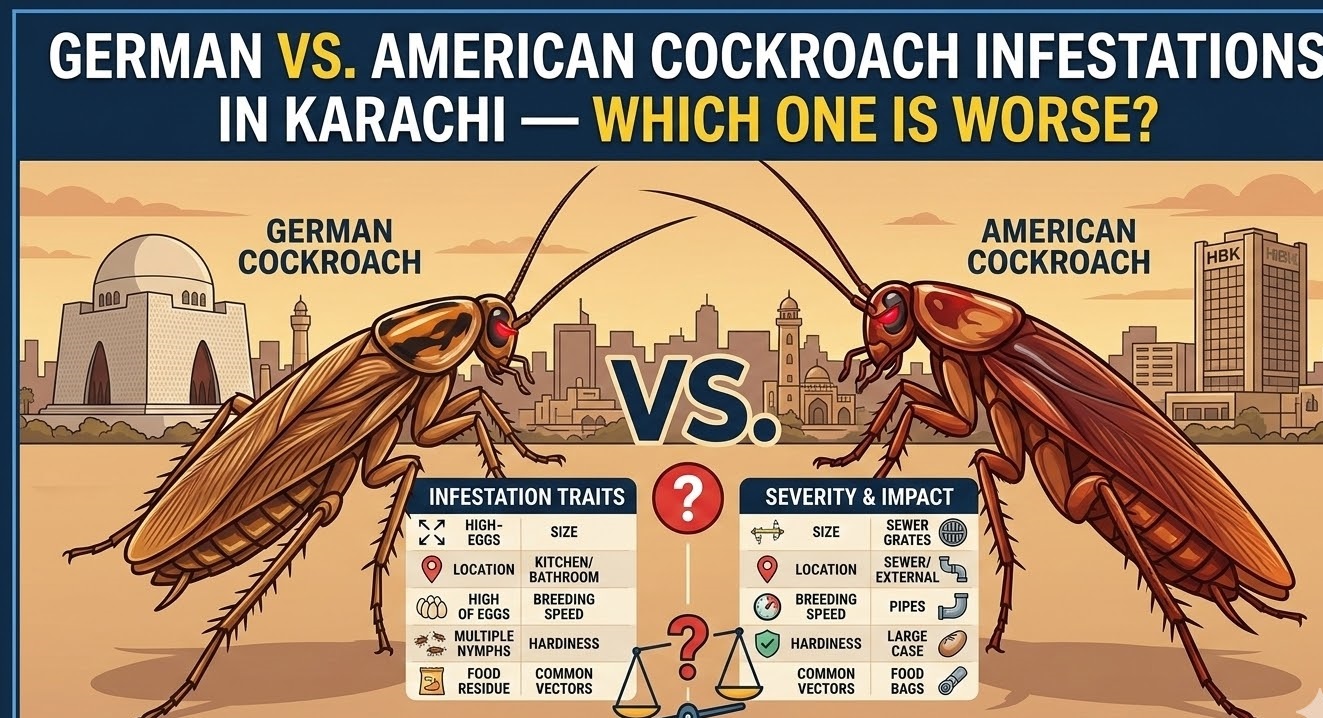

  • German vs. American Cockroach Infestations in Karachi — Which One Is Worse?

    German vs. American Cockroach Infestations in Karachi — Which One Is Worse?

    If you have ever spotted a cockroach in your Karachi home, you have probably asked yourself the same question most homeowners ask: where did it come from, and how serious is this? But there is a more important question hiding underneath that one — which species is it? Because when it comes to cockroaches, not all infestations are equal. The species you are dealing with determines how the infestation spreads, where it hides, how fast it grows, and — critically — how it needs to be treated.

    Two species dominate cockroach complaints in Karachi homes and restaurants: the German cockroach and the American cockroach. They are both extremely common, both capable of causing serious health problems, and both thriving in Karachi’s warm, humid urban environment. But they are very different pests, with very different behaviours, and very different levels of threat.

    In this guide, we break down both species in detail, compare them head-to-head across the factors that matter most to Karachi homeowners, and answer the question everyone wants answered: which one is worse — and what should you do about it?

    Quick Comparison: German vs. American Cockroach at a Glance

    Before we go deep, here is a side-by-side summary of both species across the most important factors:

    FeatureGerman CockroachAmerican Cockroach
    Size10–15 mm35–50 mm
    ColourLight brown, 2 dark stripesReddish-brown, pale band
    Breeding rateUp to 400 offspring/lifetime~150 offspring/lifetime
    Primary habitatKitchens, appliancesDrains, sewers, basements
    Can fly?RarelyYes (occasionally)
    Eradication difficultyVery HighHigh
    Entry routeBrought in on items/goodsSewers & drainage pipes
    Peak season (Karachi)Year-round, worse in summerMonsoon & pre-monsoon
    Health risk levelVery HighHigh

    Read on for the detailed breakdown — because the numbers above only tell part of the story.

    Meet the German Cockroach (Blattella germanica)

    German Cockroach Profile

    Size: 10–15 mm — small enough to hide in an electrical socket  |  Colour: Light tan to medium brown, with two distinctive dark parallel stripes running down the back of the head  |  Lifespan: Approximately 12 months  |  Reproduction: Up to 400 offspring per female in a lifetime

    Where It Lives in Karachi Homes

    Despite its small size, the German cockroach is considered the most problematic domestic cockroach species in the world — and Karachi is no exception. It is almost exclusively an indoor species, meaning it lives, breeds, and dies inside your home or business premises. It does not come in from the sewers.

    Its preferred habitats in Karachi kitchens and homes include:

    • Inside and behind kitchen appliances — microwaves, toasters, refrigerator motor housings, electric kettles
    • Inside wall-mounted kitchen cabinets, especially hinges, corners, and the space behind shelving
    • Behind and beneath the kitchen stove, particularly in the narrow gap between appliance and wall
    • Inside electrical distribution boards and control panels
    • In cracks and crevices behind tiles, particularly near heat and moisture sources
    • Inside hotel rooms, guest houses, and restaurant kitchens — particularly in seating banquettes and under counter equipment

    How It Gets Into Your Home

    This is where the German cockroach differs most significantly from the American cockroach — and where it is most deceptive. It does not enter through drains or from the outside environment. It is almost always introduced through:

    • Second-hand furniture, particularly sofas, wardrobes, and kitchen cabinets
    • Cardboard boxes and grocery packaging — particularly bulk items purchased from wholesale markets like Jodia Bazaar or Empress Market
    • Electrical appliances purchased second-hand or reconditioned
    • Moving vans and storage facilities
    • Cross-infestation from a neighbouring apartment in a shared building

    The Karachi factor: Karachi’s apartment living culture — particularly in high-density buildings across Gulshan-e-Iqbal, North Nazimabad, Clifton, and Defence — means that a German cockroach infestation in one flat can spread to multiple neighbouring units within weeks through shared wall cavities, utility chases, and ventilation gaps. In buildings with older construction and minimal inter-unit sealing, this is a persistent and frustrating problem.

    Why the German Cockroach Is So Hard to Eliminate

    The German cockroach’s reproduction rate is extraordinary. A single fertilised female can produce an egg case (ootheca) every three to four weeks, and each case contains 30 to 40 eggs. Unlike most other cockroach species, the female carries the egg case with her until just before hatching — protecting it from environmental threats and desiccation.

    At peak breeding rate in Karachi’s warm climate, a population can double every few weeks. A starting population of 10 cockroaches can theoretically become hundreds within a single season.

    Additionally, the German cockroach has developed significant resistance to many of the insecticide compounds found in over-the-counter spray products available in Karachi pharmacies and supermarkets. Spraying visible cockroaches may reduce the population temporarily, but surviving individuals quickly repopulate — and resistance is passed to offspring.

    Eradication Difficulty: Very High. Requires professional gel baiting, insect growth regulators, or targeted residual treatment. Over-the-counter sprays rarely achieve lasting results.

    Meet the American Cockroach (Periplaneta americana)

    American Cockroach Profile

    Size: 35–50 mm — Karachi’s largest common household cockroach  |  Colour: Reddish-brown with a pale, yellowish figure-eight pattern on the back of the head  |  Lifespan: Up to 2 years  |  Local names: Sewerage cockroach, Pani waala cockroach

    Where It Lives in Karachi Homes

    The American cockroach is the large, reddish-brown cockroach that most Karachi homeowners are familiar with — the one that appears from the bathroom drain at night or scuttles along the kitchen floor when the light comes on. Unlike the German cockroach, it is primarily a pest of outdoor and semi-outdoor environments that regularly enters homes in search of food, water, and shelter.

    Its preferred habitats and entry routes in Karachi include:

    • Municipal sewage systems — from which it enters homes through floor drains, U-bends, and toilet plumbing
    • Outdoor drainage channels and open nullahs — extremely common in many parts of Karachi
    • Basements, ground-floor storage rooms, and utility areas
    • Behind water heaters and in the warm, damp space beneath kitchen sinks
    • In the wall cavities of older properties, accessed through deteriorating mortar and cracked plaster
    • Under loose paving slabs, in garden areas, and in rubbish storage zones

    How It Gets Into Your Home

    The American cockroach enters homes almost exclusively through the building’s drainage and utility infrastructure — which is why it is so closely associated with bathrooms and kitchens. In Karachi, where much of the municipal sewage network is ageing and under capacity, the connection between sewer activity and household cockroach ingress is direct and consistent.

    The Karachi factor: Areas of the city with older drainage infrastructure — including large sections of Saddar, Garden, Lyari, Keamari, and many parts of East and West Karachi — experience chronic American cockroach pressure because the municipal sewer network is essentially continuous with the domestic plumbing of nearby buildings. Cockroaches living in the sewer system can and do enter homes through floor drains when the water trap in the drain dries out, particularly during the hot and dry months from March to May.

    The American cockroach can also fly, although it does so infrequently and typically only in high temperatures — another reason Karachi’s summer months see an increase in reported sightings.

    Why the American Cockroach Is Still Dangerous

    Because the American cockroach is large and visible, many Karachi homeowners underestimate the health risk it poses — treating the occasional sighting as a nuisance rather than a genuine threat. This is a mistake.

    The American cockroach spends its time in sewage systems, waste areas, and organic debris before entering your home. It carries the pathogens, bacteria, and parasites from these environments directly onto kitchen surfaces, food preparation areas, and utensils. Documented health risks include Salmonella, E. coli, various parasitic organisms, and the transmission of gastroenteritis and dysentery — all of particular concern given Karachi’s existing public health challenges.

    Its shed skin and droppings are also documented asthma and allergy triggers, particularly affecting children in homes with ongoing infestations.

    Eradication Difficulty: High, but more achievable than German cockroach elimination with professional treatment that includes both chemical treatment and physical exclusion of entry points.

    Head-to-Head: How They Compare on the Factors That Matter

    1. Breeding Speed and Infestation Growth Rate

    The German cockroach wins — in the worst possible way. Its reproduction rate is faster than any other common household cockroach species, and its habit of carrying the egg case on its body until hatching gives its offspring a significantly higher survival rate. In Karachi’s climate, where warm temperatures persist for most of the year, German cockroach populations can grow from a handful of individuals to hundreds within a single season.

    The American cockroach breeds more slowly, produces fewer offspring per female over her lifetime, and deposits egg cases in the environment (where they are more vulnerable). Its population growth is still significant, but it does not escalate with the same alarming speed as a German cockroach infestation.

    Winner (more dangerous): German Cockroach: Significantly faster breeding cycle and higher survival rate for offspring.

    2. Difficulty of Elimination

    Again, the German cockroach is considerably harder to eliminate. Its preference for living deep inside appliances, wall voids, and electrical equipment means it is physically difficult to reach with surface-applied treatments. Its acquired resistance to common pesticides means that many standard over-the-counter products have minimal long-term effect. And because it is an exclusively indoor species, there is no ‘outdoor population’ that can be addressed — the entire infestation is inside your home.

    The American cockroach is hard to eliminate completely because new individuals continue entering from the drainage system. But the infestation itself is more accessible to professional treatment, and physical exclusion work — sealing drain covers, fitting pipe mesh, ensuring U-bends retain water — significantly reduces reinfestation pressure.

    Winner (more dangerous): German Cockroach: Indoor-only habitat, pesticide resistance, and inaccessible harborage make it the harder infestation to resolve.

    3. Health Risk to Your Family

    Both species pose genuine and serious health risks through contamination of food and surfaces. However, the German cockroach’s habit of living inside kitchen appliances and food preparation areas means it has more direct and sustained contact with the surfaces your family eats from. It is also more likely to contaminate food at source — inside storage areas and appliances — rather than on surfaces that are regularly cleaned.

    The American cockroach’s route through sewage infrastructure and waste environments means it carries a particularly heavy pathogen load. A single American cockroach walking across your kitchen counter after entering through the bathroom drain deposits organisms from the municipal sewer directly onto your food preparation surface.

    Verdict: Both are high risk: German cockroach for sustained contamination of food prep areas; American cockroach for direct pathogen transfer from sewage environments. Neither should be tolerated.

    4. Visibility and Early Detection

    The American cockroach is large — up to 50mm — and significantly easier to spot. Most Karachi homeowners notice an American cockroach infestation at a fairly early stage, simply because a large reddish-brown cockroach scuttling across the floor at night is hard to miss.

    The German cockroach is far more deceptive. At 10–15mm and living primarily inside appliances and cabinet interiors, German cockroach infestations often reach significant population sizes before homeowners notice anything. By the time you see a German cockroach in daylight, the infestation is almost certainly large and well-established.

    Winner (more dangerous): German Cockroach: Its small size and hidden habitat mean infestations are typically discovered late — when they are already severe.

    5. Karachi-Specific Threat Level by Area

    Both species are present across Karachi, but their distribution reflects the city’s geography and infrastructure:

    • German cockroach risk is highest in: Dense apartment buildings, restaurant districts (Burns Road, Bahadurabad, Tariq Road), hotels and guest houses, food processing facilities, and any property where second-hand goods or bulk packaging are frequently introduced.
    • American cockroach risk is highest in: Properties near open nullahs or drainage channels, older properties with ageing plumbing (Saddar, Garden, Lyari, Civil Lines, parts of Korangi and Landhi), ground-floor and basement properties, and areas with irregular municipal waste collection.

    Many Karachi homes — particularly in older mixed-use areas — are at elevated risk from both species simultaneously, which significantly complicates both prevention and treatment.

    So Which One Is Worse? The Honest Answer

    Based purely on the factors above, the German cockroach is the more dangerous infestation for most Karachi homeowners. Its faster breeding rate, greater resistance to treatment, deceptive hiding behaviour, and tendency to be discovered only once an infestation is already severe make it a significantly harder pest to manage once established.

    However — and this is important — the American cockroach is absolutely not a problem you can ignore or dismiss. Its direct route from the sewage system into your kitchen, combined with the heavy pathogen load it carries from that environment, makes every American cockroach sighting a genuine health risk. And in areas of Karachi where sewage infrastructure is ageing or under capacity, American cockroach pressure can be relentless without professional intervention and physical exclusion work.

    The most dangerous scenario of all — and one that is more common in Karachi than most homeowners realise — is a co-infestation of both species. When German and American cockroaches are both present in the same property, the complexity of treatment increases significantly. Different species require different treatment approaches, different harborage areas need to be targeted, and entry points need to be addressed alongside internal colony elimination. This is a situation that is virtually impossible to resolve with standard consumer products.

    How to Tell Which Species You Have — Or Whether You Have Both

    Use these identification clues to make an initial assessment:

    Signs of a German Cockroach Infestation

    • Small (under 15mm) light brown cockroaches visible in the kitchen, particularly near the stove or behind appliances
    • Dark, pepper-like droppings inside kitchen cabinets, drawer corners, and near hinges
    • A mild musty smell emanating from inside cabinets or appliances
    • Egg cases (small dark brown capsules) glued to the interior surfaces of cabinets
    • Cockroaches visible during the day — a sign the infestation is already large and space is at a premium

    Signs of an American Cockroach Infestation

    • Large (over 30mm) reddish-brown cockroaches, most often seen at night in bathrooms or kitchens
    • Cockroach sightings near floor drains, toilet plumbing, or the area beneath the kitchen sink
    • Larger, ridged egg cases left near damp, dark areas
    • Smear marks along skirting boards and walls — dark, irregular streaks left where cockroaches repeatedly travel
    • A strong, oily odour in utility areas or bathrooms

    If you are seeing both small light-brown cockroaches AND large reddish-brown ones, or if you notice signs of both types, treat this as a co-infestation and seek professional assessment immediately.

    Why Consumer Products Fail Against Both Species in Karachi

    The shelves of Karachi’s pharmacies and supermarkets are stocked with cockroach sprays, chalk sticks, baits, and traps. Many homeowners spend significant money on these products and achieve, at best, a temporary reduction in visible cockroach activity. Here is why:

    • Resistance: German cockroaches in particular have developed documented resistance to the pyrethroid compounds used in most over-the-counter sprays. Killing a visible cockroach with spray does not address the colony hidden inside your appliances.
    • Egg case survival: Neither spray products nor chalk treatments penetrate the protective casing of cockroach egg cases. Even if every adult cockroach in your home is killed, the next generation hatches two to six weeks later completely unaffected.
    • Inaccessible harborage: The interior of a microwave, behind a refrigerator compressor housing, or deep inside a wall cavity is not accessible to surface-applied sprays. The colony survives and rebuilds.
    • No entry point treatment: Consumer products address cockroaches that are already present but do nothing to prevent new ones entering through drainage systems or from neighbouring properties.
    • Wrong product for the species: Treatments effective against American cockroaches (focused on drainage and perimeter) are different from those required to eliminate German cockroach colonies (focused on internal baiting and harborage). Using a single product for both is rarely effective for either.

    The Hidden Connection: Cockroaches, Structural Damage, and Other Pest Risks

    There is one additional risk factor that many Karachi homeowners overlook when dealing with cockroach infestations: the conditions that allow cockroaches to thrive — particularly moisture, structural gaps, and deteriorating building materials — are the same conditions that make properties vulnerable to other serious pest problems. Properties in Karachi that are experiencing ongoing American cockroach entry through wall voids and subfloor areas should be assessed for termite activity, which is widespread in Karachi homes and often goes undetected until significant structural damage has already occurred.

    Damp timber in subfloor spaces, wall cavities, and around ageing plumbing penetrations — exactly the environments that American cockroaches exploit — is also prime territory for termite colonies. If a professional inspection reveals extensive American cockroach ingress through structural gaps, it is well worth asking your pest control technician to also assess for termite infestation and structural damage in your Karachi property. Identifying and treating both problems together is considerably more cost-effective than dealing with them separately.

    What Professional Treatment Looks Like for Each Species

    Understanding the difference in treatment approach reinforces why species identification matters so much:

    Professional Treatment for German Cockroach Infestations

    • Targeted gel baiting — placed inside appliances, cabinet interiors, and wall voids — which cockroaches consume and carry back to the colony
    • Insect growth regulators (IGRs) that disrupt the breeding cycle, preventing nymphs from reaching reproductive maturity
    • Residual insecticide application to harborage points using formulations with documented efficacy against resistant populations
    • Monitoring traps to assess population size and treatment progress
    • Follow-up treatment sessions, as German cockroach infestations rarely resolve in a single visit

    Professional Treatment for American Cockroach Infestations

    • Residual insecticide treatment in drainage areas, utility rooms, and entry points
    • Physical exclusion: sealing pipe penetrations, fitting mesh drain covers, ensuring U-bends retain water
    • Exterior perimeter treatment to intercept cockroaches travelling from drainage channels and waste areas
    • Drain flushing with specialist products where drainage systems are heavily infested
    • Structural assessment to identify and seal the entry routes through which cockroaches are entering the building

    For co-infestations of both species, a phased treatment programme is typically required — addressing internal German cockroach colonies first, then implementing American cockroach exclusion and perimeter management.

    Not Sure Which Species You Have?

    Book a FREE Professional Inspection with Unique Fumigation.

    Correct identification is the foundation of effective cockroach control. Our licensed Karachi-based technicians will identify the species present in your home or business, assess the scale and severity of the infestation, identify entry points and harborage areas specific to each species, and design a targeted treatment programme — at no cost to you for the initial inspection.

    Whether you are dealing with German cockroaches in your kitchen appliances, American cockroaches from the drainage system, or both — we have the experience, the products, and the local knowledge to resolve it.

    Call or WhatsApp Unique Fumigation today to book your FREE inspection.

    Serving DHA, Clifton, Gulshan-e-Iqbal, Nazimabad, North Karachi, PECHS, Korangi, Saddar, Lyari, Malir, and all surrounding areas of Karachi.

    Final Word

    German or American — both cockroach species found commonly in Karachi homes are capable of causing genuine harm to your family’s health, your food safety, and in the case of food businesses, your livelihood and compliance record. The question of which is worse is less important than the question of which one you have — and what you are going to do about it.

    Do not wait for a large infestation to motivate action. Both species are far easier and less costly to eliminate when addressed early — before populations have established deeply, before resistance has compounded, and before egg cases have produced multiple new generations.

    The pre-monsoon and monsoon seasons in Karachi are the highest-risk periods for both species. If you are reading this between March and September, the time to act is now.

    © Unique Fumigation  |  Karachi’s Trusted Pest Control Specialists

  • How Cockroach Infestations Affect Food Business Licenses in Karachi

    How Cockroach Infestations Affect Food Business Licenses in Karachi

    Running a food business in Karachi — whether it is a dhaba in Saddar, a bakery in Gulshan-e-Iqbal, a café in DHA, or a catering kitchen in North Karachi — is not just about great food and loyal customers. It is also about staying legally compliant. And one of the fastest ways to lose that compliance is a cockroach infestation.

    Most business owners assume that a few roaches are a minor nuisance — something a can of spray can handle over the weekend. The reality is far more serious. In Karachi, food business licenses are directly tied to hygiene and pest control standards enforced by the Karachi Metropolitan Corporation (KMC), the Sindh Food Authority (SFA), and in some cases, the Pakistan Standards and Quality Control Authority (PSQCA). A single inspection finding cockroach activity can trigger warnings, heavy fines, forced closures, or permanent license revocations.

    This article explains exactly how cockroach infestations threaten your food business license in Karachi, what inspectors look for, what the law says, and what you can do to protect yourself before it is too late.

    The Regulatory Framework: Who Governs Food Businesses in Karachi?

    To understand the risk, you first need to understand who is watching.

    1. Sindh Food Authority (SFA)

    Established under the Sindh Pure Food Act, the SFA is the primary authority licensing and inspecting food businesses across Sindh, including Karachi. It conducts both scheduled and surprise inspections of restaurants, bakeries, hotels, catering operations, and food manufacturing units. SFA inspectors follow a detailed hygiene checklist — and pest control is one of its most heavily weighted criteria.

    2. Karachi Metropolitan Corporation (KMC)

    KMC issues trade licenses and health-related no-objection certificates (NOCs) for food establishments in Karachi. A business operating without a valid KMC health NOC is effectively illegal, and that NOC can be suspended if pest-related hygiene violations are found.

    3. Pakistan Standards and Quality Control Authority (PSQCA)

    For packaged food manufacturers and larger food processing operations, PSQCA compliance is also required. Cockroach contamination in a production facility can lead to batch seizures and license suspension under national standards.

    The bottom line: if you sell food to the public in Karachi, you are accountable to at least one — and possibly all three — of these regulatory bodies. None of them treat cockroach activity lightly.

    Why Cockroaches Are a “Red Flag” Violation for Food Inspectors

    Not all hygiene violations carry the same weight. Dirty walls or a missing soap dispenser might earn a warning. Cockroaches are different — they are classified as a critical food safety hazard for several reasons:

    • Disease transmission: Cockroaches carry over 33 types of bacteria including Salmonella, E. coli, and Staphylococcus. They physically transfer pathogens from sewage, drains, and waste directly onto food preparation surfaces.
    • Allergen risk: Cockroach droppings, shed skins, and saliva are potent allergens that contaminate food and trigger reactions in consumers.
    • Structural infestation indicator: The presence of cockroaches — especially German cockroaches (the most common species in Karachi kitchens) — signals deep-rooted sanitation failures, not just surface dirt.
    • Rapid reproduction: A single female German cockroach can produce hundreds of offspring in a few months. By the time you see them in daylight, the infestation is already severe.

    For SFA inspectors, finding even a handful of live cockroaches is enough to classify your establishment as a high-risk premises — with immediate consequences.

    What Happens When an Inspector Finds Cockroaches in Your Karachi Food Business?

    Based on SFA and KMC enforcement patterns, here is a realistic timeline of what cockroach violations can trigger:

    Stage 1: Verbal Warning and Improvement Notice

    On a first offense with minor activity, an inspector may issue a formal improvement notice, giving you 7–15 days to resolve the issue. This is logged against your business license file.

    Stage 2: Written Notice and Fine

    If the infestation is moderate or the previous warning was not addressed, you face a written notice and a financial penalty. SFA fines for hygiene violations in Karachi have ranged from PKR 5,000 to over PKR 100,000 depending on severity and business category.

    Stage 3: Temporary Closure Order

    A serious or repeated infestation can result in an immediate closure order. Your business is sealed, and you cannot reopen until you provide documentary proof of professional pest treatment and a re-inspection is passed. This can mean days or weeks of lost revenue.

    Stage 4: License Suspension or Cancellation

    Repeated violations or failure to comply with closure orders can lead to permanent license suspension. Reinstating a cancelled food business license in Karachi is a lengthy, expensive, and uncertain process.

    Stage 5: Public Blacklisting

    Increasingly, the SFA publishes lists of non-compliant food businesses online and in the press. Being named publicly as a pest-infested establishment can destroy customer trust that took years to build.

    Karachi-Specific Risk Factors That Make Cockroach Infestations Worse

    Karachi is not like other cities. Several local factors dramatically increase the risk and speed of cockroach infestations — and inspectors know this, which is why they scrutinize Karachi food businesses with extra care.

    • Heat and humidity: Karachi’s coastal climate — hot, humid summers and warm winters — is ideal for cockroach breeding year-round. Unlike colder cities where infestations slow in winter, Karachi provides no natural break.
    • Irregular water supply: The city’s inconsistent municipal water supply leads businesses to store large water tanks and drums. These create moisture-rich environments that cockroaches use as harborage.
    • Dense urban infrastructure: Areas like Saddar, Liaquatabad, Orangi Town, and New Karachi have aging buildings with crumbling plaster, exposed drains, and shared sewage infrastructure — all of which give cockroaches easy access to food businesses above.
    • Irregular waste collection: KMC garbage collection is inconsistent in many neighbourhoods. Piled waste outside food businesses directly feeds cockroach populations that then migrate indoors.
    • Shared commercial buildings: Many Karachi food businesses operate in multi-tenant commercial buildings where an infestation in one unit quickly spreads to others, even if your unit is clean.

    These factors mean that even a well-maintained Karachi food business is at constant risk. Reactive pest control — spraying when you see a cockroach — is not good enough. Inspectors know the local conditions, and they expect to see evidence of proactive, documented pest management.

    What Inspectors Actually Check: The Pest Control Audit

    When an SFA or KMC inspector evaluates your premises for pest activity, they are not simply looking for live cockroaches. They conduct a structured audit that includes:

    • Checking drains, under-sink areas, and grease traps for cockroach droppings and egg casings
    • Inspecting food storage areas, dry goods shelves, and cold room door seals
    • Looking behind and under equipment — ovens, fryers, refrigerators, and dishwashers — where heat and moisture accumulate
    • Reviewing your pest control records: Do you have a contract with a licensed pest control company? Do you have treatment certificates? Are they dated and current?
    • Assessing structural gaps: unsealed entry points around pipes, damaged door thresholds, cracks in walls near drains

    This last point is critical. Inspectors do not just want to see that you treated the problem — they want to see that you have a system in place. A business that cannot produce a current pest control service agreement is immediately suspect, even if no live cockroaches are visible on inspection day.

    This is the same structured approach that professional pest management teams apply when they assess premises for integrated pest control in Karachi — systematic, documented, and defensible to regulators.

    The Documentation That Protects Your License

    The single most protective action you can take — beyond actual pest control treatment — is maintaining a proper pest management paper trail. Here is what you should have on file at all times:

    • Pest control service contract: A written agreement with a licensed, reputable pest control company in Karachi, specifying the frequency of treatments.
    • Treatment certificates: Signed and dated certificates for every treatment visit, identifying the chemicals used, the areas treated, and the technician’s credentials.
    • Monitoring logs: Records showing regular inspection of glue boards, bait stations, or other monitoring devices installed on your premises.
    • Corrective action records: Documentation showing that when pest activity was detected, you responded promptly and took structural or procedural corrective steps.
    • Staff training records: Evidence that your kitchen and cleaning staff are trained in basic pest prevention practices — proper food storage, drain cleaning, waste management.

    When an inspector arrives unannounced — which is how most SFA inspections in Karachi happen — this documentation file is what stands between you and a closure notice.

    Why DIY Pest Control Is Not Enough for Licensed Food Businesses

    Many Karachi food business owners rely on off-the-shelf sprays, chalk lines, or ad hoc pest control measures. This approach fails for three reasons:

    1. It is not documented. Inspectors cannot verify informal treatment. Without certificates and contracts, your efforts are invisible to regulators.

    2. It does not address the root infestation. Consumer insecticides kill cockroaches on contact but do not eliminate egg casings, treat harborage areas behind walls, or address the structural conditions that allow re-infestation. A week after spraying, populations rebound.

    3. It creates chemical safety risks. Applying pesticides incorrectly in food preparation areas can itself become a food contamination violation. Professional pest control operators know which products are food-safe and how to apply them in compliance with food business regulations.

    Professional services — like licensed pest control services in Karachi — use Integrated Pest Management (IPM) approaches that combine chemical treatment, physical barriers, monitoring systems, and structural recommendations to deliver lasting, documented results.

    A Real-World Scenario: How One Inspection Can Change Everything

    Consider a mid-sized restaurant in Gulshan-e-Iqbal that had been operating for eight years without major issues. The owner managed pest control informally — using spray when needed, keeping the kitchen reasonably clean.

    An SFA spot inspection at 10 PM — when cockroach activity peaks — found evidence behind the commercial refrigerator and inside a dry goods cabinet. The inspector noted live activity, droppings, and egg casings. No pest control service agreement was on file.

    The result: an immediate 10-day closure order, a fine of PKR 75,000, mandatory professional pest treatment with documented certification before reopening, and a re-inspection condition. The 10-day closure alone cost the restaurant an estimated PKR 300,000–400,000 in lost revenue — far more than years of professional pest control contracts would have cost.

    This scenario plays out repeatedly in Karachi. The cost of prevention is always a fraction of the cost of a violation.

    How to Get and Stay Compliant: A Practical Checklist

    Here is what proactive compliance looks like for Karachi food businesses:

    • Hire a licensed, reputable pest control company and sign a formal service contract with regular treatment schedules
    • Request treatment certificates after every visit and file them in a dedicated pest control folder
    • Install cockroach monitoring stations (glue boards) in high-risk areas — under sinks, near drains, behind appliances — and check them weekly
    • Seal all structural entry points: gaps around pipes, broken drain covers, damaged door seals
    • Implement strict waste management: sealed bins, daily removal of food waste, regular cleaning of grease traps
    • Train staff on food hygiene basics, including overnight food storage, cleaning rotations, and drain maintenance
    • Schedule a pre-inspection self-audit every 3 months to identify and address issues before regulators do

    If you are unsure about your current compliance status, a professional pest inspection in Karachi can identify vulnerabilities you may not have noticed — giving you the chance to act before an SFA inspector does.

    Do Not Wait for an Inspector to Tell You There Is a Problem

    In Karachi’s competitive food industry, your license is your most valuable asset. Losing it — even temporarily — can mean lost staff, lost customers, and a reputation that takes years to rebuild. Cockroach infestations are not a matter of personal embarrassment; they are a direct, documented threat to your ability to operate legally.

    The good news is that this is entirely preventable. With the right professional partner, consistent documentation, and proactive maintenance, you can stay fully compliant and focus on what matters: running a great food business.

    📋 Book Your Free Inspection with Unique Fumigation Today

    Unique Fumigation offers certified cockroach control services trusted by food businesses across Karachi — from small dhabas to large catering operations. Our team provides fully documented treatments, service certificates, and ongoing monitoring programs designed to keep your business inspection-ready at all times.

    Do not let a cockroach cost you your license. Contact Unique Fumigation now for a free pest inspection — we will assess your premises, identify risks, and give you a clear plan to stay compliant and protected.

    Your customers trust you to keep their food safe. We help you keep that promise.

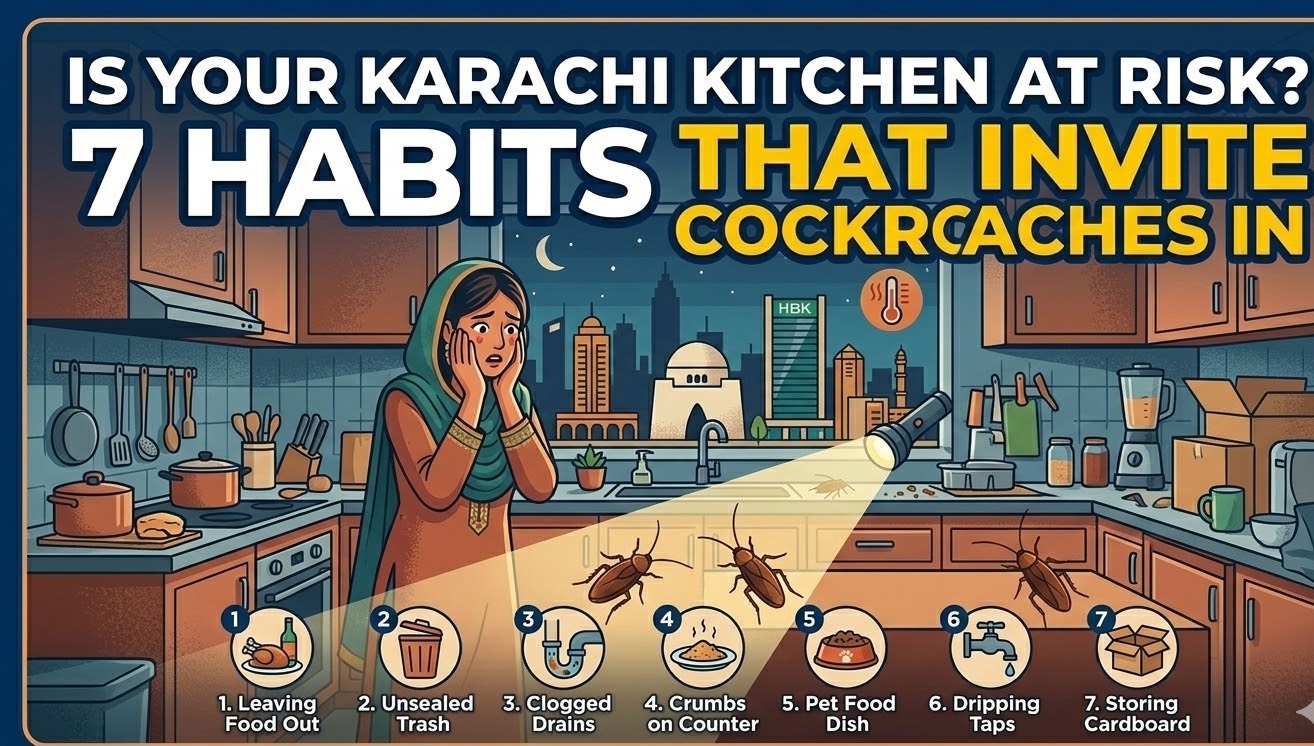
  • Is Your Karachi Kitchen at Risk? 7 Habits That Invite Cockroaches In

    Is Your Karachi Kitchen at Risk? 7 Habits That Invite Cockroaches In

    Here is an uncomfortable truth: in most Karachi homes, it is not poor hygiene that brings cockroaches in — it is a handful of everyday habits that most families do not even realise are a problem.

    You can scrub your kitchen from floor to ceiling every week and still end up sharing it with cockroaches. That is because cockroaches are not only attracted to dirt. They are attracted to food sources, moisture, warmth, and shelter — and every kitchen, no matter how clean it looks, offers all four if certain habits are left unchecked.

    Karachi’s climate makes this even more urgent. With temperatures staying warm for most of the year and monsoon season pushing humidity to extreme levels from June through September, cockroach breeding cycles in our city are faster, more aggressive, and harder to break than in cooler climates. A small problem in March can become a full infestation by July if the right conditions are present.

    In this guide, we walk through the seven most common kitchen habits that invite cockroaches into Karachi homes — and what you can do right now to change them.

    Why Cockroaches Target Your Kitchen First

    The kitchen is the cockroach’s ideal habitat. It offers everything a cockroach needs to survive and reproduce: food residue, moisture from sinks and steam, warmth from appliances, and dozens of dark, undisturbed hiding spots behind cabinets and under appliances.

    In Karachi specifically, kitchens in apartment buildings present an additional risk. Shared drainage pipes, connected wall cavities, and poorly sealed utility penetrations mean that a cockroach infestation in a neighbouring flat can spread to yours without any action on your part — unless you have actively removed the conditions that make your kitchen attractive to them.

    The seven habits below are the most common reasons Karachi homeowners end up with cockroaches, even in otherwise well-kept homes.

    Habit #1 — Leaving Dirty Dishes Overnight

    This is the single most common cockroach-attracting habit in Karachi kitchens, and it is extraordinarily easy to fall into — especially after a long day or a large family dinner.

    A single plate with food residue, a pan with cooking oil, or even a glass with a sugary drink left overnight is enough to sustain a cockroach colony. Cockroaches are most active between midnight and 4 a.m. — the exact window when your unwashed dishes are sitting on the counter or in the sink.

    The Karachi factor: During Ramadan and after family gatherings — common in homes across DHA, Gulshan-e-Iqbal, and Nazimabad — late-night cooking and delayed dishwashing create a predictable peak period for cockroach activity. Pest control professionals in Karachi consistently report increased call-outs in the weeks following Eid.

    Quick Fix: Make it a firm rule that no dishes sit in the sink overnight. Even rinsing dishes and stacking them removes the majority of the food residue that cockroaches are after.

    Habit #2 — Storing Food in Open or Loosely Sealed Containers

    Walk into most Karachi kitchens and you will find open bags of rice, loose packets of daal, unsealed flour containers, and biscuit tins with lids that do not close properly. This is an open invitation.

    Cockroaches have an extraordinary sense of smell. They can detect food odours from significant distances and will actively seek out any food source that is not properly contained. Dry goods like rice, flour, lentils, sugar, and cereals are among their preferred targets — particularly because these items are often stored in the same lower cabinets where cockroaches travel.

    The Karachi factor: Bulk buying is extremely common among Karachi households, which means large quantities of dry goods are often stored for weeks or months. A 10kg bag of rice kept in its original paper packaging in a lower cabinet is, from a cockroach’s perspective, a long-term food source that will keep them coming back reliably.

    Quick Fix: Transfer all dry goods into hard-sided, airtight containers. This single change removes one of the most reliable food signals that cockroaches use to establish themselves in a kitchen.

    Habit #3 — Ignoring Grease Build-Up Behind the Stove and Oven

    Grease is one of the most overlooked cockroach attractants in any kitchen. The area behind and beneath your stove, the sides of your oven, and the range hood above your burners accumulate cooking grease over time — and cockroaches can survive on grease alone.

    In most Karachi homes, the stove is pushed against the wall, leaving a narrow gap between the appliance and the counter or cabinets. This gap is dark, warm, rarely disturbed, and often coated with grease splatter. It is ideal cockroach harborage.

    The Karachi factor: Pakistani cooking — with its heavy use of oil, tarka, and slow-cooked curries — produces significantly more grease splatter than lighter cuisines. Homes where cooking happens multiple times a day, as is common in larger Karachi households, build up grease deposits quickly. This is one reason cockroach problems tend to concentrate in the kitchen even in otherwise clean homes.

    Quick Fix: Pull out your stove and oven every month or two and clean behind and beneath them thoroughly. Clean your range hood filter at the same time. These are the areas cockroaches are most likely to colonise first.

    Habit #4 — Letting the Bin Overflow or Go Unemptied Overnight

    Your kitchen rubbish bin is, from a cockroach’s perspective, a smorgasbord. Food scraps, packaging with residue, vegetable peelings, meat trimmings — a single day’s worth of cooking waste provides more than enough nutrition to sustain a cockroach population.

    The problem is not just what is in the bin — it is the odour that emanates from it. Cockroaches can detect the smell of organic waste from a considerable distance, and an open or overfull bin acts as a beacon, drawing cockroaches from neighbouring areas, drainage systems, and even other apartments in the same building.

    The Karachi factor: In densely populated areas of Karachi — including parts of Orangi Town, Landhi, Malir, and older residential colonies — municipal waste collection is sometimes irregular. When household rubbish accumulates outside the home for extended periods, it dramatically increases the cockroach pressure on every property in the vicinity. An uncovered or overflowing indoor bin compounds this problem significantly.

    Quick Fix: Use a bin with a tight-fitting lid. Empty it every evening before bed — not every few days. If your building has a communal waste area, ensure it is kept covered and away from your kitchen wall or window.

    Habit #5 — Ignoring Dripping Taps, Leaking Pipes, and Damp Under the Sink

    Of all the cockroach attractants, moisture may be the most underestimated. Cockroaches need water to survive, and they are strongly drawn to any consistent source of moisture — a dripping tap, a slow leak under the sink, condensation around a cold water pipe, or even the damp wood caused by a minor plumbing issue.

    The area under the kitchen sink is one of the most common cockroach harborage points in any home. It is dark, humid (due to pipe condensation and occasional drips), rarely disturbed, and often contains cleaning products and clutter that provide additional cover.

    The Karachi factor: Water supply infrastructure in many parts of Karachi is under significant pressure. Water tankers, irregular municipal supply, and ageing pipe networks mean that minor leaks and drips are extremely common — and often go unrepaired for months. During the hot season, any source of moisture becomes especially valuable to cockroaches and will reliably draw them in.

    Quick Fix: Fix all dripping taps and leaking pipes immediately. Dry out the inside of the cabinet under your sink and check it monthly. Consider fitting a dehumidifier in particularly damp kitchens, especially those in ground-floor or basement properties.

    Habit #6 — Leaving Pet Food and Water Bowls Out All Night

    Pet ownership in Karachi has grown substantially in recent years, with many families keeping cats, dogs, and birds. This brings a cockroach risk that most pet owners do not consider: pet food and water bowls left out overnight are one of the most reliable and overlooked cockroach feeding sites in the home.

    Dry pet food in particular is extremely attractive to cockroaches. It is energy-dense, has a strong odour, and is usually left in an accessible dish on the floor — exactly where cockroaches travel. A water bowl left out overnight provides the moisture that cockroaches need alongside the food source.

    The Karachi factor: Outdoor and semi-outdoor living arrangements — common in houses with courtyards and open kitchen areas in older parts of Karachi such as Lyari, Keamari, and parts of Korangi — mean that pets often eat close to areas that connect with outdoor environments. These transitional spaces are primary cockroach entry and travel routes.

    Quick Fix: Pick up pet food and water bowls before bed every night. Store dry pet food in a sealed container rather than leaving it in an open bag. Clean the area around the feeding spot daily, as food crumbs and water splashes accumulate quickly.

    Habit #7 — Neglecting Cracks, Gaps, and Unsealed Entry Points in the Kitchen

    This final habit is less about what you leave out and more about what you leave open. Cockroaches do not appear from nowhere — they enter through specific physical entry points, most of which are in or adjacent to the kitchen.

    The most common entry routes into Karachi kitchens include:

    • Gaps around water pipes and drainage pipes where they pass through the wall or floor
    • Cracks in tiled walls or floors, particularly near the sink and stove
    • Ill-fitting or damaged drain covers in the kitchen floor
    • Gaps between the back of built-in cabinets and the wall
    • Poorly sealed gaps around air conditioning pipes and exhaust fans
    • Gaps beneath kitchen doors, particularly older wooden doors that have warped

    Once cockroaches establish themselves in wall cavities and drainage systems, they have permanent access to your kitchen regardless of how careful you are with food and moisture — unless the entry points themselves are sealed.

    The Karachi factor: Older apartment buildings and houses across areas like Saddar, Garden, PECHS, and parts of Clifton have significant structural wear — cracked tiles, deteriorating grout, and ageing plumbing penetrations. These properties are at substantially higher risk of ongoing cockroach ingress regardless of surface-level cleaning habits.

    Quick Fix: Do a thorough audit of your kitchen for gaps and cracks. Use silicone sealant around pipe penetrations and caulk any cracks in tiles or walls. Fit metal or stainless steel mesh over drain openings. This physical exclusion work is one of the most effective long-term cockroach prevention measures available.

    The Broader Picture: When Cockroaches Share Space With Other Pests

    It is worth noting that the same conditions that attract cockroaches into a kitchen — moisture, structural gaps, and undisturbed cavities — are often the same conditions that create vulnerability to other household pests. In Karachi homes, particularly older properties with wooden cabinetry, structural timber, or wooden flooring, termite infestations in Karachi frequently develop in the same wall cavities and subfloor spaces through which cockroaches travel.

    If you are addressing cockroach entry points and discovering significant structural gaps, damp timber, or deteriorating woodwork in your kitchen or adjacent areas, it is sensible to have a professional also assess for termite damage and termite activity in Karachi properties. Early-stage termite infestations are frequently discovered during cockroach inspections — and treating both problems together is significantly more cost-effective than addressing them separately.

    How Quickly Can These Habits Create a Full Infestation?

    This is an important question, and the honest answer is: faster than most people expect.

    In Karachi’s climate, a female German cockroach can produce an egg case every three to four weeks, with each case containing up to 40 eggs. At that rate, a single cockroach introduced into a kitchen with the right conditions — food, moisture, harborage — can become a colony of hundreds within a few months. By the time most homeowners notice the problem, it is already well-established.

    The seven habits described above do not each individually cause an infestation overnight. But they work cumulatively. A kitchen with even three or four of these conditions present simultaneously is offering cockroaches everything they need to move in, breed, and stay.

    The most dangerous period in Karachi is the pre-monsoon window — April through June — when rising temperatures and humidity create peak breeding conditions before the rains arrive. Homeowners who have not addressed these habits by this point often find that a manageable problem becomes a severe infestation very quickly once the monsoon heat sets in.

    A Quick Self-Assessment: How Many of These Habits Apply to Your Kitchen?

    Go through the list honestly:

    • Do you regularly leave dishes overnight?
    • Is any dry food stored in unsealed packaging?
    • When did you last clean behind your stove?
    • Does your bin have a lid, and is it emptied nightly?
    • Are there any dripping taps or damp spots under your sink?
    • Are pet bowls left out overnight?
    • Are there visible cracks, gaps around pipes, or ill-fitting drain covers in your kitchen?

    If you answered yes to three or more, your kitchen is currently offering cockroaches a hospitable environment — regardless of whether you have seen any yet. Remember: cockroaches are primarily nocturnal and can be well-established long before you spot one in daylight.

    Why Changing Habits Alone Is Not Always Enough

    Improving these habits will absolutely reduce the attractiveness of your kitchen to cockroaches and lower your infestation risk. But if cockroaches are already present — particularly if they have established themselves in wall cavities, drainage systems, or within appliances — behavioural changes alone will not eliminate them.

    This is because:

    • Established colonies have reserves: Once a colony is established, cockroaches have stored resources and an existing breeding cycle that does not simply stop when food access is reduced.
    • They will adapt: Cockroaches are extremely adaptable. Reduce food access and they will shift to harder-to-detect sources — grease residue, paper, organic matter in drains.
    • Entry points remain open: Without physical exclusion work, cockroaches from neighbouring properties or the municipal drainage system will continue entering, regardless of how clean your kitchen is.
    • Eggs survive: Egg cases are resistant to many common pesticides and to changes in the environment. Even if adults are killed, the next generation will hatch in two to eight weeks.

    Professional pest management addresses all of these factors simultaneously — which is why it remains the most reliable solution for Karachi homeowners dealing with an active cockroach problem.

    Is Your Karachi Kitchen Already Infested?

    Find Out With a FREE On-Site Inspection.

    Even if you haven’t seen a cockroach yet, the conditions described in this article may already be supporting a hidden infestation. The only way to know for certain is a professional assessment — and Unique Fumigation offers this completely free of charge.

    Our licensed Karachi-based technicians will inspect your kitchen and the rest of your property, identify any active infestation, assess entry points and harborage areas, and provide a clear, honest treatment recommendation — with no pressure and no obligation.

    Call or WhatsApp Unique Fumigation today — and stop sharing your kitchen.

    Serving DHA, Clifton, Gulshan-e-Iqbal, Nazimabad, North Karachi, PECHS, Korangi, Saddar, Malir, and all surrounding areas.

    Final Word

    Cockroaches are opportunists. They do not invade clean homes out of spite — they move into kitchens that offer what they need. Remove those conditions, seal the entry points, and get professional help if they are already there, and you will have taken the most effective steps available to protect your family’s health and your home.

    Start with the seven habits above. Work through them one by one. And if you are not sure whether the problem has already started, do not wait for a midnight sighting to find out.

    The pre-monsoon season is approaching. Act now, before Karachi’s heat and humidity turn a small risk into a serious infestation.

    © Unique Fumigation  |  Karachi’s Trusted Pest Control Specialists

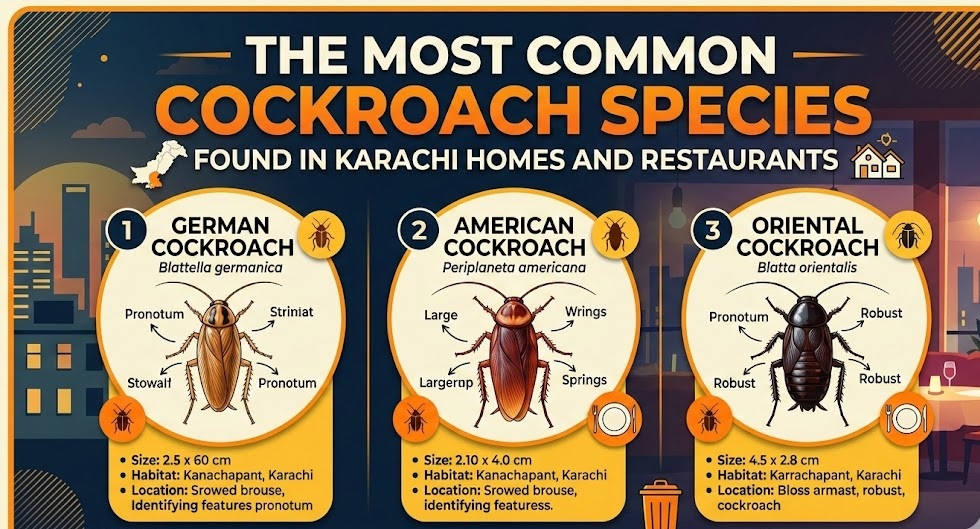
  • The Most Common Cockroach Species Found in Karachi Homes and Restaurants

    The Most Common Cockroach Species Found in Karachi Homes and Restaurants

    If you’ve ever turned on the kitchen light at night and watched something dark scurry behind your stove, you already know the problem. Cockroaches are one of the most persistent pest challenges facing Karachi homeowners and restaurant owners — and they are not just an eyesore. They carry bacteria, trigger allergies, contaminate food, and can cause serious health problems for your family or your customers.

    Karachi’s hot, humid climate — especially during the pre-monsoon and monsoon months — combined with its dense urban neighbourhoods, ageing drainage infrastructure, and bustling food industry creates the perfect breeding environment for multiple cockroach species. Knowing which species you are dealing with is the first step toward eliminating them for good.

    In this guide, we break down the most common cockroach species found in Karachi homes and restaurants, what makes each one dangerous, and — most importantly — what you can do about them.

    Why Karachi Is a Cockroach Hotspot

    Cockroaches thrive where there is warmth, moisture, and access to food. Karachi delivers all three in abundance. Here is what makes our city especially vulnerable:

    • Year-round warmth: Temperatures rarely drop low enough to naturally suppress cockroach populations.
    • Monsoon humidity: From June to September, moisture levels surge, dramatically accelerating cockroach breeding cycles.
    • Dense housing: Apartments and older residential buildings in areas like Lyari, Saddar, Orangi Town, and PECHS often share drainage and wall cavities — perfect cockroach highways.
    • Thriving food industry: Karachi’s thousands of restaurants, dhabas, and street food stalls mean organic waste is never far away.
    • Ageing sewage systems: Many areas of the city have underground drainage systems that are decades old, providing extensive shelter networks for cockroaches.

    Now, let’s look at the specific species most commonly found inside Karachi properties.

    1. The American Cockroach (Periplaneta americana)

    The Big One — and the Most Common in Karachi

    Size: 35–50mm  |  Colour: Reddish-brown with a pale yellow band behind the head  |  Local name: Sewerage cockroach / Pani waala cockroach

    Despite its name, the American cockroach is extremely common throughout South Asia, and it is arguably the most frequently spotted species in Karachi homes and commercial kitchens. You will most often find it in bathrooms and drains, under kitchen sinks and behind refrigerators, basement areas and utility rooms, restaurant kitchens and store rooms, and sewage systems — from where it enters homes through pipes and floor drains.

    • Why it is dangerous: This cockroach travels through sewers and drains before entering your kitchen. It carries Salmonella, E. coli, and other pathogens on its body and legs, depositing them directly onto food preparation surfaces. Its droppings and shed skins are also known to trigger asthma and allergic reactions, particularly in children.
    • Karachi note: In areas with older drainage infrastructure — such as parts of Clifton, Garden, and many katchi abadis — American cockroaches routinely migrate from the municipal sewer network directly into residential plumbing. If you are seeing large roaches near your bathroom at night, this is almost certainly the culprit.

    2. The German Cockroach (Blattella germanica)

    The Restaurant Nightmare

    Size: 10–15mm  |  Colour: Light brown with two dark stripes on the thorax  |  Local name: Kitchen cockroach

    If the American cockroach is the most common, the German cockroach is the most problematic — particularly for Karachi’s food service industry. This species breeds at an extraordinary rate: a single female can produce up to 400 offspring in her lifetime, and populations can double every few weeks under ideal conditions.

    It is most often found inside restaurant kitchens, pantries, and food storage areas; inside electrical appliances such as microwaves and coffee machines; behind kitchen cabinets and under countertops; and in hotel rooms and canteens.

    • Why it is dangerous: The German cockroach is notorious for contaminating food at scale. Because it lives and breeds inside electrical equipment and within wall cavities, it is much harder to eradicate with over-the-counter sprays.
    • Karachi note: This species has been identified as a growing problem in Karachi’s commercial food zones — particularly in Bahadurabad, Burns Road, and Tariq Road — where high-density restaurant operations allow rapid cross-contamination between premises. For food businesses, a German cockroach infestation is a compliance risk you cannot afford to ignore.

    3. The Oriental Cockroach (Blatta orientalis)

    The Damp Dweller

    Size: 20–25mm  |  Colour: Dark brown to black, glossy  |  Local name: Black cockroach / water bug

    The Oriental cockroach prefers cool, dark, and very damp environments — making it a frequent resident in Karachi’s older properties, particularly during and after the monsoon season. Unlike the American cockroach, it rarely flies and tends to stay low to the ground.

    You will most often find it around leaking pipes and water-damaged walls, in damp basement areas and storage rooms, near outdoor drains and rubbish areas, in ground-floor apartments with moisture problems, and in old buildings in areas like Saddar, Civil Lines, and Soldier Bazaar.

    • Why it is dangerous: The Oriental cockroach is considered one of the filthiest cockroach species. It feeds predominantly on decaying organic matter and carries a particularly heavy load of bacteria and parasites.
    • Karachi note: Water logging in certain parts of Karachi after heavy monsoon rainfall creates extended periods of standing water — ideal conditions for Oriental cockroach population explosions. Properties that experience flooding or rising damp are at significantly elevated risk.

    4. The Brown-Banded Cockroach (Supella longipalpa)

    The Hidden Invader

    Size: 10–14mm  |  Colour: Brown with distinctive light-coloured bands across the abdomen  |  Local name: TV cockroach

    The brown-banded cockroach is smaller and less commonly identified than the other species, yet it is present in many Karachi homes — often without homeowners even realising it. Unlike most cockroaches, it actively avoids moisture and prefers warm, dry, elevated areas.

    It is most often found inside televisions, radios, computers, and other electronics; behind picture frames and ceiling corners; inside wardrobes and bookshelves; in bedrooms and living rooms — not just kitchens; and within wooden furniture and ceiling cavities.

    • Why it is dangerous: Because it inhabits bedrooms and living spaces rather than kitchens, it poses a more intimate health risk. It sheds allergen-laden skin particles in sleeping areas, which can worsen asthma and cause night-time allergic reactions.
    • Karachi note: The rise in electronic goods across Karachi households has inadvertently provided the brown-banded cockroach with more hiding places than ever. It is frequently transported between homes inside second-hand furniture, electronics, and cardboard packaging.

    Warning Signs: Do You Have a Cockroach Infestation?

    Cockroaches are nocturnal and secretive — by the time you see one in daylight, you almost certainly have a much larger hidden population. Watch out for:

    • Droppings: Small, dark, pepper-like specks near food sources, in drawers, or along skirting boards.
    • Egg cases (oothecae): Brown capsule-shaped cases attached to hidden surfaces — each can contain 15–50 eggs.
    • Musty odour: A distinctive unpleasant smell that intensifies with large infestations.
    • Shed skins: Cockroaches moult as they grow. Discarded skins near hiding spots are a clear sign.
    • Smear marks: Dark, irregular marks along walls, especially near water sources.
    • Daytime sightings: If you are seeing cockroaches in daylight, the infestation is likely severe and competition for space is forcing them out of hiding.

    The Real Health Risks of Cockroach Infestations in Karachi

    This is not merely a cleanliness issue. Medical research has consistently linked cockroach infestations to serious and sometimes chronic health conditions:

    • Gastroenteritis and food poisoning: Cockroaches contaminate food and surfaces with Salmonella, E. coli, Listeria, and other bacterial pathogens.
    • Typhoid and cholera: In urban environments with poor sanitation, cockroaches can act as mechanical vectors for these diseases.
    • Asthma and allergies: Cockroach allergens — found in their droppings, shed skins, and saliva — are one of the leading triggers of childhood asthma in densely populated cities.
    • Dysentery: Cockroach faecal contamination of water and food is a known contributor to dysentery outbreaks in high-density urban areas.

    For Karachi families — especially those with young children, elderly relatives, or family members with respiratory conditions — cockroach control is a genuine health priority, not an optional one.

    Why DIY Cockroach Control Fails in Most Karachi Homes

    Walk into any pharmacy in Karachi and you will find rows of cockroach sprays, chalk, and traps. Yet infestations persist — often getting worse after initial treatment. Here is why:

    • Resistance: German and American cockroaches have developed resistance to many commonly available insecticides.
    • Incomplete treatment: Spraying visible areas does nothing to address cockroaches hiding deep inside walls, drainage systems, or electrical equipment.
    • Egg cases survive: Most surface sprays do not penetrate egg cases, meaning the next generation hatches unaffected weeks later.
    • No entry point control: Without sealing access routes — drains, cracks, pipe penetrations — cockroaches simply re-enter from outside.
    • No root cause addressing: Eliminating the infestation without addressing the conditions that caused it results in reinfestation within weeks.

    Effective cockroach control requires a professional integrated pest management (IPM) approach — one that combines species identification, targeted treatment, physical exclusion, and follow-up monitoring.

    The Connection Between Cockroaches and Other Structural Pest Problems

    Many Karachi homeowners are surprised to learn that cockroach infestations often coincide with other structural pest problems. Cockroaches exploit the same entry points — cracked foundations, damaged drainage, deteriorating woodwork — that other destructive pests use. In particular, properties dealing with cockroach entry through wall cavities and subfloor spaces should also be alert to the risk of termite activity in Karachi homes, which is especially prevalent in properties with wooden flooring, furniture, or structural timber. Termites and cockroaches often share the same hidden pathways — making a comprehensive pest inspection essential for any Karachi property owner concerned about infestation.

    If your home has already experienced cockroach entry through the substructure, it is worth having a professional assess whether you also need professional termite control services in Karachi to protect the structural integrity of your property. Addressing multiple pest risks in a single inspection is both more cost-effective and more thorough.

    Practical Cockroach Prevention Tips for Karachi Homeowners

    While professional treatment is essential for an active infestation, these measures will help reduce your risk:

    In the Kitchen

    • Store all food — including dry goods like rice, flour, and lentils — in airtight containers.
    • Do not leave dirty dishes overnight.
    • Clean behind and beneath appliances regularly. Grease build-up behind stoves is a major attractant.
    • Empty rubbish bins daily and use bins with tight-fitting lids.
    • Fix leaking taps and pipes immediately — even a slow drip provides enough moisture to sustain a colony.

    In Bathrooms and Drainage Areas

    • Fit mesh screens or drain covers over floor drains and overflow pipes.
    • Seal gaps around water pipes where they pass through walls.
    • Ensure U-bends in plumbing are always filled with water, as dry traps allow direct entry from the sewer.

    Around the Home

    • Seal cracks and crevices in walls, skirting boards, and around door frames.
    • Reduce clutter — cardboard boxes, paper bags, and stacked newspapers are prime cockroach harborage.
    • Check second-hand furniture and cardboard packaging before bringing it inside.
    • Ensure window and door screens are intact, particularly during monsoon season.

    A Note for Karachi Restaurant and Food Business Owners

    The stakes are even higher in a commercial setting. A cockroach infestation in a Karachi restaurant or food business is not just a health risk — it is a reputational and legal risk. Karachi’s food safety regulations increasingly require documented pest control programmes, and a visible infestation can result in closure orders.

    German cockroaches in particular are virtually impossible to eliminate without professional treatment. Their ability to breed inside equipment, their resistance to standard pesticides, and their rapid reproduction rate mean that even a small initial population can become a full-scale infestation within weeks during Karachi’s warmer months.

    A professional pest control programme — including regular scheduled treatments, documentation for regulatory compliance, and staff training on hygiene practices — is the only reliable solution for food businesses in Karachi.

    Book Your FREE Cockroach Inspection in Karachi

    Don’t wait until the problem gets worse.

    Unique Fumigation offers free on-site pest inspections across Karachi. Our licensed technicians will identify the cockroach species present, assess the severity of the infestation, map all entry points and harborage areas, and recommend a targeted treatment plan — with no obligation.

    We use government-approved, family-safe treatments designed to eliminate infestations at the source — and keep them from coming back.

    Call or WhatsApp Unique Fumigation today to book your FREE inspection.

    Serving DHA, Clifton, Gulshan-e-Iqbal, North Karachi, Korangi, PECHS, Saddar, and all surrounding areas.

    Final Word

    Cockroaches are not a sign of a dirty home — they are a sign of an environment that, without targeted intervention, will continue to attract and sustain them. Karachi’s unique climate and infrastructure make cockroach control a year-round challenge, not a one-time fix.

    Understanding which species you are dealing with, why they are there, and how they are getting in is the foundation of effective control. But identifying the problem is only the first step — professional pest management is what turns awareness into lasting results.

    Take action now — before the monsoon season amplifies the problem. Contact Unique Fumigation for a free, no-obligation inspection and protect your family, your guests, or your customers today.

    © Unique Fumigation | Karachi’s Trusted Pest Control Specialists