Category: Termite

This category features informative articles about termites, including identification, signs of infestation, prevention tips, treatment methods, and the damage termites can cause to homes and buildings. Explore our expert guides to learn how termites spread, how to protect your property, and what steps to take if you suspect termite activity.

  • DIY Termite Treatments vs. Professional Fumigation — What Actually Works in Karachi?

    DIY Termite Treatments vs. Professional Fumigation — What Actually Works in Karachi?

    You spot mud tubes behind the kitchen cabinet. A door frame sounds hollow when you knock on it. Wings are scattered near the window. Your stomach drops — and within minutes you are searching online for “termite treatment at home in Karachi” or watching videos about DIY pest control solutions that promise quick results at a fraction of the cost of calling a professional.

    It is a completely understandable reaction. Professional pest control has a cost, and in a city like Karachi — where household budgets are already stretched — the appeal of a Rs. 500 spray or a home remedy passed down through the family is obvious. The problem is that when it comes to termites, the gap between what appears to work and what actually works can mean the difference between a manageable treatment and a structural disaster that costs hundreds of thousands of rupees to repair.

    This guide cuts through the noise. We will examine every major DIY termite control method available in Karachi’s market — honestly, without exaggeration — and explain exactly why professional treatment works where DIY solutions fail. By the end, you will have everything you need to make an informed decision about your home.

    Why DIY Termite Control Is So Appealing in Karachi — And Why It Falls Short

    Karachi has a thriving market of retail pest control products available at general stores, hardware shops in Saddar, and increasingly through online platforms like Daraz. Walk through Urdu Bazaar, the hardware markets of Shershah, or any major superstore, and you will find shelves of sprays, powders, and solutions labeled for termite control.

    The DIY instinct is also culturally embedded in how Karachi households approach home maintenance. Many homeowners have inherited remedies and tips — from mixing kerosene into soil around the house to applying a paste of boric acid — that have been passed through generations. And in fairness, some of these remedies do produce visible short-term results. Termites retreat from treated surfaces. The mud tubes stop appearing in the area you sprayed. The problem seems solved.

    The critical issue is that termites are colony insects. The workers you see, and the mud tubes you observe, represent perhaps 1–5% of the actual colony population. The queen, the reproductives, and the vast majority of the colony are deep in the soil — typically 1 to 3 metres below the surface in Karachi’s conditions — entirely unaffected by anything applied to the surface of your home.

    ⚠️  The Core Problem with DIY: Surface treatment eliminates visible termites and creates the illusion of success. Meanwhile, the colony — which can number between 500,000 and 5,000,000 individuals — simply reroutes. New mud tubes appear in a different location within days or weeks, often deeper in the structure and harder to detect.

    Every Major DIY Termite Treatment — Examined Honestly

    1. Retail Insecticide Sprays (Most Common in Karachi)

    Products like Hit, Mortein, Doom, and various generic pesticide sprays are the first port of call for most Karachi homeowners who spot termites. They are affordable, widely available, and produce an immediate, visible kill of surface termites.

    What it actually does: Kills or repels termites on the surface it contacts. The repellent effect actually causes a phenomenon called “termite scatter” — the colony detects the chemical and splits into multiple sub-groups that establish new nesting sites in different areas of the structure, making the infestation harder to treat comprehensively.

    The Karachi problem: In Karachi’s heat, liquid sprays evaporate quickly and lose efficacy within hours. Re-application every few days is needed to maintain any barrier effect — which is neither practical nor cost-effective, and does nothing for the underground colony.

    Verdict: Useful for instant visible kill only. Does not treat the colony. May worsen the infestation by causing scatter. Not a substitute for professional treatment under any circumstances.

    2. Kerosene, Petrol, or Diesel Poured Around Foundations

    This remains one of the most widely used DIY termite approaches in older Karachi neighborhoods, particularly in areas like Orangi Town, Baldia Town, New Karachi, and Liaquatabad. Homeowners pour petroleum-based fuels around the base of walls and into soil near the foundation, believing the fumes and toxicity will penetrate and kill the colony.

    What it actually does: Petroleum products do have some toxicity to insects at the point of contact. However, they evaporate rapidly, especially in Karachi’s summer heat, and do not penetrate more than a few centimetres into compacted soil — nowhere near the depth of an established subterranean colony.

    The real danger: This approach introduces serious fire and health risks. Karachi sees multiple residential fires annually linked to the misuse of flammable liquids near structural foundations and inside wall cavities. Additionally, petroleum contamination of soil near a property can damage underground utility lines and create long-term environmental hazards.

    Verdict: Ineffective against established colonies. Actively dangerous. Do not use. This is one of the most commonly observed misapplication practices in Karachi and one of the most counterproductive.

    3. Boric Acid (Borax) Treatments

    Boric acid — sold in Karachi at pharmacies and some hardware stores as borax powder — is one of the more scientifically grounded DIY termite control substances. It works by disrupting termites’ digestive systems and nervous systems upon ingestion. Applied as a paste or powder to wooden surfaces or used in homemade bait stations, it can kill individual termites that contact it.

    What it actually does: Boric acid is genuinely toxic to termites and can eliminate individual workers that feed on treated material. It has low toxicity to humans and pets, making it one of the safer DIY options.

    The limitation: For boric acid to work as a colony treatment, it must be carried back to the queen in sufficient quantities. The mixing ratios, application methods, and bait formulations used in DIY applications are almost never optimized to achieve this. Most DIY boric acid treatments kill surface workers without meaningful impact on the colony. Additionally, boric acid washes out quickly in Karachi’s humid conditions and monsoon rain, requiring frequent reapplication.

    Verdict: Better than sprays and far safer than petroleum products. Useful as a supplementary measure on isolated wooden surfaces. Not effective as a standalone treatment for active infestations in Karachi’s climate.

    4. Retail Termiticide Powders and Concentrates

    A step up from consumer sprays, these products are diluted in water and applied to soil around the building perimeter. Brands available in Karachi’s Shershah market and agricultural supply shops include various chlorpyrifos-based and bifenthrin-based concentrates, often sold without clear labeling of concentration or safe application instructions.

    What it actually does: When properly diluted and applied in sufficient volume and depth, termiticide concentrates can create a soil barrier. The problem is that without professional equipment, training, and knowledge of application rates, DIY application almost never achieves the depth, coverage, and continuity required for an effective barrier.

    The Karachi-specific problem: Many of the termiticide concentrates available in Karachi’s open market are uncertified, improperly stored, or counterfeit. Using these products incorrectly can pose genuine health risks to household members — particularly children — and may create chemical resistance in termite populations that makes subsequent professional treatment less effective.

    Verdict: Theoretically capable but practically insufficient in almost all DIY applications. Health and safety risks are real. Without professional equipment and training, the soil barrier will have gaps — and termites will find them.

    5. Online Baiting Kits

    The most sophisticated end of the DIY market, commercially available termite baiting kits have become increasingly accessible through Daraz and other Pakistani e-commerce platforms. These typically include plastic bait stations containing cellulose-based bait mixed with a slow-acting termiticide, designed to be buried in the soil around the property perimeter.

    What it actually does: The concept behind baiting is sound and is the same technology used in professional baiting programs. Termites find the bait, consume it, and carry it back to the colony — where it eventually eliminates the queen and collapses the population.

    Why DIY baiting usually fails: The success of a baiting program depends critically on correct station placement, correct bait concentration, regular monitoring (every 4–6 weeks), and timely bait replenishment. Without professional training, bait stations are frequently placed incorrectly, checked too infrequently, or allowed to run out of bait before the colony is eliminated. In Karachi’s urban density, locating where the main colony foraging trails are requires experience and professional tools that DIY kits simply do not include.

    Verdict: The most promising DIY approach in principle. In practice, success rates in residential Karachi settings are low without professional guidance on placement and monitoring. Best viewed as a supplementary tool alongside professional treatment.

    6. Orange Oil and Other “Natural” Remedies

    Social media and home remedy websites have popularized the use of orange oil (d-limonene), neem oil, and various essential oils as “natural” termite treatments. These have gained some traction in Karachi’s middle-class neighborhoods where homeowners are concerned about chemical exposure to children and pets.

    The reality: Orange oil does have demonstrable toxicity to drywood termites when directly injected into infested wood. However, it has no meaningful effect on subterranean termites — the species responsible for the vast majority of structural damage in Karachi — and provides no soil barrier protection whatsoever. Neem oil and essential oil blends have even weaker evidence bases.

    Verdict: Ineffective against the termite species most prevalent in Karachi. May delay professional treatment while the infestation deepens. Not recommended as a primary treatment method.

    The Honest Scorecard: All Methods Compared

    MethodEffectivenessCostSafetyDurationVerdict
    Retail sprayVery LowLowModerateHours❌  Do not rely on this
    Kerosene / petrolVery LowLowDangerousNone❌  Never use
    DIY boric acidLow–ModLowModerateWeeks⚠️  Surface only
    Retail termiticideLowModRisk if misused1–3 mo⚠️  Incomplete treatment
    Online baiting kitModerateModModerateVariable⚠️  May miss main colony
    Prof. soil barrierVery HighMod–HighSafe (certified)5–10 yr✅  Recommended
    Prof. wood treatmentHighModerateSafe (certified)3–5 yr✅  Recommended
    Prof. baiting systemVery HighModerateSafe (certified)Ongoing✅  Best for active colonies

    Why Professional Termite Treatment Works Where DIY Does Not

    The difference between DIY and professional termite treatment is not simply a matter of chemicals — it is a matter of diagnosis, access, concentration, continuity, and monitoring. Here is what professional treatment delivers that DIY cannot.

    1. Accurate Species Identification

    Karachi is home to multiple termite species, including Coptotermes formosanus (Formosan subterranean termite), Odontotermes obesus (mound-building termite), Heterotermes indicola (Indian subterranean termite), and several drywood termite species. Each responds differently to treatment chemicals and methods. A professional inspection identifies the exact species present, which determines the correct treatment protocol. DIY products are designed generically and are frequently ineffective against specific prevalent Karachi species.

    2. Colony Location and Foraging Route Mapping

    Effective termite treatment targets not just the visible damage but the colony’s foraging routes and the nest location. Professional technicians are trained to read structural evidence — the pattern of mud tubes, the location of damage, the building’s construction type and age — to determine where the main colony is and how it is accessing the structure. This expertise takes years to develop and cannot be replicated by a homeowner watching a YouTube video.

    3. Professional-Grade Chemicals at Correct Concentrations

    The termiticides used by certified pest control companies in Karachi — including products from the Premise (imidacloprid), Termidor (fipronil), and Biflex (bifenthrin) families — are significantly more effective and longer-lasting than anything available over the counter. They are also applied at precisely calibrated concentrations by trained technicians using professional injection equipment that ensures the chemical reaches the correct soil depth and volume.

    This is exactly what Unique Fumigation’s professional termite control services in Karachi deliver — certified chemicals, applied by trained technicians, with documented coverage records for every treatment.

    4. The Continuous Barrier — No Gaps

    The fundamental requirement of a soil termite barrier is that it must be continuous — with no gaps. A single untreated patch of soil, even a few centimetres wide, is sufficient for a subterranean colony to bypass the entire barrier. Professional application uses precisely calculated chemical volumes injected at regular intervals to ensure total coverage. DIY surface application, by contrast, almost always has uneven coverage and leaves exploitable gaps.

    5. Access to Structural Voids

    Subterranean termites often travel through wall cavities, under floor screeds, and within hollow block construction — areas that are simply inaccessible to a homeowner with a retail spray bottle. Professional treatment includes drilling through floor tiles and walls at calculated intervals, injecting termiticide under pressure, and sealing drill points — a process that requires professional equipment and carries liability implications that only a certified company can manage.

    6. Guaranteed Follow-Up and Monitoring

    Unique Fumigation’s residential termite treatment packages include scheduled follow-up inspections that confirm treatment effectiveness, identify any new activity, and apply maintenance treatments as needed. This ongoing monitoring is what converts a one-time treatment into a long-term protection program — and it is something no DIY kit can provide.

    📊  By the Numbers: Industry data from South Asian pest control markets consistently shows that DIY termite treatments have a recurrence rate of over 80% within 12 months. Professional soil barrier treatments, properly applied and maintained, achieve recurrence rates below 10% over five years.

    The Real Cost Comparison: DIY vs. Professional in Karachi

    The financial argument for DIY termite treatment is based on a simple comparison: retail spray or powder costs Rs. 500–3,000, while professional treatment costs significantly more. On the surface, this seems like an obvious saving. The calculation changes dramatically when you factor in the full cost picture.

    The True Cost of DIY Treatment

    • Initial product cost: Rs. 500–5,000 for retail sprays, powders, or baiting kits
    • Repeated applications: Most DIY treatments require reapplication every few weeks in Karachi’s climate — an annual spend of Rs. 10,000–30,000 with no long-term resolution
    • Time investment: Multiple applications, monitoring, and research time across several months
    • The hidden cost: While DIY treatment provides the illusion of control, the colony continues feeding. A study on termite damage costs in South Asian urban housing found that delayed professional treatment increased average repair costs by 4 to 8 times compared to early professional intervention
    • Structural repair if DIY fails: Replacing termite-damaged door frames, cabinetry, and wooden fixtures in a mid-size Karachi home ranges from Rs. 80,000 to Rs. 400,000+

    The True Cost of Professional Treatment

    • Initial professional treatment: Variable based on property size, construction type, and infestation severity — Unique Fumigation provides a free inspection and transparent pricing before any commitment
    • Follow-up monitoring: Included in Unique Fumigation’s treatment packages — no hidden charges for follow-up visits within the warranty period
    • Long-term protection: A properly applied professional soil barrier provides 5–10 years of protection with standard maintenance — compared to the weekly or monthly reapplication cycle of DIY treatments
    • Repair cost avoidance: Early professional treatment eliminates the primary driver of high repair costs — the months or years of continued undetected feeding that DIY approaches allow to continue
    💡  The Real Calculation: A homeowner in Gulshan-e-Iqbal who spent 8 months attempting DIY treatment — investing approximately Rs. 18,000 in products and considerable time — eventually called Unique Fumigation to find the colony had spread from the kitchen to the master bedroom wardrobe and two door frames. Professional treatment plus repairs cost over three times what early professional treatment alone would have cost.

    When (and How) DIY Has a Legitimate Role

    This guide is not arguing that there is zero role for DIY approaches in a Karachi homeowner’s termite management strategy. There are specific, limited scenarios where DIY measures are appropriate and useful:

    As Immediate First Response While Awaiting Professional Treatment

    If you discover termites and cannot get a professional appointment for several days, applying boric acid powder to exposed mud tubes and active feeding areas is a reasonable temporary measure. It will not solve the problem but may slow visible surface activity.

    As Ongoing Maintenance Between Professional Treatments

    After professional treatment has been completed, homeowners can usefully supplement protection with borate wood treatment on newly installed timber elements — furniture, door frames installed post-treatment, wooden shelving — to add an additional layer of protection.

    As Early Warning Monitoring

    Placing simple homemade monitoring stations (pieces of untreated timber buried in the garden soil, checked monthly) can help detect new termite activity between professional inspection visits. This does not treat termites but can provide early warning that professional attention is needed.

    In all other scenarios — and especially for any active infestation — professional treatment is the only approach with a meaningful probability of success in Karachi’s termite environment. If you are seeing mud tubes, hollow wood, or swarming activity, the time for DIY experimentation has passed.

    What Professional Termite Treatment from Unique Fumigation Looks Like

    For homeowners who have never experienced professional termite fumigation and soil treatment in Karachi, here is exactly what the process involves when you book with Unique Fumigation:

    1. Free inspection: A certified technician visits your property, conducts a full inspection of all accessible areas including foundation perimeter, ground floor timber elements, and high-risk zones. No charge, no obligation.
    2. Species and infestation assessment: The technician identifies the termite species present, assesses the extent of infestation, and determines the colony’s likely access points and foraging routes.
    3. Treatment plan and transparent pricing: Based on the inspection, a detailed treatment plan is prepared with clear pricing. For soil barrier treatment, this includes the chemical product to be used, the application methodology, and the coverage area.
    4. Soil barrier installation: For subterranean termite control, the primary treatment involves injecting approved termiticide into the soil at precise intervals around the building’s perimeter and, where necessary, beneath the floor slab via drilled injection points.
    5. Wood treatment: Accessible timber elements are treated with borate-based solutions or direct termiticide application. For deeply infested wood, injection treatment through drilled channels delivers chemical directly to the active colony within the timber.
    6. Baiting systems where indicated: For large, established colonies, in-ground bait stations are installed around the perimeter and monitored at scheduled intervals until colony elimination is confirmed.
    7. Post-treatment documentation and warranty: A complete treatment record is provided, including chemical used, coverage area, and warranty terms. Follow-up inspection visits are scheduled within the warranty period.

    Why Karachi Specifically Needs Professional Standards

    It is worth addressing the specific reasons why Karachi’s environment makes professional treatment not just preferable but genuinely necessary:

    • Soil depth of established colonies: In Karachi’s conditions, Coptotermes formosanus colonies are frequently found at depths of 1.5–2.5 metres below the surface. DIY soil treatment products cannot reach this depth. Professional injection equipment operates at pressures that drive chemical to these depths.
    • Colony sizes: Mature Coptotermes colonies in Karachi’s warm, year-round active climate routinely reach 1–3 million individuals. Partially treating a colony of this size simply relocates it; only comprehensive chemical barrier treatment achieves elimination.
    • Urban density: In neighborhoods like North Nazimabad, Federal B Area, and Gulshan-e-Iqbal, properties are built close together with shared boundary walls and contiguous soil. This means termite colonies routinely span multiple properties. Treating only one property without addressing the boundary soil is insufficient — professional treatment plans account for this in a way DIY approaches cannot.
    • Monsoon reactivation: Each year’s monsoon season reactivates previously dormant soil termite activity and drives swarming events. Professional treatment schedules account for this seasonal cycle; DIY approaches are almost always reactive and therefore always one step behind the colony’s behavior.
    • Construction quality variability: Karachi’s housing stock ranges from meticulously engineered DHA villas to informally constructed homes in peripheral areas with highly variable soil contact, drainage, and structural integrity. Professional treatment is adapted to these realities in a way generic retail products are not designed to address.

    Frequently Asked Questions

    Is it safe to stay in the home during professional termite treatment?

    In most cases, yes. Unique Fumigation uses certified, government-approved termiticides that are safe for re-occupancy within a few hours of application. Your technician will give specific guidance based on the treatment method used. Soil injection treatment around the exterior perimeter typically allows immediate re-occupancy of interior spaces.

    I used a DIY treatment six months ago. Do I need professional treatment now?

    If DIY treatment appeared to resolve visible termite activity but the infestation was not professionally verified as eliminated, a professional inspection is strongly recommended. The most common scenario after DIY treatment is a colony that has rerouted — moved its foraging paths to areas not treated — and is continuing to expand unseen. Early professional assessment can detect this before significant additional damage occurs.

    What makes Unique Fumigation’s chemicals better than what I can buy in Shershah market?

    The products available in Karachi’s open markets are often unregistered, improperly labeled, or counterfeit versions of legitimate termiticides. Even genuine products require correct dilution ratios, application rates, and injection pressures to be effective — variables that are only controlled in professional application. Unique Fumigation uses authenticated, imported-grade termiticides from certified suppliers with documented concentration and efficacy data.

    Can I combine DIY treatment with professional treatment to save cost?

    Some DIY supplementary measures — such as borate treatment on new timber fittings or simple monitoring stations in the garden — can complement professional treatment. However, attempting DIY treatment in areas designated for professional soil injection treatment before the professional application is done may actually compromise the professional treatment by disturbing colony foraging routes. Always consult with the professional team before applying any DIY products to areas that will be professionally treated.

    How do I know if the professional treatment has worked?

    Unique Fumigation’s treatment plans include follow-up inspection visits within the warranty period. Signs of successful treatment include complete cessation of mud tube construction, no new hollow wood areas, and absence of swarming activity. Bait station programs are monitored at regular intervals with colony activity records maintained — you can see the evidence of effectiveness in documented monitoring reports.

    The Bottom Line: What Actually Works in Karachi

    The answer to the question in this article’s title is clear: in Karachi’s conditions, with Karachi’s termite species, and given the depth and scale of established colonies, professional termite treatment works. DIY treatment does not — at least not as a standalone solution to an active infestation.

    This is not a sales argument. It is an honest assessment of the biology of Karachi’s dominant termite species, the limitations of retail-available products, and the real cost arithmetic that plays out in home after home across the city every year.

    If you have already tried DIY approaches and are not confident the problem is resolved — or if you have just discovered signs of termite activity for the first time — the most valuable thing you can do right now is get a professional assessment. Not because you have to commit to treatment, but because understanding what you are actually dealing with is the only rational basis for deciding what to do next.

    📞  Book Your FREE Professional Inspection Today Stop guessing. Stop spending on products that won’t solve the problem. Get a certified Unique Fumigation technician to inspect your property — at zero cost and zero obligation — and tell you exactly what you are dealing with and what it will take to fix it. ►  Visit: uniquefumigation.com/termite-control-services-in-karachi/ Karachi homes from DHA to Orangi, Clifton to Korangi, Bahria Town to North Nazimabad — we inspect and treat them all. Professional treatment is not an expense. It is the cost of protecting everything else.

    Unique Fumigation  |  Karachi’s Certified Termite & Pest Control Specialists

    Government-Approved Chemicals  •  Certified Technicians  •  Warranty-Backed Treatment  •  Free Inspections
  • 5 Early Signs of Termites in Karachi Houses You Shouldn’t Ignore

    5 Early Signs of Termites in Karachi Houses You Shouldn’t Ignore

    You’ve just noticed something odd — a thin mud line running up your kitchen wall, or a door that suddenly won’t close properly. You brush it off. Life in Karachi is busy. But these small, easy-to-dismiss signs could be the beginning of a costly nightmare.

    Termites are often called the “silent destroyers” for good reason. By the time visible damage appears, these insects may have been eating through the wooden framework, flooring, and structural supports of your home for months — even years. In a city like Karachi, where humidity, heat, and urban density create the perfect conditions for termite colonies to thrive, knowing the early warning signs is not just useful. It is essential.

    ⚠  IMPORTANT:  A mature termite colony can consume up to a kilogram of wood every single day. Early detection is the only way to stop minor damage from becoming a structural catastrophe. If you spot even one of these signs, take action immediately.

    🏙  WHY KARACHI HOMES ARE ESPECIALLY VULNERABLE  Karachi’s coastal geography means high ambient humidity year-round. The city’s pre-monsoon heat (March–June) followed by the moisture surge of the monsoon season (July–September) creates near-perfect breeding conditions for subterranean termites — the most destructive species found in Pakistani homes. Add to this the prevalence of older construction in neighborhoods like PECHS, Gulshan-e-Iqbal, Nazimabad, and Clifton, where wooden beams, flooring, and door frames have aged over decades, and you have a recipe for widespread infestation.

    The 5 Early Signs of Termites in Karachi Homes

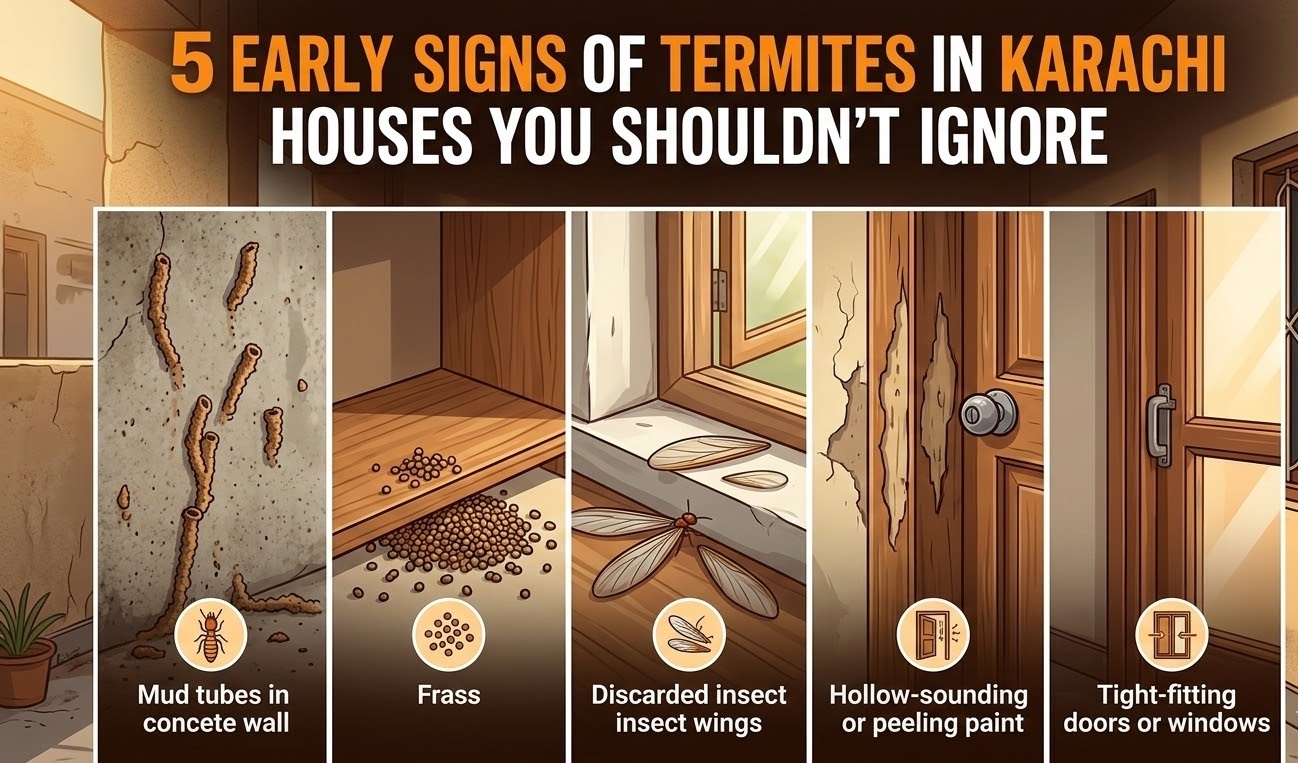
    Here are the five most important early warning signs that Karachi homeowners — and renters — should actively watch for:

      SIGN 1 of 5 

      Mud Tubes on Walls, Floors, or Foundations

    This is perhaps the most recognizable sign of subterranean termites — the species most common in Karachi. These pencil-thin tunnels, typically brown and made of soil, wood particles, and termite saliva, serve as protected highways between the termite colony underground and their food source: your home.

    Look for them along the base of exterior walls, inside cupboards near floor level, around water pipes, and on the underside of staircases. In Karachi’s older DHA and Nazimabad bungalows, mud tubes are often found behind decorative panels or along the external boundary walls where soil meets the building structure.

    Even if the tube looks dry and inactive, do not ignore it. Termites may have temporarily abandoned one route while establishing another. Professional termite inspectors in Karachi use specialized tools to detect live activity even inside dormant-looking tubes.

    💡 PRO TIP:  Break open a small section of any mud tube you find. If you see live, pale, ant-like insects — or if the tube is quickly repaired within 24–48 hours — you have an active colony on your hands.

      SIGN 2 of 5 

      Hollow-Sounding or Visibly Damaged Wood

    Termites eat wood from the inside out, leaving only a thin outer shell — which is why infested timber often looks completely normal on the surface until it’s too late. Tap on wooden door frames, floorboards, skirting boards, or wooden furniture legs. A hollow, papery sound is a serious red flag.

    In Karachi homes, wooden window frames and door frames are particularly susceptible — especially in rooms facing the sea breeze from Defence or Clifton areas, where salt-laden moisture accelerates wood softening and makes it more attractive to termites. Wooden cabinetry in kitchens and bathrooms — rooms where humidity is already higher — is another common target.

    You might also notice the wood beginning to visibly buckle, blister, or develop small pinholes. These pinholes are often exit holes where termites have broken through to the surface. If your painted wall surface appears to be bubbling in a pattern that doesn’t correspond to water damage, this could also indicate termites consuming the material just beneath the paint.

    💡 PRO TIP:  Run your knuckle firmly along wooden skirting boards and door frames every few months. This simple check takes less than five minutes but could save you lakhs in structural repairs.

      SIGN 3 of 5 

      Discarded Wings Near Windows and Light Sources

    Once or twice a year — most commonly during Karachi’s early monsoon season in July — termite colonies send out “swarmers” (reproductives) to establish new colonies. These winged termites are attracted to light and will often swarm around windows, tubelights, and exterior lamps in the evening hours.

    The swarmers shed their wings almost immediately after finding a suitable location to start a new colony. This means you may not see the swarm itself, but you might find a pile of small, translucent wings on your windowsill, near light fixtures, or on the floor of a room that faces a garden or open ground.

    Many homeowners in Karachi mistake these for flying ants, which are common and generally harmless. The distinction is important: termite wings are equal in length and almost perfectly straight, while ant wings differ in size. If you are finding these wings repeatedly in the same area of your home, it strongly suggests a colony is either already established or actively trying to establish itself nearby. This is exactly when engaging a certified termite control service in Karachi makes the most sense — before the new colony matures.

    💡 PRO TIP:  Photograph the discarded wings when you find them. A pest control professional can confirm whether they’re termite wings or ant wings in seconds, saving you guesswork and unnecessary anxiety.

      SIGN 4 of 5 

      Tight-Fitting Doors and Warped Window Frames

    A door or window that suddenly becomes stiff, hard to open, or appears visibly misaligned when it was perfectly fine before is easy to dismiss — especially in Karachi, where people often attribute this to humidity or seasonal temperature changes causing wood to swell. While that explanation is sometimes true, it is also a classic sign of termite activity.

    As termites consume wood and produce moisture within the tunnels they create, the structural integrity of wooden frames changes. The wood warps and swells in irregular patterns, causing doors and windows to stick or no longer fit their frames squarely. Unlike natural humidity-based swelling — which tends to resolve on its own after the season passes — termite-related warping is progressive and will worsen over time.

    Pay particular attention to internal doors and window frames in ground-floor rooms. Homes in Gulshan-e-Iqbal, North Nazimabad, and Landhi with older wooden construction often report this sign first, as their ground-level woodwork has had prolonged exposure to Karachi’s soil-borne termite populations. If the sticking persists or worsens, don’t wait — get a thorough termite inspection for your Karachi property before further damage occurs.

    💡 PRO TIP:  If a door was fine last season and now doesn’t close properly despite no rain or flood, inspect the frame carefully with a flashlight before calling a carpenter — you may need a pest specialist, not a woodworker.

      SIGN 5 of 5 

      Frass — Termite Droppings Near Wood

    Drywood termites — less common than subterranean termites in Karachi but still found in older wooden furniture and flooring — leave behind a very specific clue: frass. This is termite excrement, and it looks remarkably like fine sawdust or tiny wood-colored pellets pushed out through small holes in infested wood.

    You might notice small mounds of this powdery material at the base of wooden furniture, beneath bookshelves, below wooden ceiling beams, or near wooden wall panels. It is often mistaken for ordinary dust or construction debris — especially in Karachi’s homes, where renovation dust and city pollution are common. But look closely: frass granules are consistent in size, slightly oval, and may be light cream to dark brown depending on the wood being consumed.

    Drywood termites are particularly prevalent in wooden antique furniture and decorative wooden elements — elements found in many well-established homes in Clifton, PECHS, and Bath Island. If you notice this material appearing fresh over a few days, you have an active infestation. This is one sign where professional termite treatment in Karachi is non-negotiable, as DIY solutions rarely reach the full depth of the colony.

    💡 PRO TIP:  Place a white paper under suspected wooden items for 48 hours. If small, grainy pellets accumulate on the paper, you are likely dealing with drywood termites and need expert treatment promptly.

    “In Karachi’s climate, termite colonies can go from a handful of insects to hundreds of thousands within a single monsoon season. Every week of delay costs more than the week before.”

    What to Do If You Spot These Signs

    Recognizing these five warning signs is the critical first step — but it’s only the first step. Termite colonies are complex, deep-rooted systems, and over-the-counter sprays or home remedies will, at best, temporarily repel surface-level insects while leaving the colony — and its queen — completely undisturbed underground.

    Here is what you should do the moment you suspect termite activity in your Karachi home:

    • Do not disturb or break up mud tubes extensively — this may cause the colony to disperse and establish multiple new feeding sites.
    • Photograph every sign you find — location, date, and extent — to help pest control professionals assess the severity quickly.
    • Check surrounding areas: if you see one sign, inspect adjacent walls, floors, and wooden fixtures in the same vicinity.
    • Reduce moisture near affected areas — fix any leaking pipes, improve ventilation, and clear damp soil from the base of walls.
    • Do not start any carpentry or renovation work until you have had a professional inspection — this can accelerate the spread.
    • Call a licensed termite control specialist in Karachi who can use soil treatment, baiting systems, or targeted chemical application based on the specific termite species and infestation severity.

    Why Karachi Homeowners Must Act Quickly

    Unlike many pest problems that remain largely cosmetic, termite damage is structural. The longer an infestation is left untreated, the more deeply the colony penetrates load-bearing elements of your home. In Pakistan, insurance rarely covers termite damage — which means the full financial burden of repairs falls entirely on the homeowner.

    In Karachi specifically, the combination of aging housing stock, monsoon moisture, and year-round warmth means that termite colonies here can grow faster and cause damage more aggressively than in drier parts of the country. A home in Gulshan-e-Iqbal that might take four years to show serious structural damage from termites in Lahore’s climate could see the same damage in under two years in Karachi’s conditions.

    Proactive, scheduled termite inspection and treatment — not reactive emergency intervention — is always the more cost-effective approach. Many Karachi homeowners who invest in annual termite inspections report saving many times the inspection cost by catching infestations before they escalate. Think of it the same way you think of servicing your car: a small, regular investment to prevent a catastrophic breakdown.

    Worried About Termites in Your Karachi Home?
    Get a Free Inspection Today.

    Unique Fumigation’s certified specialists serve homes across Karachi — from DHA and Clifton to Gulshan, Nazimabad, and beyond. Our team uses advanced detection methods to identify termite activity before it becomes structural damage.

    →  Book Your Free Termite Inspection at uniquefumigation.com  ←

    ✓ Experienced Karachi-based team    ✓ Chemical & eco-friendly options    ✓ No-obligation assessment

  • How Karachi’s Monsoon Season Triggers Termite Swarms in Residential Areas

    How Karachi’s Monsoon Season Triggers Termite Swarms in Residential Areas

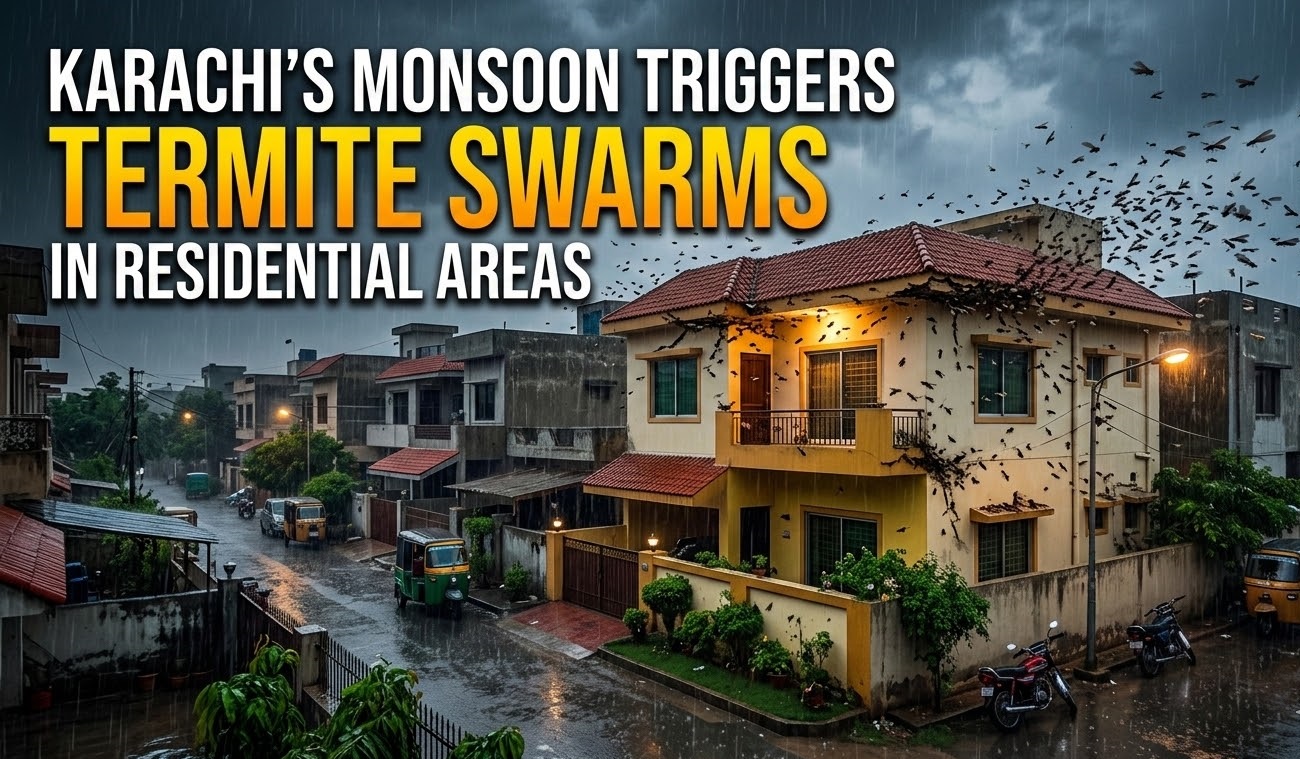
    Every year, as the first heavy rains sweep across Karachi from the Arabian Sea, homeowners across the city notice something unsettling: swarms of winged insects emerging from the ground, from walls, from under furniture — flooding their homes for a night or two before vanishing. Most people sweep them away and move on. But what they are witnessing is one of the most destructive natural events a homeowner can experience: a termite swarm triggered by monsoon conditions.

    This is not a coincidence. The relationship between Karachi’s monsoon season and termite swarming activity is deeply biological — and understanding it could be the difference between protecting your home and watching it deteriorate from the inside out.

    ⚠  URGENT:  Termite swarms are not just a nuisance — they are a declaration that a mature colony is nearby and actively expanding. If you see swarms in or around your home, treatment cannot wait.

    Understanding Termite Swarming: What Actually Happens

    Termite colonies reproduce by producing “alates” — winged reproductive termites, also called swarmers. These are not worker termites. They are the colony’s future kings and queens, released in large numbers with one mission: find a new location, mate, shed their wings, and start a brand-new colony.

    A single mature termite colony can release anywhere from a few thousand to tens of thousands of swarmers in a single event. Each pair that successfully mates and finds suitable soil or wood can establish a colony that, within three to five years, will itself be large enough to release another swarm.

    The timing of this release is not random. Termites are exquisitely sensitive to environmental conditions — specifically temperature, humidity, and soil moisture. They wait for precisely the right moment. And in Karachi, that moment arrives with the monsoon.

    “A single swarming event near your home can mean thousands of new colonies attempting to establish themselves. Even a handful of successful ones can cause severe structural damage within years.”

    Why Karachi’s Monsoon Is the Perfect Trigger

    Karachi’s monsoon season — typically running from late June through September — creates a convergence of environmental conditions that subterranean termites have evolved over millions of years to exploit. Here’s what happens:

      Factor 1 

      Sudden Rise in Soil Moisture

    The most critical trigger for termite swarming is a rapid increase in soil moisture. Before the monsoon, Karachi’s soil — particularly in areas like Gulshan-e-Iqbal, Surjani Town, and Korangi, where soil is clay-heavy — becomes dry and compact. When the rains arrive, this soil absorbs moisture quickly, signaling to termite colonies that the surface world is now hospitable for their alates to survive long enough to find a mate.

    Subterranean termites, which live in underground colonies, cannot survive on the surface in dry conditions. The monsoon rain essentially opens the “door” for them to emerge safely. Within 24 to 48 hours of the first significant rainfall of the season, swarming events begin across the city.

    💡 KARACHI FACT:  Neighborhoods with heavy clay soil — including parts of North Nazimabad, Liaquatabad, and New Karachi — experience more intense swarming events because clay retains moisture longer, sustaining ideal conditions for alate survival.

      Factor 2 

      Pre-Monsoon Heat Accelerates Colony Growth

    The months of April, May, and June in Karachi are notoriously brutal. Temperatures routinely exceed 38–42°C, with periodic heat waves pushing even higher. While these conditions are miserable for humans, they are ideal for termite colony growth. Worker termites feed and expand aggressively in the heat, and the colony’s population reaches its annual peak just as the monsoon approaches.

    This means that by the time the first rain hits, termite colonies across Karachi are at maximum strength — with the largest number of reproductives ready to swarm. The pre-monsoon heat is, in effect, a six-week preparation period for one of nature’s most destructive mass migration events.

      Factor 3 

      High Humidity Sustains Swarmers in Flight

    Termite alates are delicate creatures. They dehydrate rapidly and die quickly in low-humidity conditions. Karachi’s coastal humidity — which jumps from a pre-monsoon average of around 60–65% to over 80–85% during the monsoon — allows swarmers to remain airborne and viable for much longer, dramatically increasing their chances of successful mating and colony establishment.

    This is why swarming events in Karachi tend to be far more intense and widespread than in inland Pakistani cities like Multan or Faisalabad. The Arabian Sea essentially acts as a humidity engine, supercharging the biological conditions that favour swarming. Homes in coastal-adjacent areas like Clifton, Defence (DHA), and Korangi face particularly high swarmer density. This is precisely why residential termite control in Karachi demands a different — and more proactive — approach than in drier parts of Pakistan.

      Factor 4 

      Monsoon Flooding Creates New Entry Points

    Beyond triggering swarming, Karachi’s monsoon rains actively help termites infiltrate homes. Annual flooding — a persistent problem in areas like Orangi Town, Baldia Town, Lyari, and parts of SITE Industrial Area — saturates the soil around building foundations, softening the ground and creating new pathways for termites to enter.

    Standing water around the perimeter of a house, waterlogged planter beds, and flooded utility trenches all become superhighways for subterranean termites seeking to transition from soil to the wooden structural elements of your home. After flood water recedes, the softened, moisture-rich soil remains ideal for termite tunneling for weeks.

    ⚠  WARNING:  If your ground floor flooded during last monsoon, your home’s foundation perimeter is particularly vulnerable to termite infiltration this coming season. A pre-monsoon inspection is strongly advised.

    Which Karachi Neighborhoods Are Most at Risk?

    While termites are found across all of Karachi, certain neighborhoods face disproportionately higher risk during and after the monsoon season due to a combination of soil type, drainage infrastructure, building age, and proximity to greenery or open ground.

    • PECHS & Tariq Road: Dense older housing with mature trees whose root systems create natural termite corridors to foundations.
    • Gulshan-e-Iqbal & Gulshan-e-Hadeed: Heavy clay soil retains monsoon moisture for weeks, sustaining colony activity long after rains stop.
    • Nazimabad & North Nazimabad: Ageing bungalows with decades-old wooden beams and limited drainage — a perfect combination for post-monsoon infestations.
    • DHA & Clifton: Coastal humidity and large landscaped gardens with high soil moisture create year-round risk, peaking sharply during monsoon.
    • Orangi Town & Baldia Town: Recurring annual flooding combined with dense population and older construction makes post-monsoon termite infiltration a near-annual occurrence.
    • Korangi & Landhi: Industrial and residential mix with significant open ground — ideal for large underground colonies to thrive and expand.

    What Happens After the Swarm — The Hidden Danger

    The swarm itself lasts only a day or two. Once the alates lose their wings and either die or successfully mate, the visible event is over — and most homeowners breathe a sigh of relief. This is a dangerous mistake.

    Every mated pair that survives the swarm is now a king and queen searching for a dark, moist location to begin digging. Common establishment sites in Karachi homes include:

    • Under bathroom and kitchen flooring, where residual pipe moisture keeps soil damp year-round
    • Around the wooden frames of ground-floor doors and windows, especially those facing garden-side
    • Inside wall cavities adjacent to plumbing risers in multi-storey buildings
    • Beneath raised flooring in older bungalows in areas like Bath Island and Saddar
    • In soil adjacent to wooden furniture stored in poorly-ventilated storerooms

    Within six months, a newly established colony has worker termites actively foraging. Within two to three years, the colony is causing measurable structural damage. This is why acting immediately after a swarming event — rather than waiting for visible damage — is critical. If you witnessed swarms near your property, the right time to call in expert termite control professionals serving Karachi was yesterday. The second-best time is today.

    How to Protect Your Home Before, During, and After Monsoon

    There is no single action that eliminates termite risk entirely — but a layered, timed approach dramatically reduces the likelihood of infestation establishing in your home. Here is what Karachi homeowners should do:

    Before the Monsoon (April – June)

    • Book a professional termite inspection to assess your property’s current risk level and identify any existing activity
    • Seal all cracks and gaps in your foundation, external walls, and utility entry points using cement or appropriate sealant
    • Ensure drainage around the perimeter of your home directs water away from the foundation
    • Remove or relocate any dead wood, timber stacks, or wooden debris stored close to your home’s exterior
    • Apply pre-monsoon soil treatment around the foundation — a chemical barrier that prevents subterranean termites from approaching

    During the Monsoon (July – September)

    • Check for and promptly repair any leaking pipes, seeping walls, or water infiltration inside the home
    • Do not leave piles of wet cardboard, newspapers, or cellulose-rich material in ground-floor rooms
    • After flooding or standing water, inspect the perimeter of your home for new mud tubes or termite activity
    • Keep wooden furniture legs off direct contact with flooring in rooms prone to dampness
    • If you observe a swarm, note the location carefully and contact a pest specialist within 48 hours

    After the Monsoon (October – November)

    The post-monsoon period is when newly established colonies begin their most active growth phase. October and November are the ideal months for a follow-up inspection and, if needed, targeted professional termite treatment in Karachi to eliminate any colonies that established themselves during the season.

    • Schedule a post-monsoon termite inspection to detect any newly established colonies
    • Repair any monsoon-related structural damage — cracks, damp patches, and peeling plaster — that could provide new termite entry points
    • Consider installing a baiting system around your property perimeter for ongoing monitoring through the dry season

    Why DIY Solutions Fall Short in Karachi’s Conditions

    Walk into any hardware shop in Saddar, Jodia Bazaar, or Tariq Road and you will find a range of termite sprays, powders, and repellent products. While these may temporarily reduce surface-level insect activity, they are fundamentally inadequate against the subterranean termite colonies that Karachi’s monsoon triggers.

    Here is why: subterranean termite colonies live metres underground, with tunnels that extend in every direction beneath your home. Surface sprays cannot reach this depth. Repellent chemicals applied without professional soil injection techniques create gaps in coverage that termites quickly identify and route around. And bait stations require precise placement, monitoring, and replenishment protocols that are ineffective when applied casually.

    Beyond effectiveness, there is also the issue of species identification. Karachi is home to multiple termite species — primarily Coptotermes gestroi and Heterotermes indicola — each with different colony behaviours, food preferences, and responses to treatment chemicals. A professional pest control team identifies the species present before selecting the appropriate treatment protocol. A spray-can solution applies no such judgement.

    💡 NOTE:  Professional termite treatment in Karachi typically involves a combination of soil barrier treatment, targeted injection around wooden elements, and — for severe infestations — baiting systems that exploit the colony’s own behaviour to eliminate the queen.

    The Real Cost of Waiting

    It is tempting to delay. A termite problem that is not visibly damaging anything today does not feel urgent. But the economics of termite damage are unforgiving.

    An early-stage termite colony — detected and treated in its first year — typically costs a fraction of what is required once it has penetrated structural elements. By the time termites have damaged load-bearing wooden beams, door-frame joints, or the wooden substructure of flooring, you are looking not just at pest treatment costs but at significant carpentry and structural repair bills.

    In Karachi’s real estate market, a home with documented termite damage — especially in established neighbourhoods like PECHS, Clifton, or Gulshan-e-Iqbal — sees measurable impact on resale and rental value. Buyers and tenants increasingly ask for pest inspection certificates. A clean inspection history is an asset. An untreated infestation is a liability that compounds with time.

    “The cost of a professional termite inspection is a few thousand rupees. The cost of ignoring a termite infestation for two monsoon seasons can run into hundreds of thousands.”

    Don’t Wait for the Next Swarm.  Protect Your Home Before Monsoon Hits.

    Unique Fumigation offers free termite inspections for Karachi homeowners. Our certified specialists cover DHA, Clifton, Gulshan-e-Iqbal, Nazimabad, PECHS, Korangi, and all major residential areas across the city. We identify your risk level, detect active colonies, and provide a clear, honest treatment plan — no pressure, no guesswork.

    →  Book Your Free Termite Inspection at uniquefumigation.com  ←

    ✓ Karachi-based certified team    ✓ Chemical & eco-friendly treatment options    ✓ Free, no-obligation assessment

  • Wood vs. Concrete: Which Structures in Karachi Are Safe from Termites?

    Wood vs. Concrete: Which Structures in Karachi Are Safe from Termites?

    Walk through almost any neighborhood in Karachi — from the leafy lanes of Defence to the dense residential blocks of Gulshan-e-Iqbal — and you will find a mix of construction styles: older timber-heavy homes, modern reinforced concrete structures, and everything in between. A question that many Karachi homeowners ask, often after a neighbor suffers a costly infestation, is a simple one: Is my home safe from termites because it is built from concrete?

    The answer is more complicated — and more alarming — than most people expect. While the material your home is built from does influence termite risk, it does not eliminate it. Understanding exactly where termites can and cannot penetrate, and why even steel-reinforced concrete structures in Karachi are not fully immune, is the first step toward genuinely protecting your property.

    This guide gives you the full picture.

    The Myth of the “Termite-Proof” Concrete Home

    There is a widespread belief among Karachi homeowners that if a structure is built primarily from concrete, brick, and steel, termites simply cannot enter or cause damage. This belief, while understandable, is dangerously incomplete.

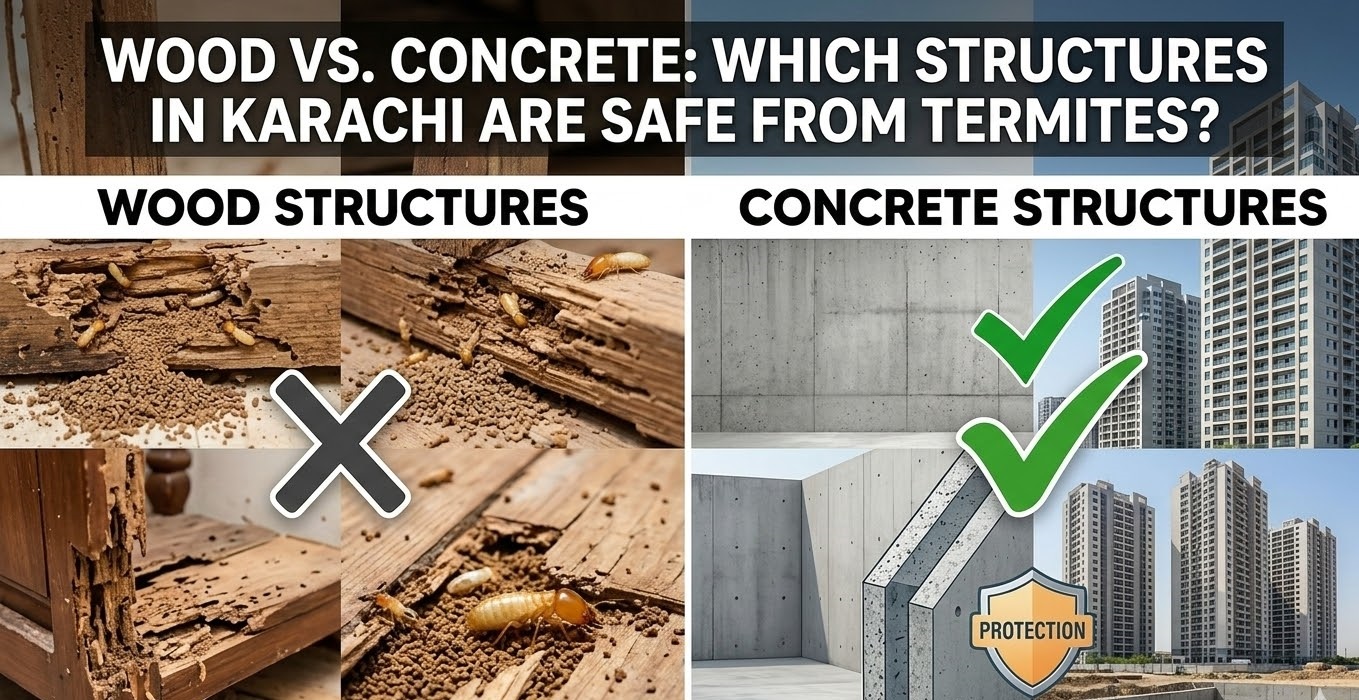
    Here is the reality: termites do not eat concrete. That much is true. But they do not need to. What termites are after is the cellulose-rich organic material inside your concrete structure — the wooden door frames, window shutters, built-in wardrobes, kitchen cabinets, flooring underlays, roof timbers, and decorative woodwork that exists in virtually every Karachi home, regardless of how it was built.

    Termites are among the most determined travelers in the insect world. Subterranean termite species — the most destructive and prevalent in Karachi — build pressurized mud tubes that allow them to cross any non-food surface, including concrete walls, brick, ceramic tile, and even metal conduits, to reach the wood on the other side.

    ⚠️  The Key Insight: Termites do not need to eat through your walls. They only need a crack, a pipe gap, or a construction joint the width of a credit card edge to gain entry. Once inside, they will find the wood.

    Timber and Wood-Frame Structures: The Highest-Risk Category

    There is no ambiguity here. Homes with substantial timber construction — whether it is a traditional wooden ceiling (“lakri ki chhat”), timber-frame walls, wooden flooring, or heavy use of untreated wood in structural and decorative elements — represent the highest-risk category for termite infestation in Karachi.

    Why Timber Construction Is So Vulnerable in Karachi

    • Direct food source: Wood is composed almost entirely of cellulose, which is what termites digest. A timber beam is not just a pathway — it is a meal.
    • Moisture retention in Karachi’s climate: Wooden elements in Karachi’s humid coastal environment absorb and retain moisture, especially during the July–September monsoon season. Moist wood is significantly more attractive to termite colonies than dry wood, and it supports faster colony growth.
    • Soil contact: In older neighborhoods like Saddar, Lyari, Orangi Town, and parts of Landhi, wooden posts, door frames, and boundary structures frequently make direct contact with the soil — providing subterranean termites with an unobstructed entry path from the ground straight into the structure.
    • Untreated timber: Much of the timber used in Karachi’s residential construction — particularly in mid- and lower-income areas — has never been pre-treated with termiticides or preservatives. This is especially common in homes built more than 15 years ago, when anti-termite pre-treatment was not a standard practice.
    • Hidden voids and cavities: Traditional timber construction creates hollow spaces within walls, ceilings, and floors that provide ideal, undisturbed conditions for termite colonies to establish and expand without detection for years.
    🏘️  At Particular Risk in Karachi: Older homes in Saddar, Lyari, and Ranchore Line with wooden ceiling structuresProperties in Korangi, SITE, and Baldia with timber-heavy compound walls and storagePre-2000 construction in Gulshan-e-Iqbal, North Nazimabad, and Federal B AreaAny home with large trees or mature garden shrubs adjacent to the structure  

    Concrete and Steel Structures: Safer — But Not Safe

    Modern reinforced concrete construction — the dominant building method across contemporary Karachi developments in DHA, Bahria Town, Clifton, Scheme 33, and Gulistan-e-Johar — significantly reduces the structural risks associated with termite attack. But it would be a serious mistake to assume it eliminates termite risk entirely.

    Where Termites Enter Concrete Structures

    1. Construction Joints and Expansion Gaps

    Every reinforced concrete structure has construction joints — the seams where separate concrete pours meet, and expansion gaps built in to allow for thermal movement. These joints, if not sealed with appropriate termite-resistant compounds, are entry highways for subterranean termite colonies traveling through the soil beneath the slab.

    In Karachi’s variable temperatures — cold January nights and scorching May afternoons — thermal expansion cycles cause these joints to open and close repeatedly, degrading standard sealants over time and creating progressively larger gaps.

    2. Utility Pipe Penetrations

    Water supply pipes, drainage pipes, gas lines, and electrical conduits must pass through the concrete slab and walls of every structure. The gaps around these penetrations — which are never perfectly sealed in practice — are among the most common termite entry points observed in Karachi homes.

    This is particularly relevant in Karachi given the frequency of plumbing repairs: every time a pipe is accessed and re-sealed, the re-sealing is rarely done with termite-resistant compounds.

    3. Hollow Block Construction

    A significant proportion of concrete construction in Karachi uses hollow concrete blocks rather than solid poured concrete. The cavities within hollow blocks are actually ideal termite habitat — they provide protected, dark, humid spaces that termites can use to travel and nest, even within an apparently solid concrete wall.

    4. The Wood Inside the Concrete Home

    Even the most comprehensively concrete-constructed home in Karachi contains substantial wood: door frames and shutters, window frames and shutters, kitchen and bathroom cabinets, wardrobes and built-in furniture, decorative ceiling treatments (false ceilings with wooden battens), parquet or wooden flooring, roof timbers beneath the final roof slab, and wooden boxing around exposed pipes.

    In a typical well-appointed three-bedroom apartment or villa in DHA or Clifton, the total timber content can amount to several tons of wood — all of it potentially accessible to a determined termite colony once they have crossed the concrete envelope.

    💡  Case Example — DHA Phase 5 Villa: A fully concrete-constructed four-bedroom villa was found to have significant termite activity in the kitchen cabinetry and master bedroom wardrobe — both installed on the ground floor. Inspection revealed a mud tube running from the soil outside, through a utility pipe penetration in the kitchen slab, across the screed floor under the tile, and into the base of the kitchen units. The concrete structure was entirely intact. The damage was 100% to timber fittings and furniture. Early professional treatment would have prevented Rs. 180,000 in replacement costs.

    Head-to-Head: Wood vs. Concrete in Karachi’s Termite Context

    🪵  Wood / Timber🧱  Concrete / Steel
    Primary material is food for termitesPrimary material is not food for termites
    Structural timbers directly at risk of collapseStructural elements safe — but timber fittings fully at risk
    Infestations typically faster-spreading and harder to detectInfestations confined to fittings — but can still be very costly
    Mud tubes may penetrate from multiple soil contact pointsEntry through pipe gaps, construction joints, and hollow blocks
    Repair costs can include full structural reconstructionRepair costs typically limited to fittings and furniture
    Pre-treatment essential before and during constructionPre-treatment still strongly recommended — especially soil barrier
    Annual professional inspection: criticalAnnual professional inspection: strongly recommended

    The “Hybrid” Reality: Most Karachi Homes Are Both

    In practice, the vast majority of Karachi’s residential housing stock is neither purely timber nor purely reinforced concrete. Most homes built between the 1960s and 2010s combine:

    • Reinforced concrete columns and beams with brick infill walls
    • Concrete slabs for floors and roof, but significant timber in door and window frames
    • Some rooms with traditional wooden ceiling treatments
    • Wooden kitchen and bathroom fixtures throughout
    • Timber used for roof framing beneath a concrete or asbestos sheet roof

    This hybrid construction model means that even homes which owners consider “RCC construction” often contain the equivalent of a fully timber-fitted interior — and all the termite vulnerability that comes with it. The structural frame may be safe, but the liveable space is not.

    This is exactly why homeowners in areas like Gulistan-e-Johar, North Karachi, Surjani Town, and even newer developments in Bahria Town Karachi should not assume their reinforced concrete homes are exempt from professional termite control treatment.

    The Critical Window: Why Pre-Construction Treatment Matters Most

    Regardless of whether your home is timber, concrete, or hybrid in construction, there is one point in the building lifecycle when termite protection is most effective and most affordable: before and during construction.

    Once a structure is completed, applying a chemical soil barrier requires drilling through finished floors, accessing foundation walls, and disrupting interior fittings. This is possible — and Unique Fumigation does it every day across Karachi — but it is significantly more involved and costly than treating during construction.

    What Pre-Construction Anti-Termite Treatment Involves

    1. Foundation soil treatment: Before the concrete slab is poured, the prepared soil base is treated with an approved, long-duration termiticide that creates a chemical barrier termites cannot cross without being eliminated.
    2. Perimeter trench treatment: A trench is dug around the building footprint and filled with termiticide solution before backfilling — creating an unbroken chemical shield around the entire structure.
    3. Pipe penetration sealing: Entry and exit points for utility pipes through the slab are pre-treated and sealed with termite-resistant compounds before the floor finish is applied.
    4. Post-slab surface treatment: After the slab is cured, the surface below the floor screed is treated before tiles or other floor finishes are installed.

    If you are currently building or planning to build in Karachi, insisting on proper pre-construction anti-termite soil treatment from a certified pest control company is not optional — it is the single most important structural protection decision you will make.

    📌  Did You Know? In many countries including India and parts of the Middle East, anti-termite soil treatment before construction is legally required for building permits. While Pakistan’s building regulations vary, Karachi’s climate makes pre-construction treatment just as essential in practice.

    Specific Scenarios: Your Home Type and Your Risk Level

    Scenario A: Older Timber-Ceiling Home in Nazimabad or Saddar

    Risk level: Critical. Traditional wooden ceiling structures, often built in the 1950s–1970s, are at extreme risk. If a professional inspection has not been conducted in the past 12 months, the likelihood of an active colony is very high. Professional termite inspection and treatment should be booked immediately.

    Scenario B: RCC Apartment in a Multi-Story Building in Clifton or DHA

    Risk level: Moderate. Ground floor and first floor apartments face the highest risk due to proximity to soil. Upper floors are lower risk for subterranean termites but can still be affected if drywood termites are introduced through infested furniture. Soil treatment around the building’s perimeter is the key protection measure — confirm with building management whether this has been done.

    Scenario C: Newly Built Villa in Bahria Town or Scheme 33

    Risk level: Moderate to High if pre-construction treatment was not applied. New construction disturbs established termite colonies in the soil, which can migrate directly into new foundations. Verify with your builder whether certified anti-termite pre-treatment was applied — and if not, arrange post-construction soil barrier treatment in Karachi as soon as possible.

    Scenario D: Home with Large Garden or Mature Trees (Any Area)

    Risk level: High. Mature trees, tree stumps, wooden garden furniture, and landscaping materials all serve as termite colony bases. Subterranean colonies established in garden soil can reach the home’s foundation within weeks. Annual perimeter inspections are essential.

    Scenario E: Under-Construction Property

    Risk level: Controllable with action. This is the ideal moment to act. Pre-construction anti-termite treatment applied now will provide long-duration protection at a fraction of the cost of post-construction treatment.

    How Unique Fumigation Protects Both Wood and Concrete Homes

    Whether your home is a traditional timber structure in Lyari or a modern concrete villa in DHA Phase 8, Unique Fumigation’s approach to comprehensive termite control in Karachi is tailored to your specific construction type, risk profile, and the degree of any existing infestation.

    • Timber homes and timber-heavy structures: Full soil treatment around the perimeter, borate wood treatment applied directly to accessible timber elements, wood injection for inaccessible voids, and baiting systems for active established colonies.
    • Concrete and RCC structures: Soil injection drilling around the building’s perimeter, chemical barrier installation beneath floors where accessible, sealing of all utility penetrations with approved compounds, and inspection of all timber fittings with targeted treatment as needed.
    • New or under-construction properties: Pre-pour soil treatment, trench treatment, post-slab surface treatment, and pipe penetration sealing — all carried out to manufacturer and industry specifications using government-approved termiticides.
    • Ongoing monitoring programs: Quarterly or bi-annual visits to check bait stations, re-inspect high-risk zones, and apply maintenance treatments — because in Karachi’s climate, one-time treatment is never sufficient for long-term protection.

    6 Things Every Karachi Homeowner Should Do Right Now

    Regardless of your construction type, these steps reduce your termite risk immediately:

    • Get a professional inspection done this season. Before the monsoon, book a certified termite inspection. Early detection saves money and structural damage.
    • Check every utility entry point. Examine where pipes enter your floors and walls. Any gap larger than a few millimetres should be sealed with appropriate filler compound.
    • Eliminate moisture problems. Fix leaking taps, pipes, and roof drainage. Moisture is the single biggest accelerant of termite colony growth.
    • Keep wood off the ground. Store timber, firewood, old furniture, and building materials elevated and away from the building perimeter.
    • Remove tree stumps and dead roots. If you have had trees removed in or around your garden, ensure the stumps are fully cleared and the soil treated — stumps are prime termite colony bases.
    • Confirm pre-construction treatment status. If you are unsure whether your home received anti-termite pre-treatment during construction, ask Unique Fumigation to inspect and advise — it is a free service.

    Frequently Asked Questions

    Can termites damage concrete directly?

    Termites cannot digest or structurally damage sound concrete. However, they can exploit cracks, gaps, and joints in concrete to gain access to the wood inside a structure. Termite activity can also accelerate moisture ingress into concrete cracks over time.

    My home is fully tiled with no exposed wood on the ground floor. Am I safe?

    Tiling provides no barrier against subterranean termites. Termites travel in sealed mud tubes across any surface — including ceramic tiles — and can enter through grout lines, expansion joints, and the tiny gaps around pipe bases. The wood in your door frames, cabinets, and wall fittings remains accessible to them.

    Is steel-frame construction termite-proof?

    Steel framing is not a food source for termites and will not be structurally damaged by them. However, steel-frame homes still contain wood in every door, window, cabinet, and fitting — and require the same soil barrier and fitting protection measures as other construction types. Do not assume a steel-frame home is termite-immune.

    How much does post-construction soil treatment cost compared to pre-construction?

    Pre-construction soil treatment typically costs 30–50% less than post-construction treatment for an equivalent structure, because it does not require drilling through finished floors, moving furniture, or extensive sealing work on completed surfaces. The earlier you treat, the more cost-effective the protection.

    I live in a high-rise apartment. Should I be concerned?

    Ground floor and first floor apartment owners should take the same precautions as house owners. In multi-story buildings, drywood termites (which do not require soil contact) can infest any floor through wooden furniture, infested timber brought in during renovation, or adjacent units. If you are on the ground floor, confirm with building management that the foundation soil has been treated.

    The Bottom Line: No Structure in Karachi Is Automatically Safe

    Whether your home is built from timber, reinforced concrete, brick, or a combination of all three, the unique conditions of Karachi — the coastal humidity, the year-round warmth, the aging urban infrastructure, and the active termite species in the soil — mean that no home is automatically exempt from termite risk.

    The question is not whether your construction material protects you. The question is whether your soil, your building’s entry points, and your timber fittings are protected. That requires professional assessment and, where necessary, professional treatment.

    The good news: with the right treatment applied at the right time, termite infestation is entirely preventable. And with Unique Fumigation’s team covering every neighborhood in Karachi, protection is a phone call away.

    📞  Book Your FREE Termite Inspection Today Whether your home is timber, concrete, or anywhere in between — our certified inspectors will assess your property’s specific risk level, identify any active termite activity, and recommend a treatment plan tailored to your construction type. ►  Visit: uniquefumigation.com/termite-control-services-in-karachi/ No obligation. No cost. Just honest expert advice — and peace of mind. Serving DHA • Clifton • Gulshan • North Nazimabad • Bahria Town • Korangi • Scheme 33 • And All of Karachi

    Unique Fumigation | Karachi’s Trusted Termite & Pest Control Specialists

  • Why Karachi Homes Are Especially Vulnerable to Termite Attacks — And What to Do About It

    Why Karachi Homes Are Especially Vulnerable to Termite Attacks — And What to Do About It

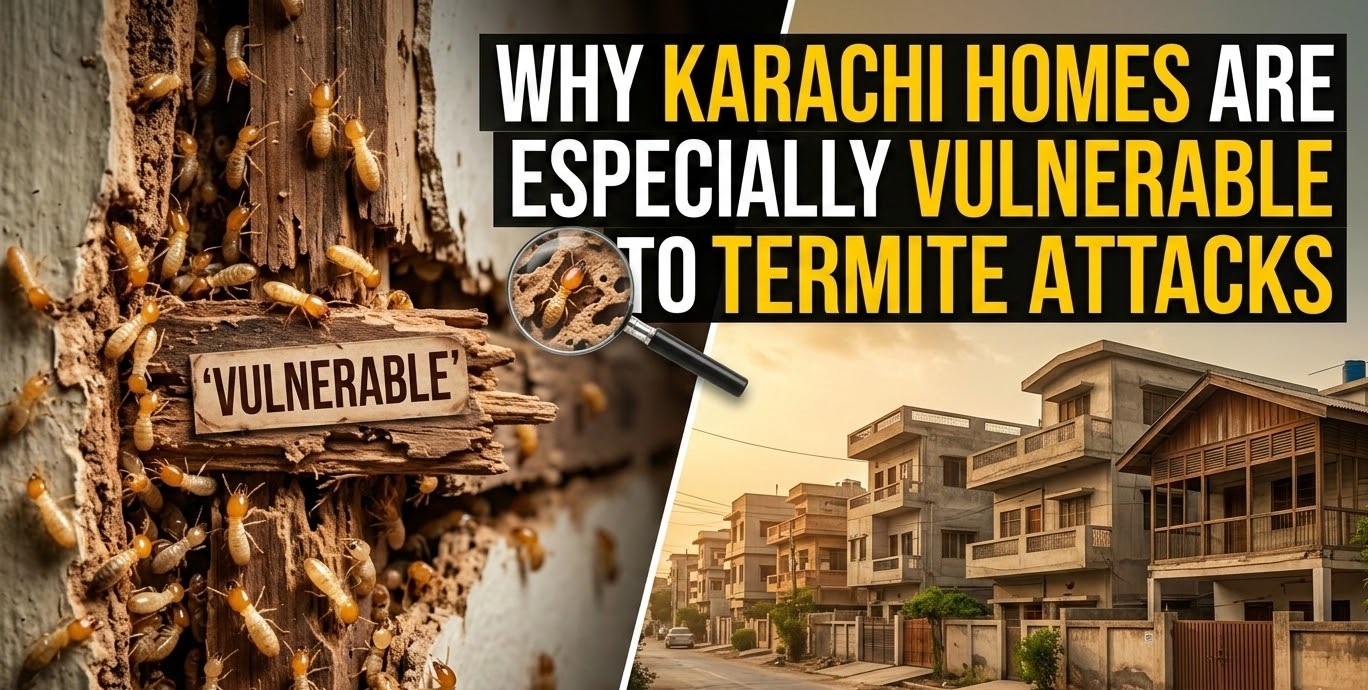
    If you own a home in Karachi, termites are one of the most serious — and most underestimated — threats to your property. Every year, thousands of Karachi homeowners discover, often too late, that these tiny insects have been silently hollowing out their furniture, wooden fixtures, door frames, and even the structural beams of their homes.

    Unlike a burst pipe or a cracked wall, termite damage is invisible until it reaches a critical stage. By the time you notice hollow-sounding wood, sagging floors, or crumbling skirting boards, the colony has likely been feeding for months — sometimes years.

    But what makes Karachi’s homes especially vulnerable? And more importantly, what can you do right now to protect your home and your family’s investment? This guide covers everything you need to know.

    The Karachi Climate: A Termite’s Paradise

    Termites thrive in warm, humid conditions — and Karachi delivers both in abundance. Situated on the Arabian Sea coast, Karachi experiences a hot, semi-arid climate with high coastal humidity, particularly during the monsoon months of July through September and in the humid winter coastal air.

    Here is what the local climate looks like from a termite’s perspective:

    • High humidity levels: Termites require moisture to survive. Coastal neighborhoods such as Clifton, Defence (DHA), and Keamari experience persistent humidity that keeps the soil and building materials consistently moist — ideal conditions for subterranean termite colonies.
    • Year-round warmth: Karachi rarely experiences true cold winters. Temperatures stay above 20°C for most of the year, allowing termite colonies to remain active and reproducing 365 days a year, unlike in colder climates where activity slows seasonally.
    • Monsoon season soil saturation: When heavy rains arrive, water saturates the soil beneath and around homes. This drives subterranean termites upward, directly into foundations, floor slabs, and ground-floor wooden elements.
    • Post-rain swarming events: After the first monsoon rains, winged termites (alates) swarm in massive numbers to establish new colonies. If you have seen clouds of flying insects around street lights in Karachi in July or August, many of those are termite swarmers searching for a new home — and yours could be next.
    ⚠️  Important: Termite colonies can grow to over one million individuals in a mature nest. A single queen can lay up to 30,000 eggs per day. Once established in your home’s foundation, a colony will not go away on its own.

    Karachi’s Urban Infrastructure: Built for Termites to Travel

    Beyond climate, Karachi’s urban fabric creates invisible highways for termite colonies to move from one property to the next. Understanding this is key to understanding why even brand-new homes in Karachi can develop termite infestations within a few years.

    1. High Density of Old Timber Construction

    Older neighborhoods in Karachi — including areas like Saddar, Lyari, North Nazimabad, and parts of Gulshan-e-Iqbal — contain a significant proportion of older homes built with substantial timber framing, wooden ceilings, and traditional woodwork. Many of these properties have existing termite colonies that have been present for decades.

    When a new property is constructed nearby, or when renovations disturb the soil, termite colonies can easily migrate. In densely packed urban areas, the colony from a neighbor’s home can reach yours within weeks.

    2. The Problem of Continuous Soil Contact

    Much of Karachi’s residential construction — particularly in middle-income neighborhoods — involves direct contact between timber elements and the ground. Door frames, wooden posts, boundary walls, and garden areas often allow uninterrupted soil-to-wood contact, which is the primary pathway for subterranean termite species like Coptotermes formosanus and Odontotermes obesus — both of which are prevalent in Karachi’s soil.

    3. Utility Lines and Underground Passages

    Karachi’s aging underground infrastructure — including water pipes, sewage lines, and electrical conduits — creates network of passages that termites readily exploit. Old cracked pipes provide moisture sources deep in the soil, and the spaces around utility entries into buildings are common termite entry points that often go unnoticed for years.

    4. Construction Material Quality

    Rapid urban expansion in areas like Gulistan-e-Johar, Surjani Town, and the outskirts of Karachi has led to widespread use of lower-grade timber that has not been pre-treated against termites. Untreated wood in high-moisture environments is essentially an open invitation to a termite colony.

    The 5 Warning Signs Karachi Homeowners Must Not Ignore

    Because termites work silently and mostly out of sight, many homeowners only discover a problem after serious structural damage has occurred. Knowing the early warning signs can save you hundreds of thousands of rupees in repair costs.

    • Mud tubes on walls or foundations: Pencil-thin tunnels of soil and saliva built by subterranean termites to travel from the ground to their food source. Check your exterior walls at ground level, inside cupboards, and around pipe entry points.
    • Hollow-sounding wood: Tap your wooden door frames, window frames, skirting boards, and furniture. A hollow or papery sound indicates that termites have consumed the interior, leaving only a thin surface shell.
    • Blistered or uneven paint: Moisture produced by termites feeding beneath painted surfaces can cause paint to blister, bubble, or look water-damaged — even on walls with no plumbing nearby.
    • Discarded wings near windows and doors: After a swarming event, termites shed their wings. Small piles of transparent wings near light sources, window sills, or door frames are a clear sign that a new colony may have been established nearby or inside your home.
    • Frass (termite droppings): Drywood termites leave behind tiny wood-colored pellets that resemble sawdust. Finding these near wooden fixtures is a tell-tale sign of active feeding activity.
    💡  Tip: Check these areas every six months in Karachi — especially after the monsoon season ends (September–October), as this is when new termite colonies are most active and detectable.

    Which Areas of Karachi Are at Highest Risk?

    While no neighborhood in Karachi is completely safe from termites, some areas carry significantly higher risk due to soil type, proximity to water, age of construction, and vegetation density.

    • Clifton and DHA (Defence Housing Authority): Coastal proximity means persistent humidity and high soil moisture. The prevalence of mature trees and landscaped gardens increases the likelihood of established subterranean colonies in the soil.
    • Gulshan-e-Iqbal and North Nazimabad: Dense older construction with significant timber elements in existing buildings provides a ready reservoir of active colonies that can spread to adjoining properties.
    • Korangi, Landhi, and SITE industrial areas: The combination of older buildings, industrial wood storage, and historically poor drainage makes these areas particularly high risk for subterranean and drywood termites.
    • New construction zones (Bahria Town, Scheme 33, Hawks Bay Road): Interestingly, newly developed areas are also high-risk because construction activity disrupts established termite colonies in the soil, causing them to relocate — often directly into the new building.
    • Homes with large gardens or mature trees: Tree stumps, old timber, and tree roots are favorite nesting sites for termites, providing a colony base that can spread underground to your home’s foundations.

    What NOT to Do: Common Mistakes Karachi Homeowners Make

    When homeowners spot signs of termites, the instinct is often to act immediately with whatever is available. Unfortunately, some of the most common responses either fail to solve the problem or, worse, allow it to get significantly worse.

    • Using retail insect sprays: Household sprays kill surface termites but do nothing to eliminate the queen or the colony. Disturbing a surface colony can cause it to scatter and establish multiple satellite nests, making the infestation harder to treat.
    • Ignoring mud tubes and removing them: Knocking down a mud tube without treating the colony simply forces termites to rebuild and find an alternative route. The colony remains active.
    • Delaying professional treatment: Every week of delay allows the colony to grow and spread deeper into the structure. What might cost Rs. 15,000–20,000 to treat today could require Rs. 200,000+ in structural repairs if left for another six months.
    • Treating only the visible damage: Professional termite control requires treating the entire affected zone — soil, foundations, and the building structure — not just the wood you can see.

    Professional Termite Control: What the Process Actually Looks Like

    Effective termite control in a Karachi home involves a systematic, multi-stage approach. At Unique Fumigation, our termite control services in Karachi follow a proven protocol that has protected thousands of homes across the city.

    Stage 1: Professional Inspection

    A certified technician conducts a comprehensive inspection of your property — including the foundation, all ground-floor timber elements, wall cavities, roof space, and external perimeter. This establishes the species present, the extent of infestation, and the appropriate treatment method.

    Stage 2: Soil Treatment (Pre- or Post-Construction)

    For subterranean termites, the primary line of defense is creating a chemical barrier in the soil around and beneath the structure. This is done using approved termiticides injected into the soil at regular intervals around the building’s perimeter and under the floor slab where accessible. This is the same approach used in anti-termite soil treatment services carried out before or during new construction.

    Stage 3: Wood Treatment

    Accessible timber elements — including skirting boards, door frames, window frames, and roof timbers — are treated with borate-based solutions or targeted termiticides that penetrate the wood and remain active for extended periods.

    Stage 4: Baiting Systems (Where Appropriate)

    For large or established colonies, in-ground bait stations may be installed around the perimeter of the property. Termites carry the bait back to the colony, eventually eliminating the queen and collapsing the entire colony. This is a slower but highly effective long-term solution for severe infestations.

    Stage 5: Follow-Up Monitoring

    A single treatment is rarely sufficient on its own in Karachi’s climate. Responsible termite management includes scheduled follow-up visits to check for any new activity and reapply treatment as needed, typically on a 6- or 12-month basis.

    Protecting Your Home Before Termites Arrive: Prevention Tips for Karachi

    Prevention is always more cost-effective than cure. If your home is currently termite-free, here are the steps Karachi homeowners should take to keep it that way:

    • Eliminate soil-to-wood contact: Ensure that wooden door frames, fence posts, and garden structures do not make direct contact with soil. Use metal saddles or concrete bases to create separation.
    • Fix water leaks promptly: Leaking pipes, dripping taps, and poor drainage create the moisture conditions that attract and sustain termite colonies. Address any plumbing issues without delay.
    • Store firewood and timber away from the house: Keep wood, old furniture, and timber offcuts stored at least two meters from the building and elevated off the ground.
    • Seal cracks and entry points: Inspect the exterior of your home for cracks in the foundation, gaps around utility penetrations, and unsealed expansion joints. Seal these with appropriate materials.
    • Schedule a pre-monsoon inspection: Book a professional termite inspection in May or June — before the rainy season creates conditions that accelerate colony growth and swarming.
    • Request pre-construction anti-termite treatment: If you are building a new home, insist on professional pre-construction anti-termite treatment in Karachi before the foundation is laid. This is far more effective and affordable than treating a completed structure.

    The True Cost of Ignoring Termites in Karachi

    It is tempting to delay action when you cannot see the damage happening. But the financial consequences of unchecked termite activity in a Karachi home are significant:

    • Structural timber replacement: Replacing termite-damaged roof timbers, floor joists, or structural beams in a mid-size Karachi home can cost between Rs. 150,000 and Rs. 500,000 depending on the extent of damage.
    • Furniture and woodwork: A fully infested wardrobe, kitchen cabinet set, or antique furniture collection may be beyond repair. Replacement costs for quality wooden furniture in Karachi run into hundreds of thousands of rupees.
    • Property value impact: Homes with known or suspected termite history are significantly harder to sell and often command lower prices. Buyers and their surveyors routinely check for evidence of termite activity.
    • Treatment cost vs. repair cost: A professional termite treatment for a standard Karachi home typically costs a fraction of what structural repair or replacement would demand. The earlier treatment begins, the lower the total cost.
    Why Unique Fumigation? Unique Fumigation has been protecting Karachi homes and commercial properties for over a decade. Our teams are trained, certified, and equipped with the latest termiticides and treatment technologies. We offer: Free professional inspection with no obligationGuaranteed, government-approved treatment chemicalsCoverage across all of Karachi — DHA, Clifton, Gulshan, North Nazimabad, Korangi, and beyondTailored treatment plans for pre-construction, under-construction, and fully built homesPost-treatment warranty and scheduled follow-up monitoring

    Frequently Asked Questions

    How long does a termite treatment take?

    For a standard residential property in Karachi, a full soil and wood treatment typically takes one to two days depending on the size of the property. Minimal disruption to the household is required.

    Is the treatment safe for children and pets?

    Unique Fumigation uses government-approved, internationally certified termiticides that are safe once dry and properly applied. Our technicians will advise on the appropriate re-entry time for your property, typically within a few hours after treatment is complete.

    Do I need termite control if my home is relatively new?

    Yes. New homes in Karachi are particularly vulnerable during the first five years if pre-construction anti-termite treatment was not applied. Construction activity disturbs the soil and can attract colonies. Our professional termite control services include assessments specifically designed for new and recently built properties.

    How often should I get my home inspected?

    We recommend a professional inspection at minimum once per year, ideally before the monsoon season begins. Homes in high-risk areas such as Clifton, DHA, or older neighborhoods should consider bi-annual inspections.

    Can termites come back after treatment?

    If the treatment is thorough and post-treatment monitoring is maintained, recurrence is uncommon. However, in Karachi’s climate, the surrounding environment always contains active colonies. This is why scheduled follow-up inspections and maintenance treatments are an important part of any long-term termite protection plan.

    Don’t Wait for the Damage to Become Visible

    In Karachi’s climate, no home is immune to termites — and no infestation gets smaller on its own. The best time to protect your home was before construction. The second best time is right now.

    Whether you have already spotted warning signs or simply want the peace of mind that your home is protected, the first step is a professional inspection by experts who understand Karachi’s unique termite risks.

    📞  Book Your FREE Termite Inspection Today Contact Unique Fumigation and let our certified team inspect your property at no cost. We will identify any existing activity, assess your risk level, and recommend a customized treatment plan — all with no obligation. ►  Visit: uniquefumigation.com/termite-control-services-in-karachi/ Protect your home, protect your investment. Karachi’s termites are active year-round — and so are we.

    Unique Fumigation | Karachi’s Trusted Termite & Pest Control Specialists

    Serving DHA, Clifton, Gulshan-e-Iqbal, North Nazimabad, Korangi, Bahria Town, and all areas of Karachi