You’ve just noticed something odd — a thin mud line running up your kitchen wall, or a door that suddenly won’t close properly. You brush it off. Life in Karachi is busy. But these small, easy-to-dismiss signs could be the beginning of a costly nightmare.
Termites are often called the “silent destroyers” for good reason. By the time visible damage appears, these insects may have been eating through the wooden framework, flooring, and structural supports of your home for months — even years. In a city like Karachi, where humidity, heat, and urban density create the perfect conditions for termite colonies to thrive, knowing the early warning signs is not just useful. It is essential.
⚠ IMPORTANT: A mature termite colony can consume up to a kilogram of wood every single day. Early detection is the only way to stop minor damage from becoming a structural catastrophe. If you spot even one of these signs, take action immediately.
🏙 WHY KARACHI HOMES ARE ESPECIALLY VULNERABLE Karachi’s coastal geography means high ambient humidity year-round. The city’s pre-monsoon heat (March–June) followed by the moisture surge of the monsoon season (July–September) creates near-perfect breeding conditions for subterranean termites — the most destructive species found in Pakistani homes. Add to this the prevalence of older construction in neighborhoods like PECHS, Gulshan-e-Iqbal, Nazimabad, and Clifton, where wooden beams, flooring, and door frames have aged over decades, and you have a recipe for widespread infestation.
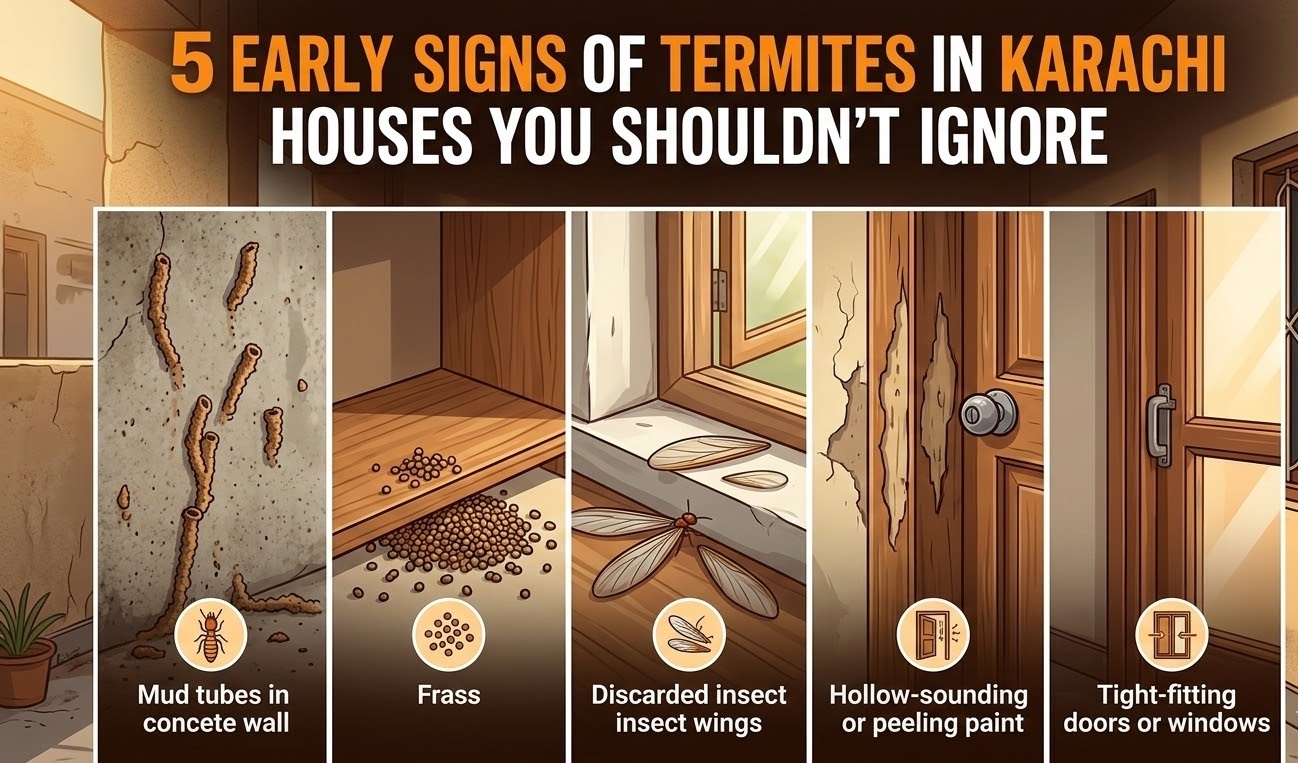
The 5 Early Signs of Termites in Karachi Homes
Here are the five most important early warning signs that Karachi homeowners — and renters — should actively watch for:
SIGN 1 of 5
Mud Tubes on Walls, Floors, or Foundations
This is perhaps the most recognizable sign of subterranean termites — the species most common in Karachi. These pencil-thin tunnels, typically brown and made of soil, wood particles, and termite saliva, serve as protected highways between the termite colony underground and their food source: your home.
Look for them along the base of exterior walls, inside cupboards near floor level, around water pipes, and on the underside of staircases. In Karachi’s older DHA and Nazimabad bungalows, mud tubes are often found behind decorative panels or along the external boundary walls where soil meets the building structure.
Even if the tube looks dry and inactive, do not ignore it. Termites may have temporarily abandoned one route while establishing another. Professional termite inspectors in Karachi use specialized tools to detect live activity even inside dormant-looking tubes.
💡 PRO TIP: Break open a small section of any mud tube you find. If you see live, pale, ant-like insects — or if the tube is quickly repaired within 24–48 hours — you have an active colony on your hands.
SIGN 2 of 5
Hollow-Sounding or Visibly Damaged Wood
Termites eat wood from the inside out, leaving only a thin outer shell — which is why infested timber often looks completely normal on the surface until it’s too late. Tap on wooden door frames, floorboards, skirting boards, or wooden furniture legs. A hollow, papery sound is a serious red flag.
In Karachi homes, wooden window frames and door frames are particularly susceptible — especially in rooms facing the sea breeze from Defence or Clifton areas, where salt-laden moisture accelerates wood softening and makes it more attractive to termites. Wooden cabinetry in kitchens and bathrooms — rooms where humidity is already higher — is another common target.
You might also notice the wood beginning to visibly buckle, blister, or develop small pinholes. These pinholes are often exit holes where termites have broken through to the surface. If your painted wall surface appears to be bubbling in a pattern that doesn’t correspond to water damage, this could also indicate termites consuming the material just beneath the paint.
💡 PRO TIP: Run your knuckle firmly along wooden skirting boards and door frames every few months. This simple check takes less than five minutes but could save you lakhs in structural repairs.
SIGN 3 of 5
Discarded Wings Near Windows and Light Sources
Once or twice a year — most commonly during Karachi’s early monsoon season in July — termite colonies send out “swarmers” (reproductives) to establish new colonies. These winged termites are attracted to light and will often swarm around windows, tubelights, and exterior lamps in the evening hours.
The swarmers shed their wings almost immediately after finding a suitable location to start a new colony. This means you may not see the swarm itself, but you might find a pile of small, translucent wings on your windowsill, near light fixtures, or on the floor of a room that faces a garden or open ground.
Many homeowners in Karachi mistake these for flying ants, which are common and generally harmless. The distinction is important: termite wings are equal in length and almost perfectly straight, while ant wings differ in size. If you are finding these wings repeatedly in the same area of your home, it strongly suggests a colony is either already established or actively trying to establish itself nearby. This is exactly when engaging a certified termite control service in Karachi makes the most sense — before the new colony matures.
💡 PRO TIP: Photograph the discarded wings when you find them. A pest control professional can confirm whether they’re termite wings or ant wings in seconds, saving you guesswork and unnecessary anxiety.
SIGN 4 of 5
Tight-Fitting Doors and Warped Window Frames
A door or window that suddenly becomes stiff, hard to open, or appears visibly misaligned when it was perfectly fine before is easy to dismiss — especially in Karachi, where people often attribute this to humidity or seasonal temperature changes causing wood to swell. While that explanation is sometimes true, it is also a classic sign of termite activity.
As termites consume wood and produce moisture within the tunnels they create, the structural integrity of wooden frames changes. The wood warps and swells in irregular patterns, causing doors and windows to stick or no longer fit their frames squarely. Unlike natural humidity-based swelling — which tends to resolve on its own after the season passes — termite-related warping is progressive and will worsen over time.
Pay particular attention to internal doors and window frames in ground-floor rooms. Homes in Gulshan-e-Iqbal, North Nazimabad, and Landhi with older wooden construction often report this sign first, as their ground-level woodwork has had prolonged exposure to Karachi’s soil-borne termite populations. If the sticking persists or worsens, don’t wait — get a thorough termite inspection for your Karachi property before further damage occurs.
💡 PRO TIP: If a door was fine last season and now doesn’t close properly despite no rain or flood, inspect the frame carefully with a flashlight before calling a carpenter — you may need a pest specialist, not a woodworker.
SIGN 5 of 5
Frass — Termite Droppings Near Wood
Drywood termites — less common than subterranean termites in Karachi but still found in older wooden furniture and flooring — leave behind a very specific clue: frass. This is termite excrement, and it looks remarkably like fine sawdust or tiny wood-colored pellets pushed out through small holes in infested wood.
You might notice small mounds of this powdery material at the base of wooden furniture, beneath bookshelves, below wooden ceiling beams, or near wooden wall panels. It is often mistaken for ordinary dust or construction debris — especially in Karachi’s homes, where renovation dust and city pollution are common. But look closely: frass granules are consistent in size, slightly oval, and may be light cream to dark brown depending on the wood being consumed.
Drywood termites are particularly prevalent in wooden antique furniture and decorative wooden elements — elements found in many well-established homes in Clifton, PECHS, and Bath Island. If you notice this material appearing fresh over a few days, you have an active infestation. This is one sign where professional termite treatment in Karachi is non-negotiable, as DIY solutions rarely reach the full depth of the colony.
💡 PRO TIP: Place a white paper under suspected wooden items for 48 hours. If small, grainy pellets accumulate on the paper, you are likely dealing with drywood termites and need expert treatment promptly.
“In Karachi’s climate, termite colonies can go from a handful of insects to hundreds of thousands within a single monsoon season. Every week of delay costs more than the week before.”
What to Do If You Spot These Signs
Recognizing these five warning signs is the critical first step — but it’s only the first step. Termite colonies are complex, deep-rooted systems, and over-the-counter sprays or home remedies will, at best, temporarily repel surface-level insects while leaving the colony — and its queen — completely undisturbed underground.
Here is what you should do the moment you suspect termite activity in your Karachi home:
- Do not disturb or break up mud tubes extensively — this may cause the colony to disperse and establish multiple new feeding sites.
- Photograph every sign you find — location, date, and extent — to help pest control professionals assess the severity quickly.
- Check surrounding areas: if you see one sign, inspect adjacent walls, floors, and wooden fixtures in the same vicinity.
- Reduce moisture near affected areas — fix any leaking pipes, improve ventilation, and clear damp soil from the base of walls.
- Do not start any carpentry or renovation work until you have had a professional inspection — this can accelerate the spread.
- Call a licensed termite control specialist in Karachi who can use soil treatment, baiting systems, or targeted chemical application based on the specific termite species and infestation severity.
Why Karachi Homeowners Must Act Quickly
Unlike many pest problems that remain largely cosmetic, termite damage is structural. The longer an infestation is left untreated, the more deeply the colony penetrates load-bearing elements of your home. In Pakistan, insurance rarely covers termite damage — which means the full financial burden of repairs falls entirely on the homeowner.
In Karachi specifically, the combination of aging housing stock, monsoon moisture, and year-round warmth means that termite colonies here can grow faster and cause damage more aggressively than in drier parts of the country. A home in Gulshan-e-Iqbal that might take four years to show serious structural damage from termites in Lahore’s climate could see the same damage in under two years in Karachi’s conditions.
Proactive, scheduled termite inspection and treatment — not reactive emergency intervention — is always the more cost-effective approach. Many Karachi homeowners who invest in annual termite inspections report saving many times the inspection cost by catching infestations before they escalate. Think of it the same way you think of servicing your car: a small, regular investment to prevent a catastrophic breakdown.
Worried About Termites in Your Karachi Home?
Get a Free Inspection Today.
Unique Fumigation’s certified specialists serve homes across Karachi — from DHA and Clifton to Gulshan, Nazimabad, and beyond. Our team uses advanced detection methods to identify termite activity before it becomes structural damage.
→ Book Your Free Termite Inspection at uniquefumigation.com ←
✓ Experienced Karachi-based team ✓ Chemical & eco-friendly options ✓ No-obligation assessment

Muhammad Ali Khan is the founder and director of Unique Fumigation Services, Karachi’s longest-running PPMA-registered pest control company, established in 1993. With over 30 years of hands-on experience in residential and commercial pest management, he has overseen more than 5,000 treatments across every major locality in Karachi — from DHA and Clifton to Orangi Town and Korangi.
Under his leadership, Unique Fumigation has maintained affiliations with the Pakistan Pest Management Association (PPMA), National Pest Management Association (NPMA), Federal Board of Revenue (FBR), and Sindh Revenue Board (SRB), while exclusively using WHO-approved, eco-safe chemicals — a standard he enforced from day one.
Muhammad Ali Khan writes on pest biology, infestation patterns specific to Karachi’s climate, treatment protocols, and chemical safety — drawing directly from three decades of field experience treating termite-damaged structures, dengue-prone areas, and food-industry facilities for clients including K-Electric, Hyperstar, IBA Karachi, and USAID.
His work is grounded in one principle: pest control done wrong is a health hazard, not just a failed service.