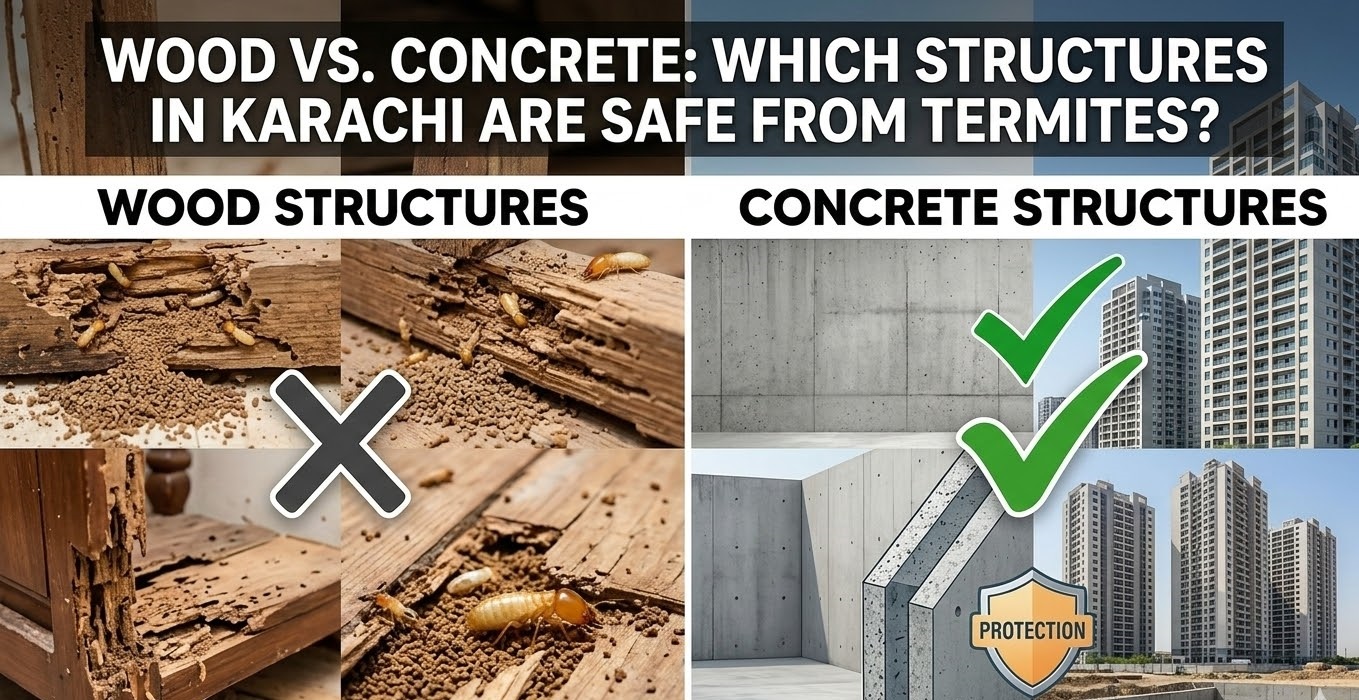
Walk through almost any neighborhood in Karachi — from the leafy lanes of Defence to the dense residential blocks of Gulshan-e-Iqbal — and you will find a mix of construction styles: older timber-heavy homes, modern reinforced concrete structures, and everything in between. A question that many Karachi homeowners ask, often after a neighbor suffers a costly infestation, is a simple one: Is my home safe from termites because it is built from concrete?
The answer is more complicated — and more alarming — than most people expect. While the material your home is built from does influence termite risk, it does not eliminate it. Understanding exactly where termites can and cannot penetrate, and why even steel-reinforced concrete structures in Karachi are not fully immune, is the first step toward genuinely protecting your property.
This guide gives you the full picture.
The Myth of the “Termite-Proof” Concrete Home
There is a widespread belief among Karachi homeowners that if a structure is built primarily from concrete, brick, and steel, termites simply cannot enter or cause damage. This belief, while understandable, is dangerously incomplete.
Here is the reality: termites do not eat concrete. That much is true. But they do not need to. What termites are after is the cellulose-rich organic material inside your concrete structure — the wooden door frames, window shutters, built-in wardrobes, kitchen cabinets, flooring underlays, roof timbers, and decorative woodwork that exists in virtually every Karachi home, regardless of how it was built.
Termites are among the most determined travelers in the insect world. Subterranean termite species — the most destructive and prevalent in Karachi — build pressurized mud tubes that allow them to cross any non-food surface, including concrete walls, brick, ceramic tile, and even metal conduits, to reach the wood on the other side.
| ⚠️ The Key Insight: Termites do not need to eat through your walls. They only need a crack, a pipe gap, or a construction joint the width of a credit card edge to gain entry. Once inside, they will find the wood. |
Timber and Wood-Frame Structures: The Highest-Risk Category
There is no ambiguity here. Homes with substantial timber construction — whether it is a traditional wooden ceiling (“lakri ki chhat”), timber-frame walls, wooden flooring, or heavy use of untreated wood in structural and decorative elements — represent the highest-risk category for termite infestation in Karachi.
Why Timber Construction Is So Vulnerable in Karachi
- Direct food source: Wood is composed almost entirely of cellulose, which is what termites digest. A timber beam is not just a pathway — it is a meal.
- Moisture retention in Karachi’s climate: Wooden elements in Karachi’s humid coastal environment absorb and retain moisture, especially during the July–September monsoon season. Moist wood is significantly more attractive to termite colonies than dry wood, and it supports faster colony growth.
- Soil contact: In older neighborhoods like Saddar, Lyari, Orangi Town, and parts of Landhi, wooden posts, door frames, and boundary structures frequently make direct contact with the soil — providing subterranean termites with an unobstructed entry path from the ground straight into the structure.
- Untreated timber: Much of the timber used in Karachi’s residential construction — particularly in mid- and lower-income areas — has never been pre-treated with termiticides or preservatives. This is especially common in homes built more than 15 years ago, when anti-termite pre-treatment was not a standard practice.
- Hidden voids and cavities: Traditional timber construction creates hollow spaces within walls, ceilings, and floors that provide ideal, undisturbed conditions for termite colonies to establish and expand without detection for years.
| 🏘️ At Particular Risk in Karachi: Older homes in Saddar, Lyari, and Ranchore Line with wooden ceiling structuresProperties in Korangi, SITE, and Baldia with timber-heavy compound walls and storagePre-2000 construction in Gulshan-e-Iqbal, North Nazimabad, and Federal B AreaAny home with large trees or mature garden shrubs adjacent to the structure |
Concrete and Steel Structures: Safer — But Not Safe
Modern reinforced concrete construction — the dominant building method across contemporary Karachi developments in DHA, Bahria Town, Clifton, Scheme 33, and Gulistan-e-Johar — significantly reduces the structural risks associated with termite attack. But it would be a serious mistake to assume it eliminates termite risk entirely.
Where Termites Enter Concrete Structures
1. Construction Joints and Expansion Gaps
Every reinforced concrete structure has construction joints — the seams where separate concrete pours meet, and expansion gaps built in to allow for thermal movement. These joints, if not sealed with appropriate termite-resistant compounds, are entry highways for subterranean termite colonies traveling through the soil beneath the slab.
In Karachi’s variable temperatures — cold January nights and scorching May afternoons — thermal expansion cycles cause these joints to open and close repeatedly, degrading standard sealants over time and creating progressively larger gaps.
2. Utility Pipe Penetrations
Water supply pipes, drainage pipes, gas lines, and electrical conduits must pass through the concrete slab and walls of every structure. The gaps around these penetrations — which are never perfectly sealed in practice — are among the most common termite entry points observed in Karachi homes.
This is particularly relevant in Karachi given the frequency of plumbing repairs: every time a pipe is accessed and re-sealed, the re-sealing is rarely done with termite-resistant compounds.
3. Hollow Block Construction
A significant proportion of concrete construction in Karachi uses hollow concrete blocks rather than solid poured concrete. The cavities within hollow blocks are actually ideal termite habitat — they provide protected, dark, humid spaces that termites can use to travel and nest, even within an apparently solid concrete wall.
4. The Wood Inside the Concrete Home
Even the most comprehensively concrete-constructed home in Karachi contains substantial wood: door frames and shutters, window frames and shutters, kitchen and bathroom cabinets, wardrobes and built-in furniture, decorative ceiling treatments (false ceilings with wooden battens), parquet or wooden flooring, roof timbers beneath the final roof slab, and wooden boxing around exposed pipes.
In a typical well-appointed three-bedroom apartment or villa in DHA or Clifton, the total timber content can amount to several tons of wood — all of it potentially accessible to a determined termite colony once they have crossed the concrete envelope.
| 💡 Case Example — DHA Phase 5 Villa: A fully concrete-constructed four-bedroom villa was found to have significant termite activity in the kitchen cabinetry and master bedroom wardrobe — both installed on the ground floor. Inspection revealed a mud tube running from the soil outside, through a utility pipe penetration in the kitchen slab, across the screed floor under the tile, and into the base of the kitchen units. The concrete structure was entirely intact. The damage was 100% to timber fittings and furniture. Early professional treatment would have prevented Rs. 180,000 in replacement costs. |
Head-to-Head: Wood vs. Concrete in Karachi’s Termite Context
| 🪵 Wood / Timber | 🧱 Concrete / Steel |
| Primary material is food for termites | Primary material is not food for termites |
| Structural timbers directly at risk of collapse | Structural elements safe — but timber fittings fully at risk |
| Infestations typically faster-spreading and harder to detect | Infestations confined to fittings — but can still be very costly |
| Mud tubes may penetrate from multiple soil contact points | Entry through pipe gaps, construction joints, and hollow blocks |
| Repair costs can include full structural reconstruction | Repair costs typically limited to fittings and furniture |
| Pre-treatment essential before and during construction | Pre-treatment still strongly recommended — especially soil barrier |
| Annual professional inspection: critical | Annual professional inspection: strongly recommended |
The “Hybrid” Reality: Most Karachi Homes Are Both
In practice, the vast majority of Karachi’s residential housing stock is neither purely timber nor purely reinforced concrete. Most homes built between the 1960s and 2010s combine:
- Reinforced concrete columns and beams with brick infill walls
- Concrete slabs for floors and roof, but significant timber in door and window frames
- Some rooms with traditional wooden ceiling treatments
- Wooden kitchen and bathroom fixtures throughout
- Timber used for roof framing beneath a concrete or asbestos sheet roof
This hybrid construction model means that even homes which owners consider “RCC construction” often contain the equivalent of a fully timber-fitted interior — and all the termite vulnerability that comes with it. The structural frame may be safe, but the liveable space is not.
This is exactly why homeowners in areas like Gulistan-e-Johar, North Karachi, Surjani Town, and even newer developments in Bahria Town Karachi should not assume their reinforced concrete homes are exempt from professional termite control treatment.
The Critical Window: Why Pre-Construction Treatment Matters Most
Regardless of whether your home is timber, concrete, or hybrid in construction, there is one point in the building lifecycle when termite protection is most effective and most affordable: before and during construction.
Once a structure is completed, applying a chemical soil barrier requires drilling through finished floors, accessing foundation walls, and disrupting interior fittings. This is possible — and Unique Fumigation does it every day across Karachi — but it is significantly more involved and costly than treating during construction.
What Pre-Construction Anti-Termite Treatment Involves
- Foundation soil treatment: Before the concrete slab is poured, the prepared soil base is treated with an approved, long-duration termiticide that creates a chemical barrier termites cannot cross without being eliminated.
- Perimeter trench treatment: A trench is dug around the building footprint and filled with termiticide solution before backfilling — creating an unbroken chemical shield around the entire structure.
- Pipe penetration sealing: Entry and exit points for utility pipes through the slab are pre-treated and sealed with termite-resistant compounds before the floor finish is applied.
- Post-slab surface treatment: After the slab is cured, the surface below the floor screed is treated before tiles or other floor finishes are installed.
If you are currently building or planning to build in Karachi, insisting on proper pre-construction anti-termite soil treatment from a certified pest control company is not optional — it is the single most important structural protection decision you will make.
| 📌 Did You Know? In many countries including India and parts of the Middle East, anti-termite soil treatment before construction is legally required for building permits. While Pakistan’s building regulations vary, Karachi’s climate makes pre-construction treatment just as essential in practice. |
Specific Scenarios: Your Home Type and Your Risk Level
Scenario A: Older Timber-Ceiling Home in Nazimabad or Saddar
Risk level: Critical. Traditional wooden ceiling structures, often built in the 1950s–1970s, are at extreme risk. If a professional inspection has not been conducted in the past 12 months, the likelihood of an active colony is very high. Professional termite inspection and treatment should be booked immediately.
Scenario B: RCC Apartment in a Multi-Story Building in Clifton or DHA
Risk level: Moderate. Ground floor and first floor apartments face the highest risk due to proximity to soil. Upper floors are lower risk for subterranean termites but can still be affected if drywood termites are introduced through infested furniture. Soil treatment around the building’s perimeter is the key protection measure — confirm with building management whether this has been done.
Scenario C: Newly Built Villa in Bahria Town or Scheme 33
Risk level: Moderate to High if pre-construction treatment was not applied. New construction disturbs established termite colonies in the soil, which can migrate directly into new foundations. Verify with your builder whether certified anti-termite pre-treatment was applied — and if not, arrange post-construction soil barrier treatment in Karachi as soon as possible.
Scenario D: Home with Large Garden or Mature Trees (Any Area)
Risk level: High. Mature trees, tree stumps, wooden garden furniture, and landscaping materials all serve as termite colony bases. Subterranean colonies established in garden soil can reach the home’s foundation within weeks. Annual perimeter inspections are essential.
Scenario E: Under-Construction Property
Risk level: Controllable with action. This is the ideal moment to act. Pre-construction anti-termite treatment applied now will provide long-duration protection at a fraction of the cost of post-construction treatment.
How Unique Fumigation Protects Both Wood and Concrete Homes
Whether your home is a traditional timber structure in Lyari or a modern concrete villa in DHA Phase 8, Unique Fumigation’s approach to comprehensive termite control in Karachi is tailored to your specific construction type, risk profile, and the degree of any existing infestation.
- Timber homes and timber-heavy structures: Full soil treatment around the perimeter, borate wood treatment applied directly to accessible timber elements, wood injection for inaccessible voids, and baiting systems for active established colonies.
- Concrete and RCC structures: Soil injection drilling around the building’s perimeter, chemical barrier installation beneath floors where accessible, sealing of all utility penetrations with approved compounds, and inspection of all timber fittings with targeted treatment as needed.
- New or under-construction properties: Pre-pour soil treatment, trench treatment, post-slab surface treatment, and pipe penetration sealing — all carried out to manufacturer and industry specifications using government-approved termiticides.
- Ongoing monitoring programs: Quarterly or bi-annual visits to check bait stations, re-inspect high-risk zones, and apply maintenance treatments — because in Karachi’s climate, one-time treatment is never sufficient for long-term protection.
6 Things Every Karachi Homeowner Should Do Right Now
Regardless of your construction type, these steps reduce your termite risk immediately:
- Get a professional inspection done this season. Before the monsoon, book a certified termite inspection. Early detection saves money and structural damage.
- Check every utility entry point. Examine where pipes enter your floors and walls. Any gap larger than a few millimetres should be sealed with appropriate filler compound.
- Eliminate moisture problems. Fix leaking taps, pipes, and roof drainage. Moisture is the single biggest accelerant of termite colony growth.
- Keep wood off the ground. Store timber, firewood, old furniture, and building materials elevated and away from the building perimeter.
- Remove tree stumps and dead roots. If you have had trees removed in or around your garden, ensure the stumps are fully cleared and the soil treated — stumps are prime termite colony bases.
- Confirm pre-construction treatment status. If you are unsure whether your home received anti-termite pre-treatment during construction, ask Unique Fumigation to inspect and advise — it is a free service.
Frequently Asked Questions
Can termites damage concrete directly?
Termites cannot digest or structurally damage sound concrete. However, they can exploit cracks, gaps, and joints in concrete to gain access to the wood inside a structure. Termite activity can also accelerate moisture ingress into concrete cracks over time.
My home is fully tiled with no exposed wood on the ground floor. Am I safe?
Tiling provides no barrier against subterranean termites. Termites travel in sealed mud tubes across any surface — including ceramic tiles — and can enter through grout lines, expansion joints, and the tiny gaps around pipe bases. The wood in your door frames, cabinets, and wall fittings remains accessible to them.
Is steel-frame construction termite-proof?
Steel framing is not a food source for termites and will not be structurally damaged by them. However, steel-frame homes still contain wood in every door, window, cabinet, and fitting — and require the same soil barrier and fitting protection measures as other construction types. Do not assume a steel-frame home is termite-immune.
How much does post-construction soil treatment cost compared to pre-construction?
Pre-construction soil treatment typically costs 30–50% less than post-construction treatment for an equivalent structure, because it does not require drilling through finished floors, moving furniture, or extensive sealing work on completed surfaces. The earlier you treat, the more cost-effective the protection.
I live in a high-rise apartment. Should I be concerned?
Ground floor and first floor apartment owners should take the same precautions as house owners. In multi-story buildings, drywood termites (which do not require soil contact) can infest any floor through wooden furniture, infested timber brought in during renovation, or adjacent units. If you are on the ground floor, confirm with building management that the foundation soil has been treated.
The Bottom Line: No Structure in Karachi Is Automatically Safe
Whether your home is built from timber, reinforced concrete, brick, or a combination of all three, the unique conditions of Karachi — the coastal humidity, the year-round warmth, the aging urban infrastructure, and the active termite species in the soil — mean that no home is automatically exempt from termite risk.
The question is not whether your construction material protects you. The question is whether your soil, your building’s entry points, and your timber fittings are protected. That requires professional assessment and, where necessary, professional treatment.
The good news: with the right treatment applied at the right time, termite infestation is entirely preventable. And with Unique Fumigation’s team covering every neighborhood in Karachi, protection is a phone call away.
| 📞 Book Your FREE Termite Inspection Today Whether your home is timber, concrete, or anywhere in between — our certified inspectors will assess your property’s specific risk level, identify any active termite activity, and recommend a treatment plan tailored to your construction type. ► Visit: uniquefumigation.com/termite-control-services-in-karachi/ No obligation. No cost. Just honest expert advice — and peace of mind. Serving DHA • Clifton • Gulshan • North Nazimabad • Bahria Town • Korangi • Scheme 33 • And All of Karachi |
Unique Fumigation | Karachi’s Trusted Termite & Pest Control Specialists

Muhammad Ali Khan is the founder and director of Unique Fumigation Services, Karachi’s longest-running PPMA-registered pest control company, established in 1993. With over 30 years of hands-on experience in residential and commercial pest management, he has overseen more than 5,000 treatments across every major locality in Karachi — from DHA and Clifton to Orangi Town and Korangi.
Under his leadership, Unique Fumigation has maintained affiliations with the Pakistan Pest Management Association (PPMA), National Pest Management Association (NPMA), Federal Board of Revenue (FBR), and Sindh Revenue Board (SRB), while exclusively using WHO-approved, eco-safe chemicals — a standard he enforced from day one.
Muhammad Ali Khan writes on pest biology, infestation patterns specific to Karachi’s climate, treatment protocols, and chemical safety — drawing directly from three decades of field experience treating termite-damaged structures, dengue-prone areas, and food-industry facilities for clients including K-Electric, Hyperstar, IBA Karachi, and USAID.
His work is grounded in one principle: pest control done wrong is a health hazard, not just a failed service.