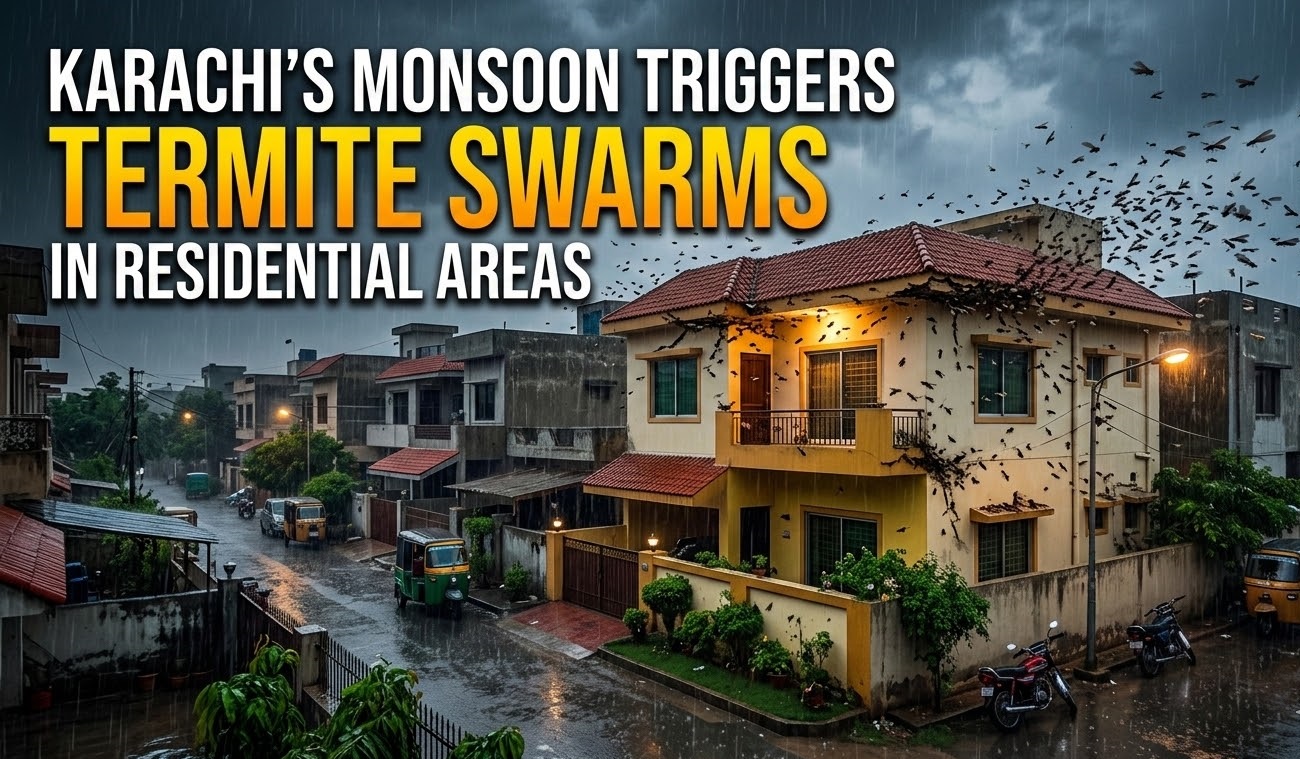
Every year, as the first heavy rains sweep across Karachi from the Arabian Sea, homeowners across the city notice something unsettling: swarms of winged insects emerging from the ground, from walls, from under furniture — flooding their homes for a night or two before vanishing. Most people sweep them away and move on. But what they are witnessing is one of the most destructive natural events a homeowner can experience: a termite swarm triggered by monsoon conditions.
This is not a coincidence. The relationship between Karachi’s monsoon season and termite swarming activity is deeply biological — and understanding it could be the difference between protecting your home and watching it deteriorate from the inside out.
⚠ URGENT: Termite swarms are not just a nuisance — they are a declaration that a mature colony is nearby and actively expanding. If you see swarms in or around your home, treatment cannot wait.
Understanding Termite Swarming: What Actually Happens
Termite colonies reproduce by producing “alates” — winged reproductive termites, also called swarmers. These are not worker termites. They are the colony’s future kings and queens, released in large numbers with one mission: find a new location, mate, shed their wings, and start a brand-new colony.
A single mature termite colony can release anywhere from a few thousand to tens of thousands of swarmers in a single event. Each pair that successfully mates and finds suitable soil or wood can establish a colony that, within three to five years, will itself be large enough to release another swarm.
The timing of this release is not random. Termites are exquisitely sensitive to environmental conditions — specifically temperature, humidity, and soil moisture. They wait for precisely the right moment. And in Karachi, that moment arrives with the monsoon.
“A single swarming event near your home can mean thousands of new colonies attempting to establish themselves. Even a handful of successful ones can cause severe structural damage within years.”
Why Karachi’s Monsoon Is the Perfect Trigger
Karachi’s monsoon season — typically running from late June through September — creates a convergence of environmental conditions that subterranean termites have evolved over millions of years to exploit. Here’s what happens:
Factor 1
Sudden Rise in Soil Moisture
The most critical trigger for termite swarming is a rapid increase in soil moisture. Before the monsoon, Karachi’s soil — particularly in areas like Gulshan-e-Iqbal, Surjani Town, and Korangi, where soil is clay-heavy — becomes dry and compact. When the rains arrive, this soil absorbs moisture quickly, signaling to termite colonies that the surface world is now hospitable for their alates to survive long enough to find a mate.
Subterranean termites, which live in underground colonies, cannot survive on the surface in dry conditions. The monsoon rain essentially opens the “door” for them to emerge safely. Within 24 to 48 hours of the first significant rainfall of the season, swarming events begin across the city.
💡 KARACHI FACT: Neighborhoods with heavy clay soil — including parts of North Nazimabad, Liaquatabad, and New Karachi — experience more intense swarming events because clay retains moisture longer, sustaining ideal conditions for alate survival.
Factor 2
Pre-Monsoon Heat Accelerates Colony Growth
The months of April, May, and June in Karachi are notoriously brutal. Temperatures routinely exceed 38–42°C, with periodic heat waves pushing even higher. While these conditions are miserable for humans, they are ideal for termite colony growth. Worker termites feed and expand aggressively in the heat, and the colony’s population reaches its annual peak just as the monsoon approaches.
This means that by the time the first rain hits, termite colonies across Karachi are at maximum strength — with the largest number of reproductives ready to swarm. The pre-monsoon heat is, in effect, a six-week preparation period for one of nature’s most destructive mass migration events.
Factor 3
High Humidity Sustains Swarmers in Flight
Termite alates are delicate creatures. They dehydrate rapidly and die quickly in low-humidity conditions. Karachi’s coastal humidity — which jumps from a pre-monsoon average of around 60–65% to over 80–85% during the monsoon — allows swarmers to remain airborne and viable for much longer, dramatically increasing their chances of successful mating and colony establishment.
This is why swarming events in Karachi tend to be far more intense and widespread than in inland Pakistani cities like Multan or Faisalabad. The Arabian Sea essentially acts as a humidity engine, supercharging the biological conditions that favour swarming. Homes in coastal-adjacent areas like Clifton, Defence (DHA), and Korangi face particularly high swarmer density. This is precisely why residential termite control in Karachi demands a different — and more proactive — approach than in drier parts of Pakistan.
Factor 4
Monsoon Flooding Creates New Entry Points
Beyond triggering swarming, Karachi’s monsoon rains actively help termites infiltrate homes. Annual flooding — a persistent problem in areas like Orangi Town, Baldia Town, Lyari, and parts of SITE Industrial Area — saturates the soil around building foundations, softening the ground and creating new pathways for termites to enter.
Standing water around the perimeter of a house, waterlogged planter beds, and flooded utility trenches all become superhighways for subterranean termites seeking to transition from soil to the wooden structural elements of your home. After flood water recedes, the softened, moisture-rich soil remains ideal for termite tunneling for weeks.
⚠ WARNING: If your ground floor flooded during last monsoon, your home’s foundation perimeter is particularly vulnerable to termite infiltration this coming season. A pre-monsoon inspection is strongly advised.
Which Karachi Neighborhoods Are Most at Risk?
While termites are found across all of Karachi, certain neighborhoods face disproportionately higher risk during and after the monsoon season due to a combination of soil type, drainage infrastructure, building age, and proximity to greenery or open ground.
- PECHS & Tariq Road: Dense older housing with mature trees whose root systems create natural termite corridors to foundations.
- Gulshan-e-Iqbal & Gulshan-e-Hadeed: Heavy clay soil retains monsoon moisture for weeks, sustaining colony activity long after rains stop.
- Nazimabad & North Nazimabad: Ageing bungalows with decades-old wooden beams and limited drainage — a perfect combination for post-monsoon infestations.
- DHA & Clifton: Coastal humidity and large landscaped gardens with high soil moisture create year-round risk, peaking sharply during monsoon.
- Orangi Town & Baldia Town: Recurring annual flooding combined with dense population and older construction makes post-monsoon termite infiltration a near-annual occurrence.
- Korangi & Landhi: Industrial and residential mix with significant open ground — ideal for large underground colonies to thrive and expand.
What Happens After the Swarm — The Hidden Danger
The swarm itself lasts only a day or two. Once the alates lose their wings and either die or successfully mate, the visible event is over — and most homeowners breathe a sigh of relief. This is a dangerous mistake.
Every mated pair that survives the swarm is now a king and queen searching for a dark, moist location to begin digging. Common establishment sites in Karachi homes include:
- Under bathroom and kitchen flooring, where residual pipe moisture keeps soil damp year-round
- Around the wooden frames of ground-floor doors and windows, especially those facing garden-side
- Inside wall cavities adjacent to plumbing risers in multi-storey buildings
- Beneath raised flooring in older bungalows in areas like Bath Island and Saddar
- In soil adjacent to wooden furniture stored in poorly-ventilated storerooms
Within six months, a newly established colony has worker termites actively foraging. Within two to three years, the colony is causing measurable structural damage. This is why acting immediately after a swarming event — rather than waiting for visible damage — is critical. If you witnessed swarms near your property, the right time to call in expert termite control professionals serving Karachi was yesterday. The second-best time is today.
How to Protect Your Home Before, During, and After Monsoon
There is no single action that eliminates termite risk entirely — but a layered, timed approach dramatically reduces the likelihood of infestation establishing in your home. Here is what Karachi homeowners should do:
Before the Monsoon (April – June)
- Book a professional termite inspection to assess your property’s current risk level and identify any existing activity
- Seal all cracks and gaps in your foundation, external walls, and utility entry points using cement or appropriate sealant
- Ensure drainage around the perimeter of your home directs water away from the foundation
- Remove or relocate any dead wood, timber stacks, or wooden debris stored close to your home’s exterior
- Apply pre-monsoon soil treatment around the foundation — a chemical barrier that prevents subterranean termites from approaching
During the Monsoon (July – September)
- Check for and promptly repair any leaking pipes, seeping walls, or water infiltration inside the home
- Do not leave piles of wet cardboard, newspapers, or cellulose-rich material in ground-floor rooms
- After flooding or standing water, inspect the perimeter of your home for new mud tubes or termite activity
- Keep wooden furniture legs off direct contact with flooring in rooms prone to dampness
- If you observe a swarm, note the location carefully and contact a pest specialist within 48 hours
After the Monsoon (October – November)
The post-monsoon period is when newly established colonies begin their most active growth phase. October and November are the ideal months for a follow-up inspection and, if needed, targeted professional termite treatment in Karachi to eliminate any colonies that established themselves during the season.
- Schedule a post-monsoon termite inspection to detect any newly established colonies
- Repair any monsoon-related structural damage — cracks, damp patches, and peeling plaster — that could provide new termite entry points
- Consider installing a baiting system around your property perimeter for ongoing monitoring through the dry season
Why DIY Solutions Fall Short in Karachi’s Conditions
Walk into any hardware shop in Saddar, Jodia Bazaar, or Tariq Road and you will find a range of termite sprays, powders, and repellent products. While these may temporarily reduce surface-level insect activity, they are fundamentally inadequate against the subterranean termite colonies that Karachi’s monsoon triggers.
Here is why: subterranean termite colonies live metres underground, with tunnels that extend in every direction beneath your home. Surface sprays cannot reach this depth. Repellent chemicals applied without professional soil injection techniques create gaps in coverage that termites quickly identify and route around. And bait stations require precise placement, monitoring, and replenishment protocols that are ineffective when applied casually.
Beyond effectiveness, there is also the issue of species identification. Karachi is home to multiple termite species — primarily Coptotermes gestroi and Heterotermes indicola — each with different colony behaviours, food preferences, and responses to treatment chemicals. A professional pest control team identifies the species present before selecting the appropriate treatment protocol. A spray-can solution applies no such judgement.
💡 NOTE: Professional termite treatment in Karachi typically involves a combination of soil barrier treatment, targeted injection around wooden elements, and — for severe infestations — baiting systems that exploit the colony’s own behaviour to eliminate the queen.
The Real Cost of Waiting
It is tempting to delay. A termite problem that is not visibly damaging anything today does not feel urgent. But the economics of termite damage are unforgiving.
An early-stage termite colony — detected and treated in its first year — typically costs a fraction of what is required once it has penetrated structural elements. By the time termites have damaged load-bearing wooden beams, door-frame joints, or the wooden substructure of flooring, you are looking not just at pest treatment costs but at significant carpentry and structural repair bills.
In Karachi’s real estate market, a home with documented termite damage — especially in established neighbourhoods like PECHS, Clifton, or Gulshan-e-Iqbal — sees measurable impact on resale and rental value. Buyers and tenants increasingly ask for pest inspection certificates. A clean inspection history is an asset. An untreated infestation is a liability that compounds with time.
“The cost of a professional termite inspection is a few thousand rupees. The cost of ignoring a termite infestation for two monsoon seasons can run into hundreds of thousands.”
Don’t Wait for the Next Swarm. Protect Your Home Before Monsoon Hits.
Unique Fumigation offers free termite inspections for Karachi homeowners. Our certified specialists cover DHA, Clifton, Gulshan-e-Iqbal, Nazimabad, PECHS, Korangi, and all major residential areas across the city. We identify your risk level, detect active colonies, and provide a clear, honest treatment plan — no pressure, no guesswork.
→ Book Your Free Termite Inspection at uniquefumigation.com ←
✓ Karachi-based certified team ✓ Chemical & eco-friendly treatment options ✓ Free, no-obligation assessment

Muhammad Ali Khan is the founder and director of Unique Fumigation Services, Karachi’s longest-running PPMA-registered pest control company, established in 1993. With over 30 years of hands-on experience in residential and commercial pest management, he has overseen more than 5,000 treatments across every major locality in Karachi — from DHA and Clifton to Orangi Town and Korangi.
Under his leadership, Unique Fumigation has maintained affiliations with the Pakistan Pest Management Association (PPMA), National Pest Management Association (NPMA), Federal Board of Revenue (FBR), and Sindh Revenue Board (SRB), while exclusively using WHO-approved, eco-safe chemicals — a standard he enforced from day one.
Muhammad Ali Khan writes on pest biology, infestation patterns specific to Karachi’s climate, treatment protocols, and chemical safety — drawing directly from three decades of field experience treating termite-damaged structures, dengue-prone areas, and food-industry facilities for clients including K-Electric, Hyperstar, IBA Karachi, and USAID.
His work is grounded in one principle: pest control done wrong is a health hazard, not just a failed service.