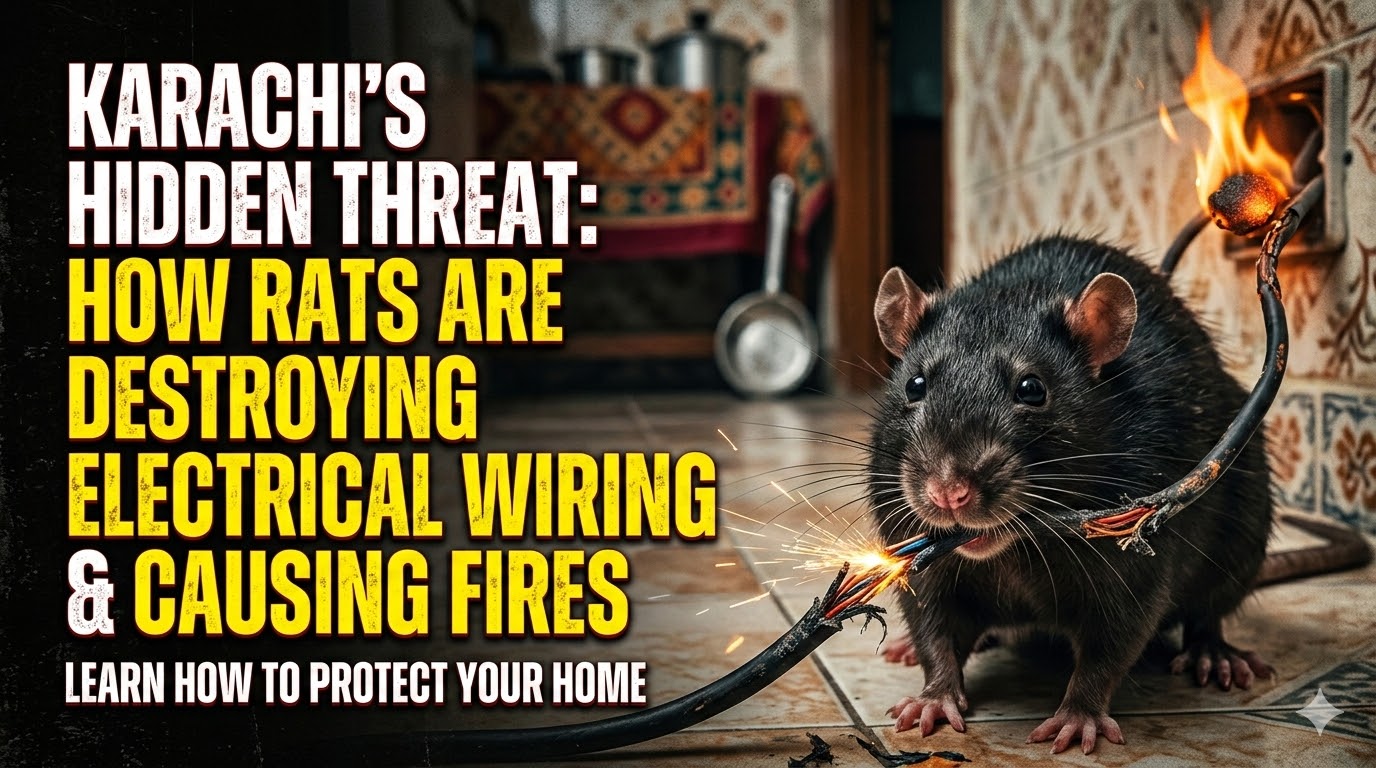
Every year, thousands of homes across Karachi suffer electrical faults, short circuits, and devastating fires — and rats are far more often to blame than most homeowners realize. From the cramped, centuries-old neighbourhood of Lyari to the sprawling apartment complexes of DHA and the densely packed streets of Orangi Town, rodents have silently become one of the most serious household threats in Pakistan’s largest city.
This isn’t just a pest problem. It is a fire safety emergency hiding inside your walls, ceilings, and electrical panels. If you live in Karachi and have ever heard unexplained scratching at night, noticed frayed cables, or experienced frequent circuit trips, you need to read this guide carefully.
Why Karachi Has Such a Severe Rat Problem
Karachi’s unique combination of geography, infrastructure challenges, and rapid urban growth makes it one of the most rat-friendly cities in the region. Understanding why the problem is so bad here is the first step toward protecting your home.
1. Year-Round Warm Climate
Unlike cities in colder climates where winter kills off rat populations, Karachi’s warm weather — with temperatures rarely dropping below 12°C even in January — allows rats to breed continuously throughout the year. A single pair of Norway rats (Rattus norvegicus), the most common species found in Karachi homes, can produce up to 2,000 descendants within a single year under optimal conditions.
2. Open Drains and Aging Sewage Infrastructure
Karachi’s famously stressed drainage system provides rats with vast underground networks to travel through undetected. Open naalis (drains) running through residential areas of Korangi, Malir, and Liaquatabad are well-documented rat highways. Rodents travel from public sewers into residential buildings through plumbing gaps, broken pipes, and utility entry points.
3. Dense, Mixed-Use Urban Construction
In older neighbourhoods like Saddar, Kharadar, and Nazimabad, commercial shops sit directly below residential apartments. The constant presence of food waste, open garbage, and poorly sealed walls gives rats unlimited access to food and nesting opportunities — and a direct route straight into the homes above.
4. High-Rise Construction Gaps
Even in newer developments in Clifton, Gulshan-e-Iqbal, and Bahria Town, construction gaps around utility pipes, improperly sealed concrete joints, and inadequate pest-proofing during building create entry points that rats exploit almost immediately.
The Gnawing Instinct: Why Rats Target Electrical Wiring Specifically
Many homeowners assume rats only damage food stores and fabric. The truth is far more alarming: rats are biologically compelled to gnaw on hard materials, and electrical wiring is one of their most preferred targets.
Rats belong to the order Rodentia, a Latin word meaning “to gnaw.” Their incisor teeth grow continuously throughout their lives — at a rate of up to 11–14 cm per year — and must be worn down constantly. If they don’t gnaw, their teeth grow so long they cannot eat and will eventually die. This means gnawing is not a choice for rats. It is survival.
Electrical cables are attractive to rats for several specific reasons:
- Modern wiring insulation is often made from PVC, soy-based compounds, or polyethylene — materials that are softer and more pliable than older rubber insulation, and which rats find easier to chew through.
- Cable bundles generate gentle heat, which attracts rodents seeking warmth, especially inside wall cavities and false ceilings — common in Karachi’s older apartment stock.
- Wiring runs near nesting areas such as attic insulation, kitchen cavity walls, and under-sink cabinets — all locations rats prefer for nesting.
- Conduit runs alongside plumbing pipes, which rats already use as pathways, making wiring incidentally easy to encounter and gnaw on.
| ⚠ Critical Fact: According to international fire safety research, rodents are estimated to be responsible for 20-25% of all house fires of unknown origin. In a city like Karachi – where electrical infrastructure is already under stress from load-shedding cycles, voltage fluctuations, and aging wiring – the danger is dramatically amplified. |
How Rat-Damaged Wiring Causes Fires in Karachi Homes
The path from a rat gnawing a cable to a house fire is disturbingly short, and it doesn’t require dramatic circumstances. Here is how it unfolds:
Stage 1: Insulation Stripping
A rat strips away the plastic insulation around a live electrical wire. This can happen inside a wall cavity, inside a distribution board (DB) box, inside an air conditioner conduit, or behind a refrigerator — all common rat pathways in Karachi apartments.
Stage 2: Wire Exposure
The bare copper conductor is now exposed. On its own, this does not immediately cause a fire. However, the exposed wire is now vulnerable to moisture (a constant concern in Karachi’s humid coastal air, especially during the monsoon season from June to September), contact with other conductors, or arcing.
Stage 3: Short Circuit or Arcing
When an exposed live wire touches a neutral wire, an earthed surface, or another conductor, a short circuit occurs. The resulting arc can reach temperatures exceeding 3,500°C — hot enough to instantly ignite dust, rat nesting material (paper, fabric, cardboard), and the surrounding wooden beam or wall cavity insulation.
Stage 4: Hidden Fire in the Wall
This is the most dangerous phase. A fire starts inside the wall, ceiling, or floor cavity — completely invisible to the occupants. By the time smoke is detected or the smell becomes noticeable, the fire has often spread significantly inside the structure. In buildings with POP (plaster of Paris) false ceilings — extremely common in Karachi’s upper-middle-class apartments — this hidden fire can engulf an entire ceiling before a single flame is visible.
Stage 5: Sudden and Uncontrollable Spread
By the time the fire breaks through, it is often already behind multiple walls. Residents have little time to escape, and the damage is catastrophic.
| Real Risk in Your Neighbourhood: Karachi’s frequent voltage fluctuations from KESC/K-Electric load-shedding and restoration surges put already-compromised wiring under additional electrical stress. A wire that rats have partially stripped may survive months of normal use but fail catastrophically during a voltage surge – which in Karachi can happen multiple times a day. |
Warning Signs That Rats Are Already Inside Your Electrical System
Most Karachi homeowners only discover a rat infestation after significant damage has already been done. Watch carefully for these early warning signs:
- Frequent, unexplained circuit breaker trips or fuse blowouts, especially at night when rats are most active
- Flickering lights or appliances that behave erratically without an obvious cause
- Burning smell from walls, sockets, or DB boxes — even without visible smoke
- Scratching, scurrying, or squeaking sounds from inside walls, ceilings, or under floors after dark
- Dark smear marks (“rub marks”) along walls, skirting boards, and pipes — caused by the oils in rat fur
- Rat droppings (small, dark, pellet-shaped) near sockets, in kitchen cabinets, or in cupboard corners
- Chewed plastic covers on light switches, plug sockets, or extension cords
- Urine stains or a persistent musty ammonia smell in certain rooms — particularly in lower-ground floors or areas close to pipes
- Pet cats or dogs displaying unusual interest in specific sections of walls or flooring
If you have noticed even one of these signs in your Karachi home, do not wait. The risk is real and it is active. Contact professional rat control services in Karachi immediately for a thorough inspection.
Areas of Karachi Most at Risk
While no neighbourhood is fully immune, certain areas of Karachi face a significantly elevated risk due to structural, environmental, or demographic factors:
Old City Areas: Saddar, Lyari, Kharadar, Mithadar
These densely built historic districts feature aging colonial-era and post-partition construction with abundant gaps in foundations, deteriorating plaster walls, and decades-old wiring. Rat colonies in these areas are well-established and often extend across multiple buildings.
Industrial & Mixed-Use Zones: Korangi, SITE, Orangi Town
Proximity to industrial activity means large volumes of food waste, packaging material, and poorly maintained infrastructure. Rats from industrial zones migrate into adjacent residential areas through drainage systems and shared walls.
High-Rise Apartments: Gulshan-e-Iqbal, North Nazimabad, Clifton Blocks
Multi-story apartment buildings create vertical rat highways through shared utility shafts, elevator pits, and common garbage chutes. An infestation on the ground floor can reach upper floors within days.
New Developments: Bahria Town, DHA Phase Extensions
Counterintuitively, newly built areas are not immune. Construction debris, open lots, and poorly sealed new builds attract rats early. Soy-based wiring insulation — increasingly common in newer construction — is especially attractive to rodents.
What Homeowners Can Do: Prevention and Professional Intervention
Protecting your home requires a two-track approach: physical prevention measures and professional pest control. Here is what you should do:
Physical Prevention Measures
- Seal all gaps around pipes, conduits, and cables where they enter walls using steel wool, metal mesh, or hydraulic cement — materials rats cannot chew through
- Install rodent-proof covers on drain openings, especially in kitchens and bathrooms
- Ensure garbage bins have tight-fitting lids and do not leave food scraps exposed overnight
- Store dry food (atta, chawal, dal) in hard plastic or metal containers, not fabric or thin plastic bags
- Check for and repair gaps under doors, especially in ground-floor apartments and shops
- Have an electrician inspect visible wiring runs in areas where rat activity has been suspected
Why DIY Rat Control Is Insufficient
Many Karachi homeowners attempt to manage rat infestations with snap traps, glue boards, or retail rat poison available from local kiryana stores. While these methods can reduce a visible population temporarily, they do not address the root cause: the active colony, its entry points, and its nesting sites inside your building’s structure.
Rats are neophobic — instinctively cautious of new objects in their environment. They will avoid improperly placed traps for weeks. Poison stations placed without knowledge of rat travel routes are frequently ignored. Only comprehensive, professionally deployed rat extermination solutions in Karachi — including detailed site surveys, strategic bait placement, population tracking, and entry-point sealing — deliver lasting results.
The Unique Fumigation Approach to Rat Control in Karachi
Unique Fumigation has been protecting Karachi homes and businesses from pest infestations for years, combining local expertise with proven pest management methods. Our rodent control programme is not a one-size-fits-all product sale — it is a structured, multi-step intervention designed for Karachi’s specific urban environment.
Our process includes:
- Detailed site inspection to identify all active rat runs, entry points, nesting sites, and wiring risk areas
- Population assessment to determine infestation severity and species present
- Strategic bait station deployment along confirmed rat pathways — not randomly placed
- Tamper-resistant bait boxes safe for households with children and pets
- Structural gap-sealing recommendations to prevent re-entry
- Follow-up monitoring visits to verify complete elimination
- Written reporting so you know exactly what was found and what was done
Whether you are dealing with a new infestation or have been struggling with recurring rat problems for years, our professional rat control services in Karachi are designed to deliver results that last.
Frequently Asked Questions
Can rats really cause a house fire?
Yes — and they do so regularly. Rat-chewed wiring is a leading cause of electrical fires globally, and Karachi’s combination of heavy rat populations, aging electrical infrastructure, and frequent voltage surges makes the risk here especially high.
How quickly can rats damage wiring?
A rat can strip the insulation from a length of cable in a single night. In an active infestation with multiple animals, significant wiring damage can occur within days of initial entry.
How do I know if rats are inside my walls?
The most common signs are nocturnal scratching sounds, the smell of urine, circuit breaker trips without explanation, and rub marks along skirting boards. A professional inspection can confirm activity even when visual signs are absent.
Is rat poison safe to use at home?
Retail rodenticides available in Karachi markets carry significant risk if misused — particularly to children, pets, and secondary scavengers. Professional-grade bait used by certified pest controllers is contained in tamper-resistant stations and deployed according to safety protocols.
How often should I have a professional rat inspection?
For properties in high-risk areas (ground-floor apartments, properties near open drains, older buildings), a professional inspection at least once every six months is advisable. Properties that have had previous infestations should be monitored quarterly.
Don’t Wait for a Fire to Take Action
| Book Your Free Rat Inspection Today | If you are a Karachi homeowner and you have noticed any of the warning signs described in this guide – or you simply want the peace of mind of knowing your home is rodent-free – Unique Fumigation is here to help. Our certified pest control specialists will conduct a thorough inspection of your property, identify any current or potential rat activity, and recommend a tailored treatment plan. This inspection is completely free – with no obligation. |
Contact Unique Fumigation now and book your free inspection at: uniquefumigation.com/rats-control-services-in-karachi
Protecting Karachi homes from rats — one inspection at a time.

Muhammad Ali Khan is the founder and director of Unique Fumigation Services, Karachi’s longest-running PPMA-registered pest control company, established in 1993. With over 30 years of hands-on experience in residential and commercial pest management, he has overseen more than 5,000 treatments across every major locality in Karachi — from DHA and Clifton to Orangi Town and Korangi.
Under his leadership, Unique Fumigation has maintained affiliations with the Pakistan Pest Management Association (PPMA), National Pest Management Association (NPMA), Federal Board of Revenue (FBR), and Sindh Revenue Board (SRB), while exclusively using WHO-approved, eco-safe chemicals — a standard he enforced from day one.
Muhammad Ali Khan writes on pest biology, infestation patterns specific to Karachi’s climate, treatment protocols, and chemical safety — drawing directly from three decades of field experience treating termite-damaged structures, dengue-prone areas, and food-industry facilities for clients including K-Electric, Hyperstar, IBA Karachi, and USAID.
His work is grounded in one principle: pest control done wrong is a health hazard, not just a failed service.