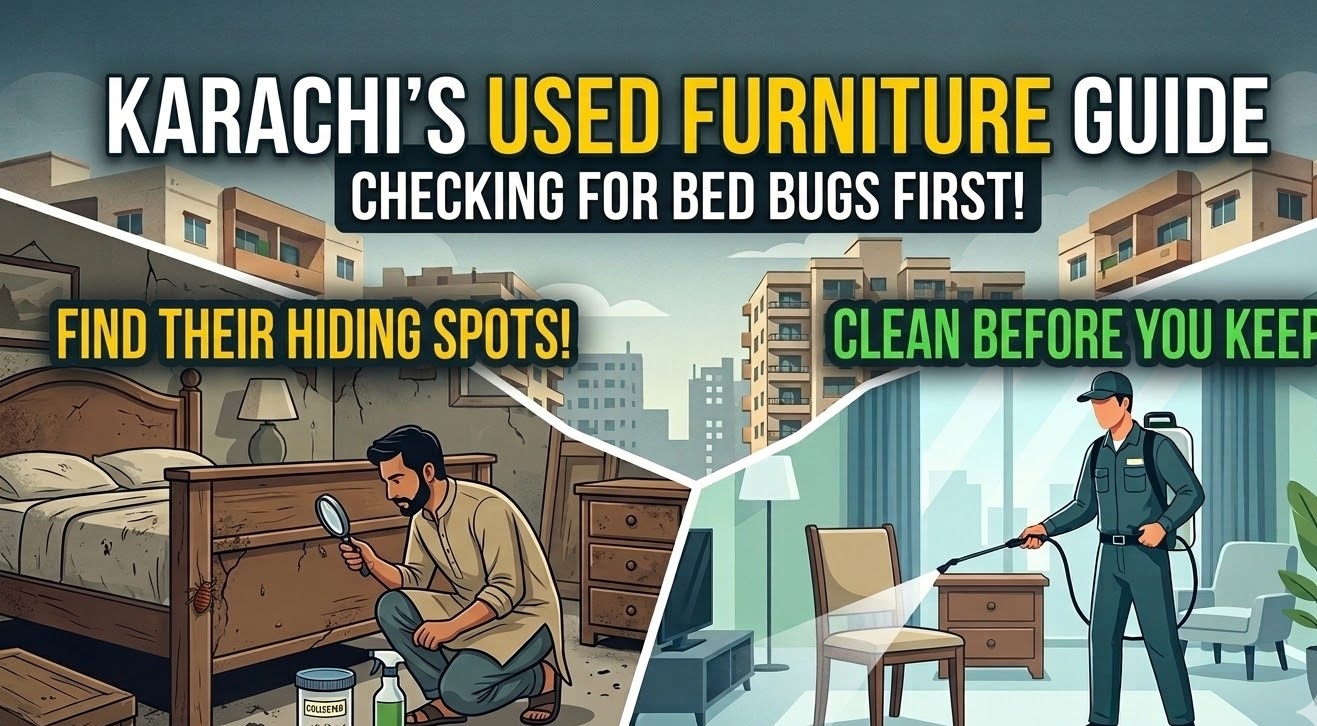
Karachi has one of Pakistan’s most active second-hand furniture markets. From the sprawling stalls of Lea Market and Sunday Bazaar in Saddar, to Facebook Marketplace listings and roadside dealers in Orangi, Landhi, and Korangi, thousands of families buy used sofas, beds, almirahs, and wooden furniture every single day. It’s economical, practical, and in a city where furnishing a home is expensive — completely understandable.
But there is a hidden danger lurking in those attractive bargains: bed bugs.
Second-hand furniture is the number one way bed bug infestations begin in Karachi homes. A single infested sofa or mattress brought in from outside can unleash hundreds of insects into your flat within weeks — spreading to bedrooms, living areas, and eventually to neighbouring apartments in your building.
The good news? With the right knowledge and a few minutes of careful inspection before you buy, you can protect your home entirely. This guide will walk you through exactly what to look for, where to look, how to safely bring second-hand furniture into your Karachi home, and what to do if you suspect you’ve already brought bed bugs in.
Why Second-Hand Furniture from Karachi Markets Is a High-Risk Source
Not all second-hand furniture carries the same risk. But Karachi’s specific conditions make locally sourced used furniture particularly likely to harbour bed bugs. Here is why:
The Scale of Karachi’s Used Furniture Trade
Karachi’s second-hand furniture markets are enormous. Lea Market in Saddar is one of the largest in South Asia, with hundreds of dealers trading furniture that has passed through multiple homes, storage facilities, and transport vehicles before reaching you. The supply chain is long, complex, and completely untested for pest contamination.
Online platforms have expanded this market dramatically. Furniture sold on OLX Pakistan, Facebook Marketplace, and WhatsApp groups changes hands rapidly, with no inspection standards and no pest control requirements at any point in the chain.
Karachi’s Climate Keeps Bed Bugs Alive in Storage
In colder climates, bed bugs in abandoned or stored furniture may die off during winter months. In Karachi, this simply does not happen. With year-round temperatures between 20 and 38 degrees Celsius, bed bugs can survive indefinitely in furniture sitting in a godown, on a market stall, or in a storage yard. A sofa that has been sitting in a Saddar warehouse for six months is just as likely to be infested as one freshly removed from a home.
High Population Density Means More Infested Sources
When furniture leaves a Karachi apartment building — whether due to a family relocating, a tenant vacating, or a landlord clearing out a unit — there is a meaningful chance it comes from a building where bed bugs are already present. Given how widely bed bugs have spread across Karachi’s apartment stock, the pool of potentially infested second-hand furniture in the city is very large.
Most Sellers Are Unaware of the Problem
Bed bugs are nocturnal, expert hiders, and easy to miss in daylight. Many sellers genuinely do not know their furniture is infested — particularly if the infestation is in its early stages. This is not dishonesty; it is simply the nature of these insects. You cannot rely on a seller’s word that furniture is clean.
What You Are Actually Looking For: A Quick Bed Bug Primer
Before you can inspect furniture properly, you need to know what bed bugs and their signs look like. Many people have never seen one, and confuse them with other insects.
The Insects Themselves
Adult bed bugs are roughly the size and shape of an apple seed — 4 to 5 millimetres long, flat, and oval-shaped. Before feeding they are pale tan or straw-coloured. After a blood meal they become dark reddish-brown and slightly swollen. Nymphs (young bed bugs) are smaller — 1 to 3 mm — and paler, making them very hard to spot with the naked eye.
The Evidence They Leave Behind
Even if you do not spot a live bug, the signs they leave are very distinctive:
- Dark faecal spots: Tiny black or dark brown dots, roughly the size of a pen tip, often in clusters. These are digested blood and will smear if wiped with a damp cloth. Look for them on seams, joints, in crevices, and on any rough or porous surface.
- Shed skins (exuviae): As bed bugs grow they shed their outer skin five times. These pale, translucent husks are hollow and papery, and often found in the same harbourage spots as the insects themselves.
- Bloodstains: Small reddish or rust-coloured smears on fabric surfaces — the result of a bug being crushed after feeding, or of blood that has oozed from a bite wound.
- Eggs and egg casings: Bed bug eggs are tiny (about 1 mm), white, and oval-shaped, resembling a grain of salt. They are laid in clusters in hidden spots and glued to surfaces, so they do not shake off easily.
- A musty, sweetish odour: A well-established infestation produces a recognisable smell — often described as musty almonds or coriander. If second-hand furniture has an unexplained sweetish, stale odour, treat this as a warning sign.
You are unlikely to find all of these signs together. Finding even one — particularly faecal spots or shed skins — is sufficient reason to decline the purchase or take protective measures before bringing the furniture home.
Your Step-by-Step Inspection Guide for Second-Hand Furniture
Here is a practical, room-by-room approach to inspecting used furniture before you buy or accept delivery. Always conduct this inspection in bright daylight or use a strong torch — bed bugs avoid light and hide in the darkest recesses.
| 🔍 What you will need for a proper inspection: • A bright torch or phone flashlight • A credit card or flat spatula to probe seams • A white sheet of paper or cloth to catch any insects you dislodge • A magnifying glass (optional but helpful for eggs and nymphs) • Disposable gloves |
How to Inspect Sofas and Upholstered Chairs
Sofas and armchairs are the highest-risk category of second-hand furniture. Their many seams, tufts, zippers, and wooden frames create dozens of ideal hiding spots.
- Remove all cushions and inspect every seam of both the cushions and the main sofa body — especially where fabric meets the wooden frame. Run your finger or a card along the seam to dislodge anything hidden.
- Flip the sofa upside down and inspect the underside, including the dust cloth (the fabric on the bottom), the legs, and any exposed wood. Faecal spots on bare wood are especially easy to spot.
- Check the area where the back of the sofa meets the seat — this deep crevice is a favourite hiding spot. Use your torch and probe with a card.
- Inspect the wooden frame wherever it is exposed — particularly joints, cracks, and any rough or unfinished wood surfaces where eggs can be glued.
- If the sofa has a zipper, open it and inspect the inside fabric and foam closely. Check the zipper teeth themselves for faecal spots.
How to Inspect Mattresses and Bed Frames
Mattresses are bed bugs’ preferred habitat — the insects evolved specifically to live near sleeping humans. A mattress inspection should be thorough.
- Inspect all four sides of the mattress, paying close attention to the stitched seams at the edges. Use a card to probe the seam and look for faecal spots, shed skins, or moving insects.
- Check both the top and bottom surfaces, including the handles and any ventilation holes or eyelets.
- Inspect the box spring or divan base separately. Remove the dust cloth if possible and inspect the inside — box springs are one of the most common bed bug harbourages and are frequently missed.
- For wooden bed frames, inspect every joint, crack, screw hole, and groove. Run a card through any slotted areas. Check the headboard on both sides — headboards are extremely common harbourage spots in Karachi apartments.
- Inspect the underside of the bed frame, particularly where horizontal slats rest on the frame, as these contact points create perfect crevices.
How to Inspect Wooden Furniture (Almirahs, Cabinets, Wardrobes)
Wooden furniture is lower risk than upholstered pieces but should still be inspected, particularly older pieces with joints, cracks, and rough interior surfaces.
- Open all drawers and remove them completely. Inspect the inside of the drawer, the drawer slides or runners, and the cavity left behind when the drawer is removed.
- Check all interior corners and joints — especially where wood panels meet at 90 degrees. Faecal spotting in these corners is a clear sign.
- Inspect the back panel of the piece, particularly if it is made of thin hardboard. Check both sides if possible.
- Look inside any hollow legs or base structures.
How to Inspect Dining Chairs and Wooden Chairs
Dining chairs are frequently overlooked. Check the underside of seats, all joints between legs and seat frame, and any upholstered padding on the seat or back.
Second-Hand Furniture Risk Level at a Glance
Not all second-hand items carry equal risk. Use this quick reference guide before making a purchase:
| Furniture Type | Risk Level & Key Inspection Points |
| Mattress | VERY HIGH — Inspect all seams, handles, and both surfaces. Consider declining altogether. |
| Sofa / Upholstered Chair | VERY HIGH — Check all seams, underneath, cushion seams, and frame joints. |
| Divan / Box Spring | VERY HIGH — Often overlooked. Remove dust cloth and inspect inside thoroughly. |
| Wooden Bed Frame / Headboard | HIGH — Check all joints, cracks, screw holes, and headboard back. |
| Almirah / Wardrobe | MEDIUM — Focus on drawer runners, interior corners, and back panel. |
| Dining Chair (upholstered) | MEDIUM — Check seat seams, underside, and all leg joints. |
| Solid Wood Cabinet / Table | LOW-MEDIUM — Check cracks, joints, and underside. |
| Metal Furniture | LOW — Still check seams and any hollow sections, but lower risk. |
Safe Practices: How to Bring Second-Hand Furniture Home Without Bringing Bed Bugs
Even if your inspection does not find obvious signs of bed bugs, the inspection itself is not 100% foolproof — especially for early-stage infestations where egg clusters may be present but hard to spot. These additional precautions provide a critical second layer of defence.
Do the Inspection Before Loading
Always inspect furniture at the seller’s location — not after it has been delivered to your home. Once infested furniture enters your flat, the insects can disperse within minutes. Inspect, decide, and only then allow the piece to be loaded.
Transport Carefully
If you decide to proceed with a piece you are not 100% certain about, transport it in a sealed plastic sheet or large plastic bag tied at the top. This prevents any insects from dropping off during transport and infesting your vehicle or building entrance.
Do Not Bring It Upstairs Immediately
If possible, leave the furniture in an outdoor area — a ground-floor veranda, car porch, or outside space — for at least 24 hours before bringing it inside. This allows you to conduct a more careful re-inspection in natural light.
Treat Before Bringing Inside
For high-risk items like mattresses and sofas, consider having them professionally treated before they enter your home. A reputable bed bug treatment service in Karachi can treat the item with appropriate insecticides or heat before it crosses your threshold — eliminating any risk entirely.
Use Mattress Encasements
If you are buying a second-hand mattress, invest in a purpose-made bed bug proof mattress encasement. These zippered covers trap any surviving bugs inside (where they will eventually die) and prevent new bugs from entering. Combined with a thorough inspection, this is a reliable safety net.
Monitor for 4 to 6 Weeks
After introducing any second-hand furniture, place bed bug interceptor traps under the legs of beds and sofas for at least four to six weeks. These small plastic traps catch any bugs attempting to climb up to a sleeping host and will alert you to a problem long before bites appear.
Already Brought the Furniture Home? Here Is What to Do Right Now
If you have recently purchased second-hand furniture and are now worried about bed bugs — or if you have already started noticing bites or other signs — do not panic. But do act immediately.
| ⚠️ The single most important rule: Do NOT move the furniture to another room. Moving suspected items spreads the infestation. Keep the piece exactly where it is until you have assessed the situation and spoken to a professional. |
Step 1: Conduct an Immediate Inspection
Using the techniques described above, inspect the piece thoroughly right now. Look for live bugs, faecal spots, shed skins, and eggs. Use a bright torch and examine all seams, joints, and crevices.
Step 2: Check the Surrounding Area
Inspect the floor, skirting boards, and any nearby furniture in the same room. If the piece has been in your home for more than a few days, bugs may already have dispersed. Check your mattress seams, the back of your headboard, and behind any loose wallpaper or electrical sockets near where the furniture was placed.
Step 3: Do Not Use DIY Sprays
Resist the temptation to immediately spray with a household insecticide. Over-the-counter products rarely penetrate the deep harbourage spots where bugs hide, and can cause the insects to scatter — making the infestation much harder to treat and potentially spreading it to additional rooms.
Step 4: Call a Professional Immediately
This is the most critical step. Professional bed bug control in Karachi uses integrated treatment methods — residual insecticides, dust formulations for wall voids, and follow-up visits timed to kill newly hatched eggs — that are simply not achievable with DIY approaches. The sooner you call, the smaller the infestation, and the less costly and disruptive the treatment.
Catching a bed bug problem at the point of introduction — when it is confined to the new piece of furniture and its immediate surroundings — is the best possible scenario for treatment. A professional can resolve this quickly and completely. Waiting even two to three weeks allows the population to grow and spread significantly.
Specific Karachi Markets: What You Need to Know
Different second-hand furniture sources in Karachi carry different levels of risk. Here is a realistic assessment:
Lea Market, Saddar
One of Karachi’s oldest and largest second-hand markets, Lea Market is a high-risk source. Furniture here passes through many hands and storage facilities, with no pest control at any stage. Always conduct a thorough inspection and treat with extra caution. The volume of furniture traded here means infested pieces are common.
Sunday Bazaar, Clifton and Defence
The weekly Sunday Bazaar in Clifton Bridge area and similar markets in Defence attract sellers from across Karachi. Furniture sold here often comes from residential areas — including from buildings and apartments that may already have bed bug problems. The source is mixed and unpredictable; always inspect carefully.
OLX Pakistan and Facebook Marketplace
Online platforms carry additional challenges: you often cannot inspect the piece properly before agreeing to buy, and delivery means the furniture arrives directly at your home without the opportunity for a pre-entry inspection. Always insist on inspecting in person before any transaction is finalised, and never accept a piece on trust or based solely on photos.
Furniture Dealers in Orangi, Landhi, and Korangi
Dealers in these high-density residential areas source furniture from the immediate local community — which, given Karachi’s bed bug situation, carries real risk. The same precautions apply. The lower prices at these markets can be tempting, but the cost of a bed bug infestation — treatment, potential furniture disposal, time, and stress — far outweighs any initial savings.
Rental Apartments with Furnished Inclusions
A frequently overlooked source: furnished rental apartments in Karachi. If you are moving into a furnished flat — even in a relatively upmarket area like DHA, Bath Island, or Gulshan — inspect all included mattresses, sofas, and beds before sleeping on or near them. Landlords rarely sanitise furniture between tenants.
When to Skip the Second-Hand Option Entirely
There are some second-hand furniture purchases that simply are not worth the risk, no matter how attractive the price. Consider purchasing new — or at minimum, having a professional inspect and treat before use — in these situations:
- Any mattress of unknown origin: Mattresses are the single highest-risk item. Unless you can verify the full history of a mattress and inspect it thoroughly with no signs found, buying new is the safer choice. The price difference is meaningless if you end up with a building-wide infestation.
- Furniture from an eviction or abandonment: If furniture is being sold cheaply because a tenant was evicted or a building unit was abandoned, treat it as high risk. Distressed housing situations are disproportionately associated with pest infestations.
- Very old upholstered pieces: Antique or very old sofas and chairs with deteriorating seams, fabric, or stuffing are extremely difficult to inspect thoroughly and equally difficult to treat if infested.
- Any piece with visible faecal spots, shed skins, or live bugs: This seems obvious, but many buyers convince themselves that the spots are ‘just dirt’ or ‘old staining.’ They are not. Walk away.
- Furniture from a market with poor storage conditions: Pieces stored in damp, dark, crowded godowns with other potentially infested items are high-risk by default.
Quick Reference: Your Pre-Purchase Bed Bug Checklist
| ✅ Bring a torch — inspect in bright light ✅ Check all seams of upholstered pieces with a card ✅ Flip and inspect the underside ✅ Remove drawers and inspect drawer runners and cavities ✅ Look for dark spots, shed skins, and eggs — not just live bugs ✅ Smell the piece — a musty sweetish odour is a warning sign ✅ Inspect the back of wooden headboards and bed frames ✅ Do the inspection at the seller’s location, not at home ✅ Transport in sealed plastic if you have any doubts ✅ Monitor with interceptor traps for 4-6 weeks after purchase ❌ Do not rely solely on the seller’s assurances ❌ Do not inspect in low light or rush the process ❌ Do not bring furniture upstairs before inspecting ❌ Do not ignore small dark spots or unusual odours |
Already Worried You May Have Brought Bed Bugs Home?
If you have recently bought second-hand furniture and are concerned — or if you are already seeing bites, spots, or signs you cannot explain — do not wait. The difference between catching a bed bug problem early and dealing with a full building-wide infestation can be as little as a few days.
Unique Fumigation’s specialist team offers expert bed bug inspection and treatment across all of Karachi — from DHA and Clifton to Gulshan-e-Iqbal, Nazimabad, North Karachi, Landhi, and beyond. We use proven, professional-grade treatment methods that eliminate infestations completely — not just temporarily.
Our free inspection service is designed for exactly this situation: you’ve brought in new furniture, you’re not sure if there’s a problem, and you want expert eyes to give you a definitive answer — with zero obligation.
| 📌 Book Your FREE Bed Bug Inspection with Unique Fumigation Karachi’s trusted pest control specialists. Fast response | Professional treatment | Building-wide solutions Serving all areas of Karachi |
�� Schedule Your Free Inspection Today
Don’t let a bargain sofa become a Rs. 50,000 pest control problem. Act now — before the bugs do.
Unique Fumigation — Karachi’s Trusted Pest Control Specialists
uniquefumigation.com | Serving all areas of Karachi
Leave a Reply