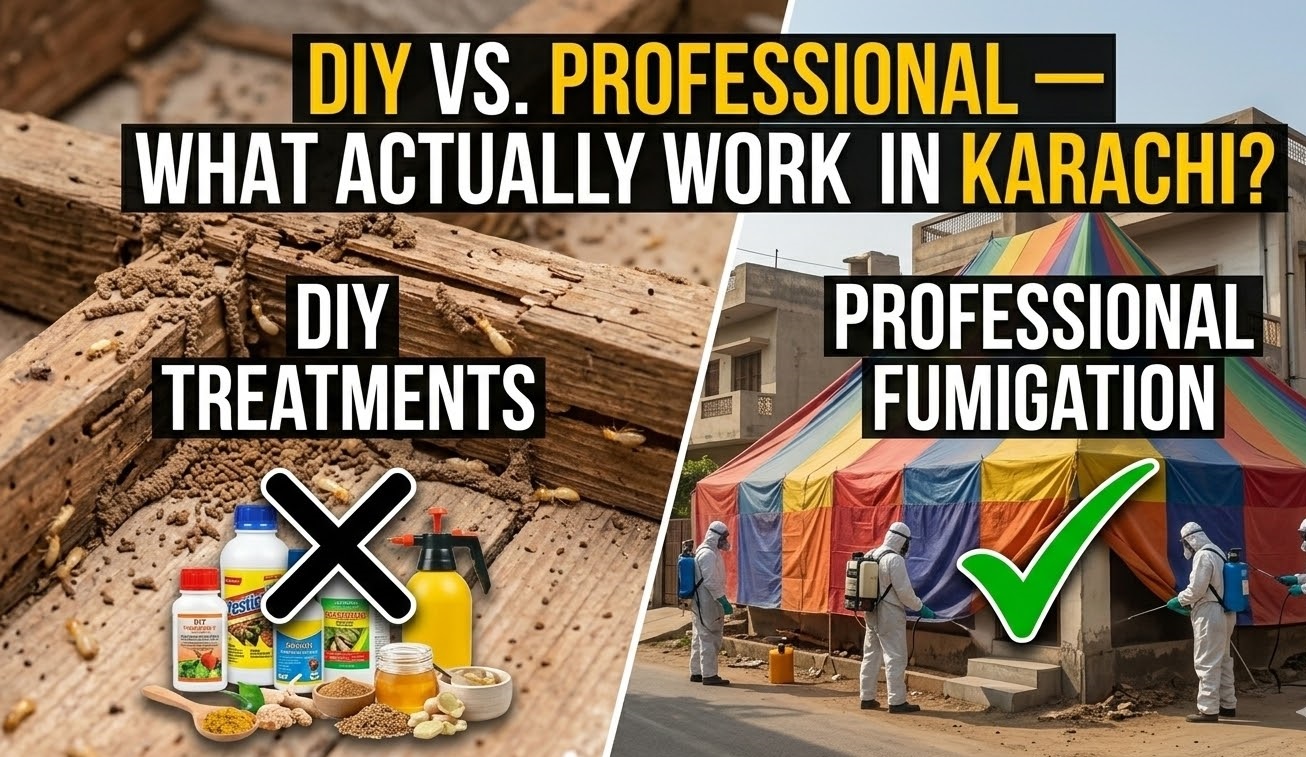
You spot mud tubes behind the kitchen cabinet. A door frame sounds hollow when you knock on it. Wings are scattered near the window. Your stomach drops — and within minutes you are searching online for “termite treatment at home in Karachi” or watching videos about DIY pest control solutions that promise quick results at a fraction of the cost of calling a professional.
It is a completely understandable reaction. Professional pest control has a cost, and in a city like Karachi — where household budgets are already stretched — the appeal of a Rs. 500 spray or a home remedy passed down through the family is obvious. The problem is that when it comes to termites, the gap between what appears to work and what actually works can mean the difference between a manageable treatment and a structural disaster that costs hundreds of thousands of rupees to repair.
This guide cuts through the noise. We will examine every major DIY termite control method available in Karachi’s market — honestly, without exaggeration — and explain exactly why professional treatment works where DIY solutions fail. By the end, you will have everything you need to make an informed decision about your home.
Why DIY Termite Control Is So Appealing in Karachi — And Why It Falls Short
Karachi has a thriving market of retail pest control products available at general stores, hardware shops in Saddar, and increasingly through online platforms like Daraz. Walk through Urdu Bazaar, the hardware markets of Shershah, or any major superstore, and you will find shelves of sprays, powders, and solutions labeled for termite control.
The DIY instinct is also culturally embedded in how Karachi households approach home maintenance. Many homeowners have inherited remedies and tips — from mixing kerosene into soil around the house to applying a paste of boric acid — that have been passed through generations. And in fairness, some of these remedies do produce visible short-term results. Termites retreat from treated surfaces. The mud tubes stop appearing in the area you sprayed. The problem seems solved.
The critical issue is that termites are colony insects. The workers you see, and the mud tubes you observe, represent perhaps 1–5% of the actual colony population. The queen, the reproductives, and the vast majority of the colony are deep in the soil — typically 1 to 3 metres below the surface in Karachi’s conditions — entirely unaffected by anything applied to the surface of your home.
| ⚠️ The Core Problem with DIY: Surface treatment eliminates visible termites and creates the illusion of success. Meanwhile, the colony — which can number between 500,000 and 5,000,000 individuals — simply reroutes. New mud tubes appear in a different location within days or weeks, often deeper in the structure and harder to detect. |
Every Major DIY Termite Treatment — Examined Honestly
1. Retail Insecticide Sprays (Most Common in Karachi)
Products like Hit, Mortein, Doom, and various generic pesticide sprays are the first port of call for most Karachi homeowners who spot termites. They are affordable, widely available, and produce an immediate, visible kill of surface termites.
What it actually does: Kills or repels termites on the surface it contacts. The repellent effect actually causes a phenomenon called “termite scatter” — the colony detects the chemical and splits into multiple sub-groups that establish new nesting sites in different areas of the structure, making the infestation harder to treat comprehensively.
The Karachi problem: In Karachi’s heat, liquid sprays evaporate quickly and lose efficacy within hours. Re-application every few days is needed to maintain any barrier effect — which is neither practical nor cost-effective, and does nothing for the underground colony.
| Verdict: Useful for instant visible kill only. Does not treat the colony. May worsen the infestation by causing scatter. Not a substitute for professional treatment under any circumstances. |
2. Kerosene, Petrol, or Diesel Poured Around Foundations
This remains one of the most widely used DIY termite approaches in older Karachi neighborhoods, particularly in areas like Orangi Town, Baldia Town, New Karachi, and Liaquatabad. Homeowners pour petroleum-based fuels around the base of walls and into soil near the foundation, believing the fumes and toxicity will penetrate and kill the colony.
What it actually does: Petroleum products do have some toxicity to insects at the point of contact. However, they evaporate rapidly, especially in Karachi’s summer heat, and do not penetrate more than a few centimetres into compacted soil — nowhere near the depth of an established subterranean colony.
The real danger: This approach introduces serious fire and health risks. Karachi sees multiple residential fires annually linked to the misuse of flammable liquids near structural foundations and inside wall cavities. Additionally, petroleum contamination of soil near a property can damage underground utility lines and create long-term environmental hazards.
| Verdict: Ineffective against established colonies. Actively dangerous. Do not use. This is one of the most commonly observed misapplication practices in Karachi and one of the most counterproductive. |
3. Boric Acid (Borax) Treatments
Boric acid — sold in Karachi at pharmacies and some hardware stores as borax powder — is one of the more scientifically grounded DIY termite control substances. It works by disrupting termites’ digestive systems and nervous systems upon ingestion. Applied as a paste or powder to wooden surfaces or used in homemade bait stations, it can kill individual termites that contact it.
What it actually does: Boric acid is genuinely toxic to termites and can eliminate individual workers that feed on treated material. It has low toxicity to humans and pets, making it one of the safer DIY options.
The limitation: For boric acid to work as a colony treatment, it must be carried back to the queen in sufficient quantities. The mixing ratios, application methods, and bait formulations used in DIY applications are almost never optimized to achieve this. Most DIY boric acid treatments kill surface workers without meaningful impact on the colony. Additionally, boric acid washes out quickly in Karachi’s humid conditions and monsoon rain, requiring frequent reapplication.
| Verdict: Better than sprays and far safer than petroleum products. Useful as a supplementary measure on isolated wooden surfaces. Not effective as a standalone treatment for active infestations in Karachi’s climate. |
4. Retail Termiticide Powders and Concentrates
A step up from consumer sprays, these products are diluted in water and applied to soil around the building perimeter. Brands available in Karachi’s Shershah market and agricultural supply shops include various chlorpyrifos-based and bifenthrin-based concentrates, often sold without clear labeling of concentration or safe application instructions.
What it actually does: When properly diluted and applied in sufficient volume and depth, termiticide concentrates can create a soil barrier. The problem is that without professional equipment, training, and knowledge of application rates, DIY application almost never achieves the depth, coverage, and continuity required for an effective barrier.
The Karachi-specific problem: Many of the termiticide concentrates available in Karachi’s open market are uncertified, improperly stored, or counterfeit. Using these products incorrectly can pose genuine health risks to household members — particularly children — and may create chemical resistance in termite populations that makes subsequent professional treatment less effective.
| Verdict: Theoretically capable but practically insufficient in almost all DIY applications. Health and safety risks are real. Without professional equipment and training, the soil barrier will have gaps — and termites will find them. |
5. Online Baiting Kits
The most sophisticated end of the DIY market, commercially available termite baiting kits have become increasingly accessible through Daraz and other Pakistani e-commerce platforms. These typically include plastic bait stations containing cellulose-based bait mixed with a slow-acting termiticide, designed to be buried in the soil around the property perimeter.
What it actually does: The concept behind baiting is sound and is the same technology used in professional baiting programs. Termites find the bait, consume it, and carry it back to the colony — where it eventually eliminates the queen and collapses the population.
Why DIY baiting usually fails: The success of a baiting program depends critically on correct station placement, correct bait concentration, regular monitoring (every 4–6 weeks), and timely bait replenishment. Without professional training, bait stations are frequently placed incorrectly, checked too infrequently, or allowed to run out of bait before the colony is eliminated. In Karachi’s urban density, locating where the main colony foraging trails are requires experience and professional tools that DIY kits simply do not include.
| Verdict: The most promising DIY approach in principle. In practice, success rates in residential Karachi settings are low without professional guidance on placement and monitoring. Best viewed as a supplementary tool alongside professional treatment. |
6. Orange Oil and Other “Natural” Remedies
Social media and home remedy websites have popularized the use of orange oil (d-limonene), neem oil, and various essential oils as “natural” termite treatments. These have gained some traction in Karachi’s middle-class neighborhoods where homeowners are concerned about chemical exposure to children and pets.
The reality: Orange oil does have demonstrable toxicity to drywood termites when directly injected into infested wood. However, it has no meaningful effect on subterranean termites — the species responsible for the vast majority of structural damage in Karachi — and provides no soil barrier protection whatsoever. Neem oil and essential oil blends have even weaker evidence bases.
| Verdict: Ineffective against the termite species most prevalent in Karachi. May delay professional treatment while the infestation deepens. Not recommended as a primary treatment method. |
The Honest Scorecard: All Methods Compared
| Method | Effectiveness | Cost | Safety | Duration | Verdict |
| Retail spray | Very Low | Low | Moderate | Hours | ❌ Do not rely on this |
| Kerosene / petrol | Very Low | Low | Dangerous | None | ❌ Never use |
| DIY boric acid | Low–Mod | Low | Moderate | Weeks | ⚠️ Surface only |
| Retail termiticide | Low | Mod | Risk if misused | 1–3 mo | ⚠️ Incomplete treatment |
| Online baiting kit | Moderate | Mod | Moderate | Variable | ⚠️ May miss main colony |
| Prof. soil barrier | Very High | Mod–High | Safe (certified) | 5–10 yr | ✅ Recommended |
| Prof. wood treatment | High | Moderate | Safe (certified) | 3–5 yr | ✅ Recommended |
| Prof. baiting system | Very High | Moderate | Safe (certified) | Ongoing | ✅ Best for active colonies |
Why Professional Termite Treatment Works Where DIY Does Not
The difference between DIY and professional termite treatment is not simply a matter of chemicals — it is a matter of diagnosis, access, concentration, continuity, and monitoring. Here is what professional treatment delivers that DIY cannot.
1. Accurate Species Identification
Karachi is home to multiple termite species, including Coptotermes formosanus (Formosan subterranean termite), Odontotermes obesus (mound-building termite), Heterotermes indicola (Indian subterranean termite), and several drywood termite species. Each responds differently to treatment chemicals and methods. A professional inspection identifies the exact species present, which determines the correct treatment protocol. DIY products are designed generically and are frequently ineffective against specific prevalent Karachi species.
2. Colony Location and Foraging Route Mapping
Effective termite treatment targets not just the visible damage but the colony’s foraging routes and the nest location. Professional technicians are trained to read structural evidence — the pattern of mud tubes, the location of damage, the building’s construction type and age — to determine where the main colony is and how it is accessing the structure. This expertise takes years to develop and cannot be replicated by a homeowner watching a YouTube video.
3. Professional-Grade Chemicals at Correct Concentrations
The termiticides used by certified pest control companies in Karachi — including products from the Premise (imidacloprid), Termidor (fipronil), and Biflex (bifenthrin) families — are significantly more effective and longer-lasting than anything available over the counter. They are also applied at precisely calibrated concentrations by trained technicians using professional injection equipment that ensures the chemical reaches the correct soil depth and volume.
This is exactly what Unique Fumigation’s professional termite control services in Karachi deliver — certified chemicals, applied by trained technicians, with documented coverage records for every treatment.
4. The Continuous Barrier — No Gaps
The fundamental requirement of a soil termite barrier is that it must be continuous — with no gaps. A single untreated patch of soil, even a few centimetres wide, is sufficient for a subterranean colony to bypass the entire barrier. Professional application uses precisely calculated chemical volumes injected at regular intervals to ensure total coverage. DIY surface application, by contrast, almost always has uneven coverage and leaves exploitable gaps.
5. Access to Structural Voids
Subterranean termites often travel through wall cavities, under floor screeds, and within hollow block construction — areas that are simply inaccessible to a homeowner with a retail spray bottle. Professional treatment includes drilling through floor tiles and walls at calculated intervals, injecting termiticide under pressure, and sealing drill points — a process that requires professional equipment and carries liability implications that only a certified company can manage.
6. Guaranteed Follow-Up and Monitoring
Unique Fumigation’s residential termite treatment packages include scheduled follow-up inspections that confirm treatment effectiveness, identify any new activity, and apply maintenance treatments as needed. This ongoing monitoring is what converts a one-time treatment into a long-term protection program — and it is something no DIY kit can provide.
| 📊 By the Numbers: Industry data from South Asian pest control markets consistently shows that DIY termite treatments have a recurrence rate of over 80% within 12 months. Professional soil barrier treatments, properly applied and maintained, achieve recurrence rates below 10% over five years. |
The Real Cost Comparison: DIY vs. Professional in Karachi
The financial argument for DIY termite treatment is based on a simple comparison: retail spray or powder costs Rs. 500–3,000, while professional treatment costs significantly more. On the surface, this seems like an obvious saving. The calculation changes dramatically when you factor in the full cost picture.
The True Cost of DIY Treatment
- Initial product cost: Rs. 500–5,000 for retail sprays, powders, or baiting kits
- Repeated applications: Most DIY treatments require reapplication every few weeks in Karachi’s climate — an annual spend of Rs. 10,000–30,000 with no long-term resolution
- Time investment: Multiple applications, monitoring, and research time across several months
- The hidden cost: While DIY treatment provides the illusion of control, the colony continues feeding. A study on termite damage costs in South Asian urban housing found that delayed professional treatment increased average repair costs by 4 to 8 times compared to early professional intervention
- Structural repair if DIY fails: Replacing termite-damaged door frames, cabinetry, and wooden fixtures in a mid-size Karachi home ranges from Rs. 80,000 to Rs. 400,000+
The True Cost of Professional Treatment
- Initial professional treatment: Variable based on property size, construction type, and infestation severity — Unique Fumigation provides a free inspection and transparent pricing before any commitment
- Follow-up monitoring: Included in Unique Fumigation’s treatment packages — no hidden charges for follow-up visits within the warranty period
- Long-term protection: A properly applied professional soil barrier provides 5–10 years of protection with standard maintenance — compared to the weekly or monthly reapplication cycle of DIY treatments
- Repair cost avoidance: Early professional treatment eliminates the primary driver of high repair costs — the months or years of continued undetected feeding that DIY approaches allow to continue
| 💡 The Real Calculation: A homeowner in Gulshan-e-Iqbal who spent 8 months attempting DIY treatment — investing approximately Rs. 18,000 in products and considerable time — eventually called Unique Fumigation to find the colony had spread from the kitchen to the master bedroom wardrobe and two door frames. Professional treatment plus repairs cost over three times what early professional treatment alone would have cost. |
When (and How) DIY Has a Legitimate Role
This guide is not arguing that there is zero role for DIY approaches in a Karachi homeowner’s termite management strategy. There are specific, limited scenarios where DIY measures are appropriate and useful:
As Immediate First Response While Awaiting Professional Treatment
If you discover termites and cannot get a professional appointment for several days, applying boric acid powder to exposed mud tubes and active feeding areas is a reasonable temporary measure. It will not solve the problem but may slow visible surface activity.
As Ongoing Maintenance Between Professional Treatments
After professional treatment has been completed, homeowners can usefully supplement protection with borate wood treatment on newly installed timber elements — furniture, door frames installed post-treatment, wooden shelving — to add an additional layer of protection.
As Early Warning Monitoring
Placing simple homemade monitoring stations (pieces of untreated timber buried in the garden soil, checked monthly) can help detect new termite activity between professional inspection visits. This does not treat termites but can provide early warning that professional attention is needed.
In all other scenarios — and especially for any active infestation — professional treatment is the only approach with a meaningful probability of success in Karachi’s termite environment. If you are seeing mud tubes, hollow wood, or swarming activity, the time for DIY experimentation has passed.
What Professional Termite Treatment from Unique Fumigation Looks Like
For homeowners who have never experienced professional termite fumigation and soil treatment in Karachi, here is exactly what the process involves when you book with Unique Fumigation:
- Free inspection: A certified technician visits your property, conducts a full inspection of all accessible areas including foundation perimeter, ground floor timber elements, and high-risk zones. No charge, no obligation.
- Species and infestation assessment: The technician identifies the termite species present, assesses the extent of infestation, and determines the colony’s likely access points and foraging routes.
- Treatment plan and transparent pricing: Based on the inspection, a detailed treatment plan is prepared with clear pricing. For soil barrier treatment, this includes the chemical product to be used, the application methodology, and the coverage area.
- Soil barrier installation: For subterranean termite control, the primary treatment involves injecting approved termiticide into the soil at precise intervals around the building’s perimeter and, where necessary, beneath the floor slab via drilled injection points.
- Wood treatment: Accessible timber elements are treated with borate-based solutions or direct termiticide application. For deeply infested wood, injection treatment through drilled channels delivers chemical directly to the active colony within the timber.
- Baiting systems where indicated: For large, established colonies, in-ground bait stations are installed around the perimeter and monitored at scheduled intervals until colony elimination is confirmed.
- Post-treatment documentation and warranty: A complete treatment record is provided, including chemical used, coverage area, and warranty terms. Follow-up inspection visits are scheduled within the warranty period.
Why Karachi Specifically Needs Professional Standards
It is worth addressing the specific reasons why Karachi’s environment makes professional treatment not just preferable but genuinely necessary:
- Soil depth of established colonies: In Karachi’s conditions, Coptotermes formosanus colonies are frequently found at depths of 1.5–2.5 metres below the surface. DIY soil treatment products cannot reach this depth. Professional injection equipment operates at pressures that drive chemical to these depths.
- Colony sizes: Mature Coptotermes colonies in Karachi’s warm, year-round active climate routinely reach 1–3 million individuals. Partially treating a colony of this size simply relocates it; only comprehensive chemical barrier treatment achieves elimination.
- Urban density: In neighborhoods like North Nazimabad, Federal B Area, and Gulshan-e-Iqbal, properties are built close together with shared boundary walls and contiguous soil. This means termite colonies routinely span multiple properties. Treating only one property without addressing the boundary soil is insufficient — professional treatment plans account for this in a way DIY approaches cannot.
- Monsoon reactivation: Each year’s monsoon season reactivates previously dormant soil termite activity and drives swarming events. Professional treatment schedules account for this seasonal cycle; DIY approaches are almost always reactive and therefore always one step behind the colony’s behavior.
- Construction quality variability: Karachi’s housing stock ranges from meticulously engineered DHA villas to informally constructed homes in peripheral areas with highly variable soil contact, drainage, and structural integrity. Professional treatment is adapted to these realities in a way generic retail products are not designed to address.
Frequently Asked Questions
Is it safe to stay in the home during professional termite treatment?
In most cases, yes. Unique Fumigation uses certified, government-approved termiticides that are safe for re-occupancy within a few hours of application. Your technician will give specific guidance based on the treatment method used. Soil injection treatment around the exterior perimeter typically allows immediate re-occupancy of interior spaces.
I used a DIY treatment six months ago. Do I need professional treatment now?
If DIY treatment appeared to resolve visible termite activity but the infestation was not professionally verified as eliminated, a professional inspection is strongly recommended. The most common scenario after DIY treatment is a colony that has rerouted — moved its foraging paths to areas not treated — and is continuing to expand unseen. Early professional assessment can detect this before significant additional damage occurs.
What makes Unique Fumigation’s chemicals better than what I can buy in Shershah market?
The products available in Karachi’s open markets are often unregistered, improperly labeled, or counterfeit versions of legitimate termiticides. Even genuine products require correct dilution ratios, application rates, and injection pressures to be effective — variables that are only controlled in professional application. Unique Fumigation uses authenticated, imported-grade termiticides from certified suppliers with documented concentration and efficacy data.
Can I combine DIY treatment with professional treatment to save cost?
Some DIY supplementary measures — such as borate treatment on new timber fittings or simple monitoring stations in the garden — can complement professional treatment. However, attempting DIY treatment in areas designated for professional soil injection treatment before the professional application is done may actually compromise the professional treatment by disturbing colony foraging routes. Always consult with the professional team before applying any DIY products to areas that will be professionally treated.
How do I know if the professional treatment has worked?
Unique Fumigation’s treatment plans include follow-up inspection visits within the warranty period. Signs of successful treatment include complete cessation of mud tube construction, no new hollow wood areas, and absence of swarming activity. Bait station programs are monitored at regular intervals with colony activity records maintained — you can see the evidence of effectiveness in documented monitoring reports.
The Bottom Line: What Actually Works in Karachi
The answer to the question in this article’s title is clear: in Karachi’s conditions, with Karachi’s termite species, and given the depth and scale of established colonies, professional termite treatment works. DIY treatment does not — at least not as a standalone solution to an active infestation.
This is not a sales argument. It is an honest assessment of the biology of Karachi’s dominant termite species, the limitations of retail-available products, and the real cost arithmetic that plays out in home after home across the city every year.
If you have already tried DIY approaches and are not confident the problem is resolved — or if you have just discovered signs of termite activity for the first time — the most valuable thing you can do right now is get a professional assessment. Not because you have to commit to treatment, but because understanding what you are actually dealing with is the only rational basis for deciding what to do next.
| 📞 Book Your FREE Professional Inspection Today Stop guessing. Stop spending on products that won’t solve the problem. Get a certified Unique Fumigation technician to inspect your property — at zero cost and zero obligation — and tell you exactly what you are dealing with and what it will take to fix it. ► Visit: uniquefumigation.com/termite-control-services-in-karachi/ Karachi homes from DHA to Orangi, Clifton to Korangi, Bahria Town to North Nazimabad — we inspect and treat them all. Professional treatment is not an expense. It is the cost of protecting everything else. |
Unique Fumigation | Karachi’s Certified Termite & Pest Control Specialists
Government-Approved Chemicals • Certified Technicians • Warranty-Backed Treatment • Free Inspections
Leave a Reply