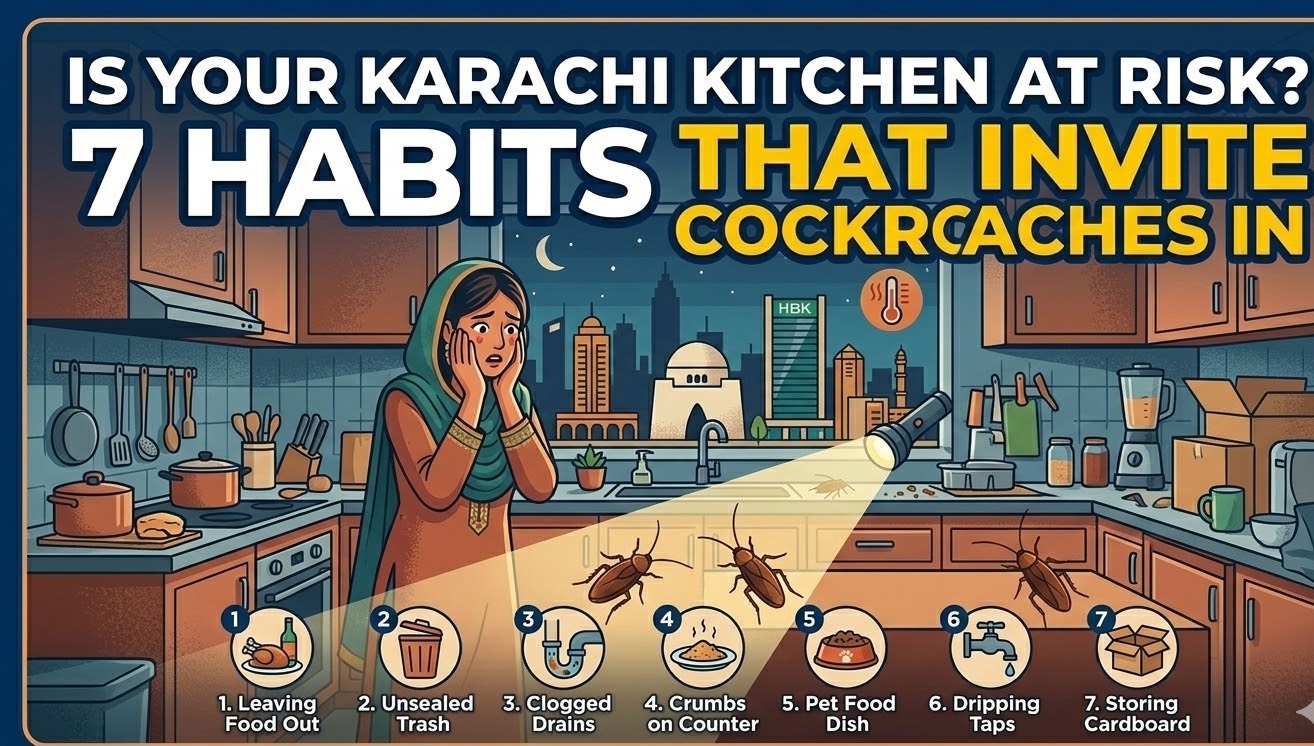
Here is an uncomfortable truth: in most Karachi homes, it is not poor hygiene that brings cockroaches in — it is a handful of everyday habits that most families do not even realise are a problem.
You can scrub your kitchen from floor to ceiling every week and still end up sharing it with cockroaches. That is because cockroaches are not only attracted to dirt. They are attracted to food sources, moisture, warmth, and shelter — and every kitchen, no matter how clean it looks, offers all four if certain habits are left unchecked.
Karachi’s climate makes this even more urgent. With temperatures staying warm for most of the year and monsoon season pushing humidity to extreme levels from June through September, cockroach breeding cycles in our city are faster, more aggressive, and harder to break than in cooler climates. A small problem in March can become a full infestation by July if the right conditions are present.
In this guide, we walk through the seven most common kitchen habits that invite cockroaches into Karachi homes — and what you can do right now to change them.
Why Cockroaches Target Your Kitchen First
The kitchen is the cockroach’s ideal habitat. It offers everything a cockroach needs to survive and reproduce: food residue, moisture from sinks and steam, warmth from appliances, and dozens of dark, undisturbed hiding spots behind cabinets and under appliances.
In Karachi specifically, kitchens in apartment buildings present an additional risk. Shared drainage pipes, connected wall cavities, and poorly sealed utility penetrations mean that a cockroach infestation in a neighbouring flat can spread to yours without any action on your part — unless you have actively removed the conditions that make your kitchen attractive to them.
The seven habits below are the most common reasons Karachi homeowners end up with cockroaches, even in otherwise well-kept homes.
Habit #1 — Leaving Dirty Dishes Overnight
This is the single most common cockroach-attracting habit in Karachi kitchens, and it is extraordinarily easy to fall into — especially after a long day or a large family dinner.
A single plate with food residue, a pan with cooking oil, or even a glass with a sugary drink left overnight is enough to sustain a cockroach colony. Cockroaches are most active between midnight and 4 a.m. — the exact window when your unwashed dishes are sitting on the counter or in the sink.
The Karachi factor: During Ramadan and after family gatherings — common in homes across DHA, Gulshan-e-Iqbal, and Nazimabad — late-night cooking and delayed dishwashing create a predictable peak period for cockroach activity. Pest control professionals in Karachi consistently report increased call-outs in the weeks following Eid.
Quick Fix: Make it a firm rule that no dishes sit in the sink overnight. Even rinsing dishes and stacking them removes the majority of the food residue that cockroaches are after.
Habit #2 — Storing Food in Open or Loosely Sealed Containers
Walk into most Karachi kitchens and you will find open bags of rice, loose packets of daal, unsealed flour containers, and biscuit tins with lids that do not close properly. This is an open invitation.
Cockroaches have an extraordinary sense of smell. They can detect food odours from significant distances and will actively seek out any food source that is not properly contained. Dry goods like rice, flour, lentils, sugar, and cereals are among their preferred targets — particularly because these items are often stored in the same lower cabinets where cockroaches travel.
The Karachi factor: Bulk buying is extremely common among Karachi households, which means large quantities of dry goods are often stored for weeks or months. A 10kg bag of rice kept in its original paper packaging in a lower cabinet is, from a cockroach’s perspective, a long-term food source that will keep them coming back reliably.
Quick Fix: Transfer all dry goods into hard-sided, airtight containers. This single change removes one of the most reliable food signals that cockroaches use to establish themselves in a kitchen.
Habit #3 — Ignoring Grease Build-Up Behind the Stove and Oven
Grease is one of the most overlooked cockroach attractants in any kitchen. The area behind and beneath your stove, the sides of your oven, and the range hood above your burners accumulate cooking grease over time — and cockroaches can survive on grease alone.
In most Karachi homes, the stove is pushed against the wall, leaving a narrow gap between the appliance and the counter or cabinets. This gap is dark, warm, rarely disturbed, and often coated with grease splatter. It is ideal cockroach harborage.
The Karachi factor: Pakistani cooking — with its heavy use of oil, tarka, and slow-cooked curries — produces significantly more grease splatter than lighter cuisines. Homes where cooking happens multiple times a day, as is common in larger Karachi households, build up grease deposits quickly. This is one reason cockroach problems tend to concentrate in the kitchen even in otherwise clean homes.
Quick Fix: Pull out your stove and oven every month or two and clean behind and beneath them thoroughly. Clean your range hood filter at the same time. These are the areas cockroaches are most likely to colonise first.
Habit #4 — Letting the Bin Overflow or Go Unemptied Overnight
Your kitchen rubbish bin is, from a cockroach’s perspective, a smorgasbord. Food scraps, packaging with residue, vegetable peelings, meat trimmings — a single day’s worth of cooking waste provides more than enough nutrition to sustain a cockroach population.
The problem is not just what is in the bin — it is the odour that emanates from it. Cockroaches can detect the smell of organic waste from a considerable distance, and an open or overfull bin acts as a beacon, drawing cockroaches from neighbouring areas, drainage systems, and even other apartments in the same building.
The Karachi factor: In densely populated areas of Karachi — including parts of Orangi Town, Landhi, Malir, and older residential colonies — municipal waste collection is sometimes irregular. When household rubbish accumulates outside the home for extended periods, it dramatically increases the cockroach pressure on every property in the vicinity. An uncovered or overflowing indoor bin compounds this problem significantly.
Quick Fix: Use a bin with a tight-fitting lid. Empty it every evening before bed — not every few days. If your building has a communal waste area, ensure it is kept covered and away from your kitchen wall or window.
Habit #5 — Ignoring Dripping Taps, Leaking Pipes, and Damp Under the Sink
Of all the cockroach attractants, moisture may be the most underestimated. Cockroaches need water to survive, and they are strongly drawn to any consistent source of moisture — a dripping tap, a slow leak under the sink, condensation around a cold water pipe, or even the damp wood caused by a minor plumbing issue.
The area under the kitchen sink is one of the most common cockroach harborage points in any home. It is dark, humid (due to pipe condensation and occasional drips), rarely disturbed, and often contains cleaning products and clutter that provide additional cover.
The Karachi factor: Water supply infrastructure in many parts of Karachi is under significant pressure. Water tankers, irregular municipal supply, and ageing pipe networks mean that minor leaks and drips are extremely common — and often go unrepaired for months. During the hot season, any source of moisture becomes especially valuable to cockroaches and will reliably draw them in.
Quick Fix: Fix all dripping taps and leaking pipes immediately. Dry out the inside of the cabinet under your sink and check it monthly. Consider fitting a dehumidifier in particularly damp kitchens, especially those in ground-floor or basement properties.
Habit #6 — Leaving Pet Food and Water Bowls Out All Night
Pet ownership in Karachi has grown substantially in recent years, with many families keeping cats, dogs, and birds. This brings a cockroach risk that most pet owners do not consider: pet food and water bowls left out overnight are one of the most reliable and overlooked cockroach feeding sites in the home.
Dry pet food in particular is extremely attractive to cockroaches. It is energy-dense, has a strong odour, and is usually left in an accessible dish on the floor — exactly where cockroaches travel. A water bowl left out overnight provides the moisture that cockroaches need alongside the food source.
The Karachi factor: Outdoor and semi-outdoor living arrangements — common in houses with courtyards and open kitchen areas in older parts of Karachi such as Lyari, Keamari, and parts of Korangi — mean that pets often eat close to areas that connect with outdoor environments. These transitional spaces are primary cockroach entry and travel routes.
Quick Fix: Pick up pet food and water bowls before bed every night. Store dry pet food in a sealed container rather than leaving it in an open bag. Clean the area around the feeding spot daily, as food crumbs and water splashes accumulate quickly.
Habit #7 — Neglecting Cracks, Gaps, and Unsealed Entry Points in the Kitchen
This final habit is less about what you leave out and more about what you leave open. Cockroaches do not appear from nowhere — they enter through specific physical entry points, most of which are in or adjacent to the kitchen.
The most common entry routes into Karachi kitchens include:
- Gaps around water pipes and drainage pipes where they pass through the wall or floor
- Cracks in tiled walls or floors, particularly near the sink and stove
- Ill-fitting or damaged drain covers in the kitchen floor
- Gaps between the back of built-in cabinets and the wall
- Poorly sealed gaps around air conditioning pipes and exhaust fans
- Gaps beneath kitchen doors, particularly older wooden doors that have warped
Once cockroaches establish themselves in wall cavities and drainage systems, they have permanent access to your kitchen regardless of how careful you are with food and moisture — unless the entry points themselves are sealed.
The Karachi factor: Older apartment buildings and houses across areas like Saddar, Garden, PECHS, and parts of Clifton have significant structural wear — cracked tiles, deteriorating grout, and ageing plumbing penetrations. These properties are at substantially higher risk of ongoing cockroach ingress regardless of surface-level cleaning habits.
Quick Fix: Do a thorough audit of your kitchen for gaps and cracks. Use silicone sealant around pipe penetrations and caulk any cracks in tiles or walls. Fit metal or stainless steel mesh over drain openings. This physical exclusion work is one of the most effective long-term cockroach prevention measures available.
The Broader Picture: When Cockroaches Share Space With Other Pests
It is worth noting that the same conditions that attract cockroaches into a kitchen — moisture, structural gaps, and undisturbed cavities — are often the same conditions that create vulnerability to other household pests. In Karachi homes, particularly older properties with wooden cabinetry, structural timber, or wooden flooring, termite infestations in Karachi frequently develop in the same wall cavities and subfloor spaces through which cockroaches travel.
If you are addressing cockroach entry points and discovering significant structural gaps, damp timber, or deteriorating woodwork in your kitchen or adjacent areas, it is sensible to have a professional also assess for termite damage and termite activity in Karachi properties. Early-stage termite infestations are frequently discovered during cockroach inspections — and treating both problems together is significantly more cost-effective than addressing them separately.
How Quickly Can These Habits Create a Full Infestation?
This is an important question, and the honest answer is: faster than most people expect.
In Karachi’s climate, a female German cockroach can produce an egg case every three to four weeks, with each case containing up to 40 eggs. At that rate, a single cockroach introduced into a kitchen with the right conditions — food, moisture, harborage — can become a colony of hundreds within a few months. By the time most homeowners notice the problem, it is already well-established.
The seven habits described above do not each individually cause an infestation overnight. But they work cumulatively. A kitchen with even three or four of these conditions present simultaneously is offering cockroaches everything they need to move in, breed, and stay.
The most dangerous period in Karachi is the pre-monsoon window — April through June — when rising temperatures and humidity create peak breeding conditions before the rains arrive. Homeowners who have not addressed these habits by this point often find that a manageable problem becomes a severe infestation very quickly once the monsoon heat sets in.
A Quick Self-Assessment: How Many of These Habits Apply to Your Kitchen?
Go through the list honestly:
- Do you regularly leave dishes overnight?
- Is any dry food stored in unsealed packaging?
- When did you last clean behind your stove?
- Does your bin have a lid, and is it emptied nightly?
- Are there any dripping taps or damp spots under your sink?
- Are pet bowls left out overnight?
- Are there visible cracks, gaps around pipes, or ill-fitting drain covers in your kitchen?
If you answered yes to three or more, your kitchen is currently offering cockroaches a hospitable environment — regardless of whether you have seen any yet. Remember: cockroaches are primarily nocturnal and can be well-established long before you spot one in daylight.
Why Changing Habits Alone Is Not Always Enough
Improving these habits will absolutely reduce the attractiveness of your kitchen to cockroaches and lower your infestation risk. But if cockroaches are already present — particularly if they have established themselves in wall cavities, drainage systems, or within appliances — behavioural changes alone will not eliminate them.
This is because:
- Established colonies have reserves: Once a colony is established, cockroaches have stored resources and an existing breeding cycle that does not simply stop when food access is reduced.
- They will adapt: Cockroaches are extremely adaptable. Reduce food access and they will shift to harder-to-detect sources — grease residue, paper, organic matter in drains.
- Entry points remain open: Without physical exclusion work, cockroaches from neighbouring properties or the municipal drainage system will continue entering, regardless of how clean your kitchen is.
- Eggs survive: Egg cases are resistant to many common pesticides and to changes in the environment. Even if adults are killed, the next generation will hatch in two to eight weeks.
Professional pest management addresses all of these factors simultaneously — which is why it remains the most reliable solution for Karachi homeowners dealing with an active cockroach problem.
Is Your Karachi Kitchen Already Infested?
Find Out With a FREE On-Site Inspection.
Even if you haven’t seen a cockroach yet, the conditions described in this article may already be supporting a hidden infestation. The only way to know for certain is a professional assessment — and Unique Fumigation offers this completely free of charge.
Our licensed Karachi-based technicians will inspect your kitchen and the rest of your property, identify any active infestation, assess entry points and harborage areas, and provide a clear, honest treatment recommendation — with no pressure and no obligation.
Call or WhatsApp Unique Fumigation today — and stop sharing your kitchen.
Serving DHA, Clifton, Gulshan-e-Iqbal, Nazimabad, North Karachi, PECHS, Korangi, Saddar, Malir, and all surrounding areas.
Final Word
Cockroaches are opportunists. They do not invade clean homes out of spite — they move into kitchens that offer what they need. Remove those conditions, seal the entry points, and get professional help if they are already there, and you will have taken the most effective steps available to protect your family’s health and your home.
Start with the seven habits above. Work through them one by one. And if you are not sure whether the problem has already started, do not wait for a midnight sighting to find out.
The pre-monsoon season is approaching. Act now, before Karachi’s heat and humidity turn a small risk into a serious infestation.
© Unique Fumigation | Karachi’s Trusted Pest Control Specialists
Leave a Reply