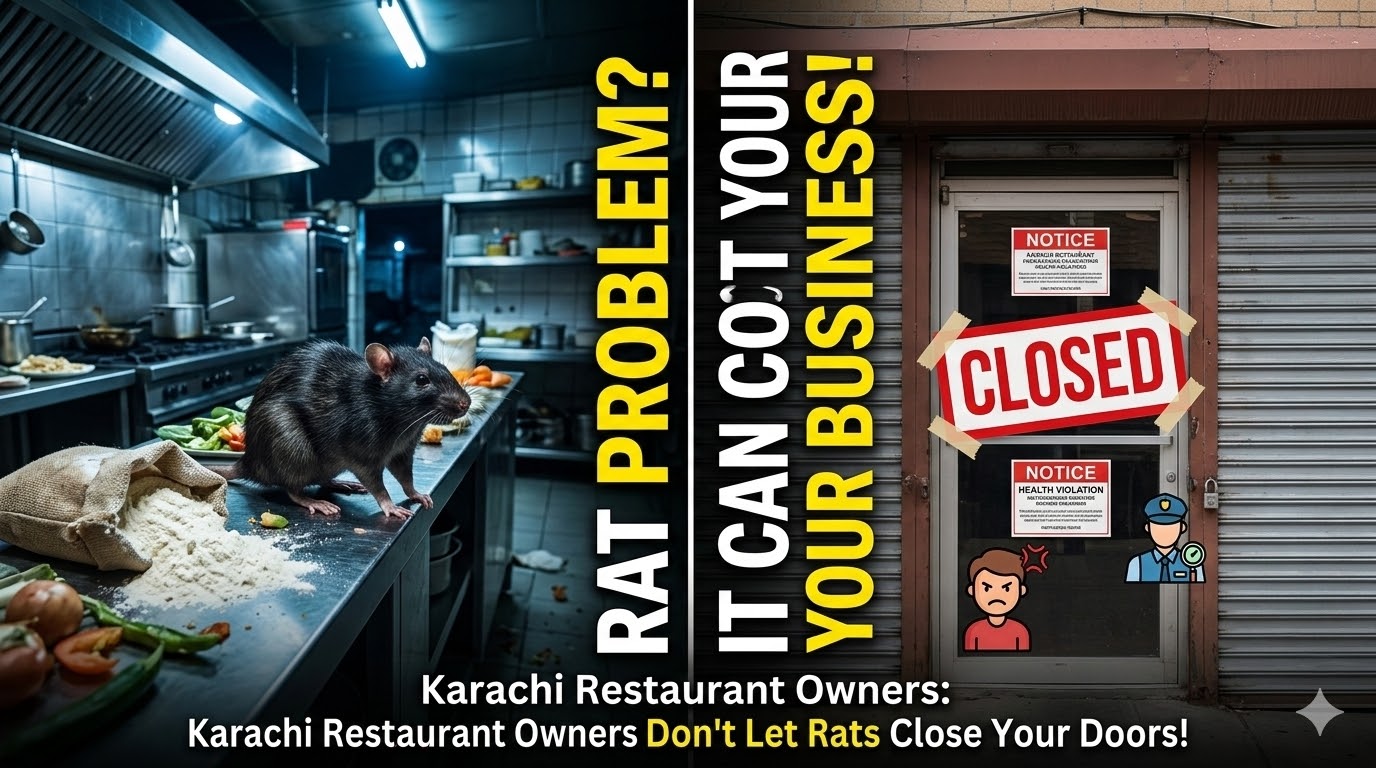
It only takes one moment. A customer spots a rat darting across the floor. Someone films it on their phone. Within hours, it’s circulating on WhatsApp groups and Instagram stories across the city. By the following morning, your restaurant’s reputation — built over years of hard work — is in ruins.
This is not a hypothetical. It has happened to real food businesses in Karachi. And with rat infestations on the rise across the city, no restaurant owner can afford to treat this as someone else’s problem.
In this article, we walk through exactly how a rat infestation can destroy a food business in Karachi, the very real legal and financial consequences you face, and — most importantly — what you can do right now to prevent it.
The Scale of Karachi’s Rat Problem in Food Areas
Karachi’s restaurant and food business scene is one of the most vibrant in South Asia. From the iconic Burns Road food street and the restaurants of Boat Basin and Zamzama, to the countless local eateries in Gulshan, Saddar, and Orangi Town — food is at the heart of the city’s culture and commerce.
But this same density of food businesses creates a perfect storm for rodent pressure. Rats are driven by three needs: food, water, and shelter. A busy commercial kitchen provides all three in abundance — and Karachi’s specific urban conditions make the problem significantly worse:
- Aging drainage and sewer infrastructure provides underground rat highways directly into kitchen areas
- Irregular municipal waste collection creates consistent food sources near food streets and commercial zones
- Dense back-alley service areas in food streets like Burns Road and Tariq Road provide nesting sites just metres from kitchens
- Monsoon flooding displaces outdoor rat colonies every year — pushing them into commercial buildings seeking higher ground
- Shared walls and drainage in older buildings mean a neighbouring business’s rat problem quickly becomes yours
Pest control professionals who provide commercial rat control services in Karachi report that restaurant kitchens, storage rooms, and dry goods areas are consistently among the highest-risk sites they attend — often with infestations far larger than the owner realised.
How a Rat Infestation Can Destroy Your Restaurant
1. The Viral Moment You Cannot Take Back
In today’s digital environment, a single video of a rat in a Karachi restaurant can reach tens of thousands of people within hours. Pakistan’s food bloggers and reviewers are highly active on Instagram, TikTok, and Facebook — and negative content about a restaurant spreads far faster than positive reviews.
Several Karachi restaurants have faced exactly this scenario in recent years. The business impact is severe: immediate footfall drops, cancellation of bookings, negative review floods on Google and Zomato, and in some cases, permanent closure.
⚠️ Real Risk: Once a video of a rat in your restaurant goes viral in Karachi, no amount of crisis PR can fully repair the damage. The only strategy that works is prevention.
2. PSQCA and Local Authority Inspections
The Pakistan Standards and Quality Control Authority (PSQCA) and Karachi Metropolitan Corporation (KMC) have the authority to inspect food premises and issue notices, fines, or closure orders for hygiene violations — including evidence of rodent activity.
Signs that inspectors look for include rat droppings in storage or food prep areas, gnaw marks on packaging, evidence of contaminated food stocks, and the presence of live or dead rodents. A failed inspection can result in:
- Immediate temporary closure pending remediation
- Substantial fines and compliance orders
- Mandatory destruction of contaminated food stock at your cost
- Permanent licence suspension for repeat violations
- Public notification of the closure, amplifying reputational damage
3. Food Contamination and Customer Illness
Rats contaminate food through direct contact, droppings, urine, and hair. They carry serious pathogens including Salmonella, Leptospirosis, and E. coli — all of which can cause severe illness in customers.
If a customer becomes ill and traces the source to your restaurant, you face not only reputational damage but potential civil liability. In a city where word-of-mouth and community reputation are critical to a food business’s survival, a food poisoning incident linked to rodents can be fatal to the business.
4. Physical Damage to Your Premises
Rats gnaw constantly — on electrical wiring, gas pipes, structural woodwork, refrigeration units, and packaging. In a commercial kitchen environment, this creates serious fire and safety hazards on top of the contamination risk. The cost of repairing rat-damaged infrastructure can run into hundreds of thousands of rupees, and may not be covered by standard commercial insurance if the infestation was not proactively managed.
5. Staff Morale and Retention
Kitchen staff who work in a rat-infested environment will leave — and they will talk. In Karachi’s competitive hospitality labour market, a reputation for poor hygiene conditions makes it harder to recruit and retain quality staff. The hidden cost of staff turnover in restaurants is consistently underestimated by business owners.
High-Risk Areas and Times for Karachi Restaurants
While every food business in Karachi faces some level of rat pressure, certain locations and circumstances carry significantly elevated risk:
High-Risk Locations
- Burns Road and Saddar food streets: High food density, aging drainage, shared back-alley waste areas
- Boat Basin and Zamzama (Clifton): Proximity to sea drains and dense commercial-residential mix
- North Nazimabad and Gulshan-e-Iqbal: Heavy mixed-use zoning with frequent waste management lapses
- Korangi industrial/commercial zone: Adjacent to industrial waste — high rat pressure migrating into food outlets
- Tariq Road and Bahadurabad: High foot traffic, street food density, and older drainage infrastructure
High-Risk Times
- Monsoon season (July–September): Flooding displaces rat colonies; infestations spike after heavy rains
- Post-Eid periods: Increased food waste in surroundings attracts and sustains larger rat populations
- Winter construction nearby: Ground disturbance displaces burrowing colonies into adjacent buildings
- After any neighbouring business closure: Rats from vacated premises migrate to active food sources nearby
The Warning Signs Every Restaurant Owner Must Know
Rats are nocturnal and adept at avoiding humans — but they leave clear evidence of their presence. Train yourself and your staff to look for:
- Droppings — dark, spindle-shaped pellets, often concentrated near food storage, under equipment, or along walls
- Gnaw marks — fresh marks appear lighter in colour; check packaging, wooden shelving, electrical conduits, and gas lines
- Grease trails — dark smear marks along walls and skirting boards where rats travel repeatedly
- Burrow holes — in ground-level flooring, near drainage, or in external walls
- Scratching or scurrying at night — often heard in ceilings, walls, or under kitchen units after closing time
- Unusual odour — a persistent musky or ammonia-like smell in enclosed storage areas
- Disturbed stock — gnawed packaging, spilled grains or lentils, or food items moved from their original positions
💡 Staff Training Tip: Brief your kitchen and storage staff weekly on these warning signs. Early detection is the single most effective way to prevent a minor rat sighting from becoming a full infestation — and a minor problem from becoming a public crisis.
What Effective Rat Control Actually Looks Like for a Karachi Restaurant
There is a significant difference between what most food businesses do about rats and what actually works. Here is a realistic breakdown:
What Doesn’t Work
- Placing a few snap traps near the back door and hoping for the best
- Using over-the-counter rat poison bait without a systematic baiting strategy
- Reacting only after a sighting — by which point the colony is already established
- Relying on municipal pest control, which is inconsistent and covers only public areas
- Assuming a clean kitchen is rat-proof — entry points are in walls, drains, and flooring, not on surfaces
What Actually Works
- Professional site survey: A trained pest controller assesses your entire premises — kitchen, storage, drains, exterior walls, ceiling voids — to map rat entry points, travel routes, and nesting sites
- Proofing and exclusion: Physical sealing of entry points using steel mesh, concrete, and door sweeps — stopping new rats from entering regardless of pressure from outside
- Targeted baiting strategy: Tamper-proof bait stations placed along rat travel routes (not randomly) using regulated rodenticides that are safe in a food environment when properly deployed
- Drain and sewer treatment: Treatment of the drainage entry points that are most commonly overlooked — and most commonly exploited by rats in Karachi’s aging infrastructure
- Monitoring and follow-up: Regular visits to check bait consumption, identify new activity, and adjust the strategy — essential in high-pressure commercial food environments
- Documentation: A professional provider gives you written service records, which are valuable evidence of due diligence in the event of an inspection or complaint
For Karachi restaurant owners looking for a reliable, food-safe solution, working with a specialist provider of professional rodent extermination services for restaurants in Karachi ensures treatments comply with food safety standards and deliver lasting results — not just a temporary knockdown.
Building a Rat-Resistant Restaurant: Practical Steps You Can Start Today
Professional treatment is essential for an active infestation, but there is much you can do operationally to reduce your vulnerability:
- Seal all incoming pipe penetrations — where water, gas, and electrical conduits enter the building. Even a 1.5 cm gap is enough for a rat to enter.
- Install door sweeps on all external doors — particularly delivery bay doors and back-alley exits that are frequently left open during service.
- Use sealed, hard-sided containers for all dry goods — open sacks of flour, rice, lentils, and spices are a primary food source for rats in restaurant storage rooms.
- Enforce strict waste discipline — seal all waste bags before disposal, keep bin areas clean, and never leave organic waste in open containers overnight.
- Deep clean under and behind equipment weekly — rats nest in the grease and debris accumulation under large kitchen equipment; regular cleaning denies them both shelter and food.
- Inspect deliveries before they enter storage — rats have been known to travel inside delivery packaging from supplier warehouses, particularly for grain and dry goods.
- Schedule professional pest control quarterly at minimum — not just when you see a rat, but as a routine part of your operations. Prevention is dramatically cheaper than crisis management.
If you’re not sure where your biggest vulnerabilities are, a free rat inspection by Unique Fumigation’s commercial pest experts can identify your specific risk areas and give you a clear, actionable plan — with no obligation.
The Cost Comparison: Prevention vs. Crisis
Restaurant owners often delay professional pest control because of cost concerns. But the financial reality of a rat crisis far exceeds the cost of prevention. Consider the typical cost of a serious infestation event:
- Revenue loss during closure or following viral exposure: Can range from PKR 200,000 to over PKR 1,000,000 depending on the scale of your operation
- Mandatory destruction of contaminated food stock: PKR 50,000 to 300,000+ depending on inventory levels
- Emergency pest treatment and structural repairs: Significantly more expensive than routine prevention contracts
- Regulatory fines and compliance costs: Variable but potentially substantial, plus ongoing monitoring requirements
- Staff recruitment following turnover: Often underestimated at PKR 30,000–100,000 per position when training costs are included
- Long-term revenue impact of reputational damage: The most significant and hardest to quantify — some businesses never fully recover
By comparison, a routine commercial pest control contract covering quarterly inspections, baiting, and monitoring for a typical Karachi restaurant represents a fraction of these costs — and eliminates the risk of a crisis event entirely.
Bottom line: The question is not whether you can afford professional rat control. It is whether you can afford not to have it.
Protect Your Restaurant Before It’s Too Late
The rat problem in Karachi’s commercial food sector is real, it is growing, and it does not resolve itself. But it is entirely manageable with the right professional support in place.
Whether you are seeing the first warning signs, want to get ahead of monsoon season, or simply want to ensure your business is fully protected before an inspection, acting now is always better than acting after an incident.
🐀 Book a Free Commercial Rat Inspection for Your Restaurant
Unique Fumigation provides free on-site inspections for Karachi food businesses.
Our licensed commercial pest specialists will inspect your kitchen, storage areas, drains, and exterior — identify every rat risk on your premises — and provide a clear, customised treatment plan. No commitment required.
👉 Schedule Your Free Inspection with Unique Fumigation Now
Don’t wait for a video to go viral. Protect your business, your staff, and your customers today.
About Unique Fumigation
Unique Fumigation is a Karachi-based pest control company specialising in commercial and residential pest management, including rodent control, termite treatment, cockroach extermination, and bed bug elimination. Serving restaurants, hotels, food manufacturers, and homeowners across all major Karachi districts, Unique Fumigation delivers licensed, safe, and food-hygiene-compliant pest solutions backed by professional documentation.
Leave a Reply