Category: Fumigation Guide

This category covers everything you need to know about fumigation — from preparation and safety precautions to post-fumigation care. Find answers to common questions like how long to stay out of your home after fumigation, whether fumigation is safe during pregnancy, how to protect food, pets, and children, and what to expect during and after the process. Our practical guides help you understand when fumigation is necessary, how to choose the right treatment, and how to re-enter your home safely. Stay informed with expert advice to make fumigation as safe and effective as possible for your household.

  • How to Choose a Fumigation Company in Karachi: 7 Red Flags to Watch For

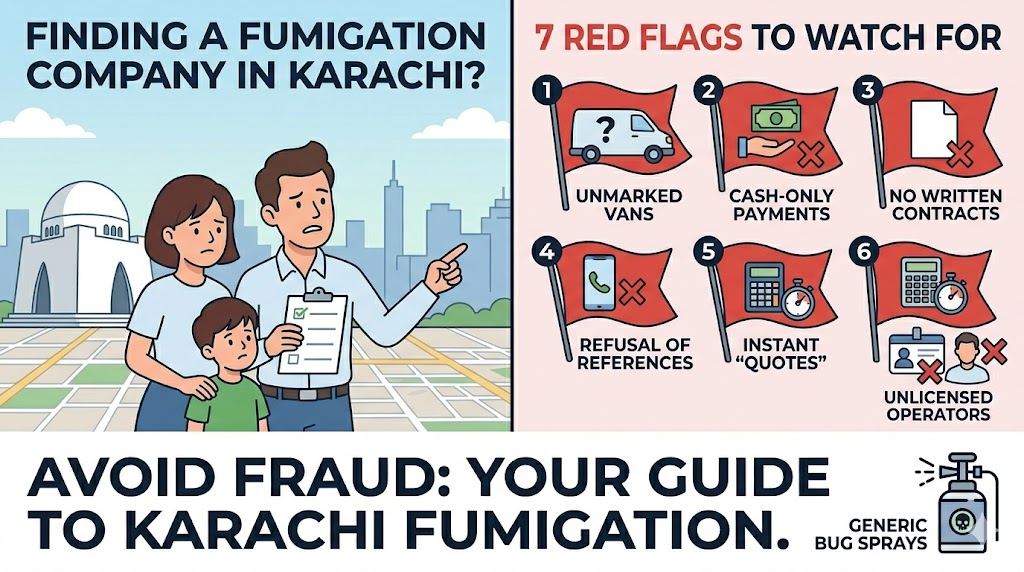
    How to Choose a Fumigation Company in Karachi: 7 Red Flags to Watch For

    Karachi is one of the most pest-pressured urban environments in Pakistan, and the pest control industry here reflects that demand — it is large, active, and highly variable in quality. On one end you have established, registered companies that have operated professionally for decades, use documented chemicals, employ trained staff, and stand behind their work with written guarantees. On the other end, you have unregistered operators — some with a spray pump and a phone number printed on a flyer pushed under the gate — who may use substandard, diluted, or entirely unverified chemicals and disappear when results don’t materialise.

    Between these extremes is a wide middle ground of operators who are not outright fraudulent but who are nonetheless inconsistent, undertrained, or primarily motivated by upselling rather than solving your pest problem effectively and safely. Knowing how to distinguish between them matters — not just for your bank account, but for your family’s health.

    This guide walks through seven specific red flags to watch for when evaluating any fumigation company in Karachi. These are drawn from three decades of observing what separates genuinely professional pest control from everything else. Take each one seriously.

    Red Flag 1: No PPMA Registration and Vague Answers When You Ask

    The Pakistan Pest Management Association (PPMA) is the professional body for the pest control industry in Pakistan. Membership and registration with PPMA means a company operates under a code of conduct, uses chemicals that meet established standards, and has accountability beyond just a phone number. It’s not a perfect guarantee of quality, but its absence is a meaningful signal.

    Ask any company you are considering, directly and early: “Are you PPMA registered?” If the answer is an immediate, clear yes with the ability to show or provide a registration number on request, that’s a good sign. If the answer is evasive — pivoting to how long they’ve been in business, or how many clients they have, or references to “international chemicals” — that evasion is itself informative. Companies that are registered know it and say so without hesitation. Companies that aren’t registered often don’t like the question.

    Registration matters practically in a second way: it gives you somewhere to go if a dispute arises. If an unregistered operator uses a chemical that causes harm to a household member, or if the treatment fails and the company refuses to return, you have no professional body to escalate to. With a PPMA-registered company, there is a formal accountability structure. Unique Fumigation Services has maintained its PPMA registration throughout its 30+ years of operation in Karachi — it’s not a detail we treat as a footnote.

    Red Flag 2: They Quote Without Inspecting

    A pest control quote that arrives via WhatsApp message, over a phone call, or through a salesperson who walks through your home without actually checking anything is not a genuine assessment — it’s a number pulled from a pricing sheet. The actual cost and appropriate scope of pest control treatment depends on factors that can only be determined by proper inspection: the species involved, the severity and extent of the infestation, the construction of the home, the specific areas requiring treatment, and any complicating factors like a pregnant household member, pets, or accessible water storage nearby.

    For termite control especially, this cannot be overstated. The treatment approach for subterranean termites attacking the foundation of a ground-floor flat is entirely different from treatment for drywood termites in wooden furniture in a high-rise apartment. Without a physical inspection — looking for mud tubes, checking wooden structures, examining the exterior foundation — it’s impossible to quote accurately or responsibly.

    Insist on an in-person inspection before agreeing to any price. A legitimate company will provide one as a matter of course. A company that resists (“just tell me the size of your home and I’ll give you the price”) is signalling that they treat pest control as a commodity transaction rather than a professional assessment and intervention.

    Red Flag 3: They Cannot Name the Chemicals They Use

    Every professional pest control technician should be able to tell you — immediately, without looking anything up, without hesitation — the name of the product being used, its active ingredient, and that it is WHO-approved or certified by an equivalent safety authority. This is basic professional knowledge. If a technician responds to this question with “imported chemicals,” “German product,” “special formula,” or any other vague descriptor that isn’t an actual product name, that is a serious warning sign.

    Why does this matter so much? Because the chemical being applied inside your home — on the surfaces your children touch, in the kitchen where your food is prepared, in the bedrooms where your family sleeps — needs to be a known, documented substance with an established safety profile. The WHO’s list of approved pesticides for public health use represents chemicals that have been evaluated for efficacy, mammalian toxicity, environmental persistence, and appropriate application methods. Chemicals outside this framework may be effective against insects but have unknown profiles for human health.

    In Karachi’s pest control market, it is not unheard of for informal operators to use agricultural-grade pesticides — products intended for outdoor crop application — in residential indoor settings. These chemicals may work on insects but are formulated for open-air use and are not appropriate for household indoor application. You have no way to verify what’s being used if the technician can’t name it. And if you can’t verify it, you shouldn’t let it into your home.

    A secondary reason this matters: if anyone in your household has a specific sensitivity, allergy, or medical condition — or if there’s a pregnancy — knowing the exact product enables your doctor to check for contraindications. An unnamed “German chemical” cannot be cross-referenced against anything.

    Red Flag 4: No Written Warranty or Guarantee

    Verbal promises evaporate. A professional pest control company that stands behind its work provides a written warranty: a documented statement of what they treated, what outcome they guarantee, what the duration of that guarantee is, and what they will do if the problem persists within that period. This document is not a bureaucratic nicety — it is the primary tool of accountability that separates an operator who expects their work to succeed from one who has no intention of returning.

    Written warranties are particularly important for treatments that require follow-up visits to be fully effective — and many do. Bed bug treatment often requires two visits, as eggs are resistant to first-round treatments and a follow-up is needed once those eggs hatch. Effective termite control involves monitoring visits to confirm the treatment barrier is holding. These follow-up visits should be part of a documented agreement, not a verbal expectation that the company may later dispute ever making.

    When evaluating a company, ask specifically: “Do you provide a written warranty for this treatment, and what does it cover?” If the answer is yes, ask to see the standard warranty document before work begins. If the answer is no, or if they say “of course we’ll come back if there’s a problem” without any intention of putting that in writing, consider how confident you are that they will honour that verbal commitment six weeks later when you call to say the cockroaches are back.

    Unique Fumigation Services provides written warranties on treatments as standard. It’s part of how we operate, and it reflects the confidence we have in our work after 30 years of service.

    Red Flag 5: Unidentifiable or Unbriefed Technicians

    You are allowing a team of workers into your home — potentially accessing every room, moving your furniture, working in your kitchen. In Karachi, where home security is a real and ongoing concern, this is not a casual act. The people coming into your home should be identifiable: company-branded uniforms or at minimum an ID card, a name that matches who you spoke with on the phone or email, and a clear, professional demeanour that reflects a company that takes its work seriously.

    But identification is only the beginning. The technicians should be briefed. They should know why they’re at your home, what they’re treating, what the scope of the job is, and any specific instructions you’ve communicated to the company — a pet in the house, a room that should not be treated, a pregnant family member, specific areas of greatest concern. If the technicians arrive seeming unfamiliar with these details, that reflects a company that sends workers without adequate job briefing, which typically produces a generic treatment rather than an appropriate one.

    A simple test: when the technician arrives, ask them “what’s the plan for today’s treatment?” A well-briefed professional will be able to tell you the treatment areas, the methods they’ll use, and approximately how long it will take. Someone who hesitates or looks uncertain doesn’t have that information. That gap between what you communicated to the company and what reaches the technician is where things go wrong on the day of treatment.

    Unique Fumigation Services employs background-checked technicians who are briefed on each job before arrival. This isn’t exceptional — it’s the minimum standard for bringing workers into people’s homes — but it’s worth verifying with any company before they set foot inside yours.

    Red Flag 6: The Same Package Recommendation for Every Home

    A pest control company with a genuine commitment to appropriate treatment will make different recommendations for different situations. A ground-floor flat in an older building in Liaquatabad with an established cockroach population and moisture around the plumbing has very different needs from a high-rise apartment in Clifton with a seasonal mosquito problem. Both deserve a treatment recommendation that reflects their specific situation — not the same six-service annual package.

    When a salesperson’s recommendation sounds identical regardless of what you’ve told them about your situation — when the pitch seems to be the same script delivered to every homeowner — that’s a sign the company sells packages rather than solving problems. The package may include services you don’t need (rat control when you’ve never seen a rat), may exclude services you do need (targeted spot treatment for a specific area), and is almost certainly priced to maximise revenue rather than optimise outcomes.

    This connects directly to the inspection point above. A company that inspects properly will make a recommendation tailored to what they find. A company that doesn’t inspect has no basis for a tailored recommendation and falls back on the package.

    Consider the difference between a company that looks at your home and says: “You have an active cockroach issue concentrated in the kitchen and bathroom, and I’d recommend a combination spray and gel treatment targeted to those areas with a follow-up in three weeks” — versus one that says “our Gold Package covers six pest types throughout your entire home for 12 months and we can start today.” The first answer comes from observation. The second comes from a sales script.

    Targeted treatments are available for specific pest problems: cockroach-specific treatment, dedicated rodent control, flea and tick treatment for pet-owning households, and others. A responsible company starts with what you need and builds from there — not the other way around.

    Red Flag 7: Pricing That Seems Too Good to Be True — Without Any Explanation

    In Karachi’s pest control market, prices vary significantly. That variation exists for real reasons: the quality of chemicals used, the experience and training of technicians, the time spent on a proper treatment, the inclusion of warranty and follow-up visits, and the overhead of operating as a formal, registered business rather than an informal one. A price that is significantly below what other reputable companies quote almost always reflects a cut somewhere in that chain.

    The most common cuts: chemical quality (cheaper, lower-grade, or improperly diluted formulations that appear to work briefly but fail quickly), application time (rushing through a job that requires methodical access to treatment zones, leaving critical areas untreated), follow-up exclusion (a low initial price that doesn’t include the follow-up visit that would have been necessary for complete treatment), and staff quality (no training, no background checking, no accountability).

    This doesn’t mean the most expensive company is the best one. Price and quality are not perfectly correlated in Karachi’s pest control market or anywhere else. The point is that price alone is a poor selection criterion, and a price that seems conspicuously low warrants curiosity about where the savings are coming from. Ask: “Is this price inclusive of a follow-up visit?” “What specific product will be used?” “How long will the treatment take?” The answers will tell you whether the price reflects a leaner but professional operation or a service that corners were cut to make possible.

    Beyond chemicals and time, there’s the question of what happens when the treatment doesn’t work as expected. A company that quoted you a low price without a written warranty has every incentive to tell you the problem was more severe than expected and charge you again for a second treatment. A company that quoted fairly and provided a written warranty returns at no cost to complete what they committed to. The warranty transforms the price from a transaction into an accountability arrangement — and that changes the economics meaningfully.

    What a Good Selection Process Looks Like in Practice

    With these red flags in mind, here is a practical approach to selecting a fumigation company in Karachi that you can trust:

    Start by asking for PPMA registration details. Cross-reference this with what they show you or send you — don’t just take the verbal claim. Ask for the specific name of the chemical product they plan to use. Research that product name briefly — WHO-approved residential insecticides are easily findable online, and knowing you’re dealing with a named, documented substance is a basic reassurance.

    Insist on an in-person inspection before agreeing to pricing. If the company won’t do this, move on. During the inspection, watch how the technician or assessor works — are they actually looking, asking questions, checking under sinks and behind appliances? Or walking through quickly while filling in a form?

    Ask specifically about the warranty: what it covers, how long it lasts, and whether you’ll receive it in writing before the job starts. Ask about the technicians: are they background-checked, how are they trained, who will you be able to contact if you have questions on the day of treatment?

    You can review our service areas and the types of treatments we provide at our service area page, and if you’d like to understand more about who we are and how we work, our About Us page covers our history, registration, and approach. We also offer a fumigation certificate for clients who need documented evidence of treatment for housing society requirements or landlord records.

    One More Consideration: Local Knowledge Matters

    This is a point that often gets overlooked. Pest control in Karachi is not the same as pest control in Lahore, Islamabad, or anywhere else in Pakistan — and it’s certainly not the same as pest control in Europe or North America, where many of the online guides you might find are written. Karachi has specific pest pressures: dengue and malaria mosquitoes that breed in the post-monsoon period, subterranean termites that thrive in the soil moisture conditions around older building foundations in areas like Saddar and Garden, cockroach species behaviours that differ in high-humidity monsoon months versus dry winter months, and rat entry patterns related to the city’s drainage and water infrastructure.

    A company that has operated specifically in Karachi for an extended period — and has treated homes in diverse areas of the city, from DHA and Clifton to Orangi and SITE — knows how pest behaviour shifts with the season, how building construction types affect treatment approaches, and what the realistic ongoing pest management challenges are in different parts of the city. This local knowledge is embedded in how a treatment is designed and what follow-up is recommended. It’s not something you can replicate by following a generic pest control manual.

    Unique Fumigation Services has operated across Karachi since 1993. That’s over 30 years of learning this specific city’s pest ecology, building stock, and seasonal patterns. It shows in how our assessments are conducted and how our treatments are designed.

    Final Thoughts

    Choosing a pest control company is not a trivial decision. You’re inviting workers into your home, exposing your family to chemicals that need to be what they claim to be, and trusting that the work will actually solve the problem you’re paying to address. The seven red flags in this article — no PPMA registration, no inspection before quoting, inability to name chemicals, no written warranty, unidentifiable or unbriefed technicians, one-size-fits-all package recommendations, and inexplicably low pricing — are each individually meaningful, and collectively they describe the difference between a professional operation and an opportunistic one.

    You deserve a company that can pass every check on this list. If you want to verify that Unique Fumigation Services does — and to get a straightforward assessment of your specific pest situation — request a free estimate online or contact our team directly. We’ll tell you what we see, what we’d recommend, and exactly what you’ll get for the price we quote — in writing, before we start.

  • How Long Should You Stay Out of Your Home After Fumigation in Karachi?

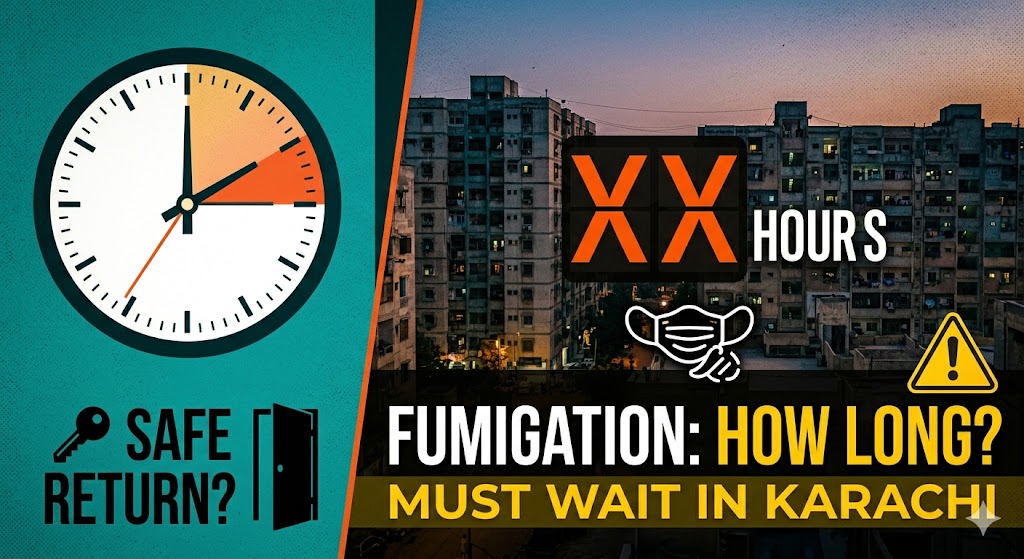
    How Long Should You Stay Out of Your Home After Fumigation in Karachi?

    You’ve just had your home fumigated. The technicians have packed up their equipment, closed the door behind them, and told you to wait before going back inside. And now you’re standing in Karachi’s afternoon heat — or worse, caught in the tail end of monsoon drizzle — wondering exactly how long “wait a while” actually means.

    This is one of the most commonly asked questions we receive at Unique Fumigation Services, and it deserves a genuinely thorough answer. Not a vague “two to four hours” that leaves you guessing, but a proper breakdown of why re-entry intervals exist, how they vary by treatment type, what Karachi’s specific climate does to those timelines, and what you need to do when you walk back through the door. We’ve been handling pest control across this city since 1993 — DHA, Gulshan, Clifton, North Nazimabad, Orangi, Korangi, and everywhere in between — and the questions families ask us on their way out the door are always the same. Let’s answer them properly.

    Why Re-Entry Times Exist: The Science Behind the Wait

    When a pest control technician applies an insecticide inside your home, the chemical is at its highest concentration in the air immediately after application. Depending on the formulation — whether it’s a water-based spray, an oil-based residual, a fog, a gel, or a fumigant gas — the substance needs time to either settle onto surfaces, dry, disperse, or break down to levels that are safe for human exposure.

    The re-entry interval (REI) is a scientifically determined window: the minimum time that must pass before people can safely return to a treated space. These intervals are set based on toxicology data — the concentration of the chemical that causes harm, how quickly that concentration drops through evaporation and ventilation, and what margin of safety is appropriate for different groups (healthy adults, children, pregnant women, the elderly).

    This isn’t bureaucratic box-ticking. Modern insecticides — particularly the WHO-approved pyrethroids and organophosphates used by registered pest control companies — are designed to be effective against insects at very low doses while breaking down relatively quickly in air. But “relatively quickly” still means you need to wait. The active ingredient in the air immediately after spraying is far higher than what the body can process without effect. Give it time, ensure ventilation, and those levels drop to negligible.

    What most people don’t realise is that the waiting period protects something specific: the mucous membranes — your eyes, nose, throat, and lungs. Skin contact with dried residue on surfaces is a much lower risk than inhaling the spray during or immediately after application. This is why ventilation — not just time — is part of the equation.

    Re-Entry Times by Treatment Type: What the Numbers Actually Mean

    There is no single universal waiting period because there is no single type of fumigation. Here is an honest, detailed breakdown by treatment category.

    General Spray Treatments (Mosquitoes, Ants, General Insects)

    Water-based spray treatments applied for general insect control — the most common type used for mosquito and dengue fumigation, ant control, and general insect management — typically require a waiting period of two to three hours. This is the time needed for the spray to dry on surfaces and for airborne concentration to fall to safe levels in a reasonably ventilated space.

    However, “two to three hours” assumes a few things: that the home has been ventilated (windows opened) immediately after the technician leaves, that it’s not a sealed, heavily air-conditioned space with no air exchange, and that Karachi’s famously variable humidity isn’t preventing proper drying. More on that below.

    Cockroach Treatments (Spray and Gel Combination)

    Professional cockroach fumigation in Karachi typically uses a combination of residual spray applied to surfaces and crevice areas, plus gel bait placed in targeted locations. The spray component requires the standard two-to-four hour waiting period. The gel bait component, which contains insecticide in a paste form applied in tiny beads inside cracks and behind fittings, requires essentially no waiting period — it’s a targeted, enclosed application with minimal airborne exposure.

    When both methods are used together, the waiting period is governed by the spray component. Plan for a minimum of three to four hours, and lean toward four if the kitchen and bathrooms — typically the most intensively treated rooms — are smaller and less well-ventilated.

    Bed Bug Treatments

    Bed bug treatment is among the more involved residential pest control procedures, and the re-entry time reflects that. Bed bug treatments often involve a combination of chemical spray applied to mattress seams, bed frames, skirting boards, electrical outlets, and furniture joints, plus heat treatment or steam in some cases. The chemical treatment for bed bugs uses insecticides that need time to work on contact surfaces — you want those surfaces to stay undisturbed while the chemical does its job.

    Standard re-entry for bed bug chemical treatment: four to six hours minimum. If a fogging device was used as part of the treatment — less common for bed bugs but sometimes employed for severe infestations — extend that to six hours, with full ventilation for the final two. Do not return to the bedroom and immediately change the sheets; allow the treated mattress and furniture surfaces to continue working. Wash bedding before sleeping, but leave the mattress treatment intact.

    Termite Treatments

    Termite control covers several different approaches, and the re-entry situation varies significantly between them. For termite control services that use soil treatment — applying termiticide around the foundation perimeter and through drilled holes in concrete — the treatment is largely external and sub-surface. Indoor re-entry can often happen within two to three hours, with the restriction being more about avoiding the treated soil perimeter than indoor air quality.

    For termite treatment applied directly to wooden structures (furniture, door frames, roof timbers), the re-entry time for the room where treatment occurred is typically four hours. The chemical needs to penetrate the timber and dry on the surface.

    Structural tent fumigation — where the entire building is sealed under a tarpaulin and flooded with gaseous fumigant (most commonly used for severe timber infestations in commercial buildings or warehouses) — is a different matter entirely. This requires 48 to 72 hours minimum, followed by professional aeration confirmation before anyone re-enters. This method is rarely applied to standard residential homes in Karachi but is worth knowing.

    Rat Control Treatments

    Professional rat control in Karachi typically involves bait station placement, tracking powder application in confined runways (wall cavities, behind kitchen units), and sometimes glue traps. Chemical spray is not the primary method. The re-entry concern here is minimal in terms of airborne chemical exposure — bait stations are enclosed, and tracking powder is placed in inaccessible areas.

    The main caution with rodent control is handling: don’t touch bait stations with bare hands, and keep children and pets away from areas where tracking powder or bait has been placed. The technician will mark these areas. Household members can return to normal activities in treated spaces essentially immediately, with the caveat of avoiding direct contact with bait equipment.

    Flea and Tick Treatments

    For homes with pets, flea and tick treatment involves spraying floors, carpets, soft furnishings, and pet bedding areas. These treatments require a waiting period of four hours minimum — and both humans and pets should be absent for the full duration. Pets are significantly more sensitive to insecticide residue than humans because they walk on treated floors and then groom themselves, leading to ingestion rather than just skin contact. When you return, vacuum floors before allowing pets back in, and wash pet bedding before they use it again.

    How Karachi’s Climate Changes Everything

    Anyone who has lived through a Karachi summer knows that this city has its own rules. The climate — oscillating between dry desert heat and oppressively humid monsoon months — directly affects how fumigation chemicals behave after application, and ignoring that is a mistake.

    The Monsoon Effect (June to September)

    During Karachi’s monsoon season, ambient humidity regularly climbs above 80 to 90 percent. High humidity dramatically slows down the evaporation and drying of water-based spray treatments. A treatment that would dry and dissipate in two hours during a dry January afternoon in Clifton might take four to five hours to reach the same level of safety during a humid July evening in the same flat.

    If your fumigation happens during monsoon months, add one to two hours to whatever re-entry interval the technician gives you. Keep windows open after your return, and run ceiling fans on low to continue the ventilation process. The humidity also reduces the effectiveness of certain insecticides over time, which is part of why pest pressure is highest in Karachi precisely during and after the monsoon — conditions that favour pest activity also compromise treatment longevity.

    Peak Summer Heat (April to June)

    At the other extreme, during Karachi’s pre-monsoon heat — when indoor temperatures in closed homes can climb above 42°C — chemicals evaporate faster, which accelerates dissipation but also means higher peak airborne concentrations immediately after application. This is counterintuitive but important: a hot, sealed home doesn’t become safe faster just because it’s warm. The same amount of chemical becomes more concentrated in the air when it evaporates quickly without ventilation.

    During summer treatments, ensure the home is properly ventilated after the technician leaves, even if that means opening windows in the heat. The ventilation matters more than the temperature. Do not assume that because Karachi is hot, the chemicals have “burned off” — proper air exchange is what clears the space.

    Older Buildings and Ventilation Challenges

    Much of Karachi’s residential housing stock — particularly in areas like Saddar, Lyari, Liaquatabad, and parts of Orangi — consists of older buildings with smaller windows, shared ventilation shafts, and limited air exchange. In these spaces, the standard re-entry interval should be extended, and ventilation after return should be sustained longer than in a modern apartment with cross-ventilation and a kitchen exhaust fan.

    If you live in a building with a centralised HVAC system (common in newer developments in DHA and Bahria Town), inform the pest control team before treatment. HVAC systems can circulate treated air through the entire building if running during treatment. The system should be off during application and for at least two hours after, before being switched back on with fresh air mode active.

    What to Do When You Return: A Room-by-Room Approach

    Coming home after fumigation isn’t just about unlocking the door and carrying on. A brief but deliberate re-entry process makes a significant difference in safety, particularly for children, elderly family members, and anyone with respiratory sensitivities.

    At the front door: Open it and wait thirty seconds before stepping inside. If the air hitting you causes any eye irritation or catches in your throat, close the door and give it another thirty to sixty minutes — ideally with a window or back door opened by reaching in rather than fully entering.

    Windows and ventilation first: Before settling in, walk through the home opening every window and activating every ceiling fan on its lowest setting. This is the single most important step. Do this before you put down your bags, before you check on anything, before you start cleaning.

    Kitchen: Wipe down all countertops and food preparation surfaces with a clean damp cloth before using them. Wash uncovered utensils in hot soapy water. Run the kitchen exhaust fan. If food items were left out (which they should not have been), discard them. The refrigerator interior can be trusted — keep it closed during treatment — but wipe down the exterior handle before touching it with food-handling hands.

    Bedrooms: If the bedroom was treated, wash pillowcases and bedding before sleeping. Do not touch your face after handling items from treated surfaces without washing your hands first. If a child’s bedroom was treated, check that all toys on the floor have been wiped down.

    Bathrooms: Wipe down toothbrush holders and any items on bathroom shelves that may have been exposed. Run the bathroom exhaust fan or open the window fully.

    For pets: Pets should not return until at least thirty minutes after you have completed the ventilation process — and ideally, an hour beyond the stated re-entry time for humans. Wash pet bowls before refilling. Vacuum floors before letting pets roam, particularly after flea treatments.

    Special Groups: Children, Elderly, and Respiratory Conditions

    Children, especially those under five, spend more time in contact with floors and surfaces than adults, and their respiratory systems are still developing, making them more sensitive to chemical residue. For households with young children, apply the longer end of any re-entry range and do not allow children to play on the floor for at least two hours after re-entry — give the ventilation process time to work. Wash hands before meals.

    Elderly family members, particularly those with asthma, chronic obstructive pulmonary disease (COPD), or other respiratory conditions, should also wait longer than the minimum stated interval. If a family member uses a home nebuliser or oxygen concentrator, these devices should be covered and sealed before the treatment and thoroughly wiped down before use after return.

    Pregnant women deserve their own detailed consideration — we’ve covered this fully in a separate article — but the short version is: stay away during treatment, wait the maximum recommended interval, and ventilate thoroughly before returning. Err toward caution in the first trimester above all.

    What If You Need to Go Back Earlier Than Expected?

    Life doesn’t always cooperate with pest control schedules. If an emergency requires re-entering the home before the full interval has passed, here is what you can do to reduce exposure: open every window and exterior door from the outside before entering, tie a cloth dampened with water loosely over your nose and mouth, spend the minimum possible time inside, avoid lingering in freshly-sprayed rooms, and wash your hands and face immediately upon leaving. This is a last resort, not a routine recommendation.

    If the situation is medical — someone needs medication left inside, or another genuine emergency — contact your pest control company. A registered, professional operator can advise you on what’s inside the home and whether any part of it is accessible sooner than the rest.

    How to Know Your Pest Control Company Is Giving You the Right Timeline

    A responsible pest control company will tell you the specific re-entry interval before beginning work — not as an afterthought as they’re leaving. They should be able to name the chemical product being used and its stated re-entry interval according to the manufacturer’s safety data sheet. If a technician is vague (“just give it an hour or two”), that’s a warning sign.

    At Unique Fumigation Services, our PPMA-registered team follows documented protocols for every treatment type. We use WHO-approved chemicals with established safety profiles, we brief clients on re-entry times before we start, and we provide written guidance to take with you. We’ve been doing this for over 30 years across Karachi — the re-entry conversation is part of every job, not an optional extra.

    If you’re ever unsure about a timeline a company has given you, you can ask for the product name and look up its safety data sheet online — most major manufacturers publish these publicly. The re-entry interval will be listed under the safety section. A legitimate company won’t object to this question.

    The Question of Fumigation Certificates

    For tenants and homeowners who need to document their pest control — for landlords, for housing society requirements, or for general records — a fumigation certificate documents not only that treatment was carried out but what was used and when. This certificate should include the chemical product used, the date and time of treatment, and the technician’s details. If your pest control company doesn’t offer a certificate, that’s a gap worth noting.

    Final Thoughts

    The re-entry time after fumigation isn’t a bureaucratic formality — it’s a genuine health protection. The specific window depends on what was treated, how it was treated, and what Karachi’s weather is doing that day. Treat the waiting period seriously, ventilate properly, clean methodically when you return, and give extra time to children, elderly family members, and anyone with respiratory sensitivities.

    If you want to work with a pest control team that tells you everything you need to know — before, during, and after treatment — request a free estimate from Unique Fumigation Services. We’ll walk you through exactly what to expect at every stage, so leaving your home for a few hours is the only inconvenient part of the whole process.