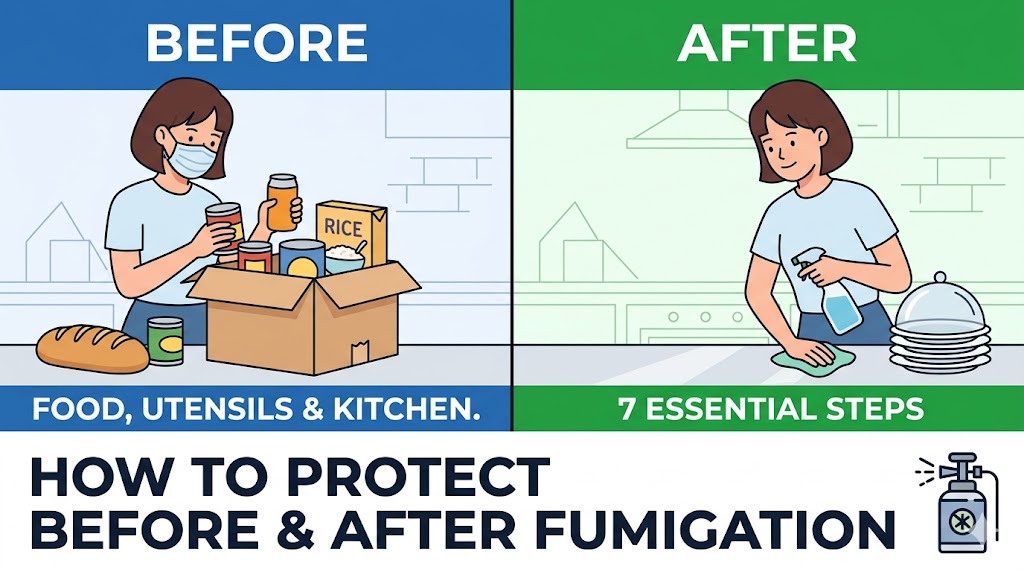
The kitchen is where fumigation preparation either gets done properly or gets skipped over in a rush — and that gap between proper and careless makes a real difference to both safety and effectiveness. In a Karachi home, the kitchen is almost always the primary target of pest control treatment. It’s where cockroaches nest behind the refrigerator motor and inside cabinet hinges. It’s where ant trails wind along grout lines. It’s where pantry pests find loose grains and lentils in unsealed containers. And it’s the room where chemical residue matters most, because everything in it eventually ends up in your family’s food.
What surprises many homeowners is that the preparation has two equally important functions. The first is obvious: protecting your food and utensils from chemical contamination. The second is less obvious but just as important: giving the pest control technician proper access to the areas where pests actually live. Treatments that are rushed because the space is cluttered, cabinets are blocked, or the area under the sink is packed with junk don’t work as well — and inadequate treatment is what leads to callbacks, repeat infestations, and the frustration of having paid for a job that didn’t hold.
This is a complete guide to kitchen preparation and post-fumigation cleanup. Whether you’re scheduling treatment yourself or helping organise one on behalf of an elderly parent or tenant, the steps here will protect your household and maximise the effectiveness of whatever treatment is being done.
Understanding What the Treatment Actually Touches
Before you start moving things around, it helps to understand what a fumigation technician is actually going to do in your kitchen, because it dictates where preparation is most important.
For cockroach treatment — the most common kitchen-focused treatment in Karachi — the primary targets are: the area behind and underneath the refrigerator (the motor housing is warm and a common nesting site), the space inside and around kitchen cabinets (particularly lower cabinets and the hinges of cabinet doors), the area under the kitchen sink, the gap between the cooker and adjacent surfaces, drain openings and grout lines along the floor, and the backs of drawers. A spray will be applied along skirting boards, into crevices, and potentially into the cabinet interiors themselves. Gel bait will be placed in small beads along the edges inside cabinets, behind appliances, and near the drain.
For general spray treatment targeting mosquitoes or other flying insects, the spray covers open wall surfaces, windows, and entry points — less intensive on surfaces where food contact is a concern, but still requiring the same basic precautions for food and utensils left in the open.
For a full home treatment that includes the kitchen as part of a broader treatment for fleas and ticks or other pervasive pests, floors and lower wall surfaces throughout will be covered, which means kitchen floor areas and any items resting on the floor need to be addressed.
Knowing this, you can prioritise your preparation efforts where they matter most.
The Day Before: What to Do 24 Hours Ahead
Good preparation begins the day before, not the morning of. Rushing through it on the day of treatment means either missing things or holding up the technicians.
Audit your pantry: Go through every item in your kitchen pantry or food storage area. Anything in an open container — loose flour, rice, daal, semolina, sugar, oats, cornflour — needs to either be transferred to an airtight container or removed from the kitchen entirely. This is also an excellent time to discard anything that’s already been compromised, as cockroaches will have been feeding on exactly these items.
In most Karachi kitchens, dried goods are commonly stored in jute bags, loosely tied plastic bags, or in open bowls. These need to be sealed. Invest in a set of airtight kitchen containers if you don’t already have them — this is a worthwhile purchase independent of fumigation, since open food storage contributes significantly to ongoing pest pressure even between treatments.
Plan your meals: For the day of treatment and the day after, plan meals that don’t require extensive kitchen use. This reduces the rush to restock and reopen the kitchen quickly after treatment, and means you’re not scrambling to cook immediately upon returning. Ideally, have meals from a restaurant or a family member’s home lined up for the treatment day.
Empty the relevant cabinets: Lower kitchen cabinets — particularly under the sink and those nearest the floor — should be emptied completely the day before. Stack these items on the dining table or in another room. Don’t just shift them to a different shelf inside the kitchen; get them out of the treatment zone. If your kitchen has an open shelf unit rather than enclosed cabinets, all items on those shelves need to be either enclosed in the refrigerator or removed from the kitchen.
Morning of Treatment: The Final Preparation Steps
On the morning of the fumigation, complete these steps before the technicians arrive:
The refrigerator: The interior of the refrigerator is safe — keep it closed during treatment and do not open it unnecessarily. The fridge acts as a sealed unit, and contents inside are not exposed to treatment spray. However, wipe down the exterior, especially around the door seal and handle, as these surfaces may receive spray residue. After treatment, wipe the handle down again before touching it with food-handling hands.
Pull the refrigerator a foot or two away from the wall if you can manage it safely. The space behind the fridge is one of the most important treatment zones, and the technician needs access to it. This single step — often skipped — makes a significant difference to cockroach treatment effectiveness, since the warm motor area is a primary nesting and breeding site.
Utensils and cooking equipment: Pots, pans, and utensils sitting in a drying rack on the counter need to be moved into a closed cabinet or covered with a clean cloth or newspaper. Anything that sits on open countertops will collect spray residue. Utensils kept inside closed drawers or cabinets are generally fine, as long as the drawer fronts were not treated directly.
Cutlery in an open holder on the counter should be moved into a drawer. Mugs and glasses hanging from under-cabinet hooks should be removed and placed inside a closed cabinet. Anything that contacts your mouth should be treated with extra care.
Small appliances: The toaster, blender, electric kettle, coffee maker — all of these should be unplugged and either placed in a cupboard with the door closed or covered with a plastic bag and secured with a rubber band around the base. Grease residue on kitchen appliances is a cockroach attractant, and these appliances will likely be treated nearby.
The cooker: Cover the hob and burner areas with an old newspaper or the metal covers if you have them. The area around and underneath the cooker will be treated. If your cooker is freestanding (common in older Karachi homes), slide it forward slightly to give the technician access to the wall behind it.
Under the sink: This space must be completely empty. Cleaning products, bin bags, dishwashing liquid, the pedal bin, extra sponges — all of it out. The plumbing area under the sink, where pipes enter the cabinet, is a high-priority treatment zone for cockroaches. A cabinet that’s packed with bottles cannot be properly treated.
Food on the counter: The fruit bowl, the bread basket, the onion-and-garlic tray that most Karachi kitchens keep out — all of it into the refrigerator, into sealed containers, or out of the kitchen entirely. Discard anything that has already been sitting open and might be compromised.
Baby and infant items: Remove from the kitchen entirely, not just to a different shelf. Feeding bottles, sippy cups, the drying rack used for baby items, formula containers — these go into another room in a sealed bag. Do not bring them back into the kitchen until the space has been fully ventilated and surfaces wiped down.
Pet bowls and pet food: Out of the kitchen. Pets are more sensitive to pesticide residue than humans, and they consume food and water directly from bowls that sit on the floor — precisely where spray residue settles. Pet food should be sealed and removed; pet water bowls discarded and replaced after treatment.
Giving the Technician What They Need
Once the kitchen is prepared, make sure the technician has clear access to what they need to treat. This means: the space behind the fridge is accessible, the area under the sink is clear, the cooker area is accessible, lower cabinets are open and empty, and there’s nothing sitting on the floor that blocks treatment of skirting boards and floor-wall junctions.
Briefly walk the technician through the kitchen before they start. Tell them where you’ve been seeing pest activity — which cabinet, which drawer, whether you’ve seen cockroaches near the drain or more commonly near the cooker — so they can prioritise those zones. A technician who treats everywhere equally is less effective than one who knows where the pressure points are.
For gel bait application, ask that it be placed inside lower cabinet hinges, inside drawer cavities, behind the refrigerator, along the inner rear wall of lower cabinets, and near the drain cover. These are the most effective placement locations and should be standard for any professional cockroach treatment.
After Fumigation: The Right Order for Cleaning and Restocking
When you return after the appropriate waiting period, resist the urge to immediately start restocking the kitchen. The sequence matters. Do it in the right order to minimise any residue exposure and to ensure you’re not working against the treatment.
Step 1 — Ventilate first: Open all kitchen windows and doors. Run the kitchen exhaust fan or any ventilation you have. Do this before you touch anything. Ventilation is not optional — it is the first safety step and should run for at least 30 to 45 minutes before you begin cleaning.
Step 2 — Wipe down counter surfaces: Using a clean damp cloth — not a chemical cleaner, not bleach, not a multi-surface spray — wipe down all countertops and food preparation surfaces. The reason to avoid chemical cleaners at this stage is that aggressive cleaning agents can break down the residual barrier that’s been applied in corners and at skirting boards, reducing the effectiveness of the treatment. You want to clean the surfaces where food will be prepared, not the corners and edges where the residual pest barrier is doing its job.
Step 3 — Wash exposed utensils: Any utensil that was not covered or that you’re uncertain about should be washed in hot soapy water or run through a dishwasher cycle before use. Sealed drawers and cabinets that weren’t treated directly — you can open them and use what’s inside without washing everything, though wiping down the interior surfaces once is sensible.
Step 4 — Wipe down the refrigerator exterior: Before you open the fridge, wipe down the handle and the door exterior with a damp cloth. Then open and check that no spray residue has gotten near the door seal.
Step 5 — Check the floor: The kitchen floor, particularly near skirting boards and under appliances, will have been treated. Don’t mop the floor with heavy detergent immediately after returning — this will wash away the residual insecticide barrier on the floor perimeter. A light wipe of the central floor area is fine; leave the treated edges and corners alone for at least a week before mopping, and when you do, stick to clean water rather than strong floor cleaners.
Step 6 — Restock selectively: Begin with items that are sealed and going into the refrigerator. Then sealed airtight containers on shelves. Last to go back are loose items, and only once you’re satisfied the kitchen environment is clean and well-aired. Don’t be in a rush to put the fruit bowl back on the counter immediately.
Water Safety: Your Overhead Tank and Kitchen Tap
One aspect of kitchen safety that many Karachi homeowners overlook in the context of fumigation is water. Most homes in Karachi — whether in DHA, Gulshan, North Nazimabad, or Federal B Area — rely on rooftop or underground water tanks fed by the KWSB supply. This water is stored in tanks that accumulate sediment, algae, and bacterial growth between cleanings.
If any fumigation activity happened near or on the rooftop, or if an outdoor treatment was applied near the tank access, confirm with the technician that the tank was not exposed. A reputable company uses methods that do not compromise water storage. However, this is worth confirming directly.
More broadly, the fumigation process is a good prompt to consider the cleanliness of your water supply. Professional water tank cleaning should be carried out every six months in Karachi’s conditions — heat, dust, and irregular supply all accelerate contamination. Combining a fumigation cycle with a tank cleaning every half-year is an efficient and sensible approach to household health maintenance.
How Long Before You Can Cook Normally?
The practical question: after doing all of the above, when can you cook a normal meal? If you’ve ventilated the kitchen properly, wiped down surfaces, and returned after the full re-entry interval, you can cook a normal meal that same evening. Use washed utensils, work on the wiped-down countertop, and ensure the cooker area is clean. The treatment that matters for ongoing pest control is in the edges, corners, and crevices — not where you’re actively cooking.
What you want to avoid is cooking on an unwashed, unventilated surface immediately upon return. Give the kitchen its hour of ventilation, complete the surface wipe-down, and your first meal back in the kitchen is safe to prepare.
Maintaining a Pest-Resistant Kitchen Between Treatments
The best preparation for fumigation is also the best ongoing prevention strategy. Karachi’s pest pressure is real, but it is not irresistible. The conditions that let pests thrive — food residue, moisture, dark undisturbed spaces, gaps in plumbing entries — can be significantly reduced through consistent maintenance.
Keep food in airtight containers as a permanent habit, not just around fumigation time. Clean behind the refrigerator every few months — the grease and dust accumulation back there is a pest attractant. Seal gaps where pipes enter the wall under the sink with caulk or expanding foam. Empty and clean the kitchen bin daily rather than letting it fill over multiple days. These steps reduce pest pressure between professional treatments and extend the effectiveness of each fumigation.
Final Thoughts
Kitchen preparation for fumigation is a thirty-to-forty minute job done properly — and it’s the difference between a treatment that works and one that’s undermined by inaccessible treatment zones and exposed food items. The cleanup on the other side is a similarly manageable process if you follow the right sequence rather than rushing to get everything back to normal in twenty minutes.
If you’d like a pest control team that walks you through the preparation steps before the job and gives you a clear re-entry plan when they leave, request a free estimate from Unique Fumigation Services. We’ve been serving Karachi kitchens — and the rest of Karachi homes — since 1993, and a thorough job means we explain every step, not just show up and spray.

Muhammad Ali Khan is the founder and director of Unique Fumigation Services, Karachi’s longest-running PPMA-registered pest control company, established in 1993. With over 30 years of hands-on experience in residential and commercial pest management, he has overseen more than 5,000 treatments across every major locality in Karachi — from DHA and Clifton to Orangi Town and Korangi.
Under his leadership, Unique Fumigation has maintained affiliations with the Pakistan Pest Management Association (PPMA), National Pest Management Association (NPMA), Federal Board of Revenue (FBR), and Sindh Revenue Board (SRB), while exclusively using WHO-approved, eco-safe chemicals — a standard he enforced from day one.
Muhammad Ali Khan writes on pest biology, infestation patterns specific to Karachi’s climate, treatment protocols, and chemical safety — drawing directly from three decades of field experience treating termite-damaged structures, dengue-prone areas, and food-industry facilities for clients including K-Electric, Hyperstar, IBA Karachi, and USAID.
His work is grounded in one principle: pest control done wrong is a health hazard, not just a failed service.