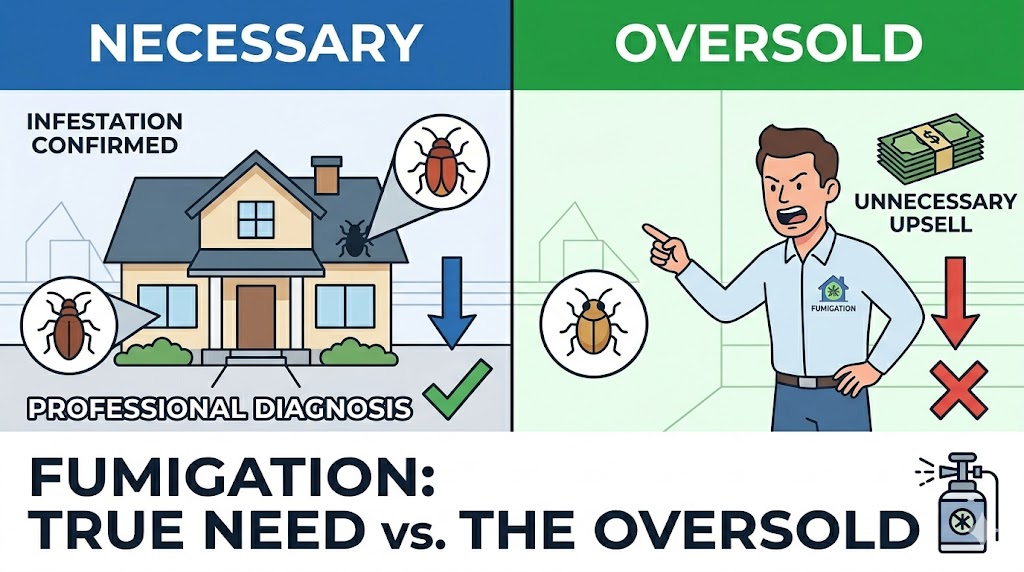
There’s something that doesn’t get said enough in the pest control industry: not every pest sighting requires professional fumigation. Not every cockroach in a kitchen is evidence of a colony that demands immediate chemical intervention. Not every mosquito circling a bedroom represents a dengue breeding site that only a fogging machine can address. And not every company operating a spray pump in Karachi has your best interests at the centre of their recommendation.
This article is the one we at Unique Fumigation Services probably shouldn’t write if we were purely profit-motivated — because part of what it says is: sometimes you don’t need us. We’re writing it anyway, because 30 years of serving Karachi homes has taught us that the clients who understand their situation clearly, who know when a problem is serious and when it isn’t, are the clients who trust us when we tell them a genuine infestation needs treatment. Honesty, over time, is a better business model than fear-based selling.
So here is an honest, detailed breakdown of when fumigation is genuinely necessary, when it isn’t, and — critically — how to recognise the signs that a company is overselling you.
The Fundamental Question: Infestation or Incursion?
The single most important distinction in pest control is the difference between an infestation and an incursion. An incursion is an isolated encounter — a cockroach that wandered in through the gap around a drain pipe, a mosquito that came through an open window, a rat that entered through a hole in an exterior wall and hasn’t established a colony. An infestation means the pest has established itself inside your home: breeding, feeding, and present in sufficient numbers that passive measures will not resolve the problem.
The pest control industry has a financial incentive to treat every incursion as an infestation. The homeowner’s anxiety about pests — which is entirely understandable, especially in Karachi where diseases like dengue are a real concern — makes it easy to upsell. A single cockroach in a spotless kitchen can be presented as evidence of a “severe infestation requiring immediate treatment” by an unscrupulous operator, and a frightened homeowner might agree without stopping to ask the right questions.
The difference between the two scenarios is diagnosis — genuine, careful assessment of what’s actually happening in your home. And that diagnosis should drive the treatment recommendation, not the other way around.
When Cockroaches Actually Require Professional Treatment
Cockroaches are the most common pest encounter in Karachi, and they’re also the pest most subject to overselling because they’re emotionally triggering — seeing a cockroach feels urgently wrong even when the actual situation may not be severe. Here is how to read the signs honestly.
Signs of a genuine infestation requiring professional treatment: You are seeing cockroaches during daylight hours. Cockroaches are nocturnal; when they are visible in the day — particularly in the kitchen or living areas — it means the population has grown large enough that available food and harbourage during night hours cannot accommodate all individuals, and they’re being pushed out during the day. This is a clear infestation signal.
You’re seeing cockroaches in multiple rooms, not just one. You’re finding egg cases (oothecae) — brown, oval, ribbed capsules roughly the size of a large kidney bean — behind appliances or inside cabinets. You’re noticing a musty, unpleasant smell in cabinets or drawers that wasn’t there before (cockroach aggregation pheromones produce a distinctive odour at higher population densities). These are all genuine infestation indicators.
Signs that do NOT necessarily indicate an infestation: A single cockroach observed once in the kitchen, particularly after the monsoon season or following construction or renovation nearby. This is typically displacement — your neighbours had a treatment, or the water table rose during monsoon and pushed pests out of drainage systems. One or two cockroaches appearing after you move into a new flat, particularly in an older building. These are exploratory incursions, not established populations.
In the incursion scenario, the right response is: identify and seal gaps around drain pipes and under cabinets, ensure all food is in sealed containers, clean grease from behind the cooker and refrigerator, and monitor for two weeks. If sightings continue or increase, that’s when you call for professional cockroach treatment. If they stop, you’ve managed an incursion without needing chemical treatment.
Termites: Almost Always Require Professional Intervention
This is a category where the “wait and see” approach carries genuine risk. Termite infestations cause structural damage that compounds progressively — timber weakens, load-bearing elements are compromised, and by the time the damage is visible externally, the internal destruction can be extensive. Unlike cockroaches, which are an aesthetic and hygiene problem, termites are a structural and financial one.
If you see mud tubes running along walls, floor edges, or around window frames — these are the sealed tunnels that subterranean termites build to move between their underground colony and their food source (your wooden structures). If you tap on wooden surfaces and hear a hollow sound where there should be solid timber. If you find wings shed in piles near windows during flying termite season (typically just after monsoon rains in Karachi). If you notice paint that bubbles or peels in a way that suggests hollow space beneath it. Any of these warrants a professional inspection without delay.
DIY termite treatments — over-the-counter sprays, boric acid applications, diesel treatments in the soil — are almost entirely ineffective for an established subterranean termite colony. The colony is underground, potentially metres from your building, and surface applications don’t reach it. Professional soil treatment creates a chemical barrier in the soil that colony foragers cannot cross. This requires professional-grade termiticides applied at specific dilutions and volumes — not something achievable with retail products.
What doesn’t require urgent treatment: a single termite sighting without associated mud tubes or wood damage. This could be a winged reproductive from a distant colony that landed in your home and died — not evidence of a colony in your walls. A proper inspection will tell you which it is.
Bed Bugs: Professional Treatment Is Almost Always the Answer
There is no category in residential pest management where DIY treatment fails more consistently than bed bugs. Bed bugs are extraordinarily resistant to many over-the-counter insecticides, they hide in locations that surface treatments cannot reach (inside mattress seams, inside electrical outlets, behind picture frames, inside the crevices of bed frames), and they reproduce rapidly — a single fertilised female can establish a new population. If you successfully kill 95% of a bed bug population with a retail spray, the 5% that survive will re-establish the infestation within weeks.
Signs that you actually have bed bugs and need professional bed bug control: waking up with lines or clusters of small, intensely itchy bites — bed bugs feed in a characteristic line pattern called “breakfast, lunch, and dinner.” Finding small rust-coloured or blood-red spots on your mattress, pillow, or bedsheet (excrement and blood residue). Seeing small, translucent shed skins (nymphs moult five times before becoming adults). Noticing a sweet, musty odour near sleeping areas — this is a pheromone produced by larger bed bug populations.
What is sometimes misattributed to bed bugs: mosquito bites (random pattern, not linear), allergic skin reactions, dust mite reactions (which cause respiratory symptoms more than bite patterns), or reactions to new laundry detergent. If you’re not finding any of the physical evidence — no staining, no shed skins, no live bugs when you inspect with a torch — get a professional inspection before assuming it’s bed bugs.
Mosquitoes: When Treatment Helps and When It Doesn’t
Karachi’s dengue problem is real, and during peak mosquito season — particularly from July through October during and after monsoon — the risk is not hypothetical. Mosquito fumigation can be a valuable part of a dengue prevention strategy, but it’s most effective when combined with source elimination — removing the standing water where Aedes aegypti mosquitoes breed. Spraying alone, without eliminating breeding sites, will reduce adult mosquito populations temporarily but allow them to rebuild from untouched larvae within days.
Professional mosquito treatment is genuinely useful when: you or your neighbours have been diagnosed with dengue and there’s active transmission in your immediate area. When you’ve eliminated all visible standing water sources but continue to experience significant mosquito pressure. When the mosquito activity is concentrated outdoors near your home and a targeted outdoor treatment would provide meaningful protection.
It is less useful when: the mosquito source is a neighbour’s property or a community drain that you cannot address. When it’s being sold as an annual maintenance treatment for homes with no particular mosquito pressure or dengue risk. When the approach is fogging without any discussion of source elimination — this is a temporary fix being presented as a solution.
Rats and Rodents: Read the Signs Before Calling
A single rat sighting — particularly in a Karachi home near a main drain or construction site — does not necessarily mean you have a colony of rats inside your walls. Rats are highly mobile and will explore new spaces, particularly during construction disturbance nearby, during monsoon flooding that displaces them from drainage systems, or when food sources in an adjacent property have been eliminated.
Signs that you need professional rat control: hearing scratching, squeaking, or running sounds inside walls or ceilings at night, consistently. Finding rat droppings regularly in multiple locations — a kitchen shelf, under the sink, behind the refrigerator. Noticing gnaw marks on food packaging, electrical wiring (this is a fire risk and demands immediate action), wooden furniture, or door frames. Finding nesting material — shredded fabric, paper, insulation — in hidden areas. Smelling a strong ammonia-like odour from urine in a confined space.
Signs that don’t necessarily require full rodent treatment: a single droppings find near an external door that you haven’t seen repeated over a week. A single rat sighting in the garden or on the roof. These warrant monitoring, gap-sealing, and removal of outdoor food sources, but not necessarily immediate indoor treatment.
Recognising When a Company Is Overselling You
The pest control industry in Karachi — as in most markets — contains a spectrum of operators from genuinely professional to actively predatory. Here are the most common overselling patterns to recognise:
The severity inflation: A technician or salesperson visiting your home describes the situation as “very severe” or “emergency level” based on minimal evidence — one cockroach sighting, a few mosquitoes, a rat print in dust. This language is designed to trigger urgency and bypass your rational evaluation of what you’re actually seeing. Ask them to show you the evidence and explain specifically why it indicates the severity level they’ve stated.
The comprehensive package push: Before they’ve completed any inspection, they’re already quoting you a “full home protection package” covering six pest types across all rooms. A genuine assessment might well lead to a comprehensive recommendation — but only after looking at what’s actually present. A package recommendation before inspection is a script, not a diagnosis.
The recurring contract from the first visit: For a moderate residential pest issue, an immediate recommendation of a 12-month monthly contract is rarely warranted. Commercial properties, food businesses, and properties with severe or recurring infestations are legitimate use cases for ongoing contracts. A first-time residential client with a manageable cockroach issue does not need to sign up for monthly visits before knowing whether the initial treatment worked.
Vagueness about chemicals and methods: A company that can’t tell you specifically what they’ll use, why they’ve chosen that approach, and what the expected outcome is over what timeframe is winging it. Professionalism shows up in specifics, not in confidence.
No inspection, immediate quote: A reputable company inspects before quoting. Any company that gives you a final price based on a phone call description or a WhatsApp message without seeing your home is not operating properly. Treatment requirements vary too much by property to be accurately quoted sight unseen.
What a Legitimate Assessment Looks Like
A genuine pest control inspection involves a technician physically checking the relevant areas of your home — under sinks, behind appliances, along skirting boards, inside roof spaces if relevant, around the foundation for termite entry points. They ask you questions: where exactly have you seen the pest, how often, over what period, have you tried anything yourself. They tell you honestly what the evidence suggests — whether it points to a light incursion, a moderate infestation, or a severe problem.
The treatment recommendation should follow from the assessment. If the assessment shows a light problem, the recommendation should be a targeted intervention, not a comprehensive package. If the assessment reveals something serious, they should be able to explain specifically what evidence they found and why it supports the recommended treatment level.
After 30 years of serving Karachi — and doing this with the PPMA registration, WHO-approved chemicals, and written warranties that separate professional operation from casual spraying — Unique Fumigation Services has built its reputation on this kind of honest assessment. We tell clients when they have a serious problem that needs immediate treatment, and we tell them when they don’t. Both kinds of conversations matter.
For a full overview of the services we actually offer — and the ones appropriate for different pest situations — you can review our service areas page or learn more about our approach at our About Us page.
Final Thoughts
The pest control decision should be driven by what you’re actually dealing with, not by anxiety, pressure, or a company’s interest in selling you the most expensive package available. Genuine infestations — termites, bed bugs, established cockroach or rodent colonies, active dengue mosquito breeding — require professional treatment, and trying to manage them yourself costs you time and money while the problem grows. But incursions and minor pest encounters can often be managed through targeted measures, sanitation improvements, and monitoring.
Knowing the difference is the first step. If you want an honest assessment of what’s happening in your home — without a sales pitch attached — request a free estimate from Unique Fumigation Services. We’ll tell you what we see and what we’d recommend. If the right answer is a targeted gel bait application rather than a full treatment, that’s what we’ll tell you.

Muhammad Ali Khan is the founder and director of Unique Fumigation Services, Karachi’s longest-running PPMA-registered pest control company, established in 1993. With over 30 years of hands-on experience in residential and commercial pest management, he has overseen more than 5,000 treatments across every major locality in Karachi — from DHA and Clifton to Orangi Town and Korangi.
Under his leadership, Unique Fumigation has maintained affiliations with the Pakistan Pest Management Association (PPMA), National Pest Management Association (NPMA), Federal Board of Revenue (FBR), and Sindh Revenue Board (SRB), while exclusively using WHO-approved, eco-safe chemicals — a standard he enforced from day one.
Muhammad Ali Khan writes on pest biology, infestation patterns specific to Karachi’s climate, treatment protocols, and chemical safety — drawing directly from three decades of field experience treating termite-damaged structures, dengue-prone areas, and food-industry facilities for clients including K-Electric, Hyperstar, IBA Karachi, and USAID.
His work is grounded in one principle: pest control done wrong is a health hazard, not just a failed service.